Analysis: A new oil shock is building. The next few weeks of war will be decisive for the economy.


Analysis: A new oil shock is building. The next few weeks of war will be decisive for the economy.

The clock is ticking on the U.S.-Israeli war in Iran. The emerging view from oil industry executives and analysts is that the economic and market fallout from the war could escalate sharply if the Strait of Hormuz isn’t reopened within roughly the next one to three weeks. Even then, enough damage may have been done already to leave energy and many other prices higher for longer. 

These risks haven’t been clearly reflected in some widely followed markets, including stocks broadly and the benchmark Brent crude price. Stopgap measures to soften the blow of the oil cutoff have kept crude prices relatively low in the U.S. and European markets. But when those measures lose their effectiveness in early-to-mid April, analysts warn there will be little the U.S. or other governments can do to keep energy prices from rising dramatically. 

Iran has attacked civilian ships and energy infrastructure in its neighborhood, causing traffic in the narrow Strait of Hormuz to fall to a standstill. Roughly 20% of global oil supply normally moves through the approximately 100-mile waterway, which borders Iran. Some oil has been rerouted through pipelines, but they can only carry so much. The U.S. and others are releasing 400 million barrels of oil from strategic reserves — the biggest release on record — and the U.S. has temporarily lifted sanctions on some Russian and Iranian oil to give the market breathing room.

Satellite image shows smoke rising from UAE’s Fujairah port, amid the U.S.-Israeli conflict with Iran, in Fujairah, United Arab Emirates, March 15, 2026.

Nasa Worldview | Via Reuters

The White House says it believes the president’s military strategy will soon end the Iranian threat, allowing the price worries to fade.

But all agree there is no substitute for reopening the strait. Oil industry executives have in the past few days sketched out the risk of growing disruption from the war. 

Read more CNBC politics coverage

“There are very real, physical manifestations of the closure of the Strait of Hormuz that are working their way around the world,” Chevron CEO Mike Wirth said Monday at S&P Global’s CERAWeek in Houston. Shell CEO Wael Sawan echoed him a few days later at the annual gathering of industry heavyweights. Disruptions that started in South Asia have “moved to Southeast Asia, Northeast Asia and then more so into Europe as we get into April,” Sawan said Wednesday.

The talk of the conference was the difference between so-called paper and physical prices, said Ben Cahill, director for energy markets and policy at the Center for Energy and Environmental Systems Analysis, University of Texas at Austin. 

Paper prices vs. physical prices

Paper prices reflect trading in financial markets and are often the headline oil prices discussed in the press. They have generally remained lower than prices for physical delivery of oil, especially in Asia, which is the main buyer of crude from the Middle East.

Brent crude futures prices rose 36% from Feb. 27, the last day of trading before the started, through March 27, when they traded above $113 a barrel. But the Dubai price, which tracks physical delivery from certain Middle East sellers, is up 76%, more than twice the paper price, at $126. That price has been especially volatile lately. 

One reason paper prices are lower is they have regularly fallen in reaction to suggestions by President Donald Trump that the war could soon end or otherwise de-escalate. Traders call that “jawboning.” 

“In that sense it’s working, it’s preventing a bigger paper-market reaction,” Cahill said of Trump’s rhetoric. “But the reality of the physical market disruption is really hard to ignore.”

That disruption isn’t limited to oil and its effects on U.S. gas prices. Prices for liquified natural gas are also a worry. LNG prices in Japan and South Korea are up 48%. Costs of jet fuel are spiraling, along with more esoteric commodities such as helium. Without relief, these prices could continue to rise, driving up global inflation and eating at growth.

Market deterioration

Markets have deteriorated over the past few days. The S&P 500 rose half a percent on Tuesday amid optimism that Trump would delay a plan to attack Iranian energy infrastructure, but proceeded to fall 3.4% from Wednesday through Friday’s close. The yield on the 10-year Treasury note has followed a similar trajectory. It has now risen by roughly a half-point over the course of the war to 4.4%, reflecting worries about inflation and the prospect that the Fed may not cut interest rates as it has hoped to do.

The looming possibility of physical supply shortages in the oil market appears to be blunting the effect of Trump’s jawboning. Financial markets reflect the reality that Trump has often managed to avoid worst-case scenarios, including when he attacked Iran’s nuclear program in June. Oil futures then spiked but quickly fell once it was clear the war wouldn’t spread. 

Trump is now moving thousands of new troops to the region. He could use them to attack Iran’s Kharg Island oil-export facility, cutting off a vital revenue source for the regime and forcing it to accept a negotiated reopening of the strait. He could attempt to retake the strait militarily. The regime could simply collapse, or any number of outcomes that would restore the flow of energy.

Futures markets reflect that those relatively optimistic possibilities are in play. But they may not be able to do so forever. 

Geopolitical strategist Marko Papic with markets advisory firm BCA Research pulled together an estimate of the sources of supply and their blockages. For now through roughly April 19, Papic estimates the world has lost 4.5-5 million barrels a day of oil from the war, amounting to about 5% of global supply. But, he writes in a research note sent out this week, “that number will double by mid-April, becoming the largest loss of crude supply.”

The world will hit an oil cliff in mid-April, in Papic’s estimation, because supplies from the strategic petroleum reserve as well as Russian and Iranian oil exempted from sanctions will run out. There is no substitute for pumping oil from the ground and sending it directly to clients. 

But the ability of the oil industry to return to delivering its product is also in question. Middle East producers don’t have enough storage for all the oil they are pumping but can’t ship, so they have had to shut in production, temporarily closing wells. Reversing that will take time. 

Sheikh Nawaf al-Sabah, CEO of Kuwait Petroleum Corp., said at the energy conference it could take three to four months to return to full production once the war ends. 

That end could come soon if Trump gets his way.

“The glimmers of light at the beginning of the tunnel are becoming more bright and more clear,” a White House official said on condition of anonymity. The official disputed the oil industry’s skepticism about the outlook. 

“I think the oil execs aren’t geopolitical masterminds,” the official said. The administration is making progress militarily, the official said, and still has more levers it can pull to get energy to the market. 

“We’re also seeing developments with Russia stepping in to expand its exports to fill that gap, so there’s still breathing room here,” the official said. 

That breathing room is real, but it appears to be quickly diminishing. Every day that Iran is willing and able to threaten shipping in the strait puts the world closer to serious economic damage.

Choose CNBC as your preferred source on Google and never miss a moment from the most trusted name in business news.


Stagflation alarm bells ring in the euro zone as energy crunch hits the global economy


Workers of German steel manufacturer Salzgitter AG stand in front of a furnace at a plant in Salzgitter, Germany, March 1, 2018.

Fabian Bimmer | Reuters

Private sector output in the euro zone sank to a 10-month low in March, amid mounting evidence of the impact the Iran conflict is having on the global economy.

The closely-watched S&P Global flash purchasing managers’ index (PMI) for the euro zone fell to 50.5 in March, marking a steep decline from the 51.9 reported in February.

Economists polled by Reuters had expected a shallower dip to 51.0. The 50.0 threshold separates expansion from contraction territory.

The reading prompted fresh warnings that the region is facing the specter of looming stagflation — a toxic combination of high inflation and unemployment, and stalling growth.

“The flash Eurozone PMI is ringing stagflation alarm bells as the war in the Middle East drives prices sharply higher while stifling growth,” Chris Williamson, chief business economist at S&P Global Market Intelligence, commented Tuesday.

“Firms’ costs are rising at the fastest rate for over three years amid the surge in energy prices and choking of supply chains resulting from the war. Supplier delays have jumped to their highest since mid-2022, largely linked to shipping issues.”

Euro zone companies surveyed by S&P Global scaled back hiring marginally during March, as bosses lowered output expectations for the year when compared with February forecasts, according to S&P Global economists.

“Stagflation” is often seen as a “worse case scenario” for economies and poses a dilemma for central banks because the tools they’d usually use to combat high inflation — higher interest rates — can stifle growth and employment, while lowering rates can boost growth but increase demand and inflation.

The euro zone is not alone in seeing private sector activity slow due to the Iran war, with PMI data from India earlier on Tuesday also showing output growth slowed to its lowest level since October 2022.

‘Critical’ energy crunch

The current turmoil in the Middle East has made previous growth and inflation forecasts largely redundant, and businesses and policymakers have been left trying to gauge the direction of travel for input costs and inflation without knowing how long the conflict will last.

In revised forecasts released last week, the European Central Bank now expects economic growth of 0.9% in 2026, and headline inflation to average 2.6% this year.

That outlook could be optimistic, however, with S&P Global’s Williamson noting that the PMI survey’s price gauge was indicative of inflation accelerating close to 3%, “with cost pressure likely to add still further to selling price inflation in the coming months.”

“The outlook depends on the duration of the war and any potential lasting impact on energy and supply chains, but the flash PMI data underscore how the European Central Bank is no longer in a ‘good place’ with respect to growth and inflation,” Williamson said.

The March PMIs show the conflict in Iran is already having a significant impact on the euro area economy, J.P. Morgan’s Raphael Brun-Aguerre noted Tuesday.

“Overall, the survey points to a large near-term inflation impact from higher energy that could feed into core prices … The energy price shock could hit business profitability and has already damaged demand conditions and output more broadly in the region. Business sentiment is being hit significantly. European Commission data [out Monday] already showed a large hit to consumer confidence in March,” he noted in emailed analysis.

A tanker carrying Iraqi fuel oil that was damaged in unidentified attacks targeting two foreign tankers, according to Iraqi port officials, near Basra, Iraq, March 12, 2026.

Mohammed Aty | Reuters

Early Tuesday, European Commission President Ursula von der Leyen said it was time for negotiations with Iran, given the “critical” nature of the global energy crisis.

“The situation is critical for the energy supply allies worldwide. We all feel the knock-on effects on gas and oil prices, our businesses and our societies, but it is of utmost importance that we come to a solution that is negotiated, and this puts an end to the hostilities that we see in the Middle East.”

Choose CNBC as your preferred source on Google and never miss a moment from the most trusted name in business news.


Nissan’s new hybrid is a U.S.-first that mixes EV driving with a gas engine


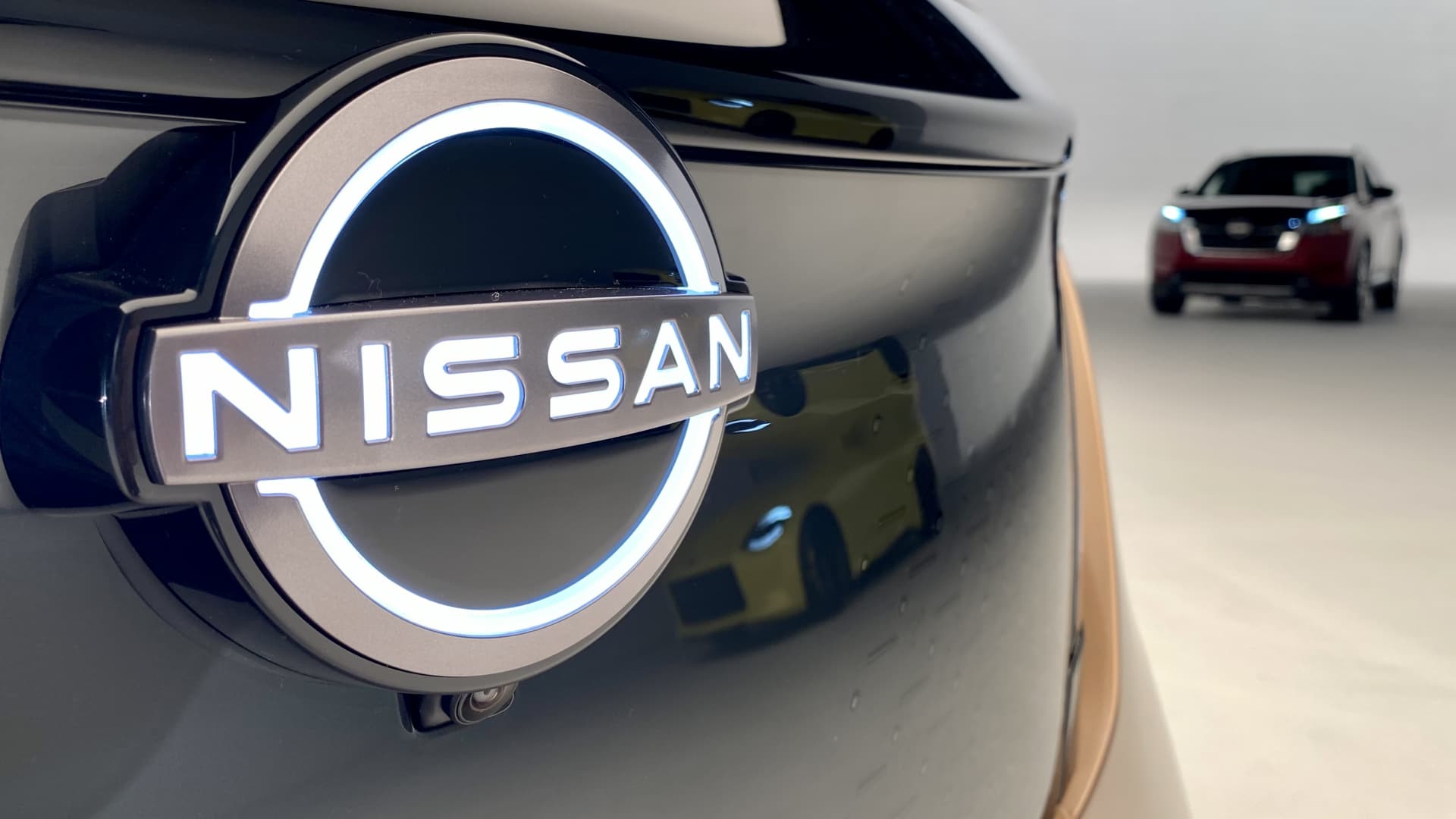
Nissan’s logo is illuminated on a prototype of its new all-electric Ariya crossover. Nissan’s Z Proto performance car is reflected in the vehicle’s grille, while a redesigned Nissan Pathfinder SUV sits in the background.

Michael Wayland / CNBC

Nissan Motor plans to introduce a new type of hybrid to the U.S. market that drives like an all-electric vehicle but is powered — not driven — by a traditional gas-powered engine. 

The new Nissan “e-Power” is called a series hybrid. It uses the engine as a generator to power the vehicle’s electric motors that then propel the vehicle. It operates like emerging extended-range electric vehicles, or EREVs, but has a smaller battery and doesn’t require a plug. 

It’s also different from a traditional hybrid, such as the Toyota Prius, because the gas engine in those vehicles is used to propel the vehicle. The series hybrid’s engine just keeps the battery charged to power the electric motors in the vehicles.

The e-Power hybrid system for Nissan is planned to launch domestically later this year in a new version of its popular Rogue compact SUV. 

Timing for such a vehicle could be ideal for Nissan with climbing gas prices, slower-than-planned adoption of EVs and an expected surge in hybrid sales amid new entries, according to officials.

After losing billions of dollars on EVs, automakers such as Nissan are turning to hybrid vehicles to meet customer expectations for fuel economy and to help with driving performance.

S&P Global Mobility expects hybrids in the U.S. this year to increase to 18.4% of new vehicle sales, up from 12.6% last year and 7.3% in 2023. It’s forecasting pure EVs, meanwhile, will be 7.1% of new vehicle sales, down from 8% last year.

“This is a unique powertrain for the for the U.S.,” Kurt Rosolowsky, Nissan North America vehicle evaluation and test engineer, said during a media briefing. “This is an electrically driven vehicle, as far as what is powering the wheels, but it doesn’t have a plug, and you fill it up with gas like you do with a normal car.”

Series hybrids

Nissan and other automakers have used series hybrids elsewhere, particularly in Asia, but companies have been reluctant to bring the vehicles to the U.S. because of consumer expectations for driving dynamics and power. 

To address those concerns, Nissan said it has developed a more powerful 1.5-liter, three-cylinder turbocharged engine specifically for the e-Power system, in addition to new packaging and other upgrades, to appease American buyers.

“The turbo is only there to serve efficiency at higher speeds for the gas engine to deliver energy,” Rosolowsky said.

The e-Power for the U.S. market is Nissan’s third generation of the series hybrid since it debuted in Japan in 2016. Since then, Nissan said it has sold more than 1.6 million vehicles globally with e-Power in nearly 70 countries.

“I think it’s going to be a really good system. I think it’s going to be very popular for Nissan in the new Rogue when it arrives later this year,” said Sam Abuelsamid, vice president of market research at communications and consulting firm Telemetry.

Abuelsamid said the only real drawback to the series hybrid is that it’s less efficient at higher speeds, which Nissan is trying to overcome with the new engine as well as battery size.

Driving e-Power

Driving a European version of the Nissan Rogue Sport sold with the ePower system around suburban Detroit, the vehicle’s driving dynamics — specifically fast acceleration and regenerative braking — are formidable.

They come with the familiar sound of an engine revving but without the shifting or sputtering of transmission gears and far less noise, vibration and harshness, or NVH, as the industry commonly refers to it. 

“The driving experience really is what makes it different with those fewer components. You have less noise and less vibration,” Rosolowsky said.

Nissan e-Power logo

Courtesy Nissan

Unlike traditional gas-powered vehicles, the e-Power system also does not require a traditional transmission to shift gears or a driveshaft that transfers torque from the transmission to the differential, powering the wheels.

While the Rogue Sport is a smaller vehicle and only forward-wheel-drive, it’s easy to see how the system will translate to a larger vehicle with all-wheel-drive, which the new Rogue with e-Power will be. 

The lack of a plug, some engine noise and slight vibration also might be more familiar for drivers who have been reluctant to adopt all-electric vehicles. 

While Nissan is not releasing specifics such as pricing or fuel economy for the upcoming Rogue with e-Power, the Rogue Sport was achieving more than 40 miles per gallon during heavy city driving, according to the vehicle’s MPG system.

The current Nissan Rogue, depending on the model, can achieve more than 30 MPG, according to U.S. Department of Energy and the U.S. Environmental Protection Agency.

Nissan’s vehicles historically been less fuel efficient than those from its larger Japanese rivals. Honda Motor and Toyota Motor, the latter of which pioneered traditional hybrids with the Prius and continues to dominate the sector in the U.S.

Nissan declined to discuss the possibility of expanding the e-Power system to other vehicles in the U.S., but confirmed the new system is modular and capable of working with many different engines.

“If we were to expand this to other vehicles, you can theoretically bolt this onto another gasoline engine of a different size and have more options for an e-Power system,” Rosolowsky said.

Choose CNBC as your preferred source on Google and never miss a moment from the most trusted name in business news.


Flights are already getting more expensive after jet fuel spike. When should you book?


Travelers wait in line at a Transportation Security Administration (TSA) checkpoint at William P. Hobby Airport in Houston, Texas, US, on Monday, March 9, 2026.

Mark Felix | Bloomberg | Getty Images

The surge in fuel prices since the U.S. and Israel attacked Iran nearly two weeks ago is already driving up airfare. Consumers’ appetite for travel this year will dictate just how much.

Cathay Pacific on Thursday said it would roughly double fuel surcharges on tickets starting March 18.

Earlier this week, Australia’s Qantas said it is raising fares to help cover its costs, Scandinavian Airlines said the “unusually rapid and substantial increase” in fuel prompted it to raise prices, and Air New Zealand pulled its financial outlook “until fuel markets and operating conditions stabilise,” adding that it has made “initial fare adjustments.”

“If the conflict leads to continued elevated jet fuel costs, the airline may need to take further pricing action and adjust its network and schedule as required,” Air New Zealand said.

U.S. airline CEOs and other executives will update investors on Tuesday at the J.P. Morgan Industrials Conference in Washington, D.C.

Analysts expect an earnings hit at least in the first quarter if not the first half of the year, though the impact will depend on how long higher fuel prices last.

“We think a hit to 1Q EPS appears almost certain at this point,” UBS airline analysts Atul Maheswari and Thomas Wadewitz wrote in a note last week.

United Airlines CEO Scott Kirby said last week on the sidelines of an event at Harvard University that higher fares were likely on the way because of the surge in fuel prices.

Kirby said travel demand is still strong, however. Two other senior airline executives at U.S. carriers, speaking on the condition of anonymity because they weren’t authorized to speak to media, also said travel demand has held up. If those trends persist, it could give airlines more pricing power, but that will depend on the war’s duration.

“Airlines never met a higher fare they didn’t want,” said Scott Keyes, founder of flight deal company Going, previously known as Scott’s Cheap Flights.

So what should consumers do?

Keyes said travelers can’t lose by booking early, as long as they’re not buying restrictive basic economy tickets. That way, customers can try to exchange or cancel their tickets and buy cheaper ones if airfare ends up falling.

“If you book a $500 summer flight today, and two weeks from now the price drops to $350, you can call up the airline and get the $150 difference back as a credit. Heads you win; tails the airlines lose,” he said.

Read more about the Middle East conflict’s travel impact

Fuel costs

Jet fuel is airlines’ biggest cost after labor, accounting for about a fifth or more of expenses, depending on the airline.

United alone spent $11.4 billion last year on fuel, at an average price of $2.44 a gallon, according to a securities filing. U.S. jet fuel on Wednesday was going for $3.78 a gallon, according to Platts.

Jefferies airline analyst Sheila Kahyaoglu said in a note Thursday that she expects “the most acute financial impact to airlines from surging oil prices to be in the next 30-90 days as airlines have been booking yields for close-in flights assuming a much lower fuel price and carriers cannot retroactively raise fares.”

She said Delta Air Lines and United, which produce most U.S. airline profits, are better positioned than other carriers because of their high-end demand. Risks to demand, particularly for more price-sensitive customers, include the recent jump in gasoline prices.

Jet fuel has more than doubled in some regions since the first U.S.–Israel attacks on Iran on Feb. 28.

Oil prices surged to roughly four-year highs after the initial strikes. Energy prices have swung wildly since then as traders assess just how long the war — and all the logistics headaches — could last.

U.S. jet fuel prices were up more than 60% from before the attacks to a peak last week, according to pricing data assessed by Platts. Jet fuel can rise by a greater degree than crude because it includes the price of processing and ever-more difficult and costly transportation from oil fields to refineries to airplane fuel tanks.

On Feb. 27, the day before the before the attacks, the cost to fill the fuel tanks of a Boeing 737-800 would have would have been about $17,000 based on average prices in New York, Houston, Chicago and Los Angeles, compiled by Argus. Less than a week later, on March 5, it would have cost more than $27,000, based on Argus prices. On Tuesday, after oil prices fell following President Donald Trump’s comment that the Iran war could end “very soon,” it would have cost around $23,000.

Line Service Technician Austin Beadles refuels a plane using a Federal Aviation Administration approved unleaded aviation fuel at Sheltair at Rocky Mountain Metropolitan Airport in Broomfield on Tuesday, Feb. 17, 2026. Sheltair, a fixed-base operator, will offer the Swift UL94 unleaded aviation alternative gas to pilots. (Photo by Matthew Jonas/MediaNews Group/Boulder Daily Camera via Getty Images)

Matthew Jonas | Boulder Daily Camera | MediaNews Group | Getty Images

After prior fuel price surges, airlines started making customers pay for bags — or charging them more. Even seemingly minor changes in weight can save airlines hundreds of thousands, if not millions of dollars, a year in fuel. United in 2018 changed to a lighter paper stock for its in-flight magazine. In 2014, American Airlines said it would switch to digital manuals for flight attendants, following changes for pilots. It said at the time that it would save $650,000 in fuel a year.

All about capacity

High fuel prices don’t automatically mean higher fares. The ongoing strong demand for travel is a key factor and so is capacity, or the amount that carriers fly.

If airlines raise fares and passengers balk, then capacity will likely go down in the form of fewer frequencies on a route or broader cuts, in more severe cases.

“Airlines love to say fuel is expensive so you have to pay more. What they’re doing is they’re setting the expectation,” said Courtney Miller, founder of Visual Approach Analytics, an airline industry advisory firm. “They price to prevent empty seats.”

If fuel prices come down, “they’re not suddenly saying ‘We’re making too much money,'” Miller added. “But they are likely to add another flight.”

Capacity, especially to and from the Middle East, is constrained because of airspace closures and other stop-and-start flights. More than 46,000 flights have been canceled to and from the region since the Feb. 28 attacks began, aviation data firm Cirium said.

Flights are already getting more expensive after jet fuel spike. When should you book?

Those constraints are driving up fares as well as demand, as United’s Kirby said, from regions where customers are looking for alterative routes.

Airspace closures are also requiring airlines to take longer, more fuel-guzzling routes, but many have strong demand, too.

Qantas, for example, told CNBC that its flight from Perth, Australia, to London is temporarily stopping in Singapore to refuel, allowing it to pick up another 60 customers, and that its Perth-London and Perth-Paris routes are more than 90% full this month, 15 percentage points higher than normal for this time of year.

Finnair said the increased demand for travel to Asia from Helsinki has pushed up its prices by 15% on average.

“The impact of higher fuel prices will be reflected in market fares with a delay, as airlines typically hedge at least part of their fuel purchases,” it said.

Airlines have been grappling with airspace closures for years, including from on-and-off conflict in the Middle East and since Russia’s 2022 invasion of Ukraine, that have left a large swath of airspace out of use for many carriers.

‘You can’t dry up an airport’

Travelers at William P. Hobby Airport in Houston, Texas, US, on Monday, March 9, 2026.

Mark Felix | Bloomberg | Getty Images

Kirby said there would likely be an impact to United’s first-quarter results and to the second quarter if the war — and blockage of the Strait of Hormuz, a key shipping channel — persists. However, he said demand was increasing sharply from regions that have been affected by the thousands of flight cancellations and airspace closures in the Middle East.

Because of airlines’ upbeat outlooks on demand to start the year, “the environment is conducive for passing along fare increases. Further, should jet fuel stay higher for longer, it should help push off-peak capacity lower,” supporting unit revenues, UBS analysts said.

Rick Joswick, who heads of near-term oil research and analytics at S&P Global Energy, told CNBC that “demand for jet fuel is inelastic. You cannot shortchange an airport. If the cost of jet fuel goes up, it’s not like the plane will choose not to fly that day.

“You can’t dry up an airport,” he said.

Read more CNBC airline news

Choose CNBC as your preferred source on Google and never miss a moment from the most trusted name in business news.


How the AI debt binge shattered hyperscalers’ ‘unspoken contract’ with investors


Hyperscalers are significantly ramping up their AI capex spending — and increasingly using credit markets to fund it.

But investors say this shift is challenging mega-cap tech giants’ so-called ‘fortress balance sheet’ status, and rips up what they call the “unspoken contract” that kept speculative AI spending largely separate from debt markets.

After Amazon, Meta and Google-owner Alphabet all unveiled sizable increases in their full-year capex spending plans during earnings season, UBS data indicates that aggregated capex spend among AI hyperscalers could top $770 billion in 2026 — some 23% higher than previously expected.

In a Feb. 18 note, UBS credit strategists said such increases imply a $40 billion to $50 billion ramp-up in borrowing from hyperscalers, pushing public market debt issuance to between $230 to $240 billion this year.

Stock Chart IconStock chart icon

How the AI debt binge shattered hyperscalers’ ‘unspoken contract’ with investors

Oracle.

Al Cattermole, fixed income portfolio manager at Mirabaud Asset Management, said this tilt toward the bond market is dramatically shifting the dynamic between hyperscalers and investors.

“For years, we’ve been told this AI spend would be funded by generated cash flow — that it is equity risk, it is speculative, and not to worry about it from a credit point of view,” Cattermole told CNBC in an interview.

“There now seems to be a change in the unspoken contract that while we would continue to lend to these businesses, really AI capex was still going to be equity or cash funded….By bringing capex spend into the debt markets, you now have the question of credit worthiness.”

‘Break point’

Vanguard's Shaan Raithatha says AI capex debt carries 'hidden risks'

“What has changed is the market’s focus: it now asks how AI adoption will translate into revenues and profits. This sorting of winners and losers means it’s prime time for active investing,” BlackRock added.

The world’s largest asset manager noted that AI builders have largely tapped the U.S. investment grade market, “so we prefer high yield and European bonds.”

As Oracle’s share price has trended lower over the past six months, credit default swaps on its bonds — which offer protection in the event of a borrower being unable to repay its debt — have seen sharp bouts of volatility.

Cattermole, meanwhile, pointed to Alphabet’s planned capex of almost 50% of its revenue for next year, which he said was approaching an “unheard-of level.”

“You wouldn’t see that for a normal company at any point in time,” he added. “We are very clearly at a break point in natural cycles.”

‘Hidden risks’

Underlining concerns over a potential debt-fueled AI overspend, investors fear that the huge data centers that are key to the buildout could be rendered obsolete by rapid technical improvements that make chips more efficient and reduce demand for capacity.

That carries far-reaching implications for debtholders, according to Cattermole.