Idaho Researchers Advance Critical Materials Recycling Technologies | Newswise


Newswise — Labeled glass containers full of liquids stirred by spinning magnets are connected to humming machines with neatly organized tubes. Here in this lab space at the Idaho National Laboratory (INL), scientists are pioneering ways to extract critical materials from recycled waste products.

Critical materials are essential to modern life because they possess properties that make them difficult to replace. They’re used in smartphones, satellites, computer chips, rechargeable batteries, fighter jets, advanced weapons systems and other technologies. But they can be hard to find; that’s where INL’s research comes in.

The national challenge

The U.S. has deposits of nearly all critical materials, but mining capabilities cannot meet the nation’s growing demand. Most extraction and processing are done overseas, much of it in China. This reliance on foreign critical materials risks supply disruptions that could affect U.S. national security, economic growth and everyday life. After mining, rocks are crushed and processed to separate valuable materials from waste. This step, called beneficiation, prepares the material for further refining. These materials are then concentrated for easier transport and treated with heat or chemicals to fully extract and purify them. However, modern processing isn’t always sufficient and often produces significant waste.

In copper mines, for example, the ore contains up to 0.2% copper, meaning about 99.8% of the rock is discarded. That waste still contains other metals and critical materials, but most processing facilities are only designed to extract one or two materials.

The critical materials in discarded rocks, e-waste and other sources don’t degrade over time and can be recovered. However, the U.S. lacks the infrastructure to recycle them.

Recycling facilities could tap into these largely untouched sources, helping meet U.S. demand. These facilities could be built far more quickly than new mines, which can take over a decade due to permitting, costs and infrastructure needs.

“The U.S. doesn’t recycle well,” said Bob Fox, a senior manager at INL. “There’s a willingness to recover critical materials from recycled sources, but there’s no infrastructure or market for it. Right now, critical materials recycling doesn’t have the economic incentives to drive infrastructure development.”

INL is working to change that by making recycling more efficient, less energy-intensive and economically viable.

“Recycling represents a crucial pathway for the U.S. to obtain critical materials, including rare earth elements like dysprosium,” said Arindam Mukhopadhyay, a staff scientist at INL. “Even critical materials we mine domestically, such as lithium, cobalt, nickel and manganese, can be recovered through recycling.”

INL’s recycling research

Since the early 2010s, INL has developed technologies that reduce chemical use, energy consumption and waste, making recycling more sustainable and cost-effective. These innovations improve recovery from sources such as electronic and agricultural waste, mine tailings and industrial wastewater.

“INL has developed a comprehensive portfolio of critical materials recycling technologies,” said Mukhopadhyay. “We have the expertise and proven processes to help make recycling economically competitive, which is essential for building a reliable domestic supply of the materials our nation depends on.”

One area INL has worked in for many years is biohydrometallurgy, which uses biological systems to dissolve and recover metals. INL’s research examines how microbial populations fed agricultural or municipal waste biomass produce organic acids that break down metals in both metallic and mineral forms. These biologically produced acids dissolve the material and release valuable metals such as rare earth elements, cobalt and lithium. The dissolved metals can then be recovered from the liquid using natural biology-based molecules instead of man-made chemicals. INL’s work is improving the efficiency, effectiveness and affordability of biohydrometallurgy and offers a promising, cost-effective alternative to harsh chemical reagents.

Ether-based Aqueous Separation and Extraction (EASE) uses water-soluble, ether-based chemicals that pull specific materials from mixtures to recover critical materials from industrial wastewater, desalination brines, mine runoff and geothermal fluids. This process uses less energy and fewer chemicals than conventional extraction methods and produces less waste.

Another area of innovation is INL’s electrochemistry work. Electrochemistry uses electricity to trigger chemical reactions that separate and recover critical materials from waste.

Electrons are easier and less expensive to generate than the chemicals required for traditional extraction methods. Electrochemistry can reduce the use of chemicals, some of which can be toxic, by 88% to 90%, and the process uses up to 75% less energy.

Electrochemical Leach (EC-Leach)

EC-Leach uses electricity to cause chemical reactions in liquids to extract critical materials like lithium, cobalt, nickel and manganese. The process was originally developed to extract critical materials from used lithium-ion batteries, but INL is adapting it for mining applications.

Pilot systems show EC-Leach can recover more than 95% of these critical materials. INL researchers are working to scale this technology for commercial deployment.

Electrochemical Recycling of Electronic Constituents of Value (E-RECOV)

E-RECOV uses an electrochemical cell to recover critical materials from electronic scrap. Electrochemical cells use chemical reactions to produce electricity used in electrochemistry. E-RECOV operates at room temperature, uses up to 75% fewer chemicals than traditional processes and doesn’t produce toxic emissions.

The technology has received a TechConnect National Innovation Award and was a finalist for an R&D 100 Award. The U.S. Department of Energy’s Critical Materials Institute supports the development of TechConnect.

Free Flowing Electrophoretic System (FFES)

The FFE unit uses an electric field with tailored ligand systems (small molecules that bind to metal ions) to separate critical materials from complex mixtures into distinct, isolated streams. The device can be moved closer to, or into, mines to separate critical materials from metal-rich liquids.

Electrochemical Membrane Reactor

Researchers at INL developed an electrochemical membrane reactor that removes contaminants from spent lithium-ion battery leachates, the mineral-rich liquids produced during recycling. The reactor recovers more than 95% of valuable metals such as nickel and cobalt using only water, air and electricity. It also produces acid that can be reused in the extraction process. The system has the potential to serve as a cost-effective closed-loop solution for recycling critical materials from batteries.

Improving purity

Most modern applications need critical materials to be at 99.999% purity or higher, but most conventional separation processing can only achieve 85% to 95% purity unless the process is run over weeks or months. INL’s electrochemical work can achieve 99.9999% purity in fewer cycles, dramatically reducing processing time and costs.

Rare Earth Element-Metal (RE-Metal)

RE-Metal is a process that recovers rare earth elements from waste materials using electricity. First, the elements are dissolved using nontoxic solutions. Then an electric current is applied to turn the dissolved materials into solid metal on an electrode.

Other projects include generating hydrogen peroxide from air to help dissolve minerals and separating graphite, copper and arsenic while immobilizing toxic chemicals.

Real-world impact

“Our goal is to make recycling economically viable,” said Mukhopadhyay. “To do that, we’ve focused on reducing chemical use, energy consumption and waste generation while maximizing recovery rates.”

INL’s technologies offer cost-effective options to secure the domestic critical materials supply chain and meet the nation’s growing demand. By advancing recycling and recovery methods, INL helps ensure the U.S. has the materials it needs to overcome current and future challenges.

About Idaho National Laboratory

Battelle Energy Alliance manages INL for the U.S. Department of Energy’s Office of Nuclear Energy. INL is the nation’s center for nuclear energy research and development, and also performs research in each of DOE’s strategic goal areas: energy, national security, science and the environment. For more information, visit www.inl.gov.

Follow us on social media:

Facebook X-twitter Youtube Instagram Linkedin Pinterest Flickr


Trump walks back Cuba oil blockade, says he has ‘no problem’ with Russian tanker delivering fuel


An old Soviet-era Lada car drives past a truck belonging to a private Cuban company (mipyme) parked in front of a gas station with an IsoTank of imported fuel in Havana on March 19, 2026.

Adalberto Roque | Afp | Getty Images

U.S. President Donald Trump said he has “no problem” with a Russian crude tanker delivering fuel to Cuba, appearing to reverse course over his administration’s oil blockade as the island grapples with a deepening energy crisis.

Speaking to reporters aboard Air Force One on Sunday, Trump said: “If a country wants to send some oil into Cuba right now, I have no problem with that, whether it’s Russia or not.”

His comments come as a Russian-flagged oil tanker, the sanctioned Anatoly Kolodkin, makes its way to Cuba carrying an estimated 730,000 barrels of crude oil.

The tanker is reportedly expected to reach port on Monday and is seen as something of a lifeline to the Caribbean nation, which is facing its biggest test since the collapse of the Soviet Union.

Cuba had been heavily dependent on oil supplies from Venezuela, but it has effectively been cut off since early January when the U.S. launched an extraordinary military operation to depose Venezuelan President Nicolás Maduro.

The Trump administration subsequently threatened to impose tariffs on any country that sent crude to Cuba, prompting the likes of Mexico to halt shipments. The Kremlin has previously shrugged off Trump’s tariff threats, pointing out that Washington and Moscow “don’t have much trade right now.”

Cuba’s President Miguel Díaz-Canel said last week that the island hadn’t received oil shipments in more than three months. The communist-run country, which has said it is holding talks with the U.S., has sought to dramatically increase its solar power generation amid the ongoing fuel shortage.

The island of roughly 10 million people has faced a series of power blackouts in recent weeks and the United Nations has warned that Cuban hospitals have been struggling to maintain emergency and intensive care services.

“Cuba is finished, they have a bad regime and they have very bad and corrupt leadership and whether or not they get a boat of oil it’s not going to matter,” Trump said Sunday.

“I prefer letting it in, whether it’s Russia or anybody else, because the people need heat and cooling and all of the other things that you need,” he added.

Choose CNBC as your preferred source on Google and never miss a moment from the most trusted name in business news.


Analysis: A new oil shock is building. The next few weeks of war will be decisive for the economy.


Analysis: A new oil shock is building. The next few weeks of war will be decisive for the economy.

The clock is ticking on the U.S.-Israeli war in Iran. The emerging view from oil industry executives and analysts is that the economic and market fallout from the war could escalate sharply if the Strait of Hormuz isn’t reopened within roughly the next one to three weeks. Even then, enough damage may have been done already to leave energy and many other prices higher for longer. 

These risks haven’t been clearly reflected in some widely followed markets, including stocks broadly and the benchmark Brent crude price. Stopgap measures to soften the blow of the oil cutoff have kept crude prices relatively low in the U.S. and European markets. But when those measures lose their effectiveness in early-to-mid April, analysts warn there will be little the U.S. or other governments can do to keep energy prices from rising dramatically. 

Iran has attacked civilian ships and energy infrastructure in its neighborhood, causing traffic in the narrow Strait of Hormuz to fall to a standstill. Roughly 20% of global oil supply normally moves through the approximately 100-mile waterway, which borders Iran. Some oil has been rerouted through pipelines, but they can only carry so much. The U.S. and others are releasing 400 million barrels of oil from strategic reserves — the biggest release on record — and the U.S. has temporarily lifted sanctions on some Russian and Iranian oil to give the market breathing room.

Satellite image shows smoke rising from UAE’s Fujairah port, amid the U.S.-Israeli conflict with Iran, in Fujairah, United Arab Emirates, March 15, 2026.

Nasa Worldview | Via Reuters

The White House says it believes the president’s military strategy will soon end the Iranian threat, allowing the price worries to fade.

But all agree there is no substitute for reopening the strait. Oil industry executives have in the past few days sketched out the risk of growing disruption from the war. 

Read more CNBC politics coverage

“There are very real, physical manifestations of the closure of the Strait of Hormuz that are working their way around the world,” Chevron CEO Mike Wirth said Monday at S&P Global’s CERAWeek in Houston. Shell CEO Wael Sawan echoed him a few days later at the annual gathering of industry heavyweights. Disruptions that started in South Asia have “moved to Southeast Asia, Northeast Asia and then more so into Europe as we get into April,” Sawan said Wednesday.

The talk of the conference was the difference between so-called paper and physical prices, said Ben Cahill, director for energy markets and policy at the Center for Energy and Environmental Systems Analysis, University of Texas at Austin. 

Paper prices vs. physical prices

Paper prices reflect trading in financial markets and are often the headline oil prices discussed in the press. They have generally remained lower than prices for physical delivery of oil, especially in Asia, which is the main buyer of crude from the Middle East.

Brent crude futures prices rose 36% from Feb. 27, the last day of trading before the started, through March 27, when they traded above $113 a barrel. But the Dubai price, which tracks physical delivery from certain Middle East sellers, is up 76%, more than twice the paper price, at $126. That price has been especially volatile lately. 

One reason paper prices are lower is they have regularly fallen in reaction to suggestions by President Donald Trump that the war could soon end or otherwise de-escalate. Traders call that “jawboning.” 

“In that sense it’s working, it’s preventing a bigger paper-market reaction,” Cahill said of Trump’s rhetoric. “But the reality of the physical market disruption is really hard to ignore.”

That disruption isn’t limited to oil and its effects on U.S. gas prices. Prices for liquified natural gas are also a worry. LNG prices in Japan and South Korea are up 48%. Costs of jet fuel are spiraling, along with more esoteric commodities such as helium. Without relief, these prices could continue to rise, driving up global inflation and eating at growth.

Market deterioration

Markets have deteriorated over the past few days. The S&P 500 rose half a percent on Tuesday amid optimism that Trump would delay a plan to attack Iranian energy infrastructure, but proceeded to fall 3.4% from Wednesday through Friday’s close. The yield on the 10-year Treasury note has followed a similar trajectory. It has now risen by roughly a half-point over the course of the war to 4.4%, reflecting worries about inflation and the prospect that the Fed may not cut interest rates as it has hoped to do.

The looming possibility of physical supply shortages in the oil market appears to be blunting the effect of Trump’s jawboning. Financial markets reflect the reality that Trump has often managed to avoid worst-case scenarios, including when he attacked Iran’s nuclear program in June. Oil futures then spiked but quickly fell once it was clear the war wouldn’t spread. 

Trump is now moving thousands of new troops to the region. He could use them to attack Iran’s Kharg Island oil-export facility, cutting off a vital revenue source for the regime and forcing it to accept a negotiated reopening of the strait. He could attempt to retake the strait militarily. The regime could simply collapse, or any number of outcomes that would restore the flow of energy.

Futures markets reflect that those relatively optimistic possibilities are in play. But they may not be able to do so forever. 

Geopolitical strategist Marko Papic with markets advisory firm BCA Research pulled together an estimate of the sources of supply and their blockages. For now through roughly April 19, Papic estimates the world has lost 4.5-5 million barrels a day of oil from the war, amounting to about 5% of global supply. But, he writes in a research note sent out this week, “that number will double by mid-April, becoming the largest loss of crude supply.”

The world will hit an oil cliff in mid-April, in Papic’s estimation, because supplies from the strategic petroleum reserve as well as Russian and Iranian oil exempted from sanctions will run out. There is no substitute for pumping oil from the ground and sending it directly to clients. 

But the ability of the oil industry to return to delivering its product is also in question. Middle East producers don’t have enough storage for all the oil they are pumping but can’t ship, so they have had to shut in production, temporarily closing wells. Reversing that will take time. 

Sheikh Nawaf al-Sabah, CEO of Kuwait Petroleum Corp., said at the energy conference it could take three to four months to return to full production once the war ends. 

That end could come soon if Trump gets his way.

“The glimmers of light at the beginning of the tunnel are becoming more bright and more clear,” a White House official said on condition of anonymity. The official disputed the oil industry’s skepticism about the outlook. 

“I think the oil execs aren’t geopolitical masterminds,” the official said. The administration is making progress militarily, the official said, and still has more levers it can pull to get energy to the market. 

“We’re also seeing developments with Russia stepping in to expand its exports to fill that gap, so there’s still breathing room here,” the official said. 

That breathing room is real, but it appears to be quickly diminishing. Every day that Iran is willing and able to threaten shipping in the strait puts the world closer to serious economic damage.

Choose CNBC as your preferred source on Google and never miss a moment from the most trusted name in business news.


Machine Learning Speeds Up Search for Better Catalysts


Newswise — UPTON, N.Y. — Scientists at the U.S. Department of Energy’s (DOE) Brookhaven National Laboratory developed a new machine learning framework that can accelerate the search for better catalysts  — the materials that speed up chemical reactions — and offer more reliable results.

Finding high-performing catalysts, which are used to accelerate processes from chemical manufacturing to energy production, can be a slow, expensive process, often relying on years of trial-and-error or massive computational resources. To add to the difficulty, ideal catalyst candidates are rare.

“Imagine driving somewhere new without using GPS,” said Brookhaven Lab chemist Wenjie Liao. “You’ll probably get there eventually, but you’ll take long detours and waste time. The discovery of catalysts can be like that.”

Researchers in the Catalysis Reactivity and Structure group in Brookhaven Lab’s Chemistry Division tackled those discovery challenges with a new multi-layer machine learning approach that screens catalysts step by step, mimicking how scientists evaluate performance in real experiments.

The team successfully used the chemical conversion of carbon dioxide (CO2) to methanol — a type of alcohol that can be used as fuel — as a case study for the new approach, which outperformed conventional models. The study also shed new light on how scientists can control key chemical reactions steps that tune two important features that make for an effective catalyst in that process: activity and selectivity.

A paper describing their work was recently published in Chem Catalysis.

The best catalysts must be active enough to drive reactions efficiently, but selective enough to favor the desired product over unwanted byproducts.

“Highly active and selective catalysts save energy and costs,” said Brookhaven Lab chemist Ping Liu, who is also an adjunct professor at Stony Brook University. “An active catalyst means it doesn’t require high pressure or high temperatures to speed up a reaction, and a selective catalyst means it doesn’t require purification, which can be costly, to get the product you want.”

Machine learning models promise faster catalyst discovery, but they face hurdles that the Brookhaven scientists set out to overcome in their study. Existing single-layer models have been limited by high costs to generate large databases needed for analysis, low data quality and uneven spread of data, the researchers said. Additionally, conventional models have not been trained with a chemical understanding to make accurate predictions about catalysts.

“Simpler one-layer models overlook the domain expertise need to reliably predict a good catalyst,” Liu said. “Based on all these limitations, we developed a multi-layer binary machine learning approach that targets complex reaction networks for real catalysis, which has never been considered before in this kind of model.”

Case study: turning CO2 into methanol

Instead of asking a single model to predict catalyst performance all at once, the Brookhaven team’s method breaks the problem into a series of simpler decisions. To test their approach, the researchers studied the performance of copper-based catalysts used to convert CO2 into methanol.

The researchers trained multiple models using synthetic datasets generated from kinetic Monte Carlo simulations, which meant for a low computational cost, according to the study. These simulations capture how chemical reactions unfold over time, including competition between multiple reaction pathways — an important feature often missing from simpler models.

“This helps improve the accuracy and reliability of the model,” said An Nguyen, a visiting graduate student from Stony Brook University. “Each layer is related to how we think about catalysts as chemists, how we break it in down into different categories with chemical or catalysis understanding.”

In their case study, the researchers’ multi-layer approach asked whether a catalyst could drive the reaction to convert CO2 to methanol, a desired product, and if it performed as well as — or even better than — the copper-based catalyst widely used in industrial and academic applications.

Applying the new framework, the team successfully screened catalyst designs that were both more active and more selective than copper catalysts. The method consistently outperformed conventional single-layer machine learning models, which struggled to find rare, high-performing candidates.

The framework also revealed which reaction steps mattered most. The analysis showed that transitions between competing reaction pathways — rather than individual steps alone — play a critical role in controlling both activity and selectivity.

“The multilayer approach allows us to dig deeper into the understanding between what we identified as key features and reaction behaviors,” Liu said. “We identified key steps that control both the activity and selectivity for CO2 to methanol, providing new insight into this process.”

The process of converting CO2 into methanol, known as hydrogenation, is already a commercial process. This work could be a step towards improving the workflow for industry partners, the researchers said. The framework can be adapted to other processes.

To develop the new framework, the researchers used computational resources from the Center for Functional Nanomaterials, a DOE Office of Science user facility at Brookhaven; the Scientific Computing and Data Facilities at Brookhaven; and SeaWulf, a high-performance computing cluster at Stony Brook University.

The research was supported by the DOE Office of Science.

Brookhaven National Laboratory is supported by the Office of Science of the U.S. Department of Energy. The Office of Science is the single largest supporter of basic research in the physical sciences in the United States and is working to address some of the most pressing challenges of our time. For more information, visit science.energy.gov.

Follow @BrookhavenLab on social media. Find us on Instagram, LinkedIn, X, and Facebook.


Oil giants raise the alarm over energy shortages as Iran war drags on


Wael Sawan, chief executive officer of Shell Plc, at the CERAWeek by S&P Global conference in Houston, Texas, US, on Tuesday, March 24, 2026.

Bloomberg | Bloomberg | Getty Images

A trio of European energy CEOs has sounded a warning over energy supplies, amid the ongoing conflict in Iran and restricted access through the strategically vital Strait of Hormuz.

Amid volatile trade, crude prices have surged around 40% in recent weeks, at one point approaching $120 a barrel as investors raised concerns over a potential lack of supply.

Those concerns have been felt particularly in Asian countries so far, with the Philippines announcing an energy emergency, while South Korea says it is preparing for “worst-case scenarios.”

Japan’s Prime Minister Sanae Takaichi has asked the International Energy Agency to consider an additional release from global crude stockpiles, with the global energy watchdog having already coordinated the release of 400 million barrels of oil amongst member countries.

Japan will release national stockpiles on Thursday, with Takaichi confirming Tokyo will access the IEA stockpiles toward the end of the month.

But now there are fears the supply concerns will move westward.

“South Asia was first to get that brunt. That’s moved to Southeast Asia, Northeast Asia and then more so into Europe as we get into April,” Shell CEO Wael Sawan said at CERAWeek in Houston, Texas.

Sawan warned governments not to take actions that could magnify the impact of supply disruptions, adding that you cannot have “national security without energy security.”

This photograph shows the Cressier’s refinery operated by Varopreem, Switzerland’s only oil refinery still in operation, in Cressier on March 18, 2026.

Fabrice Coffrini | Afp | Getty Images

Governments across Europe have already started introducing measures to shield households from rising energy costs.

Slovenia became the first country in Europe to introduce fuel rationing, Spain approved a 5-billion-euro ($5.8 billion) aid package, which included tax reductions on electricity and gas, as well as subsidies for transport operators, farmers and for the purchase of fertilizers.

European Union leaders have also discussed temporary measures to mitigate the impact of rising energy prices.

Market dislocation

Oil giants raise the alarm over energy shortages as Iran war drags on

Enquest, a North Sea-focused oil producer, also warned of a “significant” impact in the medium-to-longer term, with 2 to 3 million barrels per day removed from the market amid lost production, telling CNBC that excess capacity is gone “for years.”

Speaking on “Squawk Box Europe” on Wednesday, CEO Amjad Bseisu also expressed his concern over what comes next for the Strait of Hormuz, saying “the future is not clear.”

Choose CNBC as your preferred source on Google and never miss a moment from the most trusted name in business news.


How the Iran war is changing the way countries think about renewables


Workers check vehicle frames on the production line for electric vehicle maker Zeekr at its factory on May 29, 2025 in Ningbo, China.

Kevin Frayer | Getty Images News | Getty Images

The fallout from the Iran war is likely to expedite the shift away from fossil fuels and make countries think differently about the role renewables can play in shoring up energy security, analysts told CNBC.

The Middle East crisis has severely disrupted oil exports through the strategically vital Strait of Hormuz, which typically carries about a fifth of the world’s oil and liquified natural gas (LNG) and represents a key choke point for fertilizer trade.

It has shone a light on the extent to which the world remains deeply reliant on fragile fossil fuel trade routes, while surging oil and gas prices have rattled energy markets and triggered widespread inflation fears.

Asia’s reliance on imported energy means it now sits at the forefront of the global fossil fuel crisis, but supply disruptions are also hitting hard in Europe and Africa, where countries are responding to rising fuel costs and a considerable threat to food security.

The head of the International Energy Agency said the energy transition was moving “very strongly” before the Iran war began — but the fallout from the resulting energy shock means countries will likely direct even more investment toward clean energy sources.

Ten years ago, solar was a romantic story — but now solar is a business.

Fatih Birol

IEA Executive Director

“I expect one of the responses to this crisis will be [an] acceleration of renewables. Not only because they are helping to reduce the emissions but also, they are [a] homegrown domestic energy source,” IEA Executive Director Fatih Birol said at the National Press Club in Australia’s capital on Monday.

Clean energy sources dominated new power installations last year, for example, with renewables accounting for 85% of all new global power capacity, Birol said, citing solar as a primary driver of this trend.

“It is amazing. Ten years ago, solar was a romantic story — but now solar is a business,” Birol said.

Asia’s Ukraine moment?

Analysts said a unique component of the fallout from the Iran war is that, unlike in previous oil shocks, renewable power has become more competitive in many countries around the world.

Fossil fuels, however, such as coal, oil and gas, continue to dominate the global energy mix, meeting around 80% of worldwide demand in 2023, according to the IEA.

“The Iran crisis accelerates the shift to renewables and electrification. High fossil prices drive switching, making already cheap electrotech even more competitive,” Sam Butler-Sloss, research manager at global energy think tank Ember, told CNBC by email.

“In the old fossil fuel world, energy security meant diversifying fuel supply. With electrotech, nations now have the tools to increasingly eliminate imported fuels altogether.”

Electrotech, which refers to solar, wind, batteries and electrified transport, heating and industry, became the world’s dominant engine of global energy growth last year, Ember found in an analysis published in December. This was led by China’s emergence as the world’s first so-called “electrostate.”

Butler-Sloss said electric vehicle adoption had already been rising fast across the world, particularly in Asia, and this crisis adds a further tailwind to that trend. He estimated that scaling up EVs could save importers more than $600 billion a year in oil imports, describing the switch as a “security superlever.”

“This is Asia’s Ukraine moment. In the same way Ukraine compelled Europe to cut gas dependency, Hormuz will push Asia to cut oil dependency – but with even cheaper technology available,” Butler-Sloss said.

Grid investment

Ana Maria Jaller-Makarewicz, lead energy analyst for the Europe team at the Institute for Energy Economics and Financial Analysis (IEEFA), described the Iran war energy shock as “a wake-up call” for the European Union.

Spain serves as a prime example of how countries have been able to limit their exposure to fossil fuel price volatility, Jaller-Makarewicz said.

An energy security tool

Yet, while the Iran crisis is broadly expected to expedite the energy transition in the medium- and long-run, some warned that the shift away from fossil fuels could suffer a setback in the near-term.

Gonzalo Escribano, senior fellow for energy and climate of Elcano Royal Institute, a think tank in Madrid, cited pressures for policymakers to subsidize fossil fuels at the pump and the potential for coal to make a temporary comeback in some producing countries if the conflict drags.

PT Pertamina oil refinery plant at the port city of Balikpapan in East Kalimantan, Borneo, Indonesia.

Bloomberg | Bloomberg | Getty Images

The way countries think about renewables has “definitely” changed in the wake of the conflict, however, Escribano said. A pivot to clean energy sources is now not necessarily seen as going green, but rather an attempt to shore up domestic energy security.

“Renewables and its associated technologies are now commonly perceived as an energy security tool, no longer only a way to combat pollution and climate change, but a geopolitical asset supported by pragmatism rather than idealism,” Escribano told CNBC by email.

“Even among governments and citizens with little concern for environmental issues,” he added.

Choose CNBC as your preferred source on Google and never miss a moment from the most trusted name in business news.


Trump energy czar says Iran conflict gas spike is ‘temporary blip’ as drilling push ramps up


NEWYou can now listen to Fox News articles!

EXCLUSIVE: Despite the ongoing conflict in Iran, President Donald Trump’s “energy czar,” Doug Burgum, is confident the “temporary blip up” in gas and energy prices facing Americans will come back down very soon as the president’s “drill baby drill” agenda takes effect.

In an interview with Fox News Digital, Burgum, who leads the Interior Department and chair of Trump’s National Energy Dominance Council, said: “It’s all about supply.”

“You want prices to go down? Supply has got to go up,” he said. To this end, he said his agency approved a record 6,000-plus drilling permits on U.S. soil, reversing the Biden administration’s trend of increased regulation that he said had stunted the country’s energy independence.

“We have a temporary blip up now because of the conflict in the Middle East, but as you heard the news earlier this morning, energy prices dropped a lot today, and stock markets [are] up and energy prices down; those are all positive things for working Americans to have those two things happening simultaneously,” he said.

TRUMP’S IRAN STRATEGY SHOWCASES ‘DOCTRINE OF UNPREDICTABILITY’ AMID STRIKE THREATS AND SUDDEN PAUSE

Trump energy czar says Iran conflict gas spike is ‘temporary blip’ as drilling push ramps up

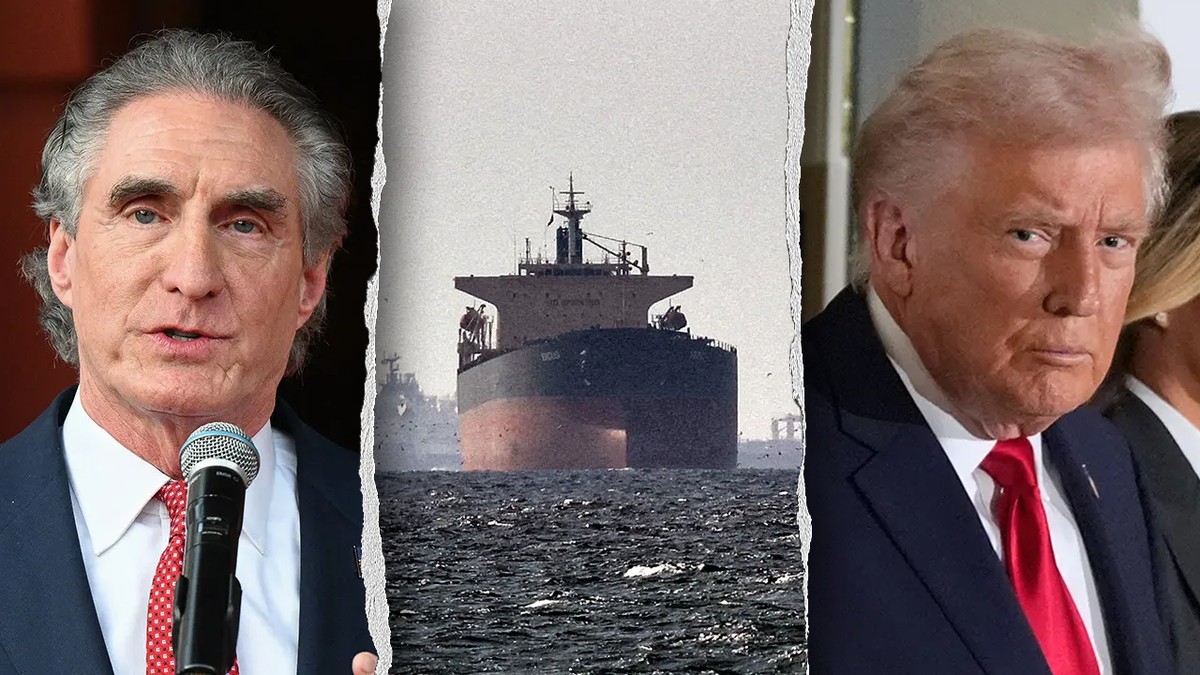
Interior Secretary and Trump energy czar Doug Burgum (left) is confident that President Donald Trump’s “drill baby drill” agenda will quickly overcome the disruption in the Strait of Hormuz (center) due to the Iran conflict. (Federico PARRA / AFP via Getty Images; Stringer/REUTERS; Manuel Balce Ceneta/AP Photo)

Despite criticism of the president’s actions on the global stage, Burgum said these moves, such as the military intervention in Venezuela and negotiations with leadership, are going to help reduce prices for Americans.

“What happened in Venezuela actually helps Americans a lot because now we’ve got Venezuelan oil flowing towards Gulf of America refineries in Louisiana and Texas,” he said.

Another major policy shift Burgum said he expects to make a big difference for Americans is the administration’s actions to “unleash Alaska.”

“The Biden administration had taken over 70 legal actions, executive orders from President Biden to regulatory actions, which were essentially sanctioning Alaska more than we sanctioned Iran during the last administration,” he explained.

Pressed on when Americans can expect to start seeing prices tick back down, Burgum said, “I think we started to see how they were happening and they happened quite effectively over the first year of the Trump administration.” He also pointed out that prices “vary a lot” depending on which state you live in and the extent of regulation and taxes placed on oil and gas production.

“Consumers need to understand that it is not just federal action, but it’s state and local action that’s often driving up the cost of your energy,” he said. “It’s not quite as simple as red state versus blue state. But if you take a look at gas prices before the war, red states were among all the lowest states in the country, blue states were among the highest in terms of that. And it was a reflection of the policies of those state legislatures and those governors that were driving energy prices up.”

US AND IRAN SEND CONFLICTING SIGNALS ON TALKS TO END THE WAR

Rocket trails streaking across the sky above the coastal city of Netanya.

Rocket trails are seen in the sky amid a fresh barrage of Iranian missile attacks above the Israeli coastal city of Netanya, on March 17, 2026. (Jack Guez / AFP)

As an example, he said that just a month ago, gas prices in Iowa were under $2 per gallon, while the price in California was $5.

“California imports 63 percent of its oil from foreign countries,” he explained, adding, “At the time of this breakout with Iran … California, by their own data, provided by the state of California, the number one country they were importing oil from in California was from Iraq.”

“They always brag about, ‘Oh, if we were a country, we’d have one of the world’s largest economies.’ And if they were a county, they would have designed for themselves one of the most energy-dependent and energy-expensive economies,” he said of California.

“They’re not saving the planet by using foreign oil in California when you could have been getting clean, reliable, affordable energy, say from the Permian Basin in Texas or New Mexico,” he continued. “When you think you’re saving the planet by blocking U.S. infrastructure, you artificially raise the prices.”

To push back on this, Burgum said that, authorized by Trump’s energy emergency declaration, Energy Secretary Chris Wright recently ordered California to reopen its Santa Ynez pipeline system to resume pumping domestic offshore oil. The order is being challenged by California in court; however, oil has already begun being pumped.

IRAN CHOKES STRAIT OF HORMUZ WITH REPORTED $2M TANKER TOLL, REGIME THREATENS GLOBAL OIL SUPPLY

Surfers waiting for waves in the water at El Porto Beach near a large crude oil tanker.

Surfers wait for waves on El Porto Beach as crude oil tanker “Chios” has its cargo pumped into the Chevron Products Company refinery, one of California’s largest petroleum processing facilities, in El Segundo, Calif., on March 4, 2026. (Damian Dovarganes/AP Photo)

He framed the administration’s “energy abundance” agenda as a move back to reality after four years of “climate fantasy” under former President Joe Biden. This move, he said, stands in stark opposition to policies still being pursued in blue states like California.

CLICK HERE TO DOWNLOAD THE FOX NEWS APP

“We’re focused on energy reality, which is all Americans deserve and need to have reliable, affordable, and secure energy,” he said. “We’re fighting for every citizen in the country, regardless of what state regime they’re under. Because like I said, every American, no matter where you live, deserves to have affordable, reliable, and nationally secure energy.”  

Fox News Digital reached out to spokespeople for Biden and California Gov. Gavin Newsom.


Trump unleashes nuclear boom, powering America back to energy dominance


NEWYou can now listen to Fox News articles!

America’s nuclear renaissance will not be built in Washington alone. Just as the states that had the foresight to build today’s nuclear fleet enjoy its benefits, the states that rebuild our nuclear industrial base will reap the rewards of its resurgence. President Donald Trump understands this truth, which is why he took executive action last May to give states the lead in reinvigorating our nuclear industrial base.

Since then, the Department of Energy has developed a clear framework focused on driving state-led efforts to reestablish the full nuclear fuel cycle at home and revitalize the American nuclear industry.

The Nuclear Lifecycle Innovation Campus concept proposes state hubs that align local and federal resources to expand regional industrial capacity, drive economic growth and restore technological leadership in this critically important field.

This state-led model builds upon America’s past success, when the nation once built a thriving, fully integrated national nuclear enterprise. At the height of America’s nuclear buildout in the 1960s and 1970s, reactors were rising from North Carolina to Arkansas while domestic enrichment in Kentucky and Ohio, fuel fabrication in Washington and South Carolina, and commercial reprocessing in New York supported a closed fuel cycle.

US POWER CRUNCH LOOMS AS OKLO CEO SAYS GRID CAN’T KEEP UP WITHOUT NEW INVESTMENT

Trump unleashes nuclear boom, powering America back to energy dominance

President Donald Trump is backing a state-based system to restore American nuclear dominance. (Getty Images)

In these and other host states, nuclear development built enduring infrastructure, highly specialized workforces, and technical expertise that sustained the industry for decades. From heavy reactor vessels forged in Pennsylvania to advanced control systems and specialty materials manufactured across the Midwest, the nuclear enterprise anchored regional industry and strengthened local economies.

In the decades that followed, this integrated enterprise withered, its decline driven by an increasingly burdensome and unpredictable regulatory environment and unfavorable public opinion that made nuclear uncompetitive in a world of cheap natural gas and deregulated electricity markets.

In 1977, the Carter administration further worsened the environment by deferring commercial reprocessing amid proliferation concerns. That decision contributed to growing waste inventories across our country, even as our allies have demonstrated safe and secure fuel recycling for decades.

TRUMP ADMIN POURS $1B INTO MASSIVE EFFORT TO RESTART NUCLEAR REACTOR AT HISTORIC MELTDOWN SITE

Over time, domestic enrichment capacity declined, fuel fabrication and conversion capabilities consolidated, and specialized manufacturing migrated or disappeared, eroding the industrial base that had once sustained a full nuclear lifecycle.

As the U.S. stepped back from fuel-cycle integration, competitors built vertically integrated nuclear industries that combined fuel services, reactor construction and long-term support, usurping our leadership in the global nuclear market.

Advanced technical capability cannot be rebuilt one component at a time across a fragmented industrial base. The United States has seen this dynamic in other sectors, from semiconductors to aerospace and biotechnology, where co-location of research, production and skilled labor accelerates innovation and builds durable expertise. Rebuilding that capability in the United States will require regional clusters where these functions co-locate, talent pipelines mature and supply chains regain scale.

DEPARTMENT OF WAR TRANSPORTS NEXT-GENERATION REACTOR IN NUCLEAR ENERGY MILESTONE

The Nuclear Lifecycle Innovation Campus model provides a practical path forward. State-led hubs would bring together fuel fabrication and recycling technologies, advanced reactor demonstration, materials testing, waste management solutions and workforce training within a regional ecosystem.

Private sector funding would accelerate commercialization across the supply chain, rebuilding domestic fuel-cycle capabilities right on campus. States that step forward stand to attract high-skill jobs, anchor advanced manufacturing, and position their communities at the center of a secure and resilient nuclear enterprise.

CLICK HERE FOR MORE FOX NEWS OPINION

The Nuclear Lifecycle Innovation Campus concept proposes state hubs that align local and federal resources to expand regional industrial capacity, drive economic growth and restore technological leadership in this critically important field.

Rebuilding the nuclear fuel cycle is not merely a domestic industrial objective. It is a matter of national sovereignty. Today, Russia controls roughly 40% of global enrichment capacity and remains a significant supplier of reactor fuel to utilities in both the U.S. and Europe. As the U.S. and its allies work to reduce reliance on Russian fuel services over the coming years, a strong domestic fuel supply will be needed.

Under Secretary Chris Wright’s leadership, the Department of Energy has taken significant action to that point, expanding domestic enrichment capacity, strengthening allied supply chains and supporting the production of high-assay low-enriched uranium.

CLICK HERE TO DOWNLOAD THE FOX NEWS APP

Many advanced reactor designs can utilize recycled fuels and alternative fuel forms, creating pathways to reduce waste and recover usable materials. Restoring domestic fuel-cycle capability through Nuclear Lifecycle Innovation Campuses would strengthen energy security, support defense requirements, and ensure the U.S. retains control over a critical technology.

America’s nuclear renaissance will be led by the states that choose to build it. Early leaders will attract investment, talent and supply chains essential to national security, demonstrating what is possible for others to follow. Competitive federalism has long driven American innovation. Applied to nuclear energy, it can restore industrial power, secure the fuel cycle, and strengthen the nation.


Trump tells CNBC ‘we are very intent on making a deal’ with Iran


Trump tells CNBC ‘we are very intent on making a deal’ with Iran

President Donald Trump said in a Truth Social post Monday that, following talks with Iranian authorities, he ordered the U.S. military to postpone strikes on Iran’s power plants and energy infrastructure for five days.

He told CNBC’s Joe Kernen in a phone call shortly after the post that “we are very intent on making a deal with Iran.”

However, Iranian state media, citing an unnamed “senior security official” in a post on Telegram disputed Trump’s description of conversations, saying direct or indirect talks have not taken place between Washington and Tehran.

“There is been no negotiation and there is no negotiation, and with this kind of psychological warfare, neither the Strait of Hormuz will return to its pre-war conditions nor will there be peace in the energy markets,” state media reported the official as saying.

Trump countered later Monday morning that the U.S. and Iran “have had very, very strong talks” yielding “major points of agreement,” including that Tehran will “never have a nuclear weapon.”

Trump, speaking to reporters in Palm Beach, Florida, said his son-in-law Jared Kushner and U.S. special envoy Steve Witkoff participated in those talks Sunday evening with “a top person” in Iran.

“They want, very much to make a deal. We’d like to make a deal too,” he said. “We’re going to get together today by, probably, phone, because it’s … very hard for them to get out, I guess. But we’ll, at some point, very, very soon, meet.”

Trump said that if the five-day halt in strikes goes well, the parties could end up “settling this.”

“Otherwise, we’ll just keep bombing our little hearts out,” he said.

The president also said that he believes Israel will be “very happy” with the progress made with Iran so far.

He added that the Strait of Hormuz “will be opened very soon, if this works.”

Asked who would control the strait, Trump said it might be “jointly controlled” by himself and “whoever the ayatollah is,” suggesting that such a move would come as part of a “very serious form of regime change.”

President Trump: Iran wants to make a deal

In his Truth Social post earlier Monday, Trump said that the U.S. and Iran had “VERY GOOD AND PRODUCTIVE CONVERSATIONS REGARDING A COMPLETE AND TOTAL RESOLUTION OF OUR HOSTILITIES IN THE MIDDLE EAST.”

The U.S. president said these talks would continue through the week. It was not immediately clear who participated in the talks or when and where they were held.

U.S. stock futures rallied, the dollar fell against other major currencies, and oil prices tumbled on the news.

Speaking with Kernen, Trump said discussions with Iranian authorities had been very intense and that he remains hopeful something very substantive can be achieved.

The U.S. president also insisted on the same call that what is unfolding in Iran can be described as regime change, Kernen reported.

The White House did not immediately respond to CNBC’s request for additional information about the purported talks, and did not immediately respond to Iran’s claim that no such negotiations are underway.

U.S. President Donald Trump speaks to reporters before boarding Air Force One at Palm Beach International Airport on March 23, 2026 in West Palm Beach, Florida.

Roberto Schmidt | Getty Images

The U.S. president on Saturday issued a 48-hour ultimatum to Tehran to reopen the Strait of Hormuz or face strikes on Iran’s power plants.

The narrow waterway is a key maritime corridor that connects the Persian Gulf and the Gulf of Oman. Roughly 20% of global oil and gas typically passes through it.

The deadline had been due to expire on Monday evening in Washington.

Read more U.S.-Iran war news

Iranian Parliament spokesperson Mohammad Baqer Qalibaf had said critical infrastructure and energy facilities in the Persian Gulf region could be “irreversibly destroyed” should Iranian power plants be attacked.

Shipping traffic through the Strait of Hormuz has virtually ground to a halt since the U.S. and Israel launched airstrikes on Iran on Feb. 28. Iran has retaliated by targeting ships trying to pass through the strait, with several incidents reported in recent weeks.

The Iran war has stoked global inflation fears and created what the International Energy Agency calls the largest supply disruption in the history of the oil market.

— CNBC’s Anniek Bao contributed to this report.

Choose CNBC as your preferred source on Google and never miss a moment from the most trusted name in business news.


More than 40 Middle East energy assets ‘severely damaged,’ IEA chief says


Fatih Birol, executive director of the International Energy Agency (IEA), speaks at the National Press Club in Canberra, Australia, on Monday, March 23, 2026.

Bloomberg | Bloomberg | Getty Images

The head of the International Energy Agency said on Monday that at least 40 energy assets across nine countries in the Middle East have been “severely or very severely” damaged since the Iran war began, raising fears of prolonged supply disruptions.

Speaking at the National Press Club in Australia’s capital, IEA Executive Director Fatih Birol said damage to oil and gas fields, refineries and pipelines across the Middle East would take some time to repair.

His comments come as market participants closely monitor threats from the U.S. and Iran over energy facilities as the sprawling regional conflict enters its fourth week.

The Iran war has severely disrupted energy trade flows through the strategically vital Strait of Hormuz, creating what the IEA says is the largest supply disruption in the history of the global oil market. The global supply of liquefied natural gas (LNG) has also been reduced by roughly 20% since the conflict began on Feb. 28.

Birol said the fallout from the Iran war is equivalent to the two major oil crises of the 1970s and the 2022 gas crisis “put together.”

He added: “And, if I may, not only oil and gas. Some of the vital arteries of the global economy, such as petrochemicals, such as fertilizers, such as sulfur, such as helium. Their trade is all interrupted, which would have serious consequences for the global economy.”

U.S. President Donald Trump on Saturday threatened to “obliterate” Iran’s power plants if Tehran did not fully reopen the Strait of Hormuz within 48 hours.

The narrow waterway is a key maritime corridor that connects the Persian Gulf and the Gulf of Oman. Roughly 20% of global oil and gas typically passes through it.

Iran’s Parliament spokesperson Mohammad Baqer Qalibaf responded, saying that critical infrastructure and energy facilities in the Gulf region could be “irreversibly destroyed” should Iranian power plants be attacked.

Given that shipping has virtually ground to a halt in the Strait of Hormuz since the conflict began, the IEA’s Birol said the reopening of the waterway was the “single most important” solution to the global energy crisis.

He singled out Asia as being at the forefront of the Iran war energy shock and said the IEA was prepared to follow-up its historic release of 400 million barrels of oil to the market on March 11.

“If it is necessary, of course, we will do it,” Birol said.

— CNBC’s Anniek Bao contributed to this report.

Choose CNBC as your preferred source on Google and never miss a moment from the most trusted name in business news.