Travelers wait in line at a Transportation Security Administration (TSA) checkpoint at Hartsfield-Jackson Atlanta International Airport (ATL) in Atlanta, Georgia, US, on Monday, March 23, 2026.
Elijah Nouvelage | Bloomberg | Getty Images
President Donald Trump said he’s considering sending the National Guard to U.S. airports, two days after the administration sent Immigration and Customs Enforcement agents to several major U.S. airports following hourslong waits for travelers because of the partial government shutdown.
In a Truth Social post on Wednesday, Trump blamed Democrats for the shutdown, which began Feb. 14.
“Thank you to our great ICE Patriots for helping. It makes a big difference,” he wrote in his post. “I may call up the National Guard for more help.”
More than 11% of TSA officers called out on Wednesday and more than 450 have quit since the shutdown started, the Department of Homeland Security said.
Elevated absences of Transportation Security Administration officers, who are required to work though they’re not getting paid during the shutdown, have contributed to long lines at major U.S. airports, including in Atlanta, Houston and New York.
Read more about the impact on air travel
DHS, which oversees both ICE and and TSA, said the ICE agents will “support airports facing the greatest strain” but the department didn’t respond to requests for comment on what the ICE agents’ duties are. ICE agents are getting paid in the shutdown.
Airlines have been warning customers about potentially long security lines, while executives grow increasingly frustrated with lawmakers about the impasse. On Tuesday, Delta Air Lines said it suspended its airport escorts and other special services for members of Congress and their staff because of the ongoing partial shutdown of the DHS.
The shutdown comes as Democrats in Congress have demanded changes to how federal immigration enforcement operates in exchange for releasing DHS funding after two U.S. citizens were shot and killed by ICE officers in Minneapolis.
Choose CNBC as your preferred source on Google and never miss a moment from the most trusted name in business news.
If you’re hauling freight on America’s highways, safety isn’t optional. It’s the price of admission.
That principle is at the heart of Dalilah’s Law, which the House Transportation and Infrastructure Committee passed today.
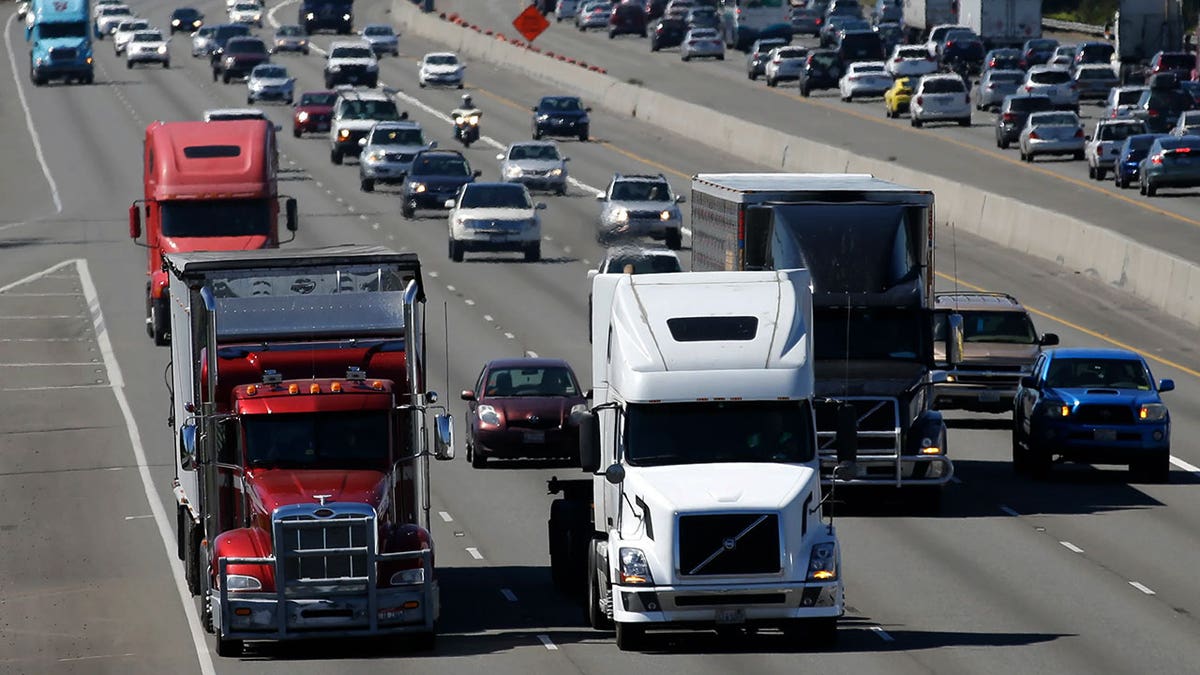
Backed by President Trump during last month’s State of the Union, this legislation reinforces a fundamental principle: only properly trained and qualified professionals should be behind the wheel of an 80,000-pound truck. It strengthens safety standards, ensures drivers can understand and communicate in English, and closes loopholes that have allowed unqualified or improperly licensed individuals to slip through the cracks — making roads safer for everyone.
FAMILY PUSHES FOR ‘DALILAH’S LAW’ AFTER TRUMP HONORS GIRL CRITICALLY INJURED BY ILLEGAL IMMIGRANT TRUCK DRIVER
Dalilah’s Law is named for a young girl whose life was forever changed by a preventable crash involving an undocumented immigrant behind the wheel of a commercial truck.
Speeding through a construction zone, this reckless driver hit the car five-year-old Dalilah Coleman was traveling in, leaving her with permanent disabilities that will require lifelong care. It is a devastating example of what happens when safety standards are not upheld or enforced.
SOME STATES HAVE LET UNQUALIFIED FOREIGN DRIVERS ON THE ROAD AND AMERICANS PAY THE PRICE
Only properly trained and qualified professionals should be behind the wheel of an 80,000-pound truck. Dalilah Coleman’s story is a painful reminder of what’s at stake when we fall short.
In the years following COVID-19, a surge in freight demand brought an influx of opportunity seekers into our industry. While many answered the call responsibly, others chased quick profits without respecting the safety standards on which the industry depends. When enforcement slips, safety suffers. And that’s when tragedies like Dalilah’s happen. We saw it in Florida. We saw it in California. We saw it in Indiana.
Dalilah’s Law addresses these gaps head-on.
DUFFY EXPOSES 54% OF NORTH CAROLINA TRUCK LICENSES ISSUED ILLEGALLY TO ‘DANGEROUS DRIVERS’
It ensures consistent enforcement of English-language proficiency requirements during roadside inspections and makes clear that drivers who cannot meet those standards should be placed out of service. It modernizes the driver record notification system, so motor carriers are promptly alerted if a driver’s commercial driver’s license (CDL) has been revoked, suspended, or is otherwise invalid. And it requires the Department of Transportation to strengthen oversight of training providers, ensuring new drivers receive the instruction they need to operate safely.
Just as importantly, it reinforces accountability across the CDL system. States play a central role in issuing licenses, and consistent, rigorous enforcement is critical. By closing gaps and improving coordination, this legislation helps remove bad actors from the road while supporting the vast majority who are doing the job the right way.
CLICK HERE FOR MORE FOX NEWS OPINION
This is what it looks like when government and industry work together to fix a real problem. President Trump, Transportation Secretary Sean Duffy, Rep. David Rouzer, and the House Transportation and Infrastructure Committee have answered the call to strengthen roadway safety.
By closing gaps and improving coordination, this legislation helps remove bad actors from the road while supporting the vast majority who are doing the job the right way.(AP Photo/Ted S. Warren)
At its core, trucking is about trust. Americans trust that the goods they rely on will arrive safely. They trust that the trucks they share the road with are operated by qualified professionals. And they trust that the system overseeing this industry is working as it should.
CLICK HERE TO DOWNLOAD THE FOX NEWS APP
Dalilah’s story is a painful reminder of what’s at stake when we fall short. This legislation is our opportunity to make sure we don’t.
There’s no room for shortcuts when lives are on the line. Congress must pass Dalilah’s Law.
CLICK HERE TO READ MORE FROM CHRIS SPEAR
Chris Spear is president and CEO of the American Trucking Associations, the nation’s leading organization representing the interests of the trucking industry.
United Airlines aircraft at Denver International Airport, Aug. 4, 2023.
Antonio Perez | Chicago Tribune | Tribune News Service | Getty Images
LOS ANGELES — United Airlines‘ formula for higher profits: fewer but better seats.
The country’s second-most profitable carrier after Delta Air Lines on Tuesday unveiled new cabin designs, including on some of its smallest planes, that feature more premium seating options and fewer in standard coach.
The differences in airfare for those seats can be vast. For example, a flight between United’s hub at Newark Liberty International Airport in New Jersey and San Francisco in the first week of May is going for $423 in standard coach and $5,556 in the carrier’s top-tier Polaris class on a Boeing 757.
Even with the spike in fuel prices, United’s executives have said in recent weeks that demand remains strong, noting that premium-travel demand has outshined the main cabin.
“The main cabin is also improving, and we’ve seen very strong demand across the board for United in Q1, but premium did lead the way yet again in the quarter, and continues to do so,” Andrew Nocella, United’s chief commercial officer, told reporters last week.
United plans to introduce a subfleet of narrow-body Airbus A321neo jets dubbed the “Coastliner” for transcontinental flights that will have 20 Polaris seats, which can recline into beds. Each Polaris seat will have aisle access.
Those jets will also have 12 premium economy seats and 36 extra-legroom seats on board, with the rest regular economy. United said it removed three seats from the plane’s standard configuration to install a snack bar at the back of the plane.
Current layouts of the plane don’t have premium economy, but they do have 57 extra-legroom seats and 123 seats in standard economy, along with 20 that are first-class recliners, not the lie-flat Polaris seats.
United said the first Coastliners will begin flying this summer and it will have 40 of them by the start of 2028.
The airline also announced its configuration for its longer-range Airbus A321XLR aircraft, which will replace some older Boeing 757s. That layout also includes the 20 Polaris suites, 12 premium economy seats and 34 in extra-legroom. The plane will debut this summer, and United said it could operate on some of its existing routes to Spain, France, Portugal and Brazil.
Read more about airlines’ race to win over big spenders
United will also add a seven-seat first-class cabin to its Bombardier CRJ-200 jets for a total of 41 seats on board, compared with the current 51-seat layout, which has only one cabin.
The first class cabin (front) inside a United Airlines Express CRJ-450, a redesigned CRJ-200 regional jet featuring a new cabin design, is displayed during a media event showcasing the airline’s new premium “Elevated” aircraft interior at Los Angeles International Airport (LAX) in Los Angeles, California on March 24, 2026.
Patrick T. Fallon | AFP | Getty Images
The changes are part of an ongoing trend for airlines, which are dedicating more of the scarce real estate on planes to premium seats, as the growth from those higher-end options outpaces sales from regular economy.
Last year, United unveiled an upgraded Polaris suite for long-haul flights on its Boeing 787 Dreamliners that includes the “Polaris Studio,” which is larger than previous models and has 27-inch 4K screens as well as an ottoman for guests.
United’s chief rival, Delta, has said it expects premium revenue to overtake main cabin sales this year. That carrier said last month that starting in May, the first of seven of its new Airbus A321neo jets will have 44 seats in first class, more than double the 20 it usually has.
The demand has been so high for plush new suites and other premium seats that the supply chain can’t keep up. The bottlenecks have even delayed delivery of aircraft, CNBC has reported.
Delta said the big first-class cabin on the A321neo is a medium-term measure, “intended to be in service for a limited time as Delta awaits delivery of flatbed suites that will ultimately be installed on these aircraft.”
Meanwhile, United has been eyeing lie-flat seats for some of its newer narrow-body jets for years.
CEO Scott Kirby told reporters in August 2018 that the carrier was planning to offer lie-flat seats on new Boeing 737 Max 10 aircraft, though that plane still hasn’t been certified and is years behind schedule.
Other airlines are also adding higher-end seats.
JetBlue Airways, which was a pioneer in offering lie-flat seats and suites on its narrow-body Airbus fleet, plans to offer a less elaborate domestic first-class cabin later this year. Southwest Airlines recently debuted extra-legroom seats on its fleet of Boeing 737s, ending its decades of standard seating throughout its cabin.
Budget carriers Spirit Airlines and Frontier Airlines are also planning to add roomier seats.
Choose CNBC as your preferred source on Google and never miss a moment from the most trusted name in business news.
A Transportation Security Administration (TSA) agent looks on passengers queue to go through security at New York’s LaGuardia airport on March 22, 2026.
Charly Triballeau | Afp | Getty Images
NEW YORK — Andrew Leonard showed up at John F. Kennedy International Airport at 4:45 a.m. on Monday for his 7 a.m. flight to Seattle. Nearly two hours later, he made it through security and to his gate just in time for boarding.
“I fly out of this terminal all the time and this is insane,” said Leonard, a 34-year-old performing arts teacher in New York who was en route to Seattle ahead of a family vacation to Hawaii.
He is one of tens of thousands of travelers around the U.S. who are facing extra-long security wait times at major airport hubs such as Atlanta, New York and Houston due to elevated absences of Transportation Security Administration officers. TSA workers are facing a second missed full paycheck this week as a partial government shutdown continues.
White House border czar Tom Homan said Sunday said the administration would deploy Immigration and Customs Enforcement agents to airports on Monday to help ease security lines amid the Department of Homeland Security shutdown.
Read more about the impact on air travel
ICE agents weren’t visible at checkpoints at Kennedy airport’s Terminal 8 early Monday, and it wasn’t clear where or when agents would be deployed. DHS and TSA didn’t immediately respond to a request for comment early Monday.
Homan told CNN’s “State of the Union” on Sunday that the ICE agents will be “helping TSA move those lines along,” including by guarding exit doors to relieve TSA agents so they could screen travelers. “We’re simply there to help TSA do their jobs in areas that don’t need their specialized expertise.”
TSA’s more than 50,000 officers have been working without their regular paychecks since the partial government shutdown began in mid-February. The shutdown comes as Democrats in Congress demand changes to how federal immigration enforcement operates in exchange for releasing DHS funding after two U.S. citizens were shot and killed by officers in Minneapolis.
Hundreds of TSA officers have quit since the shutdown started, according to their union, the American Federation of Government Employees.
The security line at John F. Kennedy International Airport on Monday, March 23, 2026.
Leslie Josephs/CNBC
Members of the travel industry, including airline executives, have blasted lawmakers for failing to pay essential government workers during repeated shutdowns that have snarled travel.
In early 2019 and in late 2025, two federal government shutdowns ended shortly after travel disruptions escalated following higher-than-typical absences of air traffic controllers. Their pay isn’t affected by this impasse.
New York’s LaGuardia Airport was closed on Monday morning following a collision of an Air Canada regional jet and an emergency vehicle on Sunday night. Some passengers told CNBC they had switched to fly out of Kennedy because of the disruptions.
The Federal Aviation Administration issued a ground stop at Newark Liberty International Airport in New Jersey on Monday morning after air traffic controllers evacuated the tower because of a burning smell coming from an elevator, adding to travel chaos around New York City.
— CNBC’s Garrett Downs contributed to this article.
Choose CNBC as your preferred source on Google and never miss a moment from the most trusted name in business news.
Travelers wait in line at a Transportation Security Administration (TSA) checkpoint at Hartsfield-Jackson Atlanta International Airport (ATL) in Atlanta, Georgia, US, on Friday, March 20, 2026.
Elijah Nouvelage | Bloomberg | Getty Images
Immigration and Customs Enforcement agents will deploy to airports on Monday to help ease security lines amid the Department of Homeland Security shutdown, White House border czar Tom Homan said Sunday.
President Donald Trump on Saturday threatened to deploy ICE agents to airports as the shutdown drags into its second month, creating headaches for travelers moving through hours-long Transportation Security Administration security lines.
Homan confirmed that ICE will be deployed on Monday during an appearance on CNN’s “State of the Union.”
“We will be at the airports tomorrow, helping TSA move those lines along,” Homan said, adding that ICE will assist in areas like guarding exit doors to relieve TSA agents for screening travelers. “We’re simply there to help TSA do their jobs in areas that don’t need their specialized expertise.”
Homan said the details of the plan are still under discussion, but will be decided by Monday morning when ICE agents deploy.
“We’ll have a plan by the end of today, what airports we’re starting with and where we’re sending them,” Homan said. “It’s a work in progress.”
The move to deploy ICE comes as the DHS shutdown, which began on Feb. 14, strains airport workers. Many TSA agents have either called out rather than work without pay or quit altogether. More than 400 TSA officers have left their jobs since the start of the shutdown, according to an NBC News report.
Read more CNBC politics coverage
Democrats are demanding statutory changes to immigration enforcement practices in exchange for funding DHS after two U.S. citizens were shot and killed by ICE in Minneapolis.
House Democratic Leader Hakeem Jeffries of New York slammed the plan to deploy ICE agents to airports.
“The last thing that the American people need are for untrained ICE agents to be deployed at airports all across the country, potentially to brutalize or, in some instances, kill them,” Jeffries said on CNN.
Jeffries, however, indicated that Democrats do not plan to back down from their demands in exchange for funding DHS.
“It’s unfortunate that Republicans have decided that they would rather force TSA agents to work without pay, inconvenience millions of Americans all across the country and now potentially expose them to untrained ICE agents and create chaos at airports throughout the land rather than get ICE agents under control,” Jeffries said. “They need to be reined in, and our view is that they should not get another dime of taxpayer dollars until we have bold and dramatic and meaningful changes.”
The Democratic leader also suggested funding TSA and all other DHS subagencies, with the exception of ICE and Customs and Border Protection. Democrats have tried to advance such a bill several times, but Republicans have stymied the legislation, fearing they would lose leverage to eventually fund ICE and CBP.
Some Republicans have warmed to the idea of splitting off ICE and CBP funding from the rest of DHS, which includes TSA, the Coast Guard, the Federal Emergency Management Agency and the Cybersecurity and Infrastructure Security Agency.
Sen. Ted Cruz, R-Texas, who leads the Senate Commerce Committee, suggested the idea in an interview with The Hill on Saturday. Sen. John Kennedy, R-La., also brought up the idea in an interview on C-SPAN’s “Ceasefire.” Both Kennedy and Cruz said Republicans would try to then pass funding for ICE through the reconciliation process, which only requires 50 votes in the Senate.
“Let’s open up everything but ICE,” Kennedy said. “But, I can tell you what’s gonna happen next, the Republicans are going to put a reconciliation bill on the floor that only requires Republican votes to fund ICE.”
This story is developing. Please refresh for updates.
Choose CNBC as your preferred source on Google and never miss a moment from the most trusted name in business news.
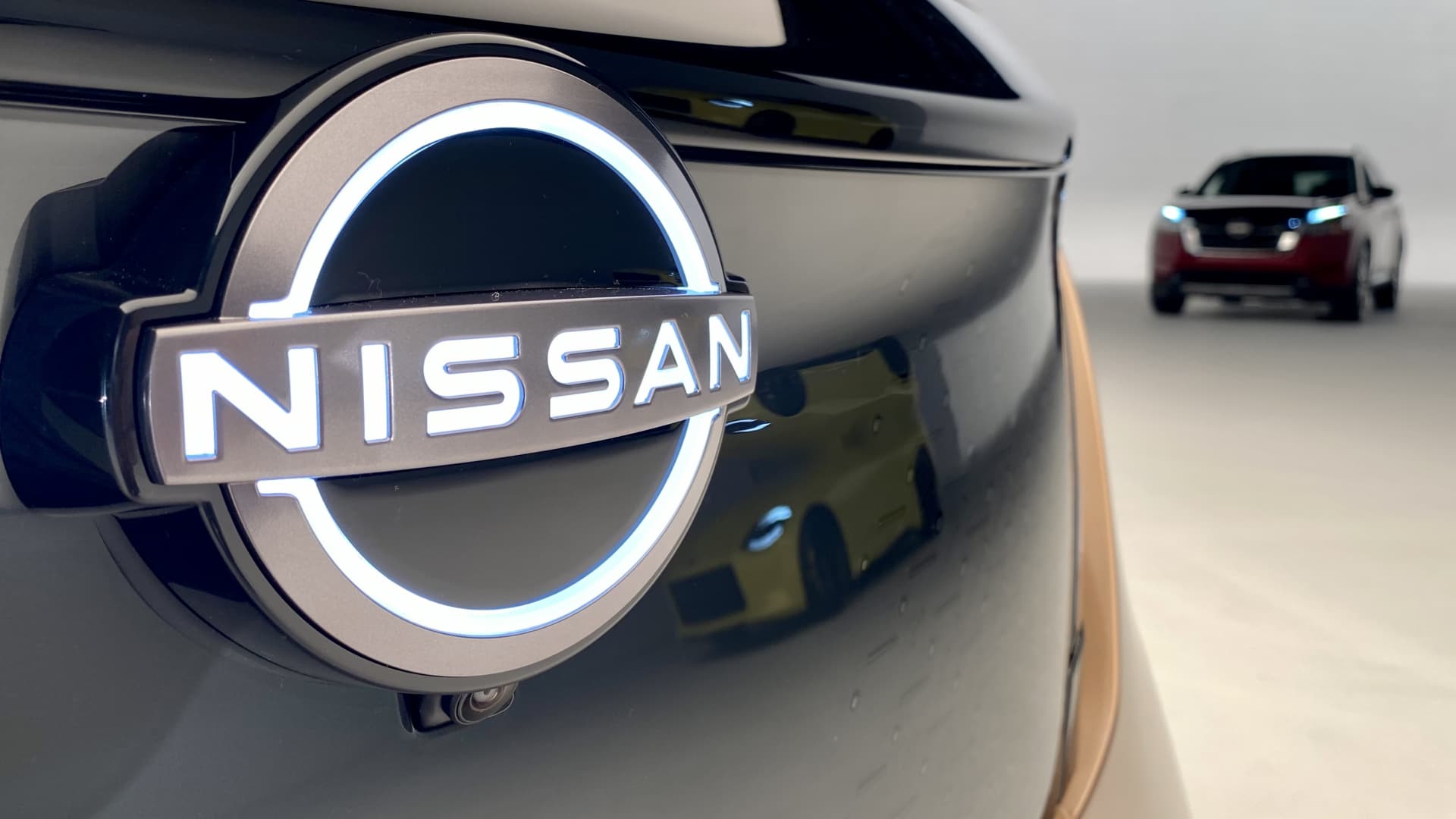
Nissan’s logo is illuminated on a prototype of its new all-electric Ariya crossover. Nissan’s Z Proto performance car is reflected in the vehicle’s grille, while a redesigned Nissan Pathfinder SUV sits in the background.
Michael Wayland / CNBC
Nissan Motor plans to introduce a new type of hybrid to the U.S. market that drives like an all-electric vehicle but is powered — not driven — by a traditional gas-powered engine.
The new Nissan “e-Power” is called a series hybrid. It uses the engine as a generator to power the vehicle’s electric motors that then propel the vehicle. It operates like emerging extended-range electric vehicles, or EREVs, but has a smaller battery and doesn’t require a plug.
It’s also different from a traditional hybrid, such as the Toyota Prius, because the gas engine in those vehicles is used to propel the vehicle. The series hybrid’s engine just keeps the battery charged to power the electric motors in the vehicles.
The e-Power hybrid system for Nissan is planned to launch domestically later this year in a new version of its popular Rogue compact SUV.
Timing for such a vehicle could be ideal for Nissan with climbing gas prices, slower-than-planned adoption of EVs and an expected surge in hybrid sales amid new entries, according to officials.
After losing billions of dollars on EVs, automakers such as Nissan are turning to hybrid vehicles to meet customer expectations for fuel economy and to help with driving performance.
S&P Global Mobility expects hybrids in the U.S. this year to increase to 18.4% of new vehicle sales, up from 12.6% last year and 7.3% in 2023. It’s forecasting pure EVs, meanwhile, will be 7.1% of new vehicle sales, down from 8% last year.
“This is a unique powertrain for the for the U.S.,” Kurt Rosolowsky, Nissan North America vehicle evaluation and test engineer, said during a media briefing. “This is an electrically driven vehicle, as far as what is powering the wheels, but it doesn’t have a plug, and you fill it up with gas like you do with a normal car.”
Series hybrids
Nissan and other automakers have used series hybrids elsewhere, particularly in Asia, but companies have been reluctant to bring the vehicles to the U.S. because of consumer expectations for driving dynamics and power.
To address those concerns, Nissan said it has developed a more powerful 1.5-liter, three-cylinder turbocharged engine specifically for the e-Power system, in addition to new packaging and other upgrades, to appease American buyers.
“The turbo is only there to serve efficiency at higher speeds for the gas engine to deliver energy,” Rosolowsky said.
The e-Power for the U.S. market is Nissan’s third generation of the series hybrid since it debuted in Japan in 2016. Since then, Nissan said it has sold more than 1.6 million vehicles globally with e-Power in nearly 70 countries.
“I think it’s going to be a really good system. I think it’s going to be very popular for Nissan in the new Rogue when it arrives later this year,” said Sam Abuelsamid, vice president of market research at communications and consulting firm Telemetry.
Abuelsamid said the only real drawback to the series hybrid is that it’s less efficient at higher speeds, which Nissan is trying to overcome with the new engine as well as battery size.
Driving e-Power
Driving a European version of the Nissan Rogue Sport sold with the ePower system around suburban Detroit, the vehicle’s driving dynamics — specifically fast acceleration and regenerative braking — are formidable.
They come with the familiar sound of an engine revving but without the shifting or sputtering of transmission gears and far less noise, vibration and harshness, or NVH, as the industry commonly refers to it.
“The driving experience really is what makes it different with those fewer components. You have less noise and less vibration,” Rosolowsky said.
Nissan e-Power logo
Courtesy Nissan
Unlike traditional gas-powered vehicles, the e-Power system also does not require a traditional transmission to shift gears or a driveshaft that transfers torque from the transmission to the differential, powering the wheels.
While the Rogue Sport is a smaller vehicle and only forward-wheel-drive, it’s easy to see how the system will translate to a larger vehicle with all-wheel-drive, which the new Rogue with e-Power will be.
The lack of a plug, some engine noise and slight vibration also might be more familiar for drivers who have been reluctant to adopt all-electric vehicles.
While Nissan is not releasing specifics such as pricing or fuel economy for the upcoming Rogue with e-Power, the Rogue Sport was achieving more than 40 miles per gallon during heavy city driving, according to the vehicle’s MPG system.
The current Nissan Rogue, depending on the model, can achieve more than 30 MPG, according to U.S. Department of Energy and the U.S. Environmental Protection Agency.
Nissan’s vehicles historically been less fuel efficient than those from its larger Japanese rivals. Honda Motor and Toyota Motor, the latter of which pioneered traditional hybrids with the Prius and continues to dominate the sector in the U.S.
Nissan declined to discuss the possibility of expanding the e-Power system to other vehicles in the U.S., but confirmed the new system is modular and capable of working with many different engines.
“If we were to expand this to other vehicles, you can theoretically bolt this onto another gasoline engine of a different size and have more options for an e-Power system,” Rosolowsky said.
Choose CNBC as your preferred source on Google and never miss a moment from the most trusted name in business news.
A Tesla Megapack battery at the Harmony Energy Ltd. and Fotowatio Renewable Ventures BV battery energy storage project near Burgess Hill, England, May 11, 2021.
Chris Ratcliffe | Bloomberg | Getty Images
Tesla is expanding ties with South Korea’s LG Energy Solution, striking a deal to buy $4.3 billion worth of battery cells for energy storage systems that will be made in Lansing, Michigan.
The plant was formerly developed for a joint venture between LG and General Motors before the automaker decided to retreat from that initiative in late-2024, selling its stake to LG as part of a pullback in the automaker’s electric vehicle investments.
While Tesla still makes most of its revenue from EVs, the company is investing in its more rapidly growing energy business, as data centers drive up electricity demand. Tesla’s Megapacks can store power produced using intermittent sources like solar or wind, or during off-peak hours, then make it available for use when demand is high.
Tesla currently sells Powerwall backup batteries for residential use with its solar installations, and much larger Megapack and Megablock systems for utility-scale power storage. Last year, revenue in the company’s energy segment increased 27% to $12.8 billion, accounting for 13% of total revenue. Total revenue dropped due to a 10% decline in the auto business.
Details of the Tesla-LG partnership were announced during an Indo-Pacific Energy Security Summit in Japan, according to a release from the U.S. Department of the Interior. The Trump administration announced a total of $56 billion in private sector commitments at the event.
A spokesman with LG Energy Solution said the company “will establish dedicated production lines at our Lansing facility to deliver on this agreement.” LG last year retooled the facility to build LFP (lithium iron phosphate) prismatic cells, later confirming a $4.3 billion deal with an unnamed company.
GM continues to have a significant presence in and around the Lansing battery plant, but the company has largely retrenched from the EV market, announcing $7.6 billion in related write-downs.
Tesla, meanwhile, expects its energy business to “have very high growth for as far into the future as we can imagine,” CEO Elon Musk said during the company’s fourth-quarter earnings call in January. Chief Financial Officer Vaibhav Taneja cautioned that the energy segment expects “margin compression” from low-cost competition and the cost of tariffs.
Tesla’s competition includes companies like BYD in China and climate-tech startups like Form, which is making iron-air batteries, and others.
WATCH: Why the EV factory boom in the U.S. south is suddenly in trouble
Choose CNBC as your preferred source on Google and never miss a moment from the most trusted name in business news.
Travelers wait in line at a Transportation Security Administration (TSA) checkpoint at William P. Hobby Airport in Houston, Texas, US, on Monday, March 9, 2026.
Mark Felix | Bloomberg | Getty Images
The surge in fuel prices since the U.S. and Israel attacked Iran nearly two weeks ago is already driving up airfare. Consumers’ appetite for travel this year will dictate just how much.
Cathay Pacific on Thursday said it would roughly double fuel surcharges on tickets starting March 18.
Earlier this week, Australia’s Qantas said it israising fares to help cover its costs, Scandinavian Airlines said the “unusually rapid and substantial increase” in fuel prompted it to raise prices, and Air New Zealand pulled its financial outlook “until fuel markets and operating conditions stabilise,” adding that it has made “initial fare adjustments.”
“If the conflict leads to continued elevated jet fuel costs, the airline may need to take further pricing action and adjust its network and schedule as required,” Air New Zealand said.
U.S. airline CEOs and other executives will update investors on Tuesday at the J.P. Morgan Industrials Conference in Washington, D.C.
Analysts expect an earnings hit at least in the first quarter if not the first half of the year, though the impact will depend on how long higher fuel prices last.
“We think a hit to 1Q EPS appears almost certain at this point,” UBS airline analysts Atul Maheswari and Thomas Wadewitz wrote in a note last week.
United Airlines CEO Scott Kirby said last week on the sidelines of an event at Harvard University that higher fares were likely on the way because of the surge in fuel prices.
Kirby said travel demand is still strong, however. Two other senior airline executives at U.S. carriers, speaking on the condition of anonymity because they weren’t authorized to speak to media, also said travel demand has held up. If those trends persist, it could give airlines more pricing power, but that will depend on the war’s duration.
“Airlines never met a higher fare they didn’t want,” said Scott Keyes, founder of flight deal company Going, previously known as Scott’s Cheap Flights.
So what should consumers do?
Keyes said travelers can’t lose by booking early, as long as they’re not buying restrictive basic economy tickets. That way, customers can try to exchange or cancel their tickets and buy cheaper ones if airfare ends up falling.
“If you book a $500 summer flight today, and two weeks from now the price drops to $350, you can call up the airline and get the $150 difference back as a credit. Heads you win; tails the airlines lose,” he said.
Read more about the Middle East conflict’s travel impact
Fuel costs
Jet fuel is airlines’ biggest cost after labor, accounting for about a fifth or more of expenses, depending on the airline.
United alone spent $11.4 billion last year on fuel, at an average price of $2.44 a gallon, according to a securities filing. U.S. jet fuel on Wednesday was going for $3.78 a gallon, according to Platts.
Jefferies airline analyst Sheila Kahyaoglu said in a note Thursday that she expects “the most acute financial impact to airlines from surging oil prices to be in the next 30-90 days as airlines have been booking yields for close-in flights assuming a much lower fuel price and carriers cannot retroactively raise fares.”
She said Delta Air Lines and United, which produce most U.S. airline profits, are better positioned than other carriers because of their high-end demand. Risks to demand, particularly for more price-sensitive customers, include the recent jump in gasoline prices.
Jet fuel has more than doubled in some regions since the first U.S.–Israel attacks on Iran on Feb. 28.
Oil prices surged to roughly four-year highs after the initial strikes. Energy prices have swung wildly since then as traders assess just how long the war — and all the logistics headaches — could last.
U.S. jet fuel prices were up more than 60% from before the attacks to a peak last week, according to pricing data assessed by Platts. Jet fuel can rise by a greater degree than crude because it includes the price of processing and ever-more difficult and costly transportation from oil fields to refineries to airplane fuel tanks.
On Feb. 27, the day before the before the attacks, the cost to fill the fuel tanks of a Boeing 737-800 would have would have been about $17,000 based on average prices in New York, Houston, Chicago and Los Angeles, compiled by Argus. Less than a week later, on March 5, it would have cost more than $27,000, based on Argus prices. On Tuesday, after oil prices fell following President Donald Trump’s comment that the Iran war could end “very soon,” it would have cost around $23,000.
Line Service Technician Austin Beadles refuels a plane using a Federal Aviation Administration approved unleaded aviation fuel at Sheltair at Rocky Mountain Metropolitan Airport in Broomfield on Tuesday, Feb. 17, 2026. Sheltair, a fixed-base operator, will offer the Swift UL94 unleaded aviation alternative gas to pilots. (Photo by Matthew Jonas/MediaNews Group/Boulder Daily Camera via Getty Images)
Matthew Jonas | Boulder Daily Camera | MediaNews Group | Getty Images
After prior fuel price surges, airlines started making customers pay for bags — or charging them more. Even seemingly minor changes in weight can save airlines hundreds of thousands, if not millions of dollars, a year in fuel. United in 2018 changed to a lighter paper stock for its in-flight magazine. In 2014, American Airlines said it would switch to digital manuals for flight attendants, following changes for pilots. It said at the time that it would save $650,000 in fuel a year.
All about capacity
High fuel prices don’t automatically mean higher fares. The ongoing strong demand for travel is a key factor and so is capacity, or the amount that carriers fly.
If airlines raise fares and passengers balk, then capacity will likely go down in the form of fewer frequencies on a route or broader cuts, in more severe cases.
“Airlines love to say fuel is expensive so you have to pay more. What they’re doing is they’re setting the expectation,” said Courtney Miller, founder of Visual Approach Analytics, an airline industry advisory firm. “They price to prevent empty seats.”
If fuel prices come down, “they’re not suddenly saying ‘We’re making too much money,'” Miller added. “But they are likely to add another flight.”
Capacity, especially to and from the Middle East, is constrained because of airspace closures and other stop-and-start flights. More than 46,000 flights have been canceled to and from the region since the Feb. 28 attacks began, aviation data firm Cirium said.
Those constraints are driving up fares as well as demand, as United’s Kirby said, from regions where customers are looking for alterative routes.
Airspace closures are also requiring airlines to take longer, more fuel-guzzling routes, but many have strong demand, too.
Qantas, for example, told CNBC that its flight from Perth, Australia, to London is temporarily stopping in Singapore to refuel, allowing it to pick up another 60 customers, and that its Perth-London and Perth-Paris routes are more than 90% full this month, 15 percentage points higher than normal for this time of year.
Finnair said the increased demand for travel to Asia from Helsinki has pushed up its prices by 15% on average.
“The impact of higher fuel prices will be reflected in market fares with a delay, as airlines typically hedge at least part of their fuel purchases,” it said.
Airlines have been grappling with airspace closures for years, including from on-and-off conflict in the Middle East and since Russia’s 2022 invasion of Ukraine, that have left a large swath of airspace out of use for many carriers.
‘You can’t dry up an airport’
Most U.S. airlines no longer hedge fuel costs, or lock in prices using futures and other securities. Southwest Airlines was one of the last holdouts, and it quit last year. A spokesman for the Dallas-based airline told CNBC that Southwest currently has “no plans” to resume hedging.
That leaves U.S. carriers more susceptible to price swings.
Travelers at William P. Hobby Airport in Houston, Texas, US, on Monday, March 9, 2026.
Mark Felix | Bloomberg | Getty Images
Kirby said there would likely be an impact to United’s first-quarter results and to the second quarter if the war — and blockage of the Strait of Hormuz, a key shipping channel — persists. However, he said demand was increasing sharply from regions that have been affected by the thousands of flight cancellations and airspace closures in the Middle East.
Because of airlines’ upbeat outlooks on demand to start the year, “the environment is conducive for passing along fare increases. Further, should jet fuel stay higher for longer, it should help push off-peak capacity lower,” supporting unit revenues, UBS analysts said.
Rick Joswick, who heads of near-term oil research and analytics at S&P Global Energy, told CNBC that “demand for jet fuel is inelastic. You cannot shortchange an airport. If the cost of jet fuel goes up, it’s not like the plane will choose not to fly that day.
“You can’t dry up an airport,” he said.
Read more CNBC airline news
Choose CNBC as your preferred source on Google and never miss a moment from the most trusted name in business news.
The Lucid display is seen at the New York International Auto Show on April 16, 2025.
Danielle DeVries | CNBC
NEW YORK — Lucid Group expects to be cash flow positive late this decade as it plans to grow its vehicle lineup and increase its software and technology offerings, the all-electric vehicle maker announced Thursday during its first investor day in nearly five years as a public company.
The EV company aims to accomplish that through market expansion into midsize vehicles, robotaxis and new counties, specifically in Europe. It also expects to achieve efficiency gains and software revenue growth with the introduction of improved advanced driver assistance systems and a new Lucid artificial intelligence assistant.
That cash flow target is aggressive given the automaker’s current performance and waning demand for EVs in the U.S. While Lucid has been able to increase sales and narrow losses, the company lost $2.7 billion on revenue of $1.35 billion in 2025. It had negative free cash flow of $3.8 billion in 2025, a loss that was roughly 31% larger than a year earlier.
Lucid interim CEO Marc Winterhoff — who unexpectedly took over for company founder Peter Rawlinson last year — on Thursday said the company’s “north star” is “accelerating to profitability,” reiterating the investor event’s theme.
The automaker has been trying to increase investor interest in the company as it prepares to launch a new midsize vehicle at the end of this year. Its largest shareholder, Saudi Arabia’s Public Investment Fund, has also changed its investment strategy in the company from capital investment to revolving credit.
Shares of Lucid were off roughly 8% during much of the Thursday event despite the company giving its most detailed product and expansion plans to date.
Robotaxi, autonomy plans
Lucid on March 12, 2026 previewed plans for a new two-seat rbotaxi that the company is developing off its upcoming midsize electric vehicle platform.
Michael Wayland / CNBC
Lucid on Thursday said it expects to achieve roughly $1 billion in annual incremental, non-vehicle revenue through services such as recurring software subscriptions by later this decade. Company executives spent a significant amount of the event discussing Lucid’s upcoming driving technologies, including revealing plans for a dedicated robotaxi car and launching a subscription service by early 2027 ranging from $69 to $199 a month, based on capabilities.
“Autonomy plays an outside role in the future of Lucid,” said Kay Stepper, Lucid vice president of advanced driving systems, adding that the company plans to offer vehicles capable of driving themselves under certain circumstances by 2029.
Winterhoff and Uber President and Chief Operating Officer Andrew Macdonald on Thursday announced they are planning to expand a previously announced tie-up for robotaxis to include upcoming midsize vehicles.
Expansion into midsize and autonomy is expected to significantly increase Lucid’s total addressable market, or TAM, from $40 billion for its current Air sedan and Gravity SUV to $700 billion, executives said Thursday.
Midsize vehicles
Lucid on Thursday said it plans to produce three midsize vehicles, starting with a vehicle called Cosmos this year, followed by a model called Earth and an unnamed vehicle during an unspecified time frame.
“We think these three unique products will give us maximum opportunity to hit the widest audience possible. And that audience is where we are today, but it’s a different audience than our current market,” said Derek Jenkins, Lucid senior vice president of design and brand.
A Lucid-supplied teaser image of its upcoming midsize vehicle behind its current Gravity SUV.
Lucid
The three midsize vehicles are targeted at upscale buyers, younger “trendsetting achievers” and outdoor enthusiasts, Jenkins said. The last would be a direct competitor to fellow EV competitor Rivian Automotive, which is expected to release a new R2 midsize vehicle this spring, beginning with a roughly $58,000 version of the vehicle.
Lucid has said its midsize vehicle is expected to begin at roughly $50,000. That would position it in line with the average transaction prices of new vehicles in the U.S. as well as entry-level models of Rivian’s R2.
Both Rivian and Lucid are attempting to reassure investors that they can not only compete in a troubled EV market but thrive through the expansion of new vehicles and technologies to better compete against U.S. EV leader Tesla. Lucid said its new midsize EV platform will be class-leading in efficiency, something the company has strived to do with all its vehicles.
Both have touted having enough capital to get them through near-term initiatives but their long-term viability is still a major question for investors.
Lucid has said its total liquidity of $5.5 billion, including a roughly $2 billion delayed draw term loan credit facility from Saudi’s PIF, is enough to get through the first half of 2027.
Rivian ended the fourth quarter with $6.59 billion in total liquidity, including nearly $6.1 billion in cash, cash equivalents and short-term investments, as the company attempts to ramp up production this year of its midsize vehicle and new autonomy technologies.
Choose CNBC as your preferred source on Google and never miss a moment from the most trusted name in business news.
Naval units from Iran and Russia carry out to simulation of rescue a hijacked vessel during the joint naval drills held at the Port of Bandar Abbas near the Strait of Hormuz in Hormozgan, Iran on February 19, 2026.
Anadolu | Anadolu | Getty Images
A cargo ship in the Strait of Hormuz has been struck by an unknown projectile, causing a fire onboard, the United Kingdom Maritime Trade Operations said in an update on Wednesday morning.
The strike forced the crew of the ship, which has not been identified, to evacuate, the UKMTO said. It urged vessels to transit with caution and report any suspicious activity while authorities continue to investigate.
The incident took place 11 nautical miles north of Oman in the Strait of Hormuz. The UKMTO said there is no report of any environmental impact.
Shipping traffic through the strategically vital Strait of Hormuz has ground to a near standstill since the U.S. and Israel launched airstrikes on Iran on Feb. 28. Iran has retaliated by targeting ships trying to pass through the strait, with multiple incidents reported in recent days.
The waterway is a narrow maritime corridor that connects the Persian Gulf and the Gulf of Oman. Roughly 20% of global oil and gas typically passes through it.
Read more U.S.-Iran war news
U.S. forces sank several Iranian ships on Tuesday, including 16 minelayers, near the Strait of Hormuz, according to U.S. Central Command. The update followed an earlier announcement from U.S. President Donald Trump that said if Iran had put any mines in the waterway, “we want them removed, IMMEDIATELY!”
This is breaking news. Please refresh for updates.
Choose CNBC as your preferred source on Google and never miss a moment from the most trusted name in business news.