New System Designed to Protect Drones From Cyber Threats | Newswise


Newswise — Adelaide University researchers have initiated the development of a world-first cybersecurity system designed to protect drones from increasingly sophisticated cyber threats.

A new study led by the Industrial AI Research Centre and published in the international journal Computers and Industrial Engineering, paves the way for safer and more resilient unmanned aerial systems (UAS) that are less vulnerable to hacking, signal disruption and malicious software.

Senior author Professor Javaan Chahl says the research addresses a growing but often overlooked problem: modern drones are effectively flying computers that can be attacked.

“Today’s drones are used in warfare, for emergency response, infrastructure inspections, agriculture, environmental monitoring, logistics and even medical deliveries,” Prof Chahl says.

“They collect large amounts of data, process it onboard, and communicate continuously with operators or cloud-based systems. While this makes drones powerful and versatile, it also makes them vulnerable.”

To solve this, the team has developed a new onboard security architecture based on Software-Defined Wide Area Networking, or SD-WAN, which acts as a smart traffic controller for internet connections.

“Instead of relying on a single link, the drone can use multiple communication pathways at once – such as mobile networks, Wi-Fi or other radio links – and automatically switch between them if one fails or is attacked.”

According to first author Tom Scully, PhD candidate and cybersecurity expert, if a drone is hacked, the impact is just not digital.

“A cyber-attack can interfere with flight controls, disrupt communications, expose sensitive data, and even cause a physical accident.”

The researchers say that many drones still rely on basic communication methods that lack encryption – the digital equivalent of sending sensitive information on an open radio channel. This means that attackers could intercept data, inject false commands or overwhelm the drone’s systems.

The system also includes a next-generation firewall, which works like an advanced security gate. It monitors incoming and outgoing data in real time, blocks suspicious activity, and ensures that only authorised communications are allowed.

Importantly, this firewall runs directly on the drone, rather than relying on remote systems.

One of the most innovative aspects of the research is the inclusion of malware sandboxing – a technology normally found in large corporate networks – where suspicious files can be opened and examined without risking damage. If malicious behaviour is detected, the system can block it immediately.

The researchers have successfully demonstrated the software on a drone platform, using real-world onboard computing hardware with cloud-based control systems.

The team plans to conduct future trials to further validate the system in real time, potentially supporting its adoption in commercial, emergency and government drone operations.

“Our goal is simple,” Scully says. “As drones become part of everyday life, we need to ensure they are not only smart and autonomous, but also secure, resilient and trustworthy.”


Nvidia, Amazon temporarily close Dubai offices, Google employees stranded amid U.S.-Iran war


A plume of smoke rises from the port of Jebel Ali following a reported Iranian strike in Dubai on March 1, 2026.

Fadel Senna | Afp | Getty Images

Nvidia, Amazon and Alphabet are among the big tech firms scrambling to ensure the safety of their employees who are traveling through or based in the Middle East after joint U.S.-Israel strikes on Iran over the weekend.

The massive attack on Iran killed Supreme Leader Ayatollah Ali Khamenei, among others, and Iran retaliated with strikes on Israeli and U.S. bases across the Gulf. The conflict has disrupted civilian life, internet access in Iran, flight routes and energy shipments across the region.

Chip tech leader Nvidia temporarily closed its Dubai offices, with employees there working remotely, according to an email reviewed by CNBC that was sent by CEO Jensen Huang to all employees early Tuesday.

Huang said in his memo that Nvidia’s crisis management team has been “working around the clock and actively supporting affected employees and their families” in the Middle East, including around 6,000 Nvidia employees based in Israel.

In 2019, Nvidia acquired Mellanox, an Israeli company that makes ethernet switches and other networking hardware, for around $7.13 billion, the largest deal in Nvidia’s history at that time. And today, outside of the U.S., Israel represents Nvidia’s largest research and development base.

As of Tuesday morning, all Nvidia employees impacted by the conflict and their immediate families were safe, Huang said.

“Nvidia has deep roots in the region,” Huang wrote. “Thousands of our colleagues live there, and many more across the globe have family and friends affected by these events. Like you, I am watching with great concern for the safety of our Nvidia families.”

Nvidia, Amazon temporarily close Dubai offices, Google employees stranded amid U.S.-Iran war

“Depart now”

The State Department said Monday that Americans should “depart now” from countries across the Middle East using available commercial transportation, citing “serious safety risks.” By Tuesday afternoon, the agency said it was working to secure military aircraft and charter flights to evacuate Americans from the region amid escalating instability.

The disruptions to air travel meant dozens of Google employees have been stranded in Dubai after a sales conference, according to sources, who asked not to be named in order to discuss sensitive matters.

The company’s cloud unit held its “Accelerate” sales kickoff in Dubai last week.

A memo was sent to some cloud employees on Sunday morning that noted it still has team members on the ground, adding that recent attacks are “concerning,” according to employees, who asked not to be named in order to speak about internal matters.

Though most employees got out of the region, dozens remain stuck there, the sources said.

Following the attack on Iran, airlines had mass cancellations. More than 11,000 Middle East flights have been cancelled since the U.S.-Israeli strikes over the weekend, according to aviation-data firm Cirium.

Google said the majority of impacted employees are not U.S.-based but in-region employees. It added that it has security and safety measures in place for its employees in the Middle East and has advised staff to follow guidance from local authorities.

“The situation in the Middle East is evolving rapidly and we are monitoring it carefully,” a Google spokesperson said in an emailed statement. “Our focus is on the safety and well-being of our employees in the region.”

Tech’s Middle East hubs

Dubai is a regional hub for Google’s cloud and sales operations across the Middle East and North Africa. Last year, Dubai’s Crown Prince Sheikh Hamdan bin Mohammed visited Google’s offices, exploring the company’s latest AI initiatives.

Tel Aviv, a central Israeli city that has been hit with strikes, is also a major hub for Google. The search giant is in the process of expanding into a massive new headquarters in the ToHa2 Tower, expected to be one of its largest global sites.

Google did not immediately respond to questions about how Tel Aviv-based operations and employees have been affected by the Iran conflict.

Amazon, which has grown its presence in the Middle East region in recent years, is also altering its operations there as it responds to the widening conflict in the region.

The company is instructing all of its corporate employees in the Middle East to work remotely and “follow local government guidelines.”

“The safety of our employees and partners remains our top priority, and we are working closely with local teams and local authorities to ensure they are supported,” an Amazon spokesperson said in a statement.

Amazon operates corporate offices in the United Arab Emirates, Saudi Arabia, Jordan, Bahrain, Kuwait, Egypt, Turkey and Israel. It also operates warehouses and data centers throughout the region, and “quick commerce outlets” in the UAE to fulfill 15-minute deliveries.

Its sprawling data center footprint became a flashpoint in the conflict on Sunday. Two data centers in the UAE were “directly struck” by drones, while a facility in Bahrain was also damaged by a nearby drone strike.

The facilities sustained structural damage, power disruptions and some water damage after firefighters worked to put out sparks and fire. The sites remain offline, and some Amazon Web Services applications, such as its popular virtual server and database services, have continued to experience issues.

AWS encouraged customers to back up their data or consider migrating workloads to other regions.

“Even as we work to restore these facilities, the ongoing conflict in the region means that the broader operating environment in the Middle East remains unpredictable,” AWS said.

Social media company Snap told CNBC that it’s asking employees at its four Middle East offices to work remotely until further notice.

The company said staffers are being advised to follow advice from local authorities regarding shelter-in-place orders and departure recommendations.

— CNBC’s Jonathan Vanian contributed to this report

WATCH: Iran has many more drones than originally expected

Iran has many more drones than originally expected, says MCC's Michelle Caruso-Cabrera


Qualcomm CEO sees robotics as a ‘larger opportunity’ within 2 years


Qualcomm CEO Cristiano Amon delivers a keynote speech at Computex in Taipei, Taiwan, May 19, 2025.

Ann Wang | Reuters

BARCELONA, Spain — Robotics will become a “larger opportunity” for Qualcomm within the next two years, CEO Cristiano Amon told CNBC, as the chip giant continues its foray into areas beyond the smartphone.

In January, Qualcomm launched a robotics processor under the Dragonwing brand name, as it looks to create a chipset that can work on multiple robotics platforms. It’s a similar approach the company has taken to smartphones, where its Snapdragon processors have become a key chip used by electronics companies.

“I think robotics will start to get scale within the next two years,” Amon told CNBC on Monday, in response to a question about when robotics becomes a material business for Qualcomm.

“I think it’s going to become like a larger opportunity within two years,” he added during the interview at the Mobile World Congress in Barcelona, Spain.

There are lots of different types of robots, from those focused on industrial applications such as robotic arms, through to humanoid robots, the type Tesla and a plethora of Chinese companies are developing.

There are various forecasts for the size of the robotics market. McKinsey projects the market for general-purpose robots could reach $370 billion by 2040, while analysts at RBC Capital Markets have forecast a global total addressable market for humanoids of $9 trillion by 2050.

Robots need processors and a lot of difficult engineering to move. But the increased bullishness around robotics has also come due to advances in AI models. These models are designed to power the robot so it can understand the world around it and act accordingly. Robots are often spoken about in a category called physical AI.

“People have said just robotics alone could be a trillion-dollar opportunity in terms of market size … the reality is, we see now, because of physical AI, robots have become a lot more useful,” Amon said.

Jensen Huang, CEO of Nvidia, said last year that robotics is one of the company’s major potential sources of growth.

Robotics is a key theme at Mobile World Congress, with different robots on display. On Sunday, Chinese smartphone player Honor teased its first humanoid robot.


A Generational ‘Moonshot’: INL’s Mining Enhancements Extract Vital Resources From Rocks | Newswise


Newswise — One of the United States’ most urgent challenges is securing a reliable domestic supply of critical materials and minerals essential for technologies like smartphones, satellites, computer chips, rechargeable batteries and advanced weapons systems.

Although the U.S. has deposits of nearly all critical materials, domestic mining is unable to meet demand, which is expected to grow over the next decade. Most extraction and processing occurs outside the country, particularly in China. This reliance on foreign processing can lead to disruptions that affect national security, economic growth and technological advancement.

“Critical materials and metals are crucial to our daily lives,” said Travis McLing, a subsurface research scientist at the Idaho National Laboratory (INL). “However, we depend heavily on foreign entities, jeopardizing our technological leadership and national security. The supply chain needs to be connected and sourced in the U.S. It isn’t enough to mine materials here. We must also produce and refine them domestically. Our goal is to create a resilient supply chain from rock to final product.”

INL is collaborating with eight national labs and nearly 30 companies to develop technologies and processes that enhance domestic critical material mining and production. The short-term goal is to advance cost-effective, low-waste processing technologies that can be rapidly deployed. The long-term goal is to better understand critical material sources, intermediate states, separation processes and final products to reduce reliance on foreign mining.

“Our aim is to increase the recovery of minerals from both conventional and unconventional sources,” said Aaron Wilson, a chemical scientist at INL. “We want to help industry maximize recovery while minimizing waste and protect American workers and the environment.”

Mining and ore processing

After extraction, rocks undergo beneficiation, a process of crushing and grinding to separate desired materials from waste. These materials are then concentrated for easier transport and treated with heat or chemicals to fully extract and purify them. However, modern processing isn’t always sufficient and often produces significant waste.

“If you look at a copper mine, for example, mine ore only contains about 0.2% copper on the high end,” said McLing. “That means they have to process and throw away 99.8% of the rock to get the 0.2% they want.”

That waste may not be worthless. According to McLing, most processing facilities are designed to extract only one or two materials. Anything of value that requires a different extraction process is often lost or discarded. Building additional processing facilities at mines or sending the materials to other processing facilities might reduce waste and bolster domestic supplies of critical materials.

Compounding the challenge is the diversity of rock types that host critical minerals. Alkaline intrusive rocks, pegmatites and hydrothermally altered rocks are known for containing significant concentrations of critical materials. Each must be processed differently based on its characteristics.

Alkaline-intrusive rocks form when magma cools slowly underground and are rich in alkali metals like sodium and potassium. Pegmatites are igneous rocks with large crystals that often contain lithium and beryllium. Hydrothermally altered rocks have been changed by hot, mineral-rich fluids under high pressure, concentrating metals and minerals that are otherwise difficult to access.

Getting industry to invest in new technologies and processes can be difficult, especially since mining lacks the research capabilities of other resource sectors like oil and gas.

“There are challenges in engaging industry effectively,” said McLing. “But INL is well suited to work with mining companies to make the entire process, from mining to production, more economical and efficient.”

To improve efficiency and safety, INL is pioneering innovative technologies and processes that optimize mining, from extraction to final processing.

Innovations in mining and processing

INL is developing digital tools and robots to characterize ores, manage mining resources and process critical materials. Digital tools use remote sensing, autonomous mining equipment, digital twins and other computational technologies to improve efficiency. INL’s robotics research is advancing systems and sensors that can more effectively separate, process and recover materials.

Another area of focus is critical material extraction. INL is developing advanced analytical instruments capable of detecting and quantifying trace amounts of critical materials in natural water, mine tailings, recycled materials and other sources.

Mineral processing separates valuable materials from waste. Advanced separation techniques further isolate and purify critical materials, ensuring the high purity required for use in consumer electronics, competitive energy systems and national defense.

INL is also advancing a method called leaching, which uses a liquid, usually an acid or base, to separate critical materials from ores, batteries or electronic waste.

Impacts

“INL researchers are inventing the next generation of mining technology,” Wilson said. “Our work will minimize waste, enhance safety and increase recovery rates. We are experienced thought leaders creating the technologies the industry needs.”

INL’s innovative technologies are crucial for securing a reliable domestic supply of critical materials. By tackling mining and ore processing challenges, INL is enhancing the efficiency and sustainability of operations and supporting U.S. economic growth and national security. As these technologies evolve, they will help build a resilient supply chain that underpins America’s technological leadership.

“Critical material extraction is this generation’s moonshot,” said McLing. “We need to solve our supply chain in the next five to seven years. That’s a policy and technical solution to create a friendly supply chain that works for everyone.”


Anthropic’s Claude hits No. 2 on Apple’s top free apps list after Pentagon rejection


In this illustration, the Claude AI app is seen in the app store on a phone on February 16, 2026 in New York City. According to reports from the Wall Street Journal, the Defense Department used Anthropic’s Claude Ai, via its Palantir contract, to help with the attack on Venezuela and capture former President Nicolás Maduro.

Michael M. Santiago | Getty Images

Anthropic’s Claude artificial intelligence assistant app jumped to the No. 2 slot on Apple’s chart of top U.S. free apps late on Friday, hours after the Trump administration sought to block government agencies’ adoption of the startup’s technology.

The rise in popularity suggests that Anthropic is benefiting from its presence in news headlines, stemming from its refusal to have its models used for mass domestic surveillance or for fully autonomous weapons.

“The Leftwing nut jobs at Anthropic have made a DISASTROUS MISTAKE trying to STRONG-ARM the Department of War, and force them to obey their Terms of Service instead of our Constitution,” President Donald Trump wrote in a Friday Truth Social post.

Department of Defense Secretary Pete Hegseth said he asked that Anthropic be labeled as a supply-chain risk to national security, and therefore, no U.S. defense contractor would be able to draw on Anthropic tools.

“It is the Department’s prerogative to select contractors most aligned with their vision,” Anthropic CEO Dario Amodei said in a statement. “But given the substantial value that Anthropic’s technology provides to our armed forces, we hope they reconsider.”

Historically, other AI chat apps have been more popular among consumers than Claude. OpenAI’s ChatGPT sat at No. 1 on the App Store rankings on Saturday, while Google’s Gemini was at No. 3.

The Claude iOS app has gained momentum this month. On Jan. 30, it was ranked No. 131 in the U.S., and it bounced around the top 20 for much of February, according to data from analytics company Sensor Tower. The data shows ChatGPT has held on to the No. 1 spot for most of February.

In the past year, Anthropic — which was formed in 2021 by former OpenAI employees — has gained momentum as a supplier of models for coding and general corporate use. OpenAI, whose ChatGPT now has over 900 million weekly users, has been responding to Anthropic’s surge in business by striking partnerships with consulting firms such as Accenture and Capgemini.

On Friday night, OpenAI CEO Sam Altman said the startup had reached an agreement with the U.S. Defense Department on the deployment of its models.

Hours later, pop singer Katy Perry posted a screenshot of Anthropic’s Pro subscription for consumers, with a heart superimposed over it.

WATCH: Sec. Pete Hegseth directs Pentagon to designate Anthropic supply-chain risk

Anthropic’s Claude hits No. 2 on Apple’s top free apps list after Pentagon rejection


WBD employees fear coming wave of job losses as Paramount tops Netflix’s bid to acquire company


The Warner Bros. Discovery board may have enriched its shareholders Thursday when it chose Paramount Skydance‘s acquisition offer over Netflix‘s, but it also terrified a lot of its employees.

While some of those people own WBD shares and may prefer the financials of Paramount’s $31-per-share bid to Netflix’s $27.75-per-share offer, CNBC spoke to 10 WBD employees in a variety of different roles at the company. All 10, who asked not to be named for fear of potential backlash, expressed concerns about potential job losses and questions of who would ultimately run their divisions if Paramount and WBD are eventually merged.

“It’s fair to say people are deflated by the news,” said one long-term WBD executive.

Nonetheless, a WBD-Paramount merger “is not a done deal,” as California Attorney General Rob Bonta said yesterday.

The transaction must gain regulatory approval both in the U.S. and in Europe. WBD CEO David Zaslav acknowledged at an all-hands meeting Friday that the deal may still be blocked and expressed sympathy for those experiencing a sense of whiplash going from Netflix to Paramount, according to people familiar with the matter.

“The deal may not close. If it doesn’t close, we get $7 billion, and we get back to work,” Zaslav said, according to leaked audio provided to Business Insider.

Still, several WBD employees told CNBC they wished Netflix had acquired WBD, citing several factors.

While Paramount and WBD both have core competencies in news, sports, theatrical film and streaming TV, Netflix has far less overlap. Netflix co-CEO Ted Sarandos repeatedly said he planned to leave the WBD business alone, keeping its theatrical business separate from Netflix while also keeping HBO Max as a separate, independent streaming service for the foreseeable future.

Netflix also wasn’t acquiring WBD’s linear cable business with its bid. Employees at CNN, Turner Sports, and the old Discovery networks would have remained in their jobs to forge a path as a standalone publicly traded company.

Now, WBD employees are staring at potentially massive job cuts. Paramount executives have previously stated they plan to cut $6 billion by eliminating “duplicative operations” on “back office, finance, corporate, legal, technology, infrastructure, et cetera,” according to Chief Strategy Officer Andy Gordon. Both WBD and Paramount have already gone through thousands of job cuts in recent years.

There are also questions about culture and leadership. While Mark Thompson currently runs CNN, Bari Weiss is the editor-in-chief at CBS and could plausibly add CNN to her purview.

The Wall Street Journal reported in December that Paramount CEO David Ellison promised President Donald Trump he’d make sweeping changes at CNN if he gained control of the network. Three CNN employees who spoke with CNBC said there’s rampant fear among their colleagues about Weiss making dramatic changes to the cable network’s anchors and tone.

“Despite all the speculation you’ve read during this process, I’d suggest that you don’t jump to conclusions about the future until we know more,” Thompson wrote in a memo to employees Thursday.

CNN media reporter Brian Stelter noted CNN “is a highly profitable business, and it would be foolish for any owner to put that at risk.”

On the entertainment side, WBD employees fear there may be too many proverbial cooks in the kitchen, which could bog down creativity and innovation for both film and TV.

One WBD executive noted that Paramount’s President Jeff Shell, Chair of Direct to Consumer Cindy Holland and Chair of TV George Cheeks are all used to being senior leaders in their organizations. Shell was CEO of NBCUniversal. Cheeks was co-CEO of Paramount before it merged with Skydance. Holland was a top executive at Netflix, where she worked for 18 years.

How that mix meshes with WBD’s entertainment leadership group is an open question and could lead to culture clashes.

TNT Sports is run by Luis Silberwasser and has largely steered WBD toward younger audiences with its programming decisions and investments, including Bleacher Report and House of Highlights. CBS Sports, meanwhile, is driven by the demographics of those who watch CBS and has historically catered to an older audience. This could lead to culture clash, or the divisions could mesh nicely as complementary assets.

While Silberwasser will have to work with CBS Sports President David Berson on employee duplications, like every other department, there’s some reason for optimism in the sports division, because WBD and CBS have worked together for many years producing March Madness, the NCAA men’s basketball tournament. That’s given the units some degree of familiarity with each other.

WBD also lost NBA rights last season. Combining with CBS’s robust portfolio of sports rights, including the NFL and the Masters, makes WBD a major player again in sports, even if it’s as a subsidiary of CBS.

One other repeated concern among employees is the $64 billion in debt coming as part of the $111 billion enterprise value for the deal. Several employees said servicing large debt loads has hindered WBD in recent years, and they feared this could lead to more of the same. Two employees noted there’s comfort being a part of a giant company like Netflix, with a market capitalization of more than $400 billion. Paramount Skydance’s market valuation is just $15 billion.


The NBA doesn’t just want to build a European basketball league — it wants to revolutionize the international pro game


Salesforce shares sink on mixed guidance as company commits $50 billion for buybacks


Salesforce CEO Marc Benioff during the World Economic Forum in Davos, Switzerland, Jan. 20, 2026.

Krisztian Bocsi | Bloomberg | Getty Images

Salesforce shares tumbled 5% in extended trading on Wednesday after the customer service software maker reported healthy results, although its fiscal 2027 revenue view trailed Wall Street projections.

Here’s how the company did in comparison with LSEG consensus:

  • Earnings per share: $3.81 adjusted vs. $3.04 expected
  • Revenue: $11.20 billion vs. $11.18 billion expected

Salesforce’s revenue grew 12% year over year in its fiscal fourth quarter, which ended on Jan. 31, according to a statement. It’s the company’s fastest growth rate in two years.

The company has allocated $50 billion for new share buybacks, “because these are some low prices,” CEO Marc Benioff said on a conference call with analysts. As of Wednesday’s close, Salesforce shares had fallen about 28% so far in 2026, while the S&P 500 index had gained 1%.

Net income of $1.94 billion, or $2.07 per share, increased from $1.71 billion, or $1.75 per share. Adjusted earnings per share excludes stock-based compensation expense, amortization of purchased intangible assets and restructuring costs.

Current remaining performance obligation, a sum of contracted but unrecognized revenue and unbilled amounts that will be recognized as revenue over the next year, came in at $35.1 billion. The figure was higher than StreetAccount’s $34.53 billion consensus.

Guidance for the fiscal first quarter included $3.11 to $3.13 in adjusted earnings per share on $11.03 billion to $11.08 billion in revenue. Analysts surveyed by LSEG were looking for $3.00 per share and $10.99 billion in revenue.

For the 2027 fiscal year, Salesforce called for $13.11 to $13.19 in adjusted earnings per share on $45.8 billion to $46.2 billion in revenue, which implies 10% to 11% growth. The LSEG consensus had $13.12 per share on $46.06 billion in revenue.

In recent weeks, investors have become increasingly worried that generative artificial intelligence models might dampen major software companies’ growth opportunities.

On Monday, IBM stock dropped 13% in its worst daily performance since 2000 after Anthropic published a blog post saying its Claude Code AI tool for developers can assist with modernizing code written in the Cobol programming language.

During the quarter, Salesforce released an AI-enabled Slackbot assistant in its Slack team communication app for paying clients. The company also completed its $8 billion Informatica acquisition and announced plans to buy marketing company Qualified. Informatica, a data management software company, contributed $399 million in revenue during the quarter.

The company now sees $63 billion in fiscal 2030 revenue, up from a target of over $60 billion it presented in October. Analysts polled by LSEG had been looking for $59.07 billion. The new number includes a contribution from Informatica.

Five customers of ServiceNow moved to Salesforce’s competing product for information technology service management during the quarter, Benioff said on the TBPN podcast on Wednesday.

Salesforce has been working to expand adoption of its Agentforce AI technology for automating customer service and other corporate functions.

The company said annualized Agentforce revenue exceeded $800 million in the quarter.

Morgan Stanley analysts, with the equivalent of a buy rating on Salesforce stock, said in a Monday note to clients that conversations with partners “continue to indicate we are in the early innings.”

Meanwhile, Salesforce is seeing a benefit from its stake in Anthropic, generating an $811 million gain on strategic investments in the quarter. That’s up from $96 million in the year-ago quarter.

“I think we just put another $100 million into the new round,” Benioff said. We’re [at] about $330 million into Anthropic invested. It’s almost about 1% of Anthropic. And believe me, I wish we had invested a lot more.”

Benioff said the company isn’t doing all that it can with debt.

“We’re just very under-leveraged on our balance sheet,” he said.

WATCH: Investors are paying less and less for software earnings these days, says Jim Cramer

Salesforce shares sink on mixed guidance as company commits  billion for buybacks


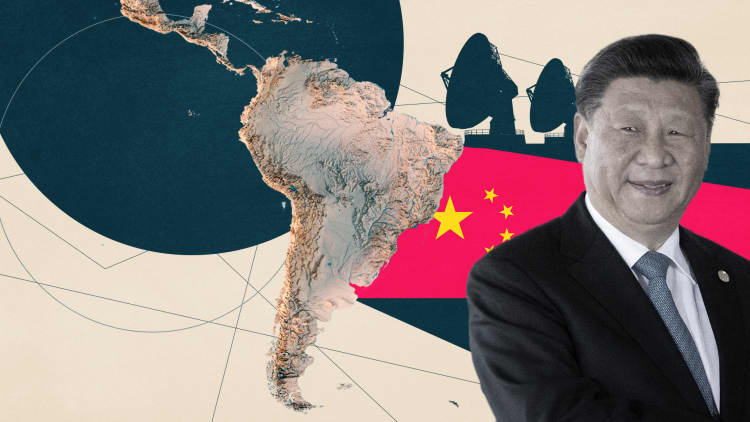
Why Chile is the latest LATAM country to be caught in a U.S.-China power struggle


View of the city of Santiago and the Andes Mountains, taken from the Metropolitan Park on July 2, 2024.

Rodrigo Arangua | Afp | Getty Images

Chile is the latest Latin American country to have become embroiled in a U.S.-China power struggle.

The country, which counts Washington as its top foreign investor and Beijing as its largest trading partner, is facing pressure from the White House over a subsea cable project with links to China.

In a surprise move, U.S. Secretary of State Marco Rubio said late last week that the Trump administration would impose visa restrictions on three Chilean officials tied to a digital cable project proposed by Chinese firms, alleging a security threat.

Chilean President Gabriel Boric, who will leave office on March 11, condemned the visa sanctions and rejected the notion that the country “promotes any action that threatens our security or that of the region.”

Chile’s outgoing left-wing government later said one of the sanctioned officials was the country’s Minister of Transport and Telecommunications Juan Carlos Muñoz, without commenting on the identities of the other two.

The U.S. ambassador to Chile, Brandon Judd, defended the visa restrictions on Monday, telling reporters that it is Washington’s “sovereign right to take actions when we feel that the region’s security is being threatened,” according to The Associated Press.

The spat comes just days before a Latin American leader’s summit in Miami, Florida — and two weeks before Chile’s incoming right-wing government takes over in Santiago.

Chile’s President-elect Jose Antonio Kast speaks to journalists after meeting with the Italian Prime Minister at Palazzo Chigi in Rome on Febuary 5, 2026.

Filippo Monteforte | Afp | Getty Images

It also represents a major test for José Antonio Kast‘s administration, following the right-wing candidate’s election victory late last year.

Analysts say U.S. President Donald Trump, who is seeking to counter China’s strategic influence in the region, is sending an unequivocal message to Latin American countries.

‘A calibrated warning’

The U.S.-Chile tensions were, above all, “a calibrated warning” to the Kast administration that strategic infrastructure decisions will be treated as geopolitical alignment choices — rather than neutral tenders, according to Mariano Machado, Americas principal analyst at risk intelligence company Verisk Maplecroft.

To be sure, digital undersea cables are the backbone of the world’s internet and telecommunications infrastructure, enabling everything from international phone calls to financial transactions. By some estimates, as much as 95% of international traffic passes through these largely unseen data super-highways.

A map of the world’s undersea communication cables.

CNBC | Jason Reginato

“The near-term external consequence is that Kast’s upcoming Washington engagements – chief among them, in the Shield of the Americas summit – will become early tests of how Chile balances partners under pressure,” Machado said.

“As US-China competition intensifies in the region, Chile’s ‘digital hub’ ambition becomes investable only if geopolitical concerns are addressed upfront, not retrofitted after a crisis,” he continued. “Winning deals will be those that lock in clear governance and credible security assurances early enough to preserve bankability.”

China’s embassy in Chile has reportedly accused Washington of “obvious contempt for the sovereignty, dignity, and national interests of Chile” following the Trump administration’s visa restrictions against Chilean officials.

China’s strategic and economic influence in Latin America is well established, although it is thought to be the target of Trump’s so-called “Donroe Doctrine” — a portmanteau of Donald Trump and the Monroe Doctrine, which refers to a 19th century foreign policy position that asserted Washington’s influence over the Western Hemisphere.

Why Chile is the latest LATAM country to be caught in a U.S.-China power struggle

In just the last few weeks, for example, Panama’s top court ruled against Hong Kong-based CK Hutchison, saying a concession held by a subsidiary of the firm to operate ports at either end of the Panama Canal was unconstitutional. The outcome was widely seen as a victory for Trump’s regional security ambitions.

The U.S. has also ratcheted up pressure on Cuba’s communist-run government, threatening to impose tariffs on any country that provides oil to Havana, and recently conducted an extraordinary military operation to depose Venezuelan President Nicolás Maduro.


Software stocks rebound as Anthropic announces new partnerships


Software stocks rebound as Anthropic announces new partnerships

Software stocks made a comeback on Tuesday after Anthropic hosted its enterprise agents event, where it revealed new partnerships, quelling some investor fears that the sector could be displaced by artificial intelligence.

The AI startup launched new updates to Claude Cowork that allow companies to integrate the productivity tool into a host of enterprise apps, such as Salesforce-owned Slack, Intuit, Docusign, LegalZoom, FactSet and Google‘s Gmail.

Organizations can also deploy customizable plugins across sectors like financial analysis, engineering and human resources, Anthropic said.

Salesforce shares jumped 4% following the Anthropic announcement while Docusign and LegalZoom each gained more than 2%. Thomson Reuters‘ stock surged more than 11% and FactSet shares rose nearly 6%.

Stock Chart IconStock chart icon

hide content

Salesforce, Docusign and Thomson Reuters one-day stock chart.

Analysts at Wedbush Securities said in a Tuesday research note that Anthropic’s event showed the competition risk to software from AI is “overblown.”

They argued that models aren’t capable of replacing entire workflows that remain “deeply embedded” in software infrastructure.

“The reality is that these new AI tools will not rip and replace existing software ecosystems and data environments with these AI tools only as useful as the data it can reach,” the analysts wrote.

Anthropic’s recent product rollouts have sent software and cybersecurity stocks tumbling in recent weeks as investors digested the looming threat of AI tools to those business models.

CrowdStrike closed largely flat Tuesday, but many of those stocks climbed higher. Okta and Cloudflare rose about 2%. Zscaler and Tenable each gained about 4% and SentinelOne climbed 3%.

IBM shares sold off heavily on Monday after Anthropic touted a tool that could automate aspects of a programming language run on IBM’s computers. IBM’s stock rebounded Tuesday, climbing more than 2%.

— CNBC’s Ashley Capoot and Kate Rooney contributed reporting to this story.