Mayo Clinic Experimental Dual-Drug Nanotherapy Crosses the Blood–Brain Barrier and Improved Survival in Preclinical Glioblastoma Models | Newswise


Newswise — JACKSONVILLE, Fla. — Mayo Clinic researchers developed an experimental nanotherapy that delivers two cancer drugs directly to brain tumors, according to a study published in Nature Communications Medicine. The strategy extended survival in preclinical models of glioblastoma, the most aggressive form of brain cancer.

The nanotechnology-based approach packages two existing cancer drugs into tiny particles engineered to cross the brain’s protective blood-brain barrier and target tumor cells. In preclinical models using patient-derived tissue, combining the treatment with radiation more than doubled survival compared with untreated controls.

Glioblastoma is notoriously difficult to treat. Patients typically survive for about 15 months after diagnosis, even with the latest therapies such as surgery, radiation and chemotherapy. One major challenge is that many drugs cannot effectively reach tumors in the brain, and those that do often lose effectiveness as tumors develop resistance.

The new approach uses small lipid-based particles, known as liposomes, to carry and deliver a combination of drugs — everolimus or rapamycin and vinorelbine — directly to cancer cells, using a new tumor-targeting strategy. By ensuring both drugs reach the same cells at the same time, researchers aim to improve tumor-killing effects while reducing the toxic side effects associated with higher drug doses.

“Glioblastoma remains extremely difficult to treat due to drug resistance and limited drug delivery to the brain,” says Debabrata (Dev) Mukhopadhyay, Ph.D., a professor of biochemistry and molecular biology at Mayo Clinic in Florida. Dr. Mukhopadhyay, a nanotechnologist, is a senior author of the study. “Our approach is designed to improve both by targeting the tumor directly and combining therapies in a way that enhances their impact.”

The drug combination includes agents that interfere with tumor growth pathways and disrupt the cancer’s ability to repair DNA damage, making tumors more sensitive to radiation.

“This represents a promising direction for treating patients with glioblastoma and advancing new technologies and therapies, so we can one day improve the survival of patients with brain cancer by delivering novel cancer therapies to the brain,” says Alfredo Quinones-Hiñojosa, M.D., dean of research emeritus and chair emeritus of the Department of Neurosurgery at Mayo Clinic in Florida and a senior author on the study. “Further research will be needed to determine whether these results translate to patients.”

Researchers are conducting additional safety and dosing studies required before clinical trials can begin. If successful, the approach could eventually be an oral or intravenous medication used alongside standard treatments or as an option for patients whose tumors do not respond to existing therapies.

“While this work is still in development, it represents an important step toward developing more precise cancer treatments that are both more effective and less toxic, potentially improving quality of life for patients,” says Dr. Mukhopadhyay.

This study was supported in part by the National Institutes of Neurologic Disorders and Stroke of the National Institutes of Health under award number R01NS129671. Read the study for a full list of authors, disclosures and funding.

About Mayo Clinic

Mayo Clinic is a nonprofit organization committed to innovation in clinical practice, education and research, and providing compassion, expertise and answers to everyone who needs healing. Visit the Mayo Clinic News Network for additional Mayo Clinic news.

About Mayo Clinic Comprehensive Cancer Center

Designated as a comprehensive cancer center by the National Cancer Institute, Mayo Clinic Comprehensive Cancer Center is defining the cancer center of the future, focused on delivering the world’s most exceptional patient-centered cancer care for everyone. At Mayo Clinic Comprehensive Cancer Center, a culture of innovation and collaboration is driving research breakthroughs in cancer detection, prevention and treatment to change lives.

Media contact:


33% of Canadian women wait more than 2 years for menopause care: survey – National | Globalnews.ca


A new GreenShield survey conducted by Ipsos has found that 33 per cent of Canadian women “wait more than two years for effective menopause care.”

33% of Canadian women wait more than 2 years for menopause care: survey – National | Globalnews.ca

The survey states that this is due to “a complex series of barriers ranging from confusion over symptoms and dismissed concerns to not knowing where to turn for help.”

“Women generally understand what perimenopause and menopause are, yet this awareness coexists with a substantial and disruptive symptom burden, and relief can take months or years to find.”

According to the Menopause Foundation of Canada’s 2022 research report, 46 per cent of Canadian women “feel unprepared for this stage of life and, in a world where no topic is off limits, more than half (54%) believe menopause is still a taboo subject.”

The Ipsos survey found that although 40 per cent of surveyed women consult a general practitioner, 39 per cent say they, “didn’t know where to go,” to receive supports and care.

Story continues below advertisement


Click to play video: 'Women’s Health: Perimenopause, menopause and mental health'


Women’s Health: Perimenopause, menopause and mental health


Twenty-nine per cent of surveyed women believe symptoms “are normal and not treatable,” while 26 per cent “not recognizing symptoms as being part of a hormonal transition,” although this number lowers in Quebec at 23 per cent.

Receive the latest medical news and health information delivered to you every Sunday.

Get weekly health news

Receive the latest medical news and health information delivered to you every Sunday.

Nineteen per cent of women also reported “uncertainty about where to seek help,” while 21 per cent reported having their symptoms dismissed.

This resulted in many women “shoulder[ing] the burden themselves,” with 55 per cent “research[ing] symptoms online, and 18 per cent repeatedly book appointments.”

Story continues below advertisement

Even when identifying symptoms, only 25 per cent of surveyed women received “effective treatment within the first three months.”

Symptoms impacting work schedules


The survey states that the most common symptoms, fatigue (74 per cent), hot flashes (68 per cent), mood swings (65 per cent), weight gain (58 per cent), and brain fog (53 per cent), “demonstrate the extent to which menopause affects day to day functioning.”

As a result, many women state that “their symptoms directly affect their work performance.”

Surveyed women also stated that these symptoms result in reduced productivity (16 per cent), needing time off (eight per cent), needing to take a short-term leave (six per cent), or considering leaving their job due to their symptoms (six per cent).

Sixty-four per cent of women say symptoms affect them at least some of the time and is lower among Quebec residents at 61 per cent.

Story continues below advertisement


Click to play video: 'Tools to navigate menopause'


Tools to navigate menopause


Fifty-five per cent of surveyed women say their employer provides “no support,” with just 13 per cent reporting “meaningful supports from their employer,” while seven per cent say “supports exist but fall short.” Twenty-four per cent are unsure.

On Feb. 26, 2026, Quebec Liberal MNA Jennifer Maccarone briefly halted a parliamentary commission to say she was experiencing symptoms of menopause, telling colleagues in French that she was having a hot flash and noting that menopause can happen even during legislative work.

“It’s like somebody turning the furnace on to 120 degrees and it’s distracting,” Maccarone later told Global News in an interview, describing the sensation.

“We should talk about this openly.”

&copy 2026 Global News, a division of Corus Entertainment Inc.


Billy Hudson named 2026 Ellis Island Medal of Honor recipient | Newswise


Newswise — Billy Hudson, PhD, director of the Vanderbilt Center for Matrix Biology and the Elliott V. Newman Professor of Medicine, is receiving the Ellis Island Medal of Honor in 2026, following a unanimous decision by Ellis Island Honors Society (EIHS) Chairman Nasser J. Kazeminy and the EIHS Board of Directors.

A native of rural Grapevine, Arkansas, Hudson joins the ranks of several U.S. presidents, Nobel laureates and influential leaders, including former President Bill Clinton and country music singer Glen Campbell, as people from Arkansas to receive the honor. Naji Abumrad, MD, a 2004 medalist, is also a Vanderbilt recipient.

Hudson was nominated by 2022 medalist Igor Babailov, Hon.RAA, KStA, the world-renowned portrait artist who has been affiliated with the Hudson family and the Aspirnaut STEM Pipeline, founded to increase opportunities in science for talented youth from rural and diverse backgrounds, for more than a decade.

EIHS Chairman Kazeminy said Hudson was selected in recognition of his pioneering contributions to matrix biology and transformative discoveries in type IV collagen research, which have fundamentally advanced the understanding of kidney disease, including Alport syndrome, Goodpasture’s disease and diabetic kidney disease.

His decades of scientific leadership, groundbreaking structural insights into basement membrane biology, and successful translation of research into therapeutic innovation have shaped modern biomedical science, Kazeminy said. Equally inspiring was Hudson’s dedication to expanding opportunity in science, technology, engineering and mathematics (STEM) through initiatives such as the Aspirnaut STEM Pipeline, reflecting a commitment not only to discovery, but to developing the next generation of scientific leaders.


“Dr. Hudson’s personal and professional journey serves an inspiration to many. Selection for this prestigious honor is fitting given his substantial contributions to the field of science and for the numerous young lives he and his wife, Julie, continue to impact through the Aspirnaut program. I want to offer my sincere congratulations to Billy for achieving this distinguished award,” said Jeff Balser, MD, PhD, President and Chief Executive Officer of Vanderbilt Health and Dean of Vanderbilt University School of Medicine.

Hudson is accepting the award on behalf of his wife, Julie Hudson, MD, brother Johnny Hudson and sister Ann Kincl, who are co-founders of the Aspirnaut STEM Pipeline; his 13 high school classmates who helped implement the pipeline; and the nearly 400 high school and undergraduate students who have participated in the pipeline over the past two decades.

“I am so very excited and humbled to be selected for the Ellis Island Medal of Honor. My journey from poverty and childhood abuse, which led to me dropping out of high school, to becoming a scientist, and now a medalist, is like being in ‘The Twilight Zone,’ where an ordinary person encounters extraordinary circumstances,” Hudson said.

“My mentors provided educational opportunities that enabled me to overcome my childhood challenges and establish the Aspirnaut Pipeline to help youth achieve their dreams. Education fuels hope and opportunity for a better tomorrow for all people, especially those who come from disadvantaged backgrounds,” he said.

Founded in 1986 by EIHS, the honor is presented annually to individuals who have demonstrated “outstanding commitment to serving our nation either professionally, culturally or civically” and “reflect a proud commitment to our nation’s ideals of diversity, opportunity and service,” according to the organization.

“Dr. Hudson’s selection is a testament to a lifetime devoted to excellence, integrity and meaningful impact. His pioneering contributions and steadfast commitment to advancing knowledge embody the very spirit of the Ellis Island Medal of Honor,” EIHS Chairman Kazeminy said. “We are proud to celebrate his accomplishments and extend our heartfelt congratulations on this well-deserved recognition,” he said.

EIHS has honored distinguished and diverse Americans including eight U.S. presidents; Nobel laureates Elie Wiesel and Malala Yousufzai; Generals Norman Schwarzkopf and Colin Powell; Justice Sandra Day O’Connor; Secretaries of State Madeleine Albright, Condoleezza Rice and Hillary Clinton; Bob Hope; Muhammad Ali; Frank Sinatra; Rosa Parks; Mike Wallace; and Rita Moreno.

The 2025 medalists included Her Majesty Queen Silvia of Sweden; Pfizer Chairman and CEO, Dr. Albert Bourla; Co-Founder of Moderna, Robert Langer; and Nobel Prize-Winning Physicist, Steven Chu.

The Ellis Island Medals of Honor ranks among the nation’s most renowned awards, officially recognized by the U.S. Senate and House of Representatives, with each year’s recipients listed in the Congressional Record.

A total of 94 Americans will be honored in 2026 for their contributions in philanthropy, humanitarian advocacy, technological and medical innovation, and professional achievements.

From visionaries in the business and scientific fields, and members of the local, state and federal government, to philanthropists and influencers in the entertainment and sports industry, each medalist has embraced their personal immigrant history and recognizes the role that uniquely American opportunities played in helping them reach their goals.

“These individuals stand as beacons of resilience, embodying the timeless values of courage, compassion and dedication,” Kazeminy said. “Their diverse backgrounds and remarkable accomplishments serve as a testament to the power of unity and the boundless potential of the human spirit. As we recognize their indelible contributions, let us reaffirm our commitment to fostering inclusivity, understanding and goodwill across all borders.”

The full list of this year’s recipients will be announced in early March, and the medal ceremony will take place Saturday, May 16, during a black-tie gala held in Ellis Island’s Great Hall, which served as the gateway for 12 million immigrants to the U.S.

EIHS is a 501(c)(3) nonprofit, which, in addition to presenting the Ellis Island Medals of Honor, is a humanitarian organization supporting educational opportunities for students with immigrant heritage and preserving the Ellis Island National Monument.

For more details on the event and a complete list of honorees, please visit EIHS official site.


Fentanyl or Phony? Machine Learning Algorithm Learns to Pick Out Opioid Signatures | Newswise


Newswise — New forms of fentanyl are created every day. For law enforcement, that poses a challenge: how do you identify a chemical you’ve never seen before?

Researchers at Lawrence Livermore National Laboratory (LLNL) aim to answer that question with a machine learning model that can distinguish opioids from other chemicals with an accuracy over 95% in a laboratory setting. The foundation for this new technique was published in Analytical Methods.

To identify synthetic opioids like fentanyl now, chemists try to match their signature to a library of a few hundred known samples. But studies suggest there could be thousands of unknown forms, some more dangerous than others. Recognizing those new versions requires a reference-free identification system: a way to catch an opioid even if it does not exist in a chemical database yet.

“When law enforcement finds a new clandestine drug operation, those labs often produce never-before-seen fentanyl derivatives. We can’t just go check a database, and we can’t just go back to who made it and ask how they did it,” said LLNL computational mathematician and author Colin Ponce. “And law enforcement needs to identify the samples they find quickly because there’s going to be another sample tomorrow. I think that’s a little bit of a unique situation.”

Machine learning might seem like a natural fit to identify novel or unknown opioids. And it is — to an extent. The method works best with large data sets, which are difficult to generate for toxic substances like synthetic opioids. 

To even get a machine learning algorithm off the ground, the team had to create the chemical data. They did so with LLNL’s mass spectrometry capabilities coupled to an autosampler, which enabled them to measure hundreds of samples under the same experimental conditions. This minimized variables for the machine learning algorithms. 

“In the world of AI, data is gold, and if you don’t have good data, then you’re not going to generate accurate machine learning models,” said LLNL chemist and author Carolyn Fisher. “Good data is something that we can control and generate at LLNL.” 

With that data in hand, they tried different machine learning techniques as they homed in on the best method: a random forest model. 

“When a model like this eventually gets into the hands of a user, the output has to be interpretable and trustworthy,” said LLNL scientist and author Kourosh Arasteh. “We explored machine learning methods ranging from simple regression and random forests to more complex neural network approaches to balance interpretability with performance.” 

The random forest approach runs through a collection of decision trees. Each tree asks a series of questions about the data and, based on each answer, lands on a prediction: opioid or not. Together, they vote on the final classification.

“Our 650 samples are not the same as having 300,000 samples. On the machine learning side, we needed to make sure that we were designing techniques that that were appropriate for that kind of scale,” said Ponce.

This study trained and tested the algorithm with analytically pure samples. These ideal chemicals contain no contaminants or impurities.

“The challenge is that nothing is analytically pure in the real world,” said Fisher. “The next step is to add in background noise and have the AI understand what it should care about during a classification task.”

Fisher and Ponce emphasized that this work would have been impossible without collaboration across the disciplines of data science and chemistry. The two are friends outside of work, and this study, a Laboratory Directed Research and Development project, emerged from a series of organic conversations between them.

“To me, this project really captures what LLNL does best,” said fellow author and LLNL software engineer Steven Magana-Zook. “When you get chemists and data scientists working side by side, you end up with results that neither group could get on their own. That kind of cross-disciplinary work is exactly what makes this place so strong.”

That approach, while essential to the work, initially proved to be an obstacle. The team faced rejection of this manuscript from two journals — reviewers in chemistry didn’t fully grasp the machine learning aspects and experts on the computational side felt uncertain about the chemistry.

“I don’t think people talk about failure enough. It’s so common in science. We fail so much more than we succeed,” said Fisher. “But we keep iterating and improving. I’m proud of our resilience.” 

The team’s persistence paid off. Looking ahead, they aim to further develop their algorithm using real-world samples with higher background signals. 

Other LLNL coauthors include Roald Leif, Alex Vu, Mark Dreyer, Brian Mayer and Audrey Williams.


New Computer Simulation Could Light the Way to Safer Cannabinoid-Based Pharmaceuticals | Newswise


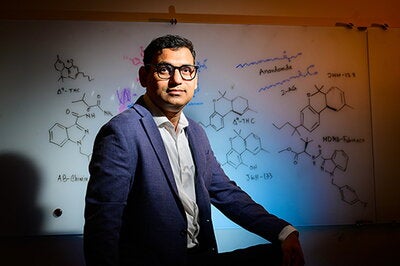
Newswise — New psychoactive substances, originally developed as potential analgesics but abandoned due to adverse side effects, may still have pharmaceutical value if researchers could nail down the causes of those side effects. A new study from the University of Illinois Urbana-Champaign used deep learning and large-scale computer simulations to identify structural differences in synthetic cannabinoid molecules that cause them to bind to human brain receptors differently from classical cannabinoids.

“The largest class of NPS are often sold as the street drugs Fubinaca, Chimica and Pinaca,” said chemical and biomolecular engineering professor Diwakar Shukla. “In addition to the adverse side effects, the formulas used to produce NPS vary, making them challenging to detect in standard drug screenings.”

New psychoactive substances are synthetic compounds; one class mimics the effects of classical cannabinoids. However, the study found that NPS tend to activate distinct signaling pathways in the human brain compared to classical cannabinoids. Specifically, they often trigger what’s called the “beta arrestin pathway” rather than the “G protein pathway.” This switch in signaling can lead to more severe psychological effects.

The study’s findings are published in the journal eLife.

“New psychoactive substances bind very strongly to cannabinoid receptors in the brain and are slow to unbind, making them difficult to observe and simulate in standard laboratory or computer experiments,” Shukla said. “It can take a huge amount of computer time to see these rare binding and unbinding events.”

In the lab, graduate student Soumajit Dutta used a new simulation approach, the Transition-Based Reweighting Method, to estimate the thermodynamics and kinetics of slow molecular processes. The team found that TRAM can also be used to observe the rare, slow molecular processes involved in the unbinding of NPS from cannabinoid receptors — by efficiently sampling these events that would otherwise require massive computing resources.

The researchers also used the Folding@Home platform, which enables millions of volunteers worldwide to donate computing power. This approach allowed the team to run many simulations in parallel, stitching the results together and using algorithms to decide which simulations to run next. It allows for the study of very long or rare events that would be nearly impossible with a single computer or a small cluster.

Together, these methods allowed the researchers to uncover new physical insights into how NPS interact with receptors — insights that were previously out of reach due to computational limitations — pointing the way toward the design of safer cannabinoid-based drugs that could avoid harmful side effects.

By revealing the NPS signal via pathways associated with more adverse effects, researchers can now focus on designing new molecules that avoid triggering these pathways for medical use. Shukla said their findings could direct more researchers to aim for compounds that bind less tightly or unbind more readily, potentially reducing the drugs’ harm.

The National Institutes of Health award R35GM-142745 and the National Science Foundation supported this research. Shukla is also affiliated with chemistry, bioengineering, the National Center for Supercomputing Applications, the Center for Digital Agriculture and the Carl R. Woese Institute for Genomic Biology.

Original release: