A fragile U.S.-Iran ceasefire sparks market relief — but no clear path to lasting peace


WASHINGTON, DC – APRIL 06: U.S. President Donald Trump speaks alongside Central Intelligence Agency Director John Ratcliffe (L) and U.S. Secretary of War Pete Hegseth (R) during a news conference in James S. Brady Press Briefing Room of the White House on April 06, 2026 in Washington, DC.

Alex Wong | Getty Images News | Getty Images

A temporary U.S.-Iran ceasefire sparked a broad relief rally across assets on Wednesday, but experts warned that any deal concerning lasting peace will be complicated by a major trust deficit.

The ceasefire came following hastened diplomatic efforts led by Pakistan and just hours before Trump’s threatened deadline for wiping out the entire Iranian civilization, briefly pulling the region back from the brink of a massive military bombardment.

Oil prices cooled to below $100 per barrel following the ceasefire announcement, but remain far above the pre-war levels of around $70 per barrel.

While U.S. President Donald Trump said the two-week ceasefire was contingent on the “complete, immediate, and safe opening” of the Strait of Hormuz, Iranian officials stated that safe passage through the strait would be “possible,” subject to coordination with its armed forces and “technical limitations” — caveats that may give Iran some room to define compliance on its own terms.

“This is a problem that could derail the ceasefire later this year,” said Matt Gertken, chief geopolitical strategist at BCA Research, warning that the coordination requirement remains a risky ambiguity in both sides’ statements so far.

Trump may temporarily accept Iran as a gatekeeper — with U.S. midterm elections approaching and gasoline prices sharply higher than before the war — but after the election, the U.S. national security establishment will start to demand a more permanent solution,” said Gertken. “Fighting will ignite later this year, if not later this month.”

A protester waves an Iranian flag and shouts slogans during a demonstration against US military action in Iran near the White House in Washington, DC, on April 7, 2026.

Mandel Ngan | Afp | Getty Images

Tehran also said that its armed forces will cease defensive operations if attacks against Iran are halted. After the ceasefire came into effect at 8 p.m. ET Tuesday, missiles were still launched from Iran towards Israel and several Gulf states.

The reprieve on Tuesday would allow some time for the two sides to reach a longer agreement to end the six-week-old war, which has killed thousands of people and sparked a global energy crisis, with their delegations expected to meet in Islamabad on Friday.

Iran is reportedly finalizing a joint maritime protocol with Oman to institutionalize coordinated management of tanker traffic through the strait, which could embed Iranian authority over the crucial energy artery into a standing bilateral agreement.

Fragile truce

The ceasefire, holding together a group of parties with sharply diverging interests, also leaves questions open over whether resumed peace talks will yield meaningful results without renewing tensions.

Pratibha Thaker, regional director, Africa and the Middle East at the Economist Intelligence Unit, described the ceasefire agreement as “a huge relief” but warned that a significant lack of trust on both sides will complicate upcoming negotiations.

“What are we are seeing right now, I would really like to stress is a pause in the conflict, rather than any kind of lasting resolution,” Thaker told CNBC’s “Europe Early Edition” on Wednesday.

“But, and this is a big but, it is a very fragile arrangement. The ceasefire hinges on Iran suspending its military activity [and] fully reopening the Strait of Hormuz to commercial shipping,” Thaker said.

“Crucially, there is a deep trust deficit on both sides. From Washington’s perspective, longstanding concerns over Iran’s nuclear program. From Tehran’s side, deep skepticisim about U.S. intentions, especially given past withdrawals from agreements and continued military presence and pressure as well.”

A fragile U.S.-Iran ceasefire sparks market relief — but no clear path to lasting peace

Israel agreed to suspend strikes but urged Washington to press for deeper Iranian concessions, including the surrender of enriched uranium stockpiles. In its 10-point terms, Iran requested Washington to accept its uranium enrichment program and the lifting of all sanctions.

The ceasefire will likely hold in the near term, given the economic costs accruing to the global economy from six weeks of conflict, said Michael Langham, emerging markets economist at Aberdeen Investments. “Parties with vested interest in stopping the conflict and reopening the strait will double down on efforts to find a compromise,” he said.

If the truce holds and the strait reopens, the global economic damage should prove manageable, Langham added. Central banks could broadly resume their pre-conflict paths — and attention may shift from inflation to growth, if commodity prices normalize quickly, he added.

The market calculation

The ceasefire sparked a relief rally in markets amid repricing for a de-escalation in the conflict, but investors will watch for something more durable than a two-week pause, Geoff Yu, senior market strategist at BNY, said on CNBC’s “Squawk Box Asia” on Wednesday.

“What the market is going to start pricing ahead is a first step towards further de-escalation and perhaps something more permanent,” he said, flagging that the disruption has extended beyond crude oil to commodities such as helium, critical to semiconductor manufacturers in South Korea and Taiwan.

Stocks surged across regions, with Asian benchmarks and U.S. futures climbing, amid rising optimism for a potential turning point in a conflict that has rattled markets for weeks.

An Indian Oil Corp. gas station in Noida, Uttar Pradesh, India, on Wednesday, April 8, 2026.

Bloomberg | Bloomberg | Getty Images

Josh Rubin, portfolio manager at Thornburg Investments, cautioned against reading the early market reaction as a definitive verdict. “There’s still low visibility [and] limited predictability” on whether the truce will hold, Rubin said, warning that tail risks remain if the strait remains closed for another two to four months.

Energy and commodity markets are likely to remain on a structurally higher floor regardless of the ceasefire outcome, said BCA Research’s Gertken, as governments hoard and restock in anticipation of renewed conflict, keeping oil and gas prices elevated well above pre-war levels even in a scenario where shipping resumes.

‘A wake-up call for everybody’

Mehran Kamrava, professor of government at Georgetown University of Qatar, said the two-week ceasefire shows that there is “tremendous willpower” from both Washington and Tehran to bring this war to an end.

“Probably the one party that did not want the war to end is Israel and we see that Israel has refused to say that this ceasefire applies to Lebanon. So yes, I think the ceasefire will hold because neither the Trump administration nor the Iranians really want this war to continue,” Kamrava told CNBC’s “Squawk Box Europe” on Wednesday.

'Tremendous' willpower to end Iran war: professor

When asked how the last 24 to 48 hours may have influenced the way the U.S. is viewed by its allies and adversaries across the globe, Kamrava said the world had been “put on notice” by some of Trump’s comments.

“One of the things we have seen here in the region is that close alliance with the United States does not necessarily bring you security. If anything, it creates adversaries and it creates problems,” Kamrava said.

“So, what we have seen in the past 48 to 24 hours, particularly given President Trump’s extremely incendiary and violent language on social media is kind of a wake up call for everybody, both allies and adversaries, that this is a very unreliable and really unpredictable actor in the White House,” he added.

Choose CNBC as your preferred source on Google and never miss a moment from the most trusted name in business news.


Trump signals possible delay to Beijing summit as U.S. pressures China to help reopen Strait of Hormuz


U.S. President Donald Trump prepares to greet Chinese President Xi Jinping ahead of a bilateral meeting at Gimhae Air Base on October 30, 2025 in Busan, South Korea.

Andrew Harnik | Getty Images

U.S. President Donald Trump said his planned trip to China later this month could be delayed as Washington sought to pressure Beijing to help reopen the Strait of Hormuz, underscoring a renewed flashpoint in an already fragile bilateral relationship.

In an interview with the Financial Times on Sunday, Trump said he expected China to help unblock the strait before he travels to Beijing for a summit with Chinese leader Xi Jinping, which had been scheduled for March 31 to April 2.

Trump added that the two weeks to the meeting were a “long time” and that Washington wanted clarity before then. “We may delay,” Trump told the FT, without elaborating on timing.

The remarks came as Treasury Secretary Scott Bessent met his Chinese counterpart He Lifeng in Paris for talks about the planned summit. Beijing has yet to confirm the dates and typically announces such plans closer to their scheduled start.

The visit would be the first for a U.S. president since Trump’s last trip during his first term in 2017. It also comes five months after the two leaders met in the South Korean city of Busan, where they agreed to a one-year truce in a trade war that had seen tit-for-tat tariffs briefly soar to triple-digit levels last year.

Chinese top diplomat Wang Yi said earlier this month that the agenda for the exchange was already “on the table.”

Trump said Sunday aboard Air Force One that China sourced about 90% of its oil through the strait, framing Beijing’s cooperation on Hormuz as a matter of self-interest. The president has appealed to several European and Asian countries, including China, to help open up the chokepoint through which roughly one-fifth of the world’s daily oil supply passes.

However, the numbers suggest Beijing may be more insulated from the closure than Trump’s comments implied.

China has spent the past two decades diversifying its energy sources and building strategic reserves to cushion the blow of any prolonged disruption.

Seaborne oil imports through the strait now account for less than half of China’s total oil shipments, according to Rush Doshi, director of the China Strategy Initiative at the Council on Foreign Relations. Nomura also estimated that oil flows through Hormuz represent just 6.6% of China’s total energy consumption.

Satellite imagery tracked by maritime research firms showed that Iran has continued to ship large amounts of crude oil to China since the war broke out late last month.

Both sides appeared to increase pressure ahead of the high-stakes summit in Beijing. The U.S. launched trade investigations into a broad swath of countries over alleged excess capacity and failures to address forced labour.

In a statement Monday, China’s commerce ministry said the Trump administration had “once again abused the Section 301 investigation process to override domestic law over international rules,” calling the probes “extremely unilateral, arbitrary and discriminatory.”

Beijing said it had formally lodged representations with Washington against the investigations. “We urge the U.S. side to immediately correct its wrong practices and meet China halfway,” a ministry spokesperson said, calling for dialogue and negotiated solutions.

The ministry said it would monitor the progress of the investigations closely and take unspecified measures to defend China’s interests.

— CNBC’s Evelyn Cheng contributed to this report.

Choose CNBC as your preferred source on Google and never miss a moment from the most trusted name in business news.


Price caps, taking the stairs, and short-sleeved shirts: How countries are coping with the Iran war energy shock


A fuel nozzle is inserted into a combustion engine at a petrol pump at a filling station during a refueling process.

Picture Alliance | Picture Alliance | Getty Images

Countries around the world have scrambled to cope with the fallout of the energy shock from the Iran war, imposing measures from fuel export bans, loosening refining standards, and even getting workers to climb stairs instead of taking elevators.

This comes as the Iran war stretches into its third week, and despite U.S. President Donald Trump proclaiming that the U.S. has “won,” the effects of the war, especially on the energy market, continue to be felt.

From the serious…

Naturally, some nationwide measures include trying to have as much fuel in country, so as to avoid having to rely on imported fuel.

On Thursday, China ordered refiners to stop refined fuel exports so as to mitigate potential domestic fuel shortages, according to Reuters.

Sources told the agency that the ban was issued by the National Development and Reform Commission, and includes shipments of gasoline, diesel and aviation fuel.

CNBC attempted to reach the NDRC for comment, but did not receive an immediate reply.

Other major countries are considering or have imposed price caps for fuel products.

On Monday, Japanese Prime Minister Sanae Takaichi said that Tokyo was considering steps ‌to cushion the economic blow from rising fuel costs, including curbing gasoline prices.

Takaichi was quoted by Japanese media on Thursday as saying she plans to cap pump prices at an average of 170 yen ($1.07) per liter nationwide, adding that gasoline prices could potentially hit 200 yen per liter.

Tokyo also conducted a unilateral release of crude from its own stockpiles, without waiting for coordination with other nations.

Japan has been particularly badly hit by the war in Iran, as the world’s third-largest economy needs to import almost all of its energy needs.

South Korean President Lee Jae Myung said on Friday the government implemented a petroleum price ceiling.

“We have decided to set a clear price cap on supply prices to curb domestic fuel prices, which are fluctuating wildly due to the unstable international situation,” Lee said.

India also had to make some tough choices. The country told oil refineries to prioritize supplying liquified petroleum gas to the 330 million households that use it as a primary cooking fuel, over 3 million businesses that use commercial LPG cylinders.

… to the quirky

While some countries have tried to secure alternative energy supplies to keep their lights on, others have focused on reducing demand on their grids.

Work-from-home orders came back in some countries after years of companies trying to coax workers back to offices after the pandemic, with Vietnam and Thailand reportedly getting employees to work remotely.

Thailand went a step further, ordering civil servants to take the stairs instead of elevators, reducing their reliance on air conditioning and telling government employees to wear short-sleeved shirts rather than suits.

The Philippines and Pakistan both instituted four-day work weeks for government workers, and Bangladesh has even shifted its calendar, bringing forward its Eid-al-fitr holiday, allowing universities to close early in a bid to save fuel.

Choose CNBC as your preferred source on Google and never miss a moment from the most trusted name in business news.


U.S. ‘misadventure’ in Iran has no clear exit strategy, Russia’s UK ambassador says


Ambassador of the Russian Federation to the UK Andrei Kelin during an interview with PA at the official residence of the Russian Ambassador in London. Picture date: Monday February 21, 2022.

Aaron Chown – Pa Images | Pa Images | Getty Images

The U.S.-Israeli war on Iran is a “misadventure” whose goals and exit strategy remain unclear, Russia’s ambassador to the U.K. told CNBC.

Andrey Kelin said Russia has “a lot of sympathy” with Tehran and said “the best end” to the escalating Middle East war is for it to “show only that they are senseless.”

“We still are trying to understand, what are the goals of President Trump in this campaign. You know that lots of doubts have been expressed about the exit strategy that the American administration can have in this endeavour,” Kelin told CNBC’s Steve Sedgwick in an interview recorded on Thursday.

Russian President Vladimir Putin sent a message to Iran’s new supreme leader, Mojtaba Khamenei, earlier this week, offering his “unwavering support” to Tehran and saying the country “has been and will remain the Islamic Republic’s reliable partner.”

U.S. ‘misadventure’ in Iran has no clear exit strategy, Russia’s UK ambassador says

The war has been raging for two weeks, with heavy strikes reported across Iran’s capital city and shipping traffic through the strategically vital Strait of Hormuz severely disrupted.

The White House has said the objectives of Operation Epic Fury have been to destroy Iran’s ballistic missile arsenal and production capacity and its navy, sever its support for proxies in other countries and ensure Iran can never acquire a nuclear weapon.

The White House said on Thursday these objectives “have remained unchanged unambiguous, and consistent” since the operation began on Feb. 28.

“We have a lot of sympathy with Iran. We have a lot of sympathy as well with the Persian Gulf states, there is no doubt at all. As for the beginning, I cannot understand the position of when everybody is blaming Iran,” Kelin said.

“[The] crisis has started with the, as I have said, with Israel and U.S. aggression against Iran and it was in the middle of talks, of course,” he continued, referring to negotiations over Iran’s nuclear program held in the Swiss city of Geneva last month.

In this pool photograph distributed by the Russian state agency Sputnik, Russia’s President Vladimir Putin attends a meeting with Iranian President in Ashgabat on December 12, 2025.

Alexander Kazakov | Afp | Getty Images

“My president discussed this issue with the president of the United States, and we can make a good contribution by the way to finish it, to wrap it up.”

CNBC has contacted a spokesperson at the White House and Israel’s Foreign Ministry and is awaiting a response.

‘A strategic partnership’

Funerals are held for members of Iran’s Revolutionary Guards Corps (IRGC) and other military figures at Enghelab Square on March 11, 2026 in Tehran, Iran.

Majid Saeedi | Getty Images News | Getty Images

U.K. Defense Secretary John Healy told reporters on Thursday that Putin’s “hidden hand” appears to be behind Iran’s military playbook as well as potentially some of Tehran’s military capabilities.

Iran has reportedly fired off more than 2,000 Shahed drones across the Middle East since the war began. These drones, which were first designed in Iran, have been used extensively during Russia’s invasion of Ukraine.

Diplomatic solution on Ukraine is ‘badly needed’

A report from the Center for Strategic and International Studies published in January said Russian battlefield casualties are significantly greater than Ukrainian fatalities, with Ukrainian forces likely suffering somewhere between 500,000 and 600,000 casualties.

Kelin said he was sure that both Moscow and Kyiv would eventually agree to a diplomatic resolution to the war.

“I cannot say when it is going to happen, but a diplomatic solution is badly needed,” Kelin said.

Kelin said The U.S. was “playing a constructive role in this diplomatic effort,” but added: “Since Ukraine is not prepared at the moment and since Europe still prefer to back up Ukraine as much as possible, to supply it with weapons, with money … making no efforts to solicit or to help this diplomatic solution, this will last for some time.”

U.S-brokered talks on the Ukraine war have been put on hold due to the Iran conflict, with U.S. Special Envoy Steve Witkoff telling CNBC on Tuesday that the discussions would now likely take place next week. Ukraine’s Zelenskyy had urged the U.S. not to remove sanctions on Russia ahead of those talks, although the White House has since moved to temporarily lift sanctions on Russian crude at sea.

A Shahed-136 drone is displayed at a rally in western Tehran, Iran, on February 11, 2026.

Nurphoto | Nurphoto | Getty Images

The European Union’s foreign policy chief, Kaja Kallas, recently said there appears to be “no end in sight” to Russia’s full-scale invasion of Ukraine.

Speaking at a news conference on Monday, she said it is clear Russia’s army was “bogged down” and its economy is in steep decline.

“Russia’s maximalist demands cannot be met with a minimalist response,” Kallas said. “It’s just common sense, if Ukraine’s military is to be limited in size, Russia’s should be too.”

Choose CNBC as your preferred source on Google and never miss a moment from the most trusted name in business news.


U.S. launches fresh Section 301 probes into 60 economies over forced-labor trade practices


Scott Bessent, US treasury secretary, speaks during a Senate Banking, Housing, and Urban Affairs Committee hearing in Washington, DC, US, on Thursday, Feb. 5, 2026.

Kent Nishimura | Bloomberg | Getty Images

The U.S. on Thursday launched new trade investigations into 60 economies to determine whether they failed to curb imports of goods made with forced labor.

The probes, conducted under Section 301(b) of the Trade Act of 1974, include China, the European Union, India and Mexico, according to a statement from the United States Trade Representative.

“Despite the international consensus against forced labor, governments have failed to impose and effectively enforce measures banning goods produced with forced labor from entering their markets,” U.S. Trade Representative Jamieson Greer said.

“These investigations will determine whether foreign governments have taken sufficient steps to prohibit the importation of goods produced with forced labor and how the failure to eradicate these abhorrent practices impacts U.S. workers and businesses,” he said.  

Section 301 permits the U.S. to impose tariffs on countries found to have engaged in unfair trade practices without congressional authorization — legal authority that Trump had used during his first term to levy duties on Chinese goods.

The new investigations could ultimately replace at least some of the reciprocal tariffs that the Supreme Court struck down last month.

The forced-labor probes follow Section 301 investigations launched on Wednesday, targeting excess industrial capacity across more than a dozen economies that also included China, the EU and Mexico.

The investigation come as Treasury Secretary Scott Bessent is expected to meet with his Chinese counterpart He Lifeng in Paris this weekend to continue bilateral trade and economic talks, and weeks ahead of a meeting between U.S. President Donald Trump and his Chinese counterpart Xi Jinping.

Choose CNBC as your preferred source on Google and never miss a moment from the most trusted name in business news.


Emmanuel Macron spelled out a pivot in France’s nuclear strategy. Here’s why it’s so significant


France’s President Emmanuel Macron delivers a speech next to nuclear-powered ballistic missile submarine (SSBN) submarine “Le Temeraire” – S617 during his visit to the Nuclear Submarine Navy Base of Ile Longue in Crozon, north-western France on March 2, 2026. (Photo by Yoan VALAT / POOL / AFP via Getty Images)

Yoan Valat | Afp | Getty Images

“To be free, one must be feared. To be feared, one must be powerful,” French President Emmanuel Macron said during a landmark speech this week on nuclear deterrence.

France is one of only two nuclear powers in Europe and, unlike the U.K., operates a nuclear weapons system entirely independent of the U.S.

As the U.S. and Israel continued to strike Iran, and European leaders appeared divided and sidelined as they scrambled to react, Macron delivered a speech on Monday that was “the most significant update to French nuclear deterrence policy in 30 years,” Bruno Tertrais, deputy director of the Foundation for Strategic Research, said in a thread on X.

Speaking from a naval base in Brittany in front of a submarine, “Le Téméraire,” Macron’s 45-minute speech laid out what he called a new “forward deterrence” doctrine for France.

Macron said France would increase its number of nuclear warheads and promised more cooperation with European allies that have expressed interest.

He said several European countries — Germany, Poland, the Netherlands, Belgium, Greece, Sweden and Denmark — could take part in exercises of France’s air-launched nuclear capacity and France’s nuclear bombers could be stationed at their air bases. Macron also said France would stop disclosing the figures for its nuclear arsenal.

Emmanuel Macron spelled out a pivot in France’s nuclear strategy. Here’s why it’s so significant

“The world is becoming more difficult, and recent events have demonstrated this once again,” he said in the speech.

“We must strengthen our nuclear deterrent in the face of the combination of threats, and we must consider our deterrence strategy within the depths of the European continent, with full respect for our sovereignty, through the progressive implementation of what I would call forward deterrence.”

Yannick Pincé, associate professor of history at the Université Sorbonne Nouvelle, told CNBC that the speech had to be seen in the context of next year’s presidential election, which a far-right National Rally candidate could win.

“He needed to give a politically acceptable speech, to announce measures that would be difficult to reverse next year,” Pincé said.

“At the same time, he needed to be credible enough with our allies. He was walking a tightrope, and from my point of view, he succeeded rather well.”

An independent nuclear deterrent has been the cornerstone of France’s defense strategy for more than 60 years.

But Macron said that the doctrine has to evolve with the threats. In 2020, Macron hinted at a shift when he said that France’s “vital interests” – a definition of which remains deliberately vague – now had “a European dimension.”

On Monday, Macron said that the years since 2020 “weigh like decades, and the last few months like years.”

“Our competitors have evolved, as have our partners,” he said, adding “the last few hours” of escalating conflict in the Middle East showed how the world has become “harsher.”

Macron mentioned the war in Ukraine and the threat from Russia, but also China and changing defense priorities of the United States.

In line with the historic nuclear doctrine, Macron said that the decision to use force “belongs solely to the President of the Republic,” rejecting explicit “guarantees” to partner countries.

Ankit Panda, Stanton senior fellow in the nuclear policy program at the Carnegie Endowment for International Peace, called the speech “remarkable.”

‘A new nuclear age in Europe’

The speech met the moment of a “new nuclear age in Europe, without abandoning the key pillars of French nuclear strategy or culture,” Panda wrote in a blog.

Darya Dolzikova, a senior research fellow for proliferation and nuclear policy at defense think-tank RUSI, wrote on X that “some allies” would be “dissatisfied” with Macron’s refusal to compromise on operational independence.

“Germany will almost certainly have been pushing for more. But joint decision-making was never going to be on the table,” she wrote.

Macron said the adapted doctrine was “perfectly complementary to that of NATO, both strategically and technically.”

Pincé said that Macron’s speech was intended to extend the principles of the Northwood Declaration – an agreement between the U.K. and France signed last year that put cooperation between Europe’s two nuclear powers on a more formal footing – to non-nuclear allies.

French President Emmanuel Macron welcomes British Prime Minister Keir Starmer (L) during a meeting on the situation in Ukraine and security issues in Europe at the Elysée Palace on February 17, 2025. (Photo by Tom Nicholson/Getty Images)

Tom Nicholson | Getty Images News | Getty Images

“That’s the right idea and really the only possible way,” Pincé added.

France and Germany issued a joint statement afterwards pledging “concrete steps this year” such as German participation in French nuclear exercises.”

Macron’s speech was long planned but was updated to mention “the ongoing war in the Near and Middle East”, which Macron said “carries and will continue to carry its seeds of instability and potential conflagration to our borders, with Iran possessing nuclear and ballistic capabilities that have not yet been destroyed.”

“Forward deterrence” has raised questions in France around financing, particularly as the country struggles to reduce its debt.

Pincé said Macron had addressed this by saying allies would handle all the non-nuclear aspects of the new system. Pincé called this a “way of sharing the burden” without giving French allies access to anything that would raise questions about their input into French decision-making on nuclear weapons.

Domestic criticism of the speech has been limited. Marine Le Pen, a former presidential candidate for National Rally, and the party’s potential next candidate, Jordan Bardella, said in a statement that “France must assume its role as a strategic power in Europe, engage in dialogue with its partners, and contribute to the continent’s security.”

“It can only do so by retaining exclusive control over its ultimate decision-making,” they said.

The question is whether whoever wins the election next year will continue the doctrine as laid out by Macron.


Why Chile is the latest LATAM country to be caught in a U.S.-China power struggle


View of the city of Santiago and the Andes Mountains, taken from the Metropolitan Park on July 2, 2024.

Rodrigo Arangua | Afp | Getty Images

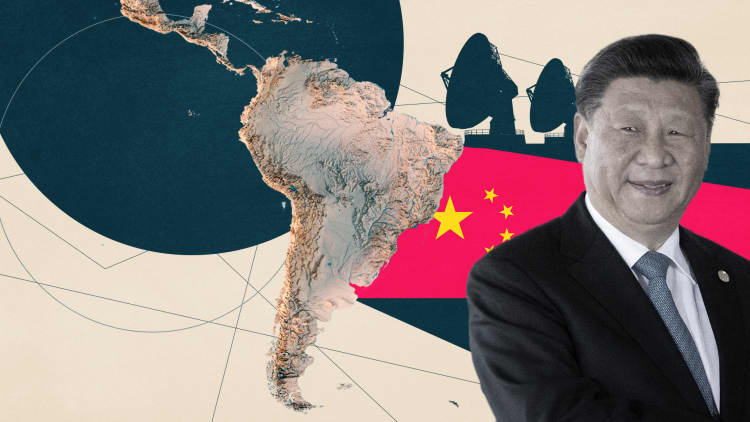
Chile is the latest Latin American country to have become embroiled in a U.S.-China power struggle.

The country, which counts Washington as its top foreign investor and Beijing as its largest trading partner, is facing pressure from the White House over a subsea cable project with links to China.

In a surprise move, U.S. Secretary of State Marco Rubio said late last week that the Trump administration would impose visa restrictions on three Chilean officials tied to a digital cable project proposed by Chinese firms, alleging a security threat.

Chilean President Gabriel Boric, who will leave office on March 11, condemned the visa sanctions and rejected the notion that the country “promotes any action that threatens our security or that of the region.”

Chile’s outgoing left-wing government later said one of the sanctioned officials was the country’s Minister of Transport and Telecommunications Juan Carlos Muñoz, without commenting on the identities of the other two.

The U.S. ambassador to Chile, Brandon Judd, defended the visa restrictions on Monday, telling reporters that it is Washington’s “sovereign right to take actions when we feel that the region’s security is being threatened,” according to The Associated Press.

The spat comes just days before a Latin American leader’s summit in Miami, Florida — and two weeks before Chile’s incoming right-wing government takes over in Santiago.

Chile’s President-elect Jose Antonio Kast speaks to journalists after meeting with the Italian Prime Minister at Palazzo Chigi in Rome on Febuary 5, 2026.

Filippo Monteforte | Afp | Getty Images

It also represents a major test for José Antonio Kast‘s administration, following the right-wing candidate’s election victory late last year.

Analysts say U.S. President Donald Trump, who is seeking to counter China’s strategic influence in the region, is sending an unequivocal message to Latin American countries.

‘A calibrated warning’

The U.S.-Chile tensions were, above all, “a calibrated warning” to the Kast administration that strategic infrastructure decisions will be treated as geopolitical alignment choices — rather than neutral tenders, according to Mariano Machado, Americas principal analyst at risk intelligence company Verisk Maplecroft.

To be sure, digital undersea cables are the backbone of the world’s internet and telecommunications infrastructure, enabling everything from international phone calls to financial transactions. By some estimates, as much as 95% of international traffic passes through these largely unseen data super-highways.

A map of the world’s undersea communication cables.

CNBC | Jason Reginato

“The near-term external consequence is that Kast’s upcoming Washington engagements – chief among them, in the Shield of the Americas summit – will become early tests of how Chile balances partners under pressure,” Machado said.

“As US-China competition intensifies in the region, Chile’s ‘digital hub’ ambition becomes investable only if geopolitical concerns are addressed upfront, not retrofitted after a crisis,” he continued. “Winning deals will be those that lock in clear governance and credible security assurances early enough to preserve bankability.”

China’s embassy in Chile has reportedly accused Washington of “obvious contempt for the sovereignty, dignity, and national interests of Chile” following the Trump administration’s visa restrictions against Chilean officials.

China’s strategic and economic influence in Latin America is well established, although it is thought to be the target of Trump’s so-called “Donroe Doctrine” — a portmanteau of Donald Trump and the Monroe Doctrine, which refers to a 19th century foreign policy position that asserted Washington’s influence over the Western Hemisphere.

Why Chile is the latest LATAM country to be caught in a U.S.-China power struggle

In just the last few weeks, for example, Panama’s top court ruled against Hong Kong-based CK Hutchison, saying a concession held by a subsidiary of the firm to operate ports at either end of the Panama Canal was unconstitutional. The outcome was widely seen as a victory for Trump’s regional security ambitions.

The U.S. has also ratcheted up pressure on Cuba’s communist-run government, threatening to impose tariffs on any country that provides oil to Havana, and recently conducted an extraordinary military operation to depose Venezuelan President Nicolás Maduro.