
Robin Hood-style activist group strikes again — this time in a forest
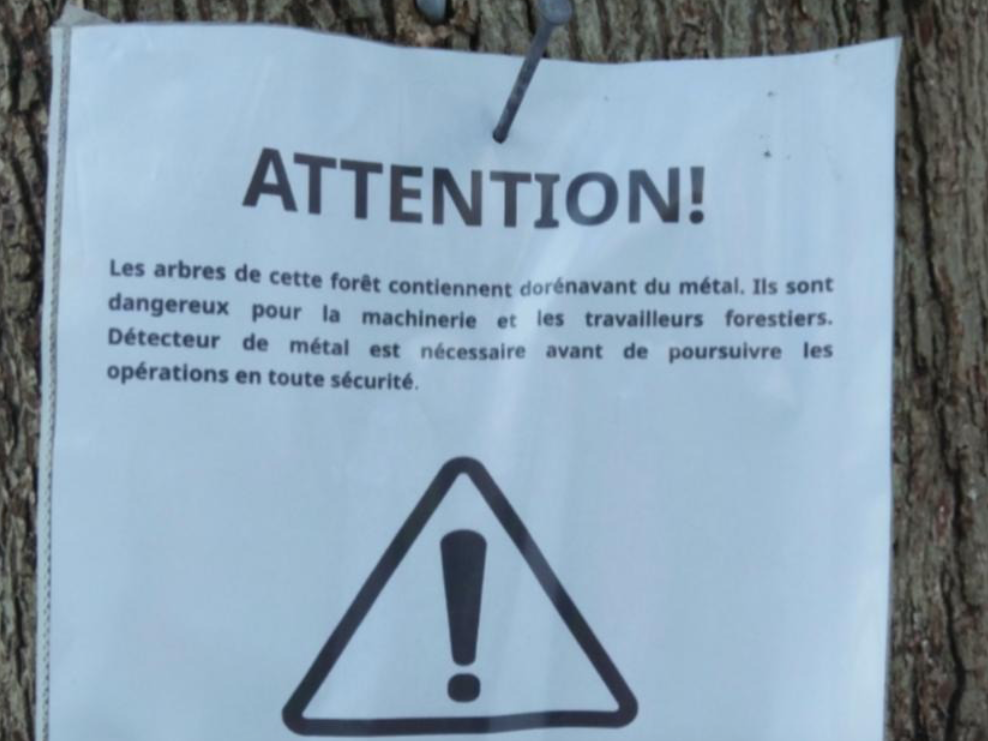
An activist group calling itself Les Robins des ruelles has followed its recent Robin Hood-style grocery store heists in Montreal with a claim to have sabotaged planned logging operations in a forest in the Mauricie region.
Montreal police are still investigating the group’s rather colourful robberies on Dec. 15 and Feb. 3 at two grocery stores in the Plateau-Mont-Royal borough. No arrests had been made as of Friday afternoon, a Montreal police spokesperson said.
Translated as the Robins of the Alleyways, the group’s name is intended to evoke the legendary English folk hero who robbed from the rich to give to the poor.
The group claims on social media that although it delivered the booty to community kitchens and low-cost housing complexes, the grocery heists were not really about charity, but rather political statements against the current economic order.
On Dec. 15, at least a dozen masked people,
some wearing Santa Claus outfits and others dressed as elves
, filed into a Metro grocery store on Laurier Ave. and helped themselves to about $3,000 worth of food.
On the evening of Feb. 3, about 60 masked activists, this time wearing tuques and hats decorated with red feathers, did the same at a Rachelle Béry store on the corner of St-Laurent Blvd. and Villeneuve St. This time, they made off with an estimated $6,000 worth of food.
In both cases, the activists filmed themselves walking into the store, spray-painting messages on the floors and windows, and disabling security cameras with spray paint. Along with those videos, they posted photos supporting the claims they had delivered the stolen food to “community fridges” and to housing complexes in the Mercier—Hochelaga-Maisonneuve borough.
The Robins say they wish to remain anonymous and refused The Gazette’s request for an interview. They did, however, answer questions through an intermediary, a group called Les Soulèvements du fleuve (The River’s Uprisings).
The Robins describe themselves as “a group that was formed in response to the call of Les Soulèvements du fleuve to reject the food production and distribution system and take direct action.”
Asked why they decided to attack the food industry, and whether they intend to target other sectors of the economy, they said they chose “the agro-industrial complex” because it “prioritizes profit to the detriment of the essential needs of the population, (and so it) must be dismantled.”
“For us, this dismantlement will happen through the expropriation of the big grocery chains and the collective reappropriation of our subsistence. We have chosen to attack those who own our food supply; others will attack those who own the roofs over our heads. These problems have the same causes. The solution resides in their expropriation.”
They say they welcome new members, and a member is “anyone who decides to take action … to organize to expropriate those who are exploiting us.”
Asked whether the group was concerned those who are persuaded to follow suit may find themselves facing criminal charges, they answered: “We are not afraid to disobey the rules that protect those who appropriate our work to pay for their yachts and luxurious mansions. … We know that shaking up the status quo is a risky move, but it is also a necessary move that we are prepared to take.”
The latest such move by the group seems to be an action in the Mékinac forest, north of the municipality of Ste-Thècle in the Mauricie region in central Quebec.
In a statement made public by Les Soulèvements du fleuve on Friday, the Robins say they have “armed the forest by driving steel bars through the trees on the site.”
They said the action is aimed at preventing logging “without compromising the integrity of the trees.” They say the tactic has been used by environmentalists for more than 40 years to protect forests, and the group has posted warning signs “for the safety of the forestry workers.”
An example of such a sign, appended to the group’s statement, reads: “CAREFUL! The trees in this forest now contain metal. They are dangerous for machinery and forestry workers. A metal detector is necessary before proceeding with safe operations.”
The group’s statement mentions a moratorium citizens’ groups in the area have succeeded in obtaining to pause planned logging in the Grandbois forest, but in the meantime, logging operations have increased in areas to the north of that forest. The group claims Forex Langlois Inc., the Dion sawmill and “the broader forest industry exert almost total control over the management of this dispute surrounding logging.”
In their statement, the Robins declare: “This action should not frighten citizen groups. If we wish to address issues related to the forestry regime and land protection, we must employ various strategies and roles; we must effectively block the industry’s abuses while developing alternatives to the current dominant model, and practising other ways of inhabiting the territory. Let us sabotage the equipment, block the operations, and harass the elected officials in the industry’s pay. The environmental movement must intensify its efforts.”
Antoine Langlois, president of Forex Langlois Inc., said in an interview he is taking the sabotage claims “very seriously,” adding he has been in contact with the Sûreté du Québec and is also discussing the issue with his lawyers.
He said the company, which is a forest operations contractor based in Lac-aux-Sables, has all the necessary authorizations to carry out the work it is doing in the Mékinac forest.
The Robins claim to have taken their action in response to a call from Les Soulèvements du fleuve to “rise against the appropriation of the St. Lawrence River, its banks and its watersheds by multinationals that destroy the territory and disregard local populations.”
On social media, Les Soulèvements du fleuve describes itself as “neither an organization nor a particular group, but the composition of a resistance to the death economy.” The entity seems to have been inspired by the French environmental collective Les Soulèvements de la Terre (The Earth’s Uprisings).
Founded in 2021, that collective has been organizing direct actions across France, such as blockades, sit-ins and sabotage against industrial farming and against infrastructure projects it deems harmful to the environment.
The French group has held large protests against the construction of a giant irrigation reservoir in a village in western France, and against the controversial Lyon-Turin high-speed rail project. It occupied a Lafarge cement plant in Bouc-Bel-Air, near Marseille, to protest the company’s carbon emissions.
On its website, Les Soulèvements du fleuve says it was “born out of the meeting of many local struggles across the territories with the desire to set in motion a movement to resist industrial, colonial and extractivist development.”
The idea, it explains, is to “respond to the international call of Les Soulèvements de la Terre to gather raw forces and directly attack those who exploit and destroy the living, to interrupt the catastrophic continuity of progress, the incessant rhythm of its flux and permanence of the infrastructures that maintain it.”
In June 2024, Les Soulèvements du fleuve claimed responsibility for attacking what it called “a symbol of the containerization of the St. Lawrence River” by sabotaging machinery at Ray-Mont Logistique (RML) in Hochelaga-Maisonneuve. Activists covered machinery in paint.
RML plans to build the largest trans-shipment platform in North America, and local groups have objected that it would be only 100 metres from social housing, a seniors’ residence and a wooded area.
Beyond the RML project, the groups more broadly oppose the Quebec government’s “St. Lawrence Project,” which they say would turn the Lower St. Lawrence into a kind of Québécois Silicon Valley.
Les Soulèvements du fleuve lists “destructive” initiatives such as the ill-fated Northvolt electric-vehicle battery plant in the Montérégie region, port projects in Lévis and Contrecoeur, and the InnoVitam project to transform part of Quebec City into a technology and research hub. It is also against plans to mine critical minerals such as lithium, graphite, copper and nickel in Quebec’s north.
The online statement suggests Quebec has not seen the last of Les Soulèvements du fleuve’s actions.
“Each season, the Uprisings take on a different theme inspired by different local struggles around which to rally. We are organizing in big cities and in the regions so that the battles are well shared and will gain in intensity.”
The idea is to “build a network of local struggles while simultaneously initiating a movement of rebellion against the architects of the end of the world.”
While some may dismiss the tactics of the Robins and Les Soulèvements as extremist, along with their denunciation of such targets as the food industry and high grocery prices, their message has resonated with many.
“We understand the meaning of the actions of Les Robins des ruelles,” said Nathalie Ainsley, a spokesperson for Mères au front, a coalition of environmental groups in Quebec. “When families can’t manage to fill their grocery cart while profits explode at the top and the managers give themselves salaries of many millions of dollars, it is not surprising that these acts of protest emerge.”
Indeed, in one of their public statements, the Robins point directly to the salaries of certain grocery magnates.
Rachelle Béry stores, they noted, belong to the Sobeys chain, which is owned by Empire Company Ltd. “The president of Empire, Pierre St-Laurent, has made $3.42 million in salary and benefits since he was appointed last November, while the average Canadian earned $65,300 in 2025,“ the Robins claim.
The head of corporate affairs for Sobeys, Anne-Hélène Lavoie, confirmed their Montreal store had been the target of a robbery and vandalism. She said the company has complained to Montreal police and condemns “any criminal act that jeopardizes the safety of our teammates and customers, and (we) are working closely and in collaboration with the authorities through the investigation.”
No customers or employees were reported hurt in either of the grocery store actions.
Lavoie said Sobeys is “deeply rooted in the communities where we operate. We prioritize the needs of the families we serve, which is why we donate millions of dollars to a variety of community organizations and programs across Quebec on a yearly basis — particularly those focused on food security, family support and community well-being.”
She did not confirm or deny the salary information of the company’s president.