Team Simulates a Living Cell That Grows and Divides | Newswise


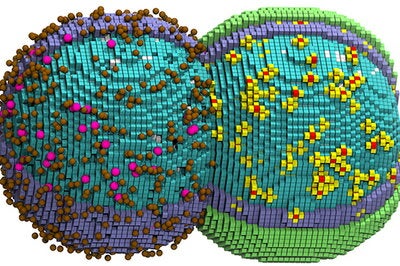
Newswise — By simulating the life cycle of a minimal bacterial cell — from DNA replication to protein translation to metabolism and cell division — scientists have opened a new frontier of computer vision into the essential processes of life.

The researchers, led by chemistry professor Zan Luthey-Schulten, present their findings in the journal Cell.

The team simulated a living cell at nanoscale resolution and recapitulated how every molecule within that cell behaved over the course of a full cell cycle. The work took many years, vast computer resources, large experimental datasets, a suite of experimental and computational techniques and an understanding of the roles, behaviors and physical interactions of thousands of molecular players. The researchers had to account for every gene, protein, RNA molecule and chemical reaction occurring within the cell to recreate the timing of cellular events. For example, their model had to accurately reflect the processes that allow the cell to double in size prior to cell division.

Watch a video of the full life cycle 4D simulation of a minimal bacterial cell. 

To make the task more manageable, the team used a living “minimal cell” developed at the J. Craig Venter Institute in California. The version of the cell used in the new study, JCVI-syn3A — “Syn3A” for short — is a modified bacterium with a pared-down genome that carries only the genes needed to replicate its DNA, grow, divide and perform most of the other functions that make life possible.

“This is a three-dimensional, fully dynamic kinetic model of a living minimal cell that mimics what goes on in the actual cell,” Luthey-Schulten said. “Such a comprehensive undertaking was only possible through the combined efforts of a host of collaborators at the U of I as well as Harvard Medical School, where we systematically modeled the essential metabolism and other subcellular networks through a series of publications starting in 2018.”

The Syn3A cell has fewer than 500 genes, all of which reside on a single circular strand of DNA. The laboratories of study co-authors Angad Mehta, a professor of chemistry, and Taekjip Ha, of Boston Children’s Hospital and Harvard Medical School, generated additional experimental data that allowed the team to accurately simulate and validate numerous aspects of cell function.

Watch a video of the first-ever whole cell 4D simulation showing everything everywhere all at once.

“Most importantly, their work revealed the extent of DNA replication and that Syn3A’s cell division is symmetrical,” Luthey-Schulten said.

Both factors guided and validated the simulations performed by Zane Thornburg, a postdoctoral fellow at the Beckman Institute for Advanced Science and Technology and the Cancer Center at Illinois, and Andrew Maytin, a graduate student in Luthey-Schulten’s lab.

Like other bacterial cells, Syn3A has no nucleus. Every molecule that comprises and sustains it is either a component of its outer membrane, is transported into it from outside the cell or is assembled in the cytoplasm. The cell is so jam-packed with molecular players that, when creating high-resolution cartoons and animations of their computer simulations, the researchers had to render some of the components invisible. Making all the cellular proteins invisible, for example, allowed the scientists to see how Syn3A’s chromosome threads through the cell’s crowded interior.

Some processes were more computationally expensive than others, the team discovered. For example, Maytin realized that chromosome replication was slowing the whole simulation to a crawl, nearly doubling the time it took to capture the whole cell cycle. He determined that efficiently simulating the cell’s DNA replication process required its own dedicated graphics processing unit, while another GPU handled all other cellular dynamics. This allowed the team to simulate the full, 105-minute cell cycle in just six days of computer time.

Thornburg and Maytin struggled with the challenge of simulating cellular events occurring at the same time in various parts of the cell.

“I can’t overstate how hard it is to simulate things that are moving — and doing it in 3D for an entire cell was … triumphant,” Thornburg said. “One of the last big hurdles that Andrew and I had to solve was understanding how the membrane and the DNA talk to one another when both are moving.”

While the simulated cell cycle has its limitations — this was not an atom-by-atom simulation but instead averaged the dynamics of individual molecules — it yielded a surprisingly accurate accounting of the timing of cellular processes. In repeated simulations involving individual cells with slightly varying start conditions, the simulated cell cycle occurred, on average, within two minutes of the real-world cell cycle, Thornburg said. The work was repeatedly guided and tested against actual experimental outcomes, a process that allowed the scientists to refine their simulations.

The ability to accurately capture the ever-changing conditions within a living cell opens a new window on the foundations of living systems, Luthey-Schulten said.

“We have a whole-cell model that predicts many cellular properties simultaneously,” she said. “If you want to know what’s going on, say, in nucleotide metabolism, you can also look at what’s going on in DNA replication and the biogenesis of ribosomes. So the simulations can give you the results of hundreds of experiments simultaneously.”

Study co-authors also include Illinois chemistry alumnus Benjamin Gilbert and John Glass, who leads the J. Craig Venter Institute Synthetic Biology Group.

This work was conducted in the National Science Foundation’s Science and Technology Center for Quantitative Cell Biology at the U of I. Luthey-Schulten also is a professor of physics and a professor in the Beckman Institute at the U. of I. The research was conducted using the Delta advanced computing and data resource, which is supported by the NSF and the state of Illinois. Delta is a joint effort of the U of I and its National Center for Supercomputing Applications.


ASU Expedition Finds an Aquatic World Teeming with Life | Newswise


Newswise — Imagine descending nearly a mile and a half into a watery abyss, watching the sunlight disappear as the world around you turns completely black. Then suddenly, you find yourself surrounded by a shower of brilliant, bioluminescent fireworks.

This is just the beginning of an ocean expedition into the realm of deep-sea hydrothermal vents — alien ecosystems teeming with life we have yet to fully understand. Here, a place where the sunlight never reaches, crabs, rays and fish thrive even under the extreme hydrostatic pressure.

A team of intrepid researchers from Arizona State University embarked on a recent journey to these hidden depths to learn more about nitrogen cycling and the microbial life thriving in these extreme conditions. These microscopic organisms play a vital role in the ocean’s delicate chemistry.

“I think the deep sea is one of the final frontiers of exploration on Earth,” said Carolynn Harris, a postdoctoral researcher in ASU’s School of Earth and Space Exploration. “We know more about the surface of the moon than we know about the bottom of the ocean on our own planet.”

Sheryl Murdock, a postdoctoral research scholar with ASU’s School of Ocean Futures, part of the Julie Ann Wrigley Global Futures Laboratory, led the expedition along with Elizabeth Trembath-Reichert, an associate professor with the School of Earth and Space Exploration. Six ASU students and staff participated, working on everything from taking samples and planning the next day’s dive, to testing equipment and leading the team’s experiments and school outreach.

Murdock and her research team are working to understand exactly what the smallest inhabitants of the ocean are contributing to ocean chemistry. While microbes are tiny, they have a tremendous impact, and Murdock says they’re not something that gets thought about often when it comes to protecting and managing the ocean.

“Nobody’s going to buy the ‘save the microbes’ bumper sticker,” Murdock said. “We need the public to know that the way the chemistry of the ocean stays in balance has loads to do with microbes and how they cycle nitrogen and other chemical elements. And by understanding what microbes contribute, we can learn how that plays into the wider ocean chemistry and, importantly, ocean health.”

One way the researchers learn more is by taking samples of microbes that thrive under deep-sea pressure — gathered from water and sediment samples. But this team is trying something that has never been done before.

“We are working to understand the microbes living in tubeworm communities by sampling the fluids and then bringing the water back onto the ship, running incubations, and looking at how those microbes use different sources of nitrogen,” Murdock said. “What’s novel about this is bringing them to the surface but keeping them under seafloor pressure and running experiments at that high pressure.”

This process is difficult at best. The team must travel far out to sea on a ship called the R/V Atlantis — a U.S. Navy-owned research vessel operated by the Woods Hole Oceanographic Institution. This ship is designed specifically to launch Alvin, a specialized “human occupied vehicle,” or HOV, used by researchers to explore the deep sea.

Once the team reached its final destination in the Pacific northwest — a spreading center between tectonic plates called the Juan de Fuca Ridge — the team performed multiple dives in the submersible, as weather conditions allowed.

Their innovative approach to collecting water, sediment and microbial samples — bringing them to the surface under the same pressure — is expected to bring new insights to our understanding of ocean chemistry, what roles microbes play on the seafloor, and how they contribute to ecosystem health and function.

Ship to shore: Bringing deep-sea exploration to the classroom

Beyond the scientific breakthroughs, the expedition sparked a wave of inspiration among hundreds of students back on land. The cruise carried a dedicated outreach team — responsible for a ship-to-shore “virtual field trip” program that brought live video, interviews and demonstrations into classrooms thousands of miles away.

Will Carter, an outreach coordinator with the ASU Bermuda Institute of Ocean Sciences, or BIOS, helped build the pipeline.

“We had a full Zoom setup,” Carter said, describing a dizzying array of gear: a handheld gimbal and iPhone for roaming footage, a 360 conference camera to show a room, and microphones that had to survive both wind and poor bandwidth. “You can imagine with all of these different tech elements, especially being on a ship where there’s limited Wi-Fi, it took a long time to really set up and master.”

Carter, who has a background in biology and media studies, edited dive footage each night and crafted short, punchy videos for the next day’s calls. Their goal was modest at first — reach a few hundred students — but the appetite for real-time science grew fast.

For students at Osborne Middle School in Phoenix, the experience wasn’t a distant slideshow. Science teacher Jim Hess watched his seventh and eighth graders press toward the screen, leaning in to see hydrothermal chimneys and hear Alvin crew explain life in a tin can at the bottom of the world.

“They decorated Styrofoam cups before the team left to go to the boat,” Hess said. The cups were taken down on the outside of the submersible; at 2,300 meters (more than six Empire State Buildings) deep, the air is crushed out of the foam. “Your regular six-inch Styrofoam cup shrinks down to about the size of your thumb,” he told students. The cups were returned as tiny souvenirs — a reminder that sometimes science is a tactile thrill as much as it is data.

Middle schoolers asked the questions adults skip. 

“How do you use the bathroom?” one asked. And the answer — “you try to go before, and if not, then you go on this little red bedpan” — produced exactly the reaction the outreach team wanted: awe and laughter, followed by curiosity. 

“Those middle school questions,” Carter said, “are perfect.”

From the beginning, the ship-to-shore goal was simple but ambitious: bring real impact and working science directly to students in real time, as discovery is unfolding live.

“We knew to get this over the goal line, it couldn’t just be creating a curriculum module,” said Kaitlin Noyes, director of education and community engagement at ASU BIOS. “It needed to be something bigger.” 

That “something bigger” became a series of live broadcasts from the research vessel and the submersible using special communications tools, connecting students from third grade through college — and even professional educators — to science, as it was happening at sea.

Over the course of the two-week expedition, they hosted 29 live shows and reached 857 participants.

“A lot of these kids have never had interaction with anything outside of their immediate area,” Hess said. “They hear about ASU, but they don’t really know what that means. This shows them the world is bigger — and that they can be part of it.”

From under the sea to under the microscope

Back on deck, the science had its own setbacks: rough weather grounded dives, forcing the team to compress their goals into fewer opportunities. Harris described how team dynamics became essential in cramped, chilly, sometimes seasick conditions.

“Anytime you take a group of people and put them in a confined, isolated situation, the group dynamics are so important,” she said. “We had a quarter fewer dives than we had hoped, but we still accomplished all of our major science objectives.”

Now the team’s samples — including water, sediments and microbes — will be analyzed. The next phase will take time and precision: sequencing DNA from microbes, measuring nitrogen species and piecing together how these unseen organisms move nutrients through a world without sunlight.

As the team measures the samples over the next several months, the researchers share a message: The deep sea is not a desolate wasteland but a vibrant ecosystem facing unprecedented threats due to climate impacts, overfishing and bottom-trawling, pollution and potential deep-sea mining.

“Industrialization of the deep sea is really knocking at the door,” Murdock said. “Our research is but one important step to reaching a better understanding of how our ocean works, and by doing that, we hope to contribute to strategies that ensure future ocean health.”


Corpses Leave Clues Behind in the Soil Long After They’re Gone | Newswise


Corpses leave clues behind in the soil long after they’re gone

ASU research has potential to help forensic teams solve cases when a victim’s body has been moved

Newswise — President’s Professor Pamela Marshall (left) and Assistant Professor Katelyn Bolhofner pose with soil samples in one of their labs on Thursday, Feb. 19, on the West Valley campus. The researchers analyze the microbial and chemical traces left behind when remains are moved, uncovering patterns of postmortem change that can guide forensic investigations. Photo by Charlie Leight/ASU News.  Download article assets

 It is not uncommon for a body to be moved after a murder, usually to hide or eliminate evidence.

And while the Arizona desert may seem like the perfect place to commit such a crime, a new study shows that a cadaver can still leave critical clues behind in that harsh environment.

Arizona State University researchers have found that trace elements linger at an original dump site even after an extensive amount of time. These elements can provide insights into postmortem processes, helping forensic investigators uncover clandestine burials and relocate the remains of murder victims.

“A lot of times a murderer will kill someone and put the body somewhere, stash it, panic and then move it. And how can you ever trace where they have done this?” said Assistant Professor Katelyn Bolhofner with the School of Interdisciplinary Forensics, who collaborated with President’s Professor Pam Marshall from the School of Mathematical and Natural Sciences on the study.

“The surprising result was that even with the hot Arizona summer, we could still tell that there had been something that was dying and decomposing in that spot in the desert,” Bolhofner said.

Uncovering signatures in the soil

Prior to the study, Bolhofner and Marshall believed that any evidence on the original site of a transported body would be baked under Arizona’s scorching summer sun.

That was far from the case.

The study used two 200-pound pig models that were dressed up in jeans and a button-up shirt by students, since murder victims are commonly clothed. They were left to decompose in large cages (to keep scavenging animals away) in various environments and seasons in the Sonoran Desert.

After 25 days, the remains were moved to a secondary burial location. Then, over a period of nine months, the researchers tested the soil where the model was originally placed, where it was moved and in a location adjacent to the original burial as a control.

“It’s a multifaceted, year-round project to try to determine timing, insects involved, and the humidity and the temperature and many other of these factors,” Bolhofner said.

What they found were distinct microbial fingerprints where death gave way to new life — bacteria and fungi that once lived inside or on the body and were released into the surrounding ground as decomposition occurred.

“It turned out to be a really crazy finding,” Bolhofner said. “It’s like the murder victim is leaving a signature of themselves in death … almost like leaving breadcrumbs right around the desert (indicating) that they had been there, and those breadcrumbs stayed there in the soil, invisible to the naked eye for a year.”

“No one has ever done an experiment like this,” Marshall said. “It was unique because no one had looked at a dumped body that was then moved. It was also unusual because no one’s been looking at the Sonoran Desert.”


It’s like the murder victim is leaving a signature of themselves in death … almost like leaving breadcrumbs right around the desert.

Kaitlyn BolhofnerAssistant professor of forensics

Counting on collaboration

The study was a collective and collaborative effort.

ASU graduate Jennifer Matta Salinas worked on the study for her honors thesis. She collected and processed the data, and extracted DNA for the study.

“I felt like my results definitely opened the door to a novel area of forensic science that has many avenues to explore and to still verify,” said Salinas, who earned a bachelor’s degree in forensic science. “I’m hoping someday it is used to help find someone’s loved ones months or years after their disappearance no matter where the environment is.”

The DNA was then prepped and analyzed by Kristina Buss in ASU’s Bioinformatics Facility and Desert Southwest Genomics Center, and Teaching Professor Ken G. Sweat performed the chemical analysis of the soil.

“We here in the School of Mathematical and Natural Sciences and the School of Interdisciplinary Forensics are very collaborative — we depend on each other,” Marshall said. “Without Jennifer needing to write her thesis, this wouldn’t have happened. Without Ken doing the elemental analysis, that part wouldn’t have happened either.”

Future forensic potential

Stuart Somershoe, a retired police detective with the Phoenix Police Department’s missing-persons division, was also a part of the project.

According to the World Population Review, Arizona has one of the highest number of missing persons in the nation, with more than 1,000 people missing and 1,588 resolved cases in 2025.

Somershoe says the desert plays into those statistics. He sees the potential application of this study in cold cases and missing persons cases both now and in the future.

“I read the study and could see the value in police investigations,” Somershoe said. “It would certainly be something that could be used.”

Somershoe said that as this research develops and becomes more well-known, it could become a technique as commonly used as DNA testing.

But first, more experiments and studies will be needed.

“We’re way in our infancy,” Marshall said.

The researchers are interested in taking the study on the road to see if the findings can be confirmed in other climates, but Marshall is hopeful.

“This study is really specific to this climate and this landscape and this geography,” Marshall said. “Our soil and our climate (are) so harsh and so odd. The fact that this can be proven here should show that in other climates, it’s much more doable. Those climates are much friendlier.”

The researchers also plan to verify that human remains would yield similar results.

“We need to confirm that the things we’re seeing in pigs are the same in humans,” she said. “We need to figure out how what we have discovered is transferable.”


 Download article assets


Researchers Decode Bacterial Energy Production, Paving the Way for Future Antibiotics | Newswise


Many disease-causing bacteria — including pathogens that can cause cholera, meningitis, and certain types of pneumonia — contain an enzyme called Na⁺-NQR. The enzyme is essentially a pump that helps bacteria generate energy by moving sodium ions across their cell membranes while transferring electrons.  

Crucially, the enzyme is present in many types of harmful bacteria but not in the cells of humans and other animals, making it an ideal target for future antibiotics. But to disrupt the enzyme’s functions, scientists need to understand how, exactly, it works. An international team of researchers, including RPI postdoctoral fellow Moe Ishikawa-Fukuda, Ph.D., and Biological Sciences Professor Blanca Barquera, Ph.D., recently took a major stride in that direction with the publication of a new paper in Nature Communications

In the paper, Barquera and her colleagues used cryo-electron microscopy and computer simulations to capture “snapshots” of Na⁺-NQR in different stages of action. By studying mutant versions of the enzyme, adding specific chemical inhibitors, and removing sodium from the solution, they effectively “froze” its molecular machinery at various points in its operation. 

They found that the enzyme changes its physical configuration as it works, and identified at least five different structural configurations corresponding to different states in the bacterial energy cycle. 

“Na⁺-NQR has long been a bit of a puzzle for researchers, because certain parts of the enzyme appeared to be too far apart to facilitate the electron transfer that’s critical for bacterial respiration,” Barquera said. “With this work, we have documented how the enzyme reconfigures itself to make electron transfer possible.” 

This mechanism is fundamentally different from how cellular respiration works in humans and other animals, meaning that Na⁺-NQR is an ideal target for future antibiotics.  

“Knowing how the enzyme works is key to disrupting its action,” Barquera said. In future studies, the team will explore whether the structural states they identified can be targeted to effectively shut down the enzymatic pump.  


UWM Student Taps Into Her Love of Bugs to Fight Antibiotic-Resistant Organisms | Newswise


Newswise — Kieyarrah Dennis can wear a lot of hats. In fact, versatility has shaped her personal and academic pursuits.

Her adaptability blossomed during her elementary years at a community-focused bilingual school in Milwaukee. Later, it drove her to earn a bachelor’s degree in biochemistry and history as an undergraduate student at the College of Saint Benedict in Minnesota.

“I knew that biochemistry was a broad enough scientific track that I could use it as a foundation to do anything,” she said. “And I want to do it all.”

In 2021, Dennis joined the University of Wisconsin-Milwaukee’s School of Freshwater Sciences as a PhD student — propelled by a love of water and bugs.

She now specializes in expanding our understanding of antibiotic-resistant organisms so that the field of medicine can better equip people to survive bacterial infections. Her research advocates for more diverse treatments against the pathogens we are exposed to in our water systems and other public spaces.

“I’ve taken antibiotics,” Dennis said, “but I didn’t think about the fact that treatments could or could not work based on what organism you’re sick with and whatever resistance mechanisms they pick up.”

Following ‘creepy crawlers’

Dennis’ biochemistry studies for her bachelor’s degree planted the seeds for her work as a grad student today. “I was just thinking about parasites,” she said. “I’ve always been interested in creepy crawlers.”

Charged with writing a mock proposal for research, her capstone explored the development of a vaccine against a disease spread by freshwater parasites. The process introduced Dennis to disease transmission routes, dynamic food chains and freshwater environments, including public parks and green spaces.

Dennis was fascinated and hooked, and she started as a freshwater sciences grad student at UWM less than a month after graduation. “I drove home, rested for maybe eight days, then started here,” she said.

Probing antibiotic resistance

Over the past four years, Dennis has plunged into the complexities of how certain pathogens — such as E. coli, which is prevalent in bodies of freshwater and beyond — evolve and adapt to resist antibiotic treatment.

The issues of antibiotic resistance and multidrug-resistant organisms have grown significantly since the 1980s, which has prompted concern and significant funding to prevent a future where antibiotics no longer work.

For Dennis, some days her research looks like microscopic sequencing of gene families in the lab. Other days, it requires donning her history hat, while contemplating anthropology, sociology and other disciplines.

“You can’t solve this issue when you only look at a slice of where it occurs,” she said. “It’s out in the community. It’s in the hospitals. It’s in our food chain. It’s in the water.”

Bridging science and neighborhoods

With her lab hat on, Dennis immerses herself in the detailed genetics and mutation patterns of these microorganisms, as well as the freshwater environments that drive the evolution of the pathogens. Her findings will help develop new solutions to protect us from them.

Recently, though, she also discovered a love for public health. She hopes to educate communities about these issues in our world, bringing the science to everyday people.

“There’s usually a disconnect between the people doing the actual research and the people doing advocacy or the application of research,” she said. “I would like to do both.”