Countries around the world are considering teen social media bans – why experts warn it’s a ‘lazy’ fix


Gen Z girl looking at smartphone screen feeling upset scrolling on social media.

Mementojpeg | Moment | Getty Images

Governments around the world are making efforts to crack down on teen social media use amid mounting evidence of potential harms, but critics argue blanket bans are an ineffective quick fix.

Australia became the first country to enforce a sweeping social media ban for under-16s in December, requiring platforms like Meta’s Instagram, ByteDance’s TikTok, Alphabet’s YouTube, Elon Musk’s X, and Reddit to implement age verification measures or face penalties.

Several European countries are now looking to follow Australia’s lead, with the U.K., Spain, France, and Austria drafting their own proposals. Although a national ban in the U.S. looks unlikely, state-level legislation is underway.

Countries around the world are considering teen social media bans – why experts warn it’s a ‘lazy’ fix

It comes after Meta, the parent company of Facebook, Instagram and Threads, faced two separate defeats in trials related to child safety and social media harms in March.

A Santa Fe jury found Meta misled users about child safety on its apps. The next day, a Los Angeles jury ruled that Meta and YouTube designed platform features that contributed to a plaintiff’s mental health harms.

Meta CEO and Chairman Mark Zuckerberg arrives at Los Angeles Superior Court ahead of the social media trial tasked to determine whether social media giants deliberately designed their platforms to be addictive to children, in Los Angeles, on Feb. 18, 2026.

Meta’s stock drops almost 8% as 2 court defeats add to Zuckerberg’s recent woes

These developments are set to “unleash a lot more legislation,” Sonia Livingstone, social psychology professor and director of the London School of Economics’ Digital Futures for Children center, told CNBC.

However, Livingstone said a social media ban for teens is a slapdash solution from governments that have failed to properly police tech giants for years.

“I think the argument for a ban is an admission of failure that we cannot regulate companies, so we can only restrict children,” she said, explaining that the U.S. and Europe already have a lot of legislation in the books that isn’t being enforced.

“When are governments really going to enforce, raise the stakes on fines, ban the companies if necessary for not complying,” she added.

Enforce existing laws

Experts argue the sector has for too long escaped accountability and the rigid requirements faced by other industries.

“[Governments] should be implementing the law [and] big tech companies should be facing a slew of regulatory interventions that forbid a whole series of practices that they currently do,” Livingstone said.

She highlighted the U.K.’s Online Safety Act, which “requires safety by design” — this means features such as Snapchat’s “Quick Add” that invite teens to befriend others should be stopped, according to Livingstone.

Livingstone believes that a blanket ban wouldn’t even be under discussion if social media companies had undergone appropriate premarket testing to establish if their features are safe for their target audience.

“There are lots of areas where we have a well functioning market that requires testing to establish it meets the standards…[before products] can go into the market,” she said. “If we did that for AI and for social media, we would be in a whole different place and we’d not be having to talk about banning children from anything.”

Josh Golin, executive director at Boston-based non-profit Fairplay for Kids, told CNBC that he’d like to see “privacy and safety by design legislation rather than blanket bans” across the U.S.

This includes passing the Children and Teen Online Privacy Protection Act to put a stop to personal data-driven advertising towards children, so there’s “less financial incentive for social media companies to target and addict kids.”

Golin added that passing the Senate’s version of the Kids Online Safety Act (KOSA) is also key to ensuring platforms are held legally responsible for design features that can cause addiction or other harms.

He added that Meta has already successfully lobbied to stop KOSA even though it passed the Senate in 2024. But, if it continues to block legislation further, Golin thinks this could see further pressure “line up behind bans because addictive and unsafe is not OK.”

Regulatory pressure to follow after landmark social media verdict: Legal Analyst

A ban is ‘lazy’ and ‘unfair’

A sweeping social media ban only punishes a generation of young people who have become increasingly dependent on online means of interaction, according to Livingstone. She said bans are a “lazy” solution from governments and an “unfair” outcome for young people.

“It’s the 15 years in which we don’t let our children go outside and meet their friends. It’s the 15 years in which we stopped funding parks and youth clubs for them to meet in,” she said.

“So a ban now is to say to ‘Children, we can’t make the regulation work. We can’t update it fast enough. We haven’t built you anything else to do, but that’s just tough. We’ve terrified your parents into feeling that there’s nothing they can do, and we’re going to take you away from the service where you hoped you would feel some sociability and entertainment.”

A young woman wearing headphones browses vintage vinyl records in a store.

A ‘quiet revolution’: Why young people are swapping social media for lunch dates, vinyl records and brick phones
Choose CNBC as your preferred source on Google and never miss a moment from the most trusted name in business news.


French, South Korean leaders say they’ll work together on the Strait of Hormuz


French President Emmanuel Macron and South Korean President Lee Jae Myung agreed Friday to work together to help reopen the Strait of Hormuz and ease global economic uncertainties caused by the war in the Middle East.

Their summit in Seoul came as US President Donald Trump slammed allies for not supporting the US and Israeli war against Iran. 

Macron was making his first visit to South Korea since taking office in 2017, as part of an Asian tour that already has taken him to Japan.

French President Emmanuel Macron shakes hands with South Korean President Lee Jae Myung during their meeting in Seoul, South Korea on April 3, 2026. AP

Macron told Lee at the start of the meeting that the two countries can play a role in helping to stabilize the situation in the Middle East, including Iran’s chokehold on the Strait of Hormuz, which has unleashed shock on global energy markets.

At a joint televised briefing afterward, Macron underscored the need for France and South Korea to cooperate to help reopen the strait and deescalate Middle East animosities, while Lee said the two affirmed “their resolves to cooperate to secure the safe shipping route in the Strait of Hormuz.”

The two leaders did not take questions and did not elaborate on how they would help reopen the strait — the narrow waterway between Iran and Oman through which about one-fifth of the world’s oil usually passes.

“We need to clearly define, at the international level, the conditions for a process to ease the crisis and conflict in the Middle East,” Macron said. “We need to ensure that the Strait of Hormuz is reopened.”

Cargo ships in the Gulf near the Strait of Hormuz, north of Oman, on March 11, 2026. REUTERS

Lee said he and Macron agreed to expand cooperation in technology, energy and other areas. South Korean and French officials also signed agreements to cooperate on nuclear fuel supply chains, jointly invest in an offshore wind project in southern South Korea and to collaborate on critical minerals.

South Korea has moved to increase output at its nuclear reactors to mitigate the energy crunch and Lee has also called for a faster transition to renewable energy, saying the war has exposed the country’s heavy reliance on fossil fuel imports.

President Trump had called for his allies in Asia and China to get involved in reopening the Strait of Hormuz REUTERS

Macron’s Asia trip comes as Trump has ramped up his frustration with allies.

In a speech Wednesday, Trump said Americans “don’t need” the strait but the countries who do “must grab it and cherish it.”

In an earlier Easter event at the White House, Trump called for his allies in Asia and China to get involved in reopening the waterway.

“Let South Korea, you know, we only have 45,000 soldiers in harm’s way over there, right next to a nuclear force — let South Korea do it,” Trump said. “Let Japan do it. They get 90% of their oil from the strait. Let China do it.”

The United States stations about 28,000 troops in South Korea, not the 45,000 stated by Trump.

The US troops’ deployment in South Korea is meant to deter potential aggressions from North Korea.

Macron has said reopening the Strait of Hormuz through a military operation is unrealistic.

South Korean officials have said they are in contact with Washington on the issue and that Seoul isn’t considering paying Iran transit fees to secure fuel shipments through the strait.


More than 40 Middle East energy assets ‘severely damaged,’ IEA chief says


Fatih Birol, executive director of the International Energy Agency (IEA), speaks at the National Press Club in Canberra, Australia, on Monday, March 23, 2026.

Bloomberg | Bloomberg | Getty Images

The head of the International Energy Agency said on Monday that at least 40 energy assets across nine countries in the Middle East have been “severely or very severely” damaged since the Iran war began, raising fears of prolonged supply disruptions.

Speaking at the National Press Club in Australia’s capital, IEA Executive Director Fatih Birol said damage to oil and gas fields, refineries and pipelines across the Middle East would take some time to repair.

His comments come as market participants closely monitor threats from the U.S. and Iran over energy facilities as the sprawling regional conflict enters its fourth week.

The Iran war has severely disrupted energy trade flows through the strategically vital Strait of Hormuz, creating what the IEA says is the largest supply disruption in the history of the global oil market. The global supply of liquefied natural gas (LNG) has also been reduced by roughly 20% since the conflict began on Feb. 28.

Birol said the fallout from the Iran war is equivalent to the two major oil crises of the 1970s and the 2022 gas crisis “put together.”

He added: “And, if I may, not only oil and gas. Some of the vital arteries of the global economy, such as petrochemicals, such as fertilizers, such as sulfur, such as helium. Their trade is all interrupted, which would have serious consequences for the global economy.”

U.S. President Donald Trump on Saturday threatened to “obliterate” Iran’s power plants if Tehran did not fully reopen the Strait of Hormuz within 48 hours.

The narrow waterway is a key maritime corridor that connects the Persian Gulf and the Gulf of Oman. Roughly 20% of global oil and gas typically passes through it.

Iran’s Parliament spokesperson Mohammad Baqer Qalibaf responded, saying that critical infrastructure and energy facilities in the Gulf region could be “irreversibly destroyed” should Iranian power plants be attacked.

Given that shipping has virtually ground to a halt in the Strait of Hormuz since the conflict began, the IEA’s Birol said the reopening of the waterway was the “single most important” solution to the global energy crisis.

He singled out Asia as being at the forefront of the Iran war energy shock and said the IEA was prepared to follow-up its historic release of 400 million barrels of oil to the market on March 11.

“If it is necessary, of course, we will do it,” Birol said.

— CNBC’s Anniek Bao contributed to this report.

Choose CNBC as your preferred source on Google and never miss a moment from the most trusted name in business news.


‘We no longer need NATO’: Trump sends shockwaves through Europe with ferocious attack on allies


Donald Trump has turned on America’s allies in a furious broadside after they rejected his plea for help in the Strait of Hormuz.

‘We no longer ‘need,’ or desire, the NATO countries’ assistance – we never did,’ Trump wrote on Truth Social on Tuesday.

Trump said he had been told America’s allies ‘don’t want to get involved’ in the Iran war, despite his appeals for help securing the strait as oil prices spiral. 

The President slammed NATO as a ‘one way street’ and said ‘we will protect them, but they will do nothing for us, in particular, in a time of need.’ 

Trump has been left exposed after the United Kingdom, France, Japan and Australia all declined to help protect commercial shipping in the Strait. 

Gas prices have surged to an average of $3.80 a gallon from $2.90 before the conflict began three weeks ago, while the Strait – through which a fifth of the world’s oil flows – remains blockaded by Iranian mines and missiles.

Senator Lindsey Graham, one of Trump’s closest allies and a leading proponent of the military campaign, wrote on X after speaking with the President that he had ‘never heard him so angry,’ over Europe’s unwillingness to help protect the Strait. 

Britain came in for particular punishment. Trump said he had personally asked Prime Minister Keir Starmer for minesweepers only to be told that consultations were needed first.

He re-upped his savage comparison to Britain’s heroic wartime leader Winston Churchill, gesturing to his bust in the Oval Office during a meeting with Ireland’s Taoiseach Micheál Martin on St Patrick’s Day.

‘Unfortunately, Keir is not Winston Churchill,’ Trump said.

‘We no longer need NATO’: Trump sends shockwaves through Europe with ferocious attack on allies

President Donald Trump gives remarks to the media as he signs an executive order in the Oval Office on Monday

An oil tanker burns after being hit by an Iranian strike in the ship-to-ship transfer zone at Khor al-Zubair port near Basra, Iraq

An oil tanker burns after being hit by an Iranian strike in the ship-to-ship transfer zone at Khor al-Zubair port near Basra, Iraq

Starmer said yesterday: ‘While taking the necessary action to defend ourselves and our allies, we will not be drawn into the wider war.’ 

Israel claimed it had killed two high-ranking Iranian commanders overnight. Thirteen US troops have been killed in the conflict, with more than 200 injured across seven countries.

Trump may now be forced to put boots on the ground in Iran to salvage victory, sources close to White House have warned, as Iran shows no signs of letting up. 

‘We clearly just kicked [Iran’s] a** in the field, but, to a large extent, they hold the cards now,’ a source close to the White House told Politico. ‘They decide how long we’re involved, and they decide if we put boots on the ground. And it doesn’t seem to me that there’s a way around that, if we want to save face.’

Trump confidantes fear he risks being dragged into an open-ended conflict just as the midterm elections approach, with the escalating war threatening to drive up the cost of living for voters already furious about affordability. 

‘The terms have changed,’ said a second person familiar with the military operation. ‘The off-ramps don’t work anymore because Iran is driving the asymmetric action.’

The war has also caused a schism between top allies within Trump’s MAGA movement, including Tucker Carlson and Megyn Kelly, as the President has argued for years against regime-change wars in the Middle East.

US intelligence has also determined that Iran’s regime will likely remain in power despite relentless airstrikes. 

The Islamic Revolutionary Guard Corps will likely tighten its domestic grip as the country’s internal enforcer, intelligence officials told the Washington Post.  

Israeli defense minister Israel Katz said security chief Ali Larijani and Gholamreza Soleimani, commander of Iran’s Basij forces, have joined the late Ayatollah Khamenei in the ‘depths of hell’ after targeted overnight airstrikes. 

The attack on Larijani comes four days after he marched alongside thousands of Iranians at a Quds Day rally in Tehran where he taunted Trump during a live interview. 

Iran’s Supreme Leader Ayatollah Mojtaba Khamenei, unseen since the war began, has said the US and Israel must be ‘brought to their knees’ and accept defeat before any peace deal is possible. 

‘For the White House, now the only easy day was yesterday,’ the source familiar with the military operation added. ‘They need to worry about an unraveling.’

The White House and Pentagon continue to insist the war is a ‘tremendous success,’ pointing to US naval and aerial superiority over Iran. 

Despite the success touted by the administration, the US Navy remains unable to guarantee safe passage for commercial oil tankers through the Strait.

The human toll comes amid mounting concerns over the financial cost, the Pentagon having burned through $5.6billion worth of munitions in the first two days of the war

The human toll comes amid mounting concerns over the financial cost, the Pentagon having burned through $5.6billion worth of munitions in the first two days of the war

Mojtaba Khamenei, son of Iran's supreme leader Ayatollah Ali Khamenei, walks along a street in Tehran on May 31, 2019

Mojtaba Khamenei, son of Iran’s supreme leader Ayatollah Ali Khamenei, walks along a street in Tehran on May 31, 2019

Israel claims to have assassinated top Iranian official Ali Larijani in an airstrike overnight

Israel claims to have assassinated top Iranian official Ali Larijani in an airstrike overnight

The US military has moved additional forces to the region, including the USS Tripoli and its 2,000-strong Marine Expeditionary Unit capable of seizing Iranian ports.

The deployment has led some to believe Trump will soon launch a limited ground offensive against the Islamic Regime to alleviate the global oil crisis. 

Trump has suggested that the fighting could end soon, while also warning the US is prepared for a long-term offensive.


France 48-46 England: Thomas Ramos’ last-gasp penalty snatches Six Nations title win after 13-try thriller


Last Updated: 14/03/26 10:09pm

France 48-46 England: Thomas Ramos’ last-gasp penalty snatches Six Nations title win after 13-try thriller

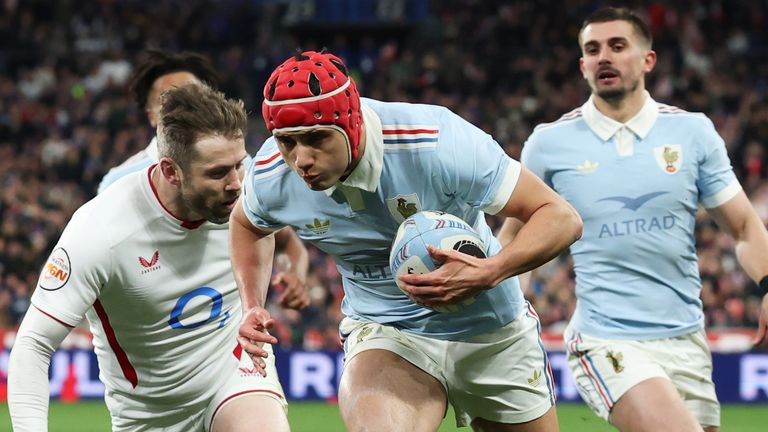
Louis Bielle-Biarrey scored four tries against England

England fell agonisingly short of a famous victory in Paris as Thomas Ramos’ last-gasp penalty saw France snatch a stunning 48-46 victory to retain their Six Nations title.

Ramos nailed a long-range penalty with the clock in the red to settle a 13-try thriller which England looked to have won when Tommy Freeman crossed with four minutes remaining.

More to follow…

This is a breaking news story that is being updated and more details will be published shortly. Please refresh this page for the latest updates.

Sky Sports brings you live updates as they happen. Get breaking sports news, analysis, exclusive interviews, replays and highlights.

Sky Sports is your trusted source for breaking sports news headlines and live updates. Watch live coverage of your favourite sports: Football, F1, Boxing, Cricket, Golf, Tennis, Rugby League, Rugby Union, NFL, Darts, Netball and get the latest transfers news, results, scores and more.

Visit skysports.com or the Sky Sports App for all the breaking sports news headlines. You can receive push notifications from the Sky Sports app for the latest news from your favourite sports, you can follow @SkySportsNews on X to get the latest updates and you can also now follow Sky Sports’ WhatsApp channel.


Wales 31-17 Italy: Wales end three-year wait for Six Nations win as they snap losing streak in style


Wales snap 15-game losing streak in Six Nations with bonus-point win over Italy in Cardiff; Aaron Wainwright scores two tries with captain Dewi Lake and fly-half Dan Edwards also dotting down; it is Wales’ first home win in Six Nations since beating Scotland in February 2022

Last Updated: 14/03/26 6:42pm

Wales 31-17 Italy: Wales end three-year wait for Six Nations win as they snap losing streak in style

Aaron Wainwright scored two first-half tries

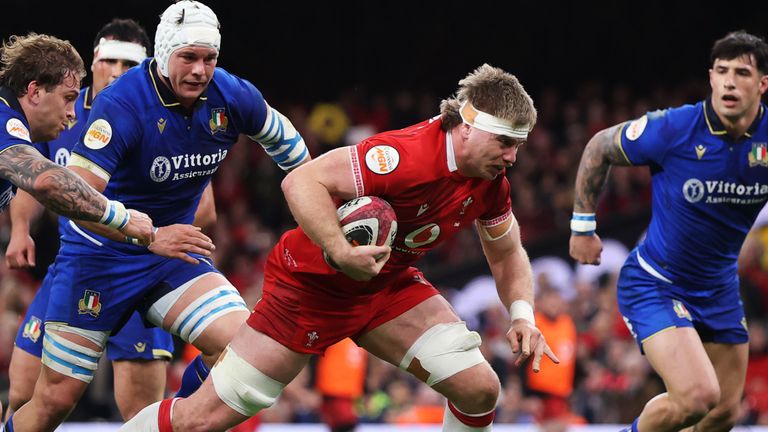
Wales emphatically ended their three-year wait for a Six Nations win with a 31-17 crushing of Italy in Cardiff.

Steve Tandy’s side have shown marked improvement since their shambolic loss to England in round one and were finally rewarded with a win as Aaron Wainwright’s first-half double put them on course for a much-needed victory, their first in the tournament since March 2023 to snap a 15-game Six Nations losing streak.

It will not prevent a third successive wooden spoon unless England fall to a record loss in Paris, but it at least gives some reasons for optimism during uncertain times in Welsh rugby.

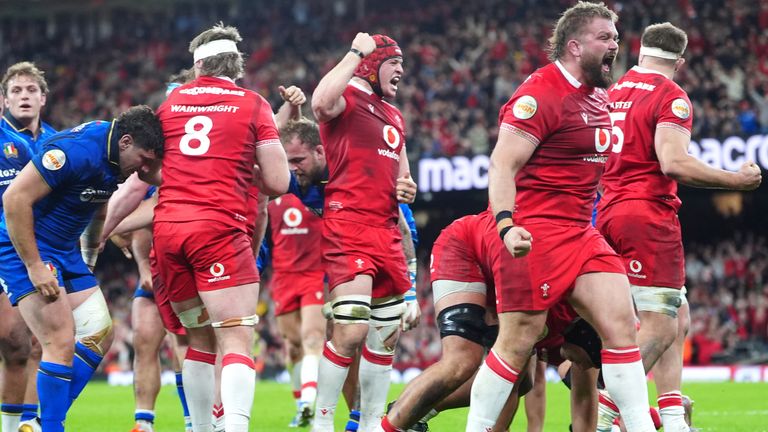
No 8 Wainwright crossed twice in 11 minutes during a man-of-the-match display, with captain Dewi Lake also dotting down on the half-hour to give Wales a 21-0 lead at the interval.

The Wales players celebrate Dewi Lake's try

The Wales players celebrate Dewi Lake’s try

Fly-half Dan Edwards bagged the bonus-point try, while also adding 11 points with the boot, with replacements Luigi Di Bartolomeo and Tommaso Allan and fly-half Paolo Garbisi responding for the outclassed Italians.

Italy were a shadow of the side that claimed a historic win over England. They employed a kick-heavy gameplan and did edge their hosts in the air on occasion, but it was a frustrating afternoon for their talented backline which was spent mostly on the back foot.

An early Tommaso Menoncello break from inside his own half proved a false dawn, with Garbisi squandering the chance to open the scoring as he dragged a penalty across the posts. Things went steadily downhill from there.

Follow Sky Sports on WhatsApp

Follow Sky Sports on WhatsApp for the latest sports news, videos, features, analysis and much more

Wales went in front on 15 minutes through Wainwright, who ran over Giacomo Nicotera on his way to the tryline, and he forced his way over for a second after the hosts mauled to within a metre of the whitewash.

Another catch and drive on 30 minutes resulted in a try for captain Lake, Edwards converting all three during a dream first period.

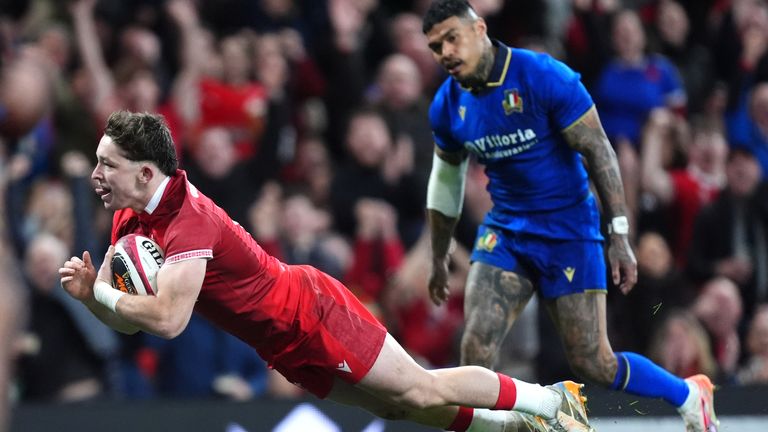
Dan Edwards scores Wales' bonus-point try

Dan Edwards scores Wales’ bonus-point try

Edwards crossed for the bonus-point try after the restart, dummying his way over on penalty advantage, and he tagged on a drop-goal to make it 31-0 after 48 minutes.

Luigi Di Bartolomeo touched down from a driving maul to get Italy on the scoreboard, with replacement prop Archie Griffin yellow-carded for his cynical attempts to take it to ground, but they failed to further reduce the deficit during the 10-minute sin-bin period.

Fellow replacement Allan scored their second, moments after butchering a chance down the right wing, while the TMO ruled out late efforts from Monty Ioane and Leonardo Marin.

Garbisi did dive over in the corner on the final play but Wales supporters were already basking in a first home Six Nations win since February 2022.


Trump appeals for UK to send ships to Strait of Hormuz to help unlock it… after Britain finally managed to deploy HMS Dragon on Tuesday


Donald Trump has asked for Britain’s help to save the Strait of Hormuz from closure while also calling for other foreign leaders to send ships to the strategic passage. 

The US President asked for help from France, Japan, South Korea and China, a country which has long been considered his country’s geopolitical rival. 

Trump’s new post on Truth Social suggests Iran has been successful in bringing the strategic water passage to a close. 

In recent days, Tehran has launched several missile strikes on vessels passing through the Strait, as well as sending its own explosive-laden ships, amid threats to send the price of oil to $200 per barrel. 

‘Many countries, especially those who are affected by Iran’s attempted closure of the Hormuz Strait, will be sending warships in conjunction with the United States of America, to keep the Strait open and safe,’ Trump wrote. 

‘We have already destroyed 100% of Iran’s military capability, but it’s easy for them to send a drone or two, drop a mine, or deliver a close-range missile somewhere along, or in, this Waterway, no matter how badly defeated they are.’ 

Trump went on to call on several states that ‘are affected by this artificial constraint’, including the UK, to send vessels to Strait in a bid to help unblock one of the world’s most important shipping routes. 

‘In the meantime, the United States will be bombing the hell out of the shoreline, and continually shooting Iranian boats and ships out of the water,’ he said, later vowing to get the passage ‘open, safe and free’ ‘one way or another’.

Meanwhile, Britain’s HMS Dragon was only just deployed on Tuesday and has spent the last three days ‘bobbing around in the Channel’ after being sent to defend the nation’s forces from Iranian drone attacks in Cyprus. 

Trump appeals for UK to send ships to Strait of Hormuz to help unlock it… after Britain finally managed to deploy HMS Dragon on Tuesday

Donald Trump has asked for Britain’s help to save the Strait of Hormuz from closure in a new social media post

HMS Dragon sets sail from Portsmouth Harbour on March 10, 2026

HMS Dragon sets sail from Portsmouth Harbour on March 10, 2026

The US President's new post asking other nations for help in opening the Strait of Hormuz suggests Iran has been successful in closing the passage

The US President’s new post asking other nations for help in opening the Strait of Hormuz suggests Iran has been successful in closing the passage

And the £1billion Type-45 destroyer only departed from UK waters yesterday, despite having been deployed several days earlier amid mounting criticism over Britain’s slow response to the conflict. 

After leaving the harbour, the warship switched off its transporter – a system which broadcasts a vessel’s position – meaning its movements could no longer be publicly monitored.  

HMS Dragon had also been scheduled to stop at Plymouth for a crew change, but those plans were reportedly abandoned as pressure mounted to get the vessel to the east of the Mediterranean.

And despite previous rebukes to the US-Israel’s attacks on Iran, Sir Keir Starmer ordered HMS Dragon’s departure after RAF Akrotiri, in Cyprus, was struck by an enemy drone on March 1. 

And while the Royal Navy vessel, which is heading to the Mediterranean Sea, is equipped with the country’s best air defence missiles and can launch several interceptor missiles at once, he continues to be criticised for his slow response.

HMS Dragon should have been ready to sail at 72 hours’ notice. It was docked and undergoing welding work before being thrust back into service by the Royal Navy. 

Navy sources have since insisted ‘they did six weeks’ work in six days’ to get her ready to sail to the Mediterranean; however, this explanation has done little to quieten critics.

In Cyprus, Britain has become a laughing stock among locals, with one giggling when asked about the UK’s course of action, quipping: ‘What response? There was no response’.

Nicholas Andreo, 35, an engineer from Sakak near RAF Akrotiri, added: ‘There was a response from France, from Greece, from Italy.’

Told that HMS Dragon had only just left British waters on Friday, Mr Andreo asked pointedly: ‘So the ship is still coming? Who is going to protect the ship – not Britain.

‘It is frustrating. What’s happening now is happening because of your base. Cyprus is in danger because of the English base. But the people who own the base? They are not even here.

‘I think Britain now is lost. The whole country is a mess. You know, I think maybe 10 years ago maybe things were different.

‘But now the government has many problems, internal and external, and now your mess is coming to Cyprus. Because of the British, and because of Trump,’ he sniped. ‘It is embarrassing.’

Shopkeeper Andreas Kyriacou, 80, said the Cypriot government had made a mistake allowing ‘so many’ helicopters, aeroplanes, ships to come to the island.

‘We don’t have a problem here, the problems are outside Cyprus but now people do not come,’ he said. ‘Britain has a responsibility, it is their bases that brought this and now they must explain.

‘They send one big, big ship – we don’t want it here. It only brings problems. Why would anyone attack us without these bases? This war is very damaging.

‘The people are afraid and do not know what is going to happen, the prices are going up because of the all, the tourists have stopped coming.’

Petros Pavlou, 87, of Asomatos and works near the RAF base as an electrician, said:  ‘We know your friendship. England has supported us every time. We remember 1955 to 1959, how Britain supported the Cypriots against Turkey.

‘The base gave us security, and it gives people jobs. But if the base was not here, we would not have had this attack. Now I think more people think that, sadly after your response.’

A Cypriot living in Akrotiri who gave his name as Andreas, 33, said: ‘The locals here have problems with the British.

‘The British don’t know how to act anymore. They don’t know what game they are going to play with us now.’

A fire broke out in Fujairah - one of the largest oil facilities in the Middle East - after it was struck by debris from an intercepted Iranian drone

A fire broke out in Fujairah – one of the largest oil facilities in the Middle East – after it was struck by debris from an intercepted Iranian drone 

A missile hit the US embassy in Baghadad today as plumes of smoke were seen billowing over the skies of the Iraqi city

A missile hit the US embassy in Baghadad today as plumes of smoke were seen billowing over the skies of the Iraqi city

Donald Trump previously boasted that he 'totally obliterad' Iraq and said the US had hit all military targets on Kharg Island

Donald Trump previously boasted that he ‘totally obliterad’ Iraq and said the US had hit all military targets on Kharg Island

Marios, who lives with his wife and two children near the base, said: ‘For us living by this base, this is the first time we are afraid.

‘Now we are only safe because we have Greece and Spain and other countries here. Britain is sending its one ship. 

‘I think we need more safety from England, it is their base here,’ he added. ‘It is quite late.’

Elsewhere, HMS Prince of Wales was recently upgraded to advanced readiness, amid the ongoing criticism of Britain’s military response to the conflict in the Middle East. 

This means the crew of the £3billion ship, currently undergoing repairs in Portsmouth, must be ready to sail with five days’ notice.

HMS Prince of Wales could also require a French escort to the Middle East if there are not enough British military vessels to do the job. 

Crew members have reportedly been alerted to a potential mission, but with most of the Royal Navy’s warships unavailable or broken, allies such as France, the US and other European nation may be called upon to take their place.

An aircraft carrier usually needs to be accompanied by two or three warships, either destroyers or frigates, and an attack submarine – although it’s understood no decision has been taken over whether to deploy the carrier, or whether it would be escorted.

The Royal Navy has six destroyers in total, but only one, HMS Dragon, is thought to be action-ready but is already on its way to protect the British sovereign base in Cyprus.

And of the fleet’s seven frigates, only HMS Somerset and HMS St Albans are understood to be available, with the rest needing maintenance or problems to be fixed. 

James Cartlidge, the shadow defence secretary, told The Telegraph: ‘Labour’s talk of putting a carrier on greater readiness is a distraction from the real question: why didn’t Starmer plan properly and move naval assets weeks ago, when a major US operation was clearly coming?

‘The truth is Labour have prioritised welfare over defence, leaving an under-funded Ministry of Defence forced to make £2.6bn in cuts this year. 

‘That’s why there are no Royal Navy warships in the Middle East and why even if a carrier were deployed, there would be serious questions about escort ships.’

It comes after Donald Trump launched a scathing attack on the Prime Minister, saying: ‘This is not Winston Churchill we are dealing with.’

The US President delivered a withering verdict on the Prime Minister as he continued to fume at Sir Keir for failing to back US and Israeli strikes on Iran.

In comments that immediately plunged the so-called ‘special relationship’ into an unprecedented crisis, Mr Trump declared that he was ‘not happy’ with the PM and accused him of being ‘very, very uncooperative’.

Speaking in the White House, the US President hit out again at Sir Keir’s initial decision to block the US using British bases to launch attacks on Tehran.

In an apparent reference to Diego Garcia in the Chagos Islands, the US President said: ‘That island… It’s taken three, four days for us to work out where we can land there.

‘It would have been much more convenient landing there as opposed to flying many extra hours, so we are very surprised.’

Referring to Britain’s war-time PM, a bust of whom sits in the Oval Office, Mr Trump added: ‘This is not Winston Churchill that we’re dealing with.’

The US President went on to criticise the UK’s approach to the ‘stupid island’ as he issued a fresh blast at Sir Keir’s bid to cede sovereignty of the Chagos Islands to Mauritius.

‘This is not the age of Churchill. I will say the UK has been very, very uncooperative with that stupid island that they have, that they gave away and took a 100-year lease,’ he told reporters in the Oval Office, as he sat alongside German Chancellor Friedrich Merz.

‘Having to do with, perhaps, indigenous people claiming the island that never even saw the island before. What’s that all about? They ruin relationships, it’s a shame.’

Today, a missile has struck a helipad inside the US Embassy in Baghdad with plumes of smoke seen above in the skies of the Iraqi capital. 

It comes after Donald Trump said on Truth Social that the US had ‘totally obliterated’ all military targets in ‘Iran’s crown jewel’, Kharg Island. 

The US President also vowed to ‘wipe out’ oil infrastructure on the island if Iran continued its attacks on vessels on the Strait of Hormuz. 

Iran retaliated by striking a major oil hub in the UAE, with clouds of black smoke seen billowing into the skies above the port of Fujairah following a drone attack.

Former Iranian foreign minister Manouchehr Mottaki, has also threatened to ‘capture’ US forces if they make an attempt to seize oil infrastructure in Kharg Island.

Iran’s Islamic Revolutionary Guard Corps (IRGC) has also warned that US ‘hideouts’ in the UAE are ‘legitimate’ targets after Trump attacked the export terminal.


The riddle of the Black and Decker murder: Brit tool company boss was gunned down outside his villa in the South of France… 40 years later his daughters think they finally know why


Seeking a motive for the assassination of Kenneth Marston, an upright and much–admired English executive, investigators would explore every imaginable theory – from far–Left terrorism to corporate corruption on a vast scale, and even a secret love affair.          

However, as Friday, April 25, 1986, began there was no hint of the horrific scene Jo was about to witness. Indeed, having moved to Lyon from County Durham two years earlier, the Marston family were living the ex–pat dream.

In those days, the power–tools multinational Black&Decker was synonymous with DIY, with handymen the world over using its inventive equipment.

Having joined the US–owned company as a shop–floor engineer, Mr Marston, 42, had whizzed through the ranks. After a successful stint as boss of a plant in North–East England, in 1984 he had been tasked with turning round its puzzlingly underperforming French operation.

Two years into his posting, which came with a salary of £500,000 at today’s rates, the move appeared to be a roaring success. Apparently liked and respected by colleagues, he had installed his family in a stylish, single–storey villa in an affluent Lyon suburb, and built a pool in the grounds.

Though she was struggling to learn French, Mr Marston’s wife, Mary, 46, who shared his working–class Birmingham background, found her neighbours surprisingly welcoming.

Their older children, Neil, 16, and Andrea, 13, were weekday borders at a British school in Paris, while Jo had settled into a local primary and was already bilingual. Weekends and holidays were often spent skiing in the nearby Alps, they’d rented a yacht on the Med, and that Friday they were due to fly to Barcelona for a spring break. ‘Life was good,’ Jo tells me. ‘There were no plans to go back to the UK.’

The riddle of the Black and Decker murder: Brit tool company boss was gunned down outside his villa in the South of France… 40 years later his daughters think they finally know why

Kenneth Marston (pictured) – a British executive for Black & Decker – was shot by a mortorbike hitman soon after taking up a new post in Lyon, France in 1986 

The Marston Family (back row from left): Ken Marston, wife Mary, son Neil. (front row) Jo and Andrea

The Marston Family (back row from left): Ken Marston, wife Mary, son Neil. (front row) Jo and Andrea

Everything changed at 8.11am, according to a neighbour who checked his watch after two booming cracks from a sawn–off boar–hunting rifle echoed across the street.

I will remember her evil smile for the rest of my life 


I’m Tom Rawstorne, and nearly 30 years ago a 12–year–old murderer, with a gold crucifix hanging round her neck, gave me a moment I’ll never forget.

Sharon Carr is to this day Britains’s youngest–ever female murderer, having killed an 18–year–old hairdresser in an unproved act of gruesome violence. I watched her up close in court for three weeks and it’s something I’l never forget. I’ve written about it in The Crime Desk newsletter – sign up to read it for free.

Mr Marston had intended to drop Jo at school on his way to work, 15 minutes away in Dardilly. Dressed in a crimson jumper and jeans, she was following him as he walked towards the front door.

She remembers retreating down the hallway as he opened it and found himself face to face with a stranger, and how he left the door ajar as they spoke.

Moments later she heard a ‘big bang’ followed by the piercing cries of her mother, who had been watching the scene from a side window as she unfurled the blind.

‘Mum was screaming, so I started screaming, too,’ says Midlands–based Jo, now 50 and working in marketing for a ski company.

‘I didn’t know what she was screaming about, but I thought if she was screaming, I must be scared. So I hid behind the curtains, thinking we were in danger. When I came out, Dad was lying in a pool of blood at the bottom of the front steps.’

The gunman had shot Mr Marston twice in the chest, leaving him to die as he sped off in a car parked near the side gate.

Hearing the shots, neighbour Jacqueline Martin dashed to the villa, where she found a heart–rending scene.

Mr Marston’s body was ‘lying across the doorstep and beside him was his little girl’, she recalled.

‘I was very surprised by her behaviour – very calm – and she said to me, in impeccable French: ‘I want to stay here so I can tell the police that I saw someone running away, in black, wearing a balaclava helmet’.’

Jo’s apparent composure may have been a reaction to shock. However, she drew on it commendably during the ensuing hours and days when – astonishing as it seems today – French police used the ten–year–old girl as their interpreter. ‘There was no counselling back then,’ she says. ‘I was back at school within a week.’

Mr Marston's daughters today - Jo Corey (left) and Andrea Marston (right). Until now the sisters have never spoken about the murder publicly

Mr Marston’s daughters today – Jo Corey (left) and Andrea Marston (right). Until now the sisters have never spoken about the murder publicly

Mr Marston with his daughter Jo and son Neil. The family's older children, Neil, 16, and Andrea, 13, were weekday borders at a British school in Paris, while Jo had settled into a local primary and was already bilingual

Mr Marston with his daughter Jo and son Neil. The family’s older children, Neil, 16, and Andrea, 13, were weekday borders at a British school in Paris, while Jo had settled into a local primary and was already bilingual

Mr Marston by his house in Lyon. He had installed his family in a stylish, single–storey villa in an affluent Lyon suburb, and built a pool in the grounds

Mr Marston by his house in Lyon. He had installed his family in a stylish, single–storey villa in an affluent Lyon suburb, and built a pool in the grounds

After 40 years, Kenneth Marston’s murder remains unsolved. Until now, Jo and her sister Andrea, 53, a London HR director, have never spoken about it publicly.

However, I first delved into it over 30 years ago, and this week they granted me this interview in the faint hope of stirring the memory – or conscience – of someone who might, even now, identify the hitman and his paymasters.

Under France’s statute of limitations law, the case was closed after 20 years. It can’t be reopened, even if the killer came forward and confessed.

Yet their mother, who moved to Gloucestershire after the older children finished their Paris education (living on a £21,000 annual pension), fought for the truth for the rest of her days.

She died without closure six years ago, aged 80, and her children have taken up the baton in her honour.

‘Dad was the love of her life, and she never gave up, though she was diagnosed with early–onset Parkinson’s disease a few months after the murder,’ says Jo, adding that doctors believed the illness might have been hastened by grief. Though the ruthless murder of a high–powered executive briefly made headlines in Britain, France and the US, it was soon forgotten, for the following day a nuclear reactor at Chernobyl exploded.

As Jo and Andrea told me, the Lyon investigators also seemed frustratingly – and strangely – uninterested in the case, and when Mary Marston sought to discover what leads they were following she was stonewalled.

‘That seems to be true of a lot of French investigations,’ says Jo. ‘If you look at the number of unsolved foreign cases, it’s unbelievable. It wasn’t just the language or cultural barrier. It was the whole system.’

Mr and Mrs Marston with Neil and Andrea. Mrs Marston died without closure six years ago aged 80

Mr and Mrs Marston with Neil and Andrea. Mrs Marston died without closure six years ago aged 80

Mr Marston on holiday in the 80s. Before his death the family were due to fly to Barcelona for a spring break

Mr Marston on holiday in the 80s. Before his death the family were due to fly to Barcelona for a spring break

At first, police believed Mr Marston had been killed either by Arab or French far–Left terrorists. It was an understandable assumption. Then, as now, the US was embroiled in a conflict with an Arab nation, but the arch–enemy was Libya. On April 5, 1986, Libyan dictator Muammar Gaddafi had ordered the bombing of a Berlin disco frequented by American servicemen, killing three and injuring 229. In retaliation, ten days later, the US rained missiles on Gaddafi’s desert compound.

Soon after Mr Marston’s murder, an anonymous caller with a Middle Eastern accent phoned news agencies in Paris and London, claiming responsibility for the killing and for blowing up the Amex building in Lyon 20 hours later.

The Amex bombers daubed a wall with the slogan ‘Black and Decker, American Express, Control Data – US Go Home.’

The militant far–Left cell Action Directe also fell under suspicion. In a raid on their Lyon lair, police found a list of prominent foreigners they intended to target, together with their movements.

It is unclear whether Mr Marston was named. However, the spectre of terrorism sparked chaos and pandemonium.

The US sent CIA agents to comb the villa for clues and mingle with the many mourners at Mr Marston’s funeral.

The family were hidden in a hotel, bodyguards escorted them wherever they went, and Jo was told to remove her name from her school bag to avoid being identified. ‘I remember walking around a shopping centre with these guys dressed all in black. It felt like we were in a bad movie,’ she says.

As time passed, however, the terrorism theory began to unravel. For one thing, they had never been known to kill with boar–hunting rifles. Also, there wasn’t a strand of evidence to back the anonymous caller’s claim of responsibility, which was dismissed as a publicity–seeking hoax.

When Georges Fenech, an ambitious young investigating judge in Lyon, took over the case, he explored other avenues, among them the possibility that Mr Marston had taken a lover, like many powerful men in France.

Jo said the Lyon investigators also seemed frustratingly – and strangely – uninterested in the case, and when Mary Marston sought to discover what leads they were following she was stonewalled

Jo said the Lyon investigators also seemed frustratingly – and strangely – uninterested in the case, and when Mary Marston sought to discover what leads they were following she was stonewalled

Andrea and her sister believe the answers to the case lie within Black&Decker. Their file contains an email from its former chief executive, declining their mother's request for funding for a private detective

Andrea and her sister believe the answers to the case lie within Black&Decker. Their file contains an email from its former chief executive, declining their mother’s request for funding for a private detective

As the retired judge told the Mail this week, the Black&Decker chief travelled widely and had ample opportunity to stray.

Yet after examining his bank and phone records, and his hotel bills, Mr Fenech was sure ‘he had no mistress’, and was ‘very attached to his family, and to his wife, Mary, a truly distinguished and very classy English woman’. He was also ‘scrupulously honest’.

As theory after theory fell away, Mr Fenech delved deeper into Mr Marston’s business affairs. It was through these inquiries that he formed the shocking view he still holds today: that the murder was orchestrated by enemies within Black&Decker.

Many of the reasons are contained in a previously unseen dossier he received from a Lyon police chief in 1991. This highly revealing report is contained in the Marstons’ case file, which they allowed me to examine.

Fifteen months before the murder, two Lyonnaise men – notorious underworld boss Jean Schnaebele and scrap dealer Gilbert Zini – were jailed for fencing 15,800 items valued at £500,000, stolen from the Black&Decker factory.

Their vast stash – drills, lawnmowers, water pumps and power saws – was piled 20ft high in Zini’s scrapyard. He was so proud of the booty mountain he videoed it. But as these shady characters told me when I tracked them down in 1993 – and as the police dossier confirms – they were relatively minor players in a far greater scam whose ringleaders held senior posts inside the company.

Thousands of goods were being removed from the production line, certified as obsolete or ‘not up to French standards’, then sold off cheaply on the black market in France, Holland, Belgium and North Africa. Investigators also heard this story from many well–placed sources. And when police quizzed Schnaebele over the murder, he told them straight: ‘Mr Marston was assassinated because he discovered the ones who were responsible for the trafficking for many years.’

Soon after Mr Marston's murder, an anonymous caller with a Middle Eastern accent phoned news agencies in Paris and London, claiming responsibility for the killing and for blowing up the Amex building in Lyon 20 hours later

Soon after Mr Marston’s murder, an anonymous caller with a Middle Eastern accent phoned news agencies in Paris and London, claiming responsibility for the killing and for blowing up the Amex building in Lyon 20 hours later

The gangster claimed he could identify those involved, the police report says, but refused to do so.

Further evidence of the fraud came from Mr Marston’s secretary, Maryvonne Corsin, who told police of suspicious occurrences preceding and following the murder. Just before Mr Marston arrived in Lyon, a senior former colleague had seized and destroyed confidential company documents. Then, after the Briton’s death, his diary went missing.

However, Maryvonne’s most disturbing claim was that the wife of a senior British former Black&Decker executive had told her – in a phone call in 1988 – that she, too, knew ‘the names of the people responsible’.

She had declined to repeat them over the phone. At Mr Fenech’s request, Berkshire police interviewed the wife – who is named in the police dossier – but she denied making the remark.

All this prompted Mr Fenech to launch a second investigation into corruption at Black&Decker. It resulted in three senior staff being charged with ‘abuse of company assets.’ Frustratingly, however, he was never able to link them, or anyone else involved, with the murder.

Mr Marston’s daughters also believe the answers lie within Black&Decker. Their file contains an email from its former chief executive, declining their mother’s request for funding for a private detective, and after a few years, they say, the company wanted to draw a veil over the affair.

‘It was just, please go away and stop rocking the boat,’ says Andrea. ‘It could have been because they didn’t want the stock price to go down, but we feel something was being hidden relating to the murder.’

If a private eye had been enlisted, the sisters say, he could have probed many mysteries.

Mr Marston and his wife Mary on their wedding day in 1968. Though she was struggling to learn French, Mrs Marston who shared his working–class Birmingham background, found her neighbours surprisingly welcoming

Mr Marston and his wife Mary on their wedding day in 1968. Though she was struggling to learn French, Mrs Marston who shared his working–class Birmingham background, found her neighbours surprisingly welcoming

Why, for example, did their father – a punctual man – go missing for 85 minutes on the day before his death? He left the office at 1.30pm but arrived late for a French language lesson at 2.55pm, vaguely explaining that he’d been ‘unavoidably delayed’.

Then there was the mysterious ‘special meeting’ of senior executives that Mr Marston had called on the day he was shot. What was its purpose? Was it true, as I was told all those years ago, that he intended to out the thieves?

In 1993, with Mr Fenech about to close the investigation, Mary Marston made a last roll of the dice, persuading Black&Decker to put up a reward of one million francs (£115,000) for information leading to a conviction.

Mr Fenech agreed to publicise this with one of France’s first Crimewatch–style TV appeals. The two–hour show, which included a reconstruction of the murder, attracted 10 million viewers – 223 of whom phoned in with supposed new leads.

The callers provided no crucial evidence. Five years later, though, a former French Foreign Legionnaire convicted of a car–bomb murder, claimed he could identify Mr Marston’s killers.

Mary Marston’s lawyer visited him in prison, and his knowledge of unpublished details, such as the type of weapon used, the layout of the villa, and the make of the suspected getaway car, were highly convincing. But he would not go on the record until the reward was paid into his foreign bank. Black&Decker declined. And when the Mail tracked him down, he claimed to have been acting for another prisoner who was lying to get the reward money.

Today, Mr Fenech remains certain of this story’s genesis. An Englishman of the highest integrity stumbles into a cesspool of corporate corruption, determines to blow the whistle, and pays the ultimate price.

The truth behind this perplexing crime ‘lies within the company’, he says, adding: ‘This case was a huge failure. I still think about it and how much suffering it must have caused his family.’

It has, but it hasn’t ‘destroyed’ them – the fear Mary Marston harboured when I met her in 1993. Her resilient daughters are successful career women and mothers with no time for self–pity, and their brother has also fared well.

Understandably, though, the family still wants the truth.

‘Life goes on but it comes back in fits and starts,’ Jo says.

When she least expects it, a memory will suddenly surface, and she is back on the doorstep. The little girl in the crimson jumper, waiting by her daddy’s body so she can tell the police about the man in the balaclava.

Anyone with information about Mr Marston’s murder should email david.jones@dailymail.co.uk in confidence


Emmanuel Macron spelled out a pivot in France’s nuclear strategy. Here’s why it’s so significant


France’s President Emmanuel Macron delivers a speech next to nuclear-powered ballistic missile submarine (SSBN) submarine “Le Temeraire” – S617 during his visit to the Nuclear Submarine Navy Base of Ile Longue in Crozon, north-western France on March 2, 2026. (Photo by Yoan VALAT / POOL / AFP via Getty Images)

Yoan Valat | Afp | Getty Images

“To be free, one must be feared. To be feared, one must be powerful,” French President Emmanuel Macron said during a landmark speech this week on nuclear deterrence.

France is one of only two nuclear powers in Europe and, unlike the U.K., operates a nuclear weapons system entirely independent of the U.S.

As the U.S. and Israel continued to strike Iran, and European leaders appeared divided and sidelined as they scrambled to react, Macron delivered a speech on Monday that was “the most significant update to French nuclear deterrence policy in 30 years,” Bruno Tertrais, deputy director of the Foundation for Strategic Research, said in a thread on X.

Speaking from a naval base in Brittany in front of a submarine, “Le Téméraire,” Macron’s 45-minute speech laid out what he called a new “forward deterrence” doctrine for France.

Macron said France would increase its number of nuclear warheads and promised more cooperation with European allies that have expressed interest.

He said several European countries — Germany, Poland, the Netherlands, Belgium, Greece, Sweden and Denmark — could take part in exercises of France’s air-launched nuclear capacity and France’s nuclear bombers could be stationed at their air bases. Macron also said France would stop disclosing the figures for its nuclear arsenal.

Emmanuel Macron spelled out a pivot in France’s nuclear strategy. Here’s why it’s so significant

“The world is becoming more difficult, and recent events have demonstrated this once again,” he said in the speech.

“We must strengthen our nuclear deterrent in the face of the combination of threats, and we must consider our deterrence strategy within the depths of the European continent, with full respect for our sovereignty, through the progressive implementation of what I would call forward deterrence.”

Yannick Pincé, associate professor of history at the Université Sorbonne Nouvelle, told CNBC that the speech had to be seen in the context of next year’s presidential election, which a far-right National Rally candidate could win.

“He needed to give a politically acceptable speech, to announce measures that would be difficult to reverse next year,” Pincé said.

“At the same time, he needed to be credible enough with our allies. He was walking a tightrope, and from my point of view, he succeeded rather well.”

An independent nuclear deterrent has been the cornerstone of France’s defense strategy for more than 60 years.

But Macron said that the doctrine has to evolve with the threats. In 2020, Macron hinted at a shift when he said that France’s “vital interests” – a definition of which remains deliberately vague – now had “a European dimension.”

On Monday, Macron said that the years since 2020 “weigh like decades, and the last few months like years.”

“Our competitors have evolved, as have our partners,” he said, adding “the last few hours” of escalating conflict in the Middle East showed how the world has become “harsher.”

Macron mentioned the war in Ukraine and the threat from Russia, but also China and changing defense priorities of the United States.

In line with the historic nuclear doctrine, Macron said that the decision to use force “belongs solely to the President of the Republic,” rejecting explicit “guarantees” to partner countries.

Ankit Panda, Stanton senior fellow in the nuclear policy program at the Carnegie Endowment for International Peace, called the speech “remarkable.”

‘A new nuclear age in Europe’

The speech met the moment of a “new nuclear age in Europe, without abandoning the key pillars of French nuclear strategy or culture,” Panda wrote in a blog.

Darya Dolzikova, a senior research fellow for proliferation and nuclear policy at defense think-tank RUSI, wrote on X that “some allies” would be “dissatisfied” with Macron’s refusal to compromise on operational independence.

“Germany will almost certainly have been pushing for more. But joint decision-making was never going to be on the table,” she wrote.

Macron said the adapted doctrine was “perfectly complementary to that of NATO, both strategically and technically.”

Pincé said that Macron’s speech was intended to extend the principles of the Northwood Declaration – an agreement between the U.K. and France signed last year that put cooperation between Europe’s two nuclear powers on a more formal footing – to non-nuclear allies.

French President Emmanuel Macron welcomes British Prime Minister Keir Starmer (L) during a meeting on the situation in Ukraine and security issues in Europe at the Elysée Palace on February 17, 2025. (Photo by Tom Nicholson/Getty Images)

Tom Nicholson | Getty Images News | Getty Images

“That’s the right idea and really the only possible way,” Pincé added.

France and Germany issued a joint statement afterwards pledging “concrete steps this year” such as German participation in French nuclear exercises.”

Macron’s speech was long planned but was updated to mention “the ongoing war in the Near and Middle East”, which Macron said “carries and will continue to carry its seeds of instability and potential conflagration to our borders, with Iran possessing nuclear and ballistic capabilities that have not yet been destroyed.”

“Forward deterrence” has raised questions in France around financing, particularly as the country struggles to reduce its debt.

Pincé said Macron had addressed this by saying allies would handle all the non-nuclear aspects of the new system. Pincé called this a “way of sharing the burden” without giving French allies access to anything that would raise questions about their input into French decision-making on nuclear weapons.

Domestic criticism of the speech has been limited. Marine Le Pen, a former presidential candidate for National Rally, and the party’s potential next candidate, Jordan Bardella, said in a statement that “France must assume its role as a strategic power in Europe, engage in dialogue with its partners, and contribute to the continent’s security.”

“It can only do so by retaining exclusive control over its ultimate decision-making,” they said.

The question is whether whoever wins the election next year will continue the doctrine as laid out by Macron.


Sweden intercepts suspected Russian drone during visit by French aircraft carrier


The Swedish military has intercepted a suspected Russian drone off the south of the country as a French aircraft carrier was docked in the port of Malmö, officials say.

The armed forces said on Thursday that a Swedish naval ship observed the suspected drone during a patrol in the Öresund, the strait that divides Sweden from Denmark.

They said that unspecified countermeasures were taken to disrupt the drone, and that contact with the drone was then lost.


Sweden intercepts suspected Russian drone during visit by French aircraft carrier
The French aircraft carrier Charles De Gaulle (R91) during a media tour while moored at the quay of the North Port in Malmo, Sweden, on Feb. 25, 2026. TT NEWS AGENCY/AFP via Getty Images

The French nuclear-powered aircraft carrier Charles de Gaulle is in the southern Swedish city of Malmö this week as part of regular NATO exercise activities. Malmö is located on the Öresund, opposite the Danish capital of Copenhagen.

French military spokesperson Guillaume Vernet told The Associated Press that the drone was detected on Wednesday and handled by Swedish forces integrated into a security system around the carrier.

He said Friday that the drone was more than 6 miles from the Charles de Gaulle.

“This system showed it is robust, and this event had no impact on the activity of the aircraft carrier battle group,” Vernet said.

Swedish Defense Minister Pål Jonson told public broadcaster SVT Thursday evening that the suspected violation of Swedish airspace by a drone happened in connection with a Russian military ship being in Swedish territorial waters.


The French nuclear-powered aircraft carrier Charles de Gaulle is in the southern Swedish city of Malmö this week as part of regular NATO exercise activities
The French nuclear-powered aircraft carrier Charles de Gaulle is in the southern Swedish city of Malmö this week as part of regular NATO exercise activities. via REUTERS

Asked what country he thinks the drone belongs to, he replied: “Probably Russia.”

The Russian ship continued into the Baltic Sea, and Swedish authorities have been in close contact with Denmark about the incident, Jonson said. The armed forces said no further drones were observed.

Western officials say Russia is masterminding a campaign of sabotage and disruption across Europe. An Associated Press database has documented well over 100 incidents.

Not all incidents are public and it can sometimes take officials months to establish a link to Moscow. While officials say the campaign — waged since President Vladimir Putin’s invasion of Ukraine in 2022 — aims to deprive Kyiv of support, they believe Moscow is also trying to identify Europe’s weak spots and suck up law enforcement resources.