Team Simulates a Living Cell That Grows and Divides | Newswise


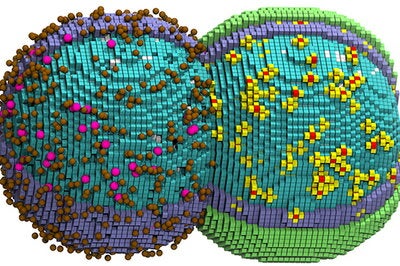
Newswise — By simulating the life cycle of a minimal bacterial cell — from DNA replication to protein translation to metabolism and cell division — scientists have opened a new frontier of computer vision into the essential processes of life.

The researchers, led by chemistry professor Zan Luthey-Schulten, present their findings in the journal Cell.

The team simulated a living cell at nanoscale resolution and recapitulated how every molecule within that cell behaved over the course of a full cell cycle. The work took many years, vast computer resources, large experimental datasets, a suite of experimental and computational techniques and an understanding of the roles, behaviors and physical interactions of thousands of molecular players. The researchers had to account for every gene, protein, RNA molecule and chemical reaction occurring within the cell to recreate the timing of cellular events. For example, their model had to accurately reflect the processes that allow the cell to double in size prior to cell division.

Watch a video of the full life cycle 4D simulation of a minimal bacterial cell. 

To make the task more manageable, the team used a living “minimal cell” developed at the J. Craig Venter Institute in California. The version of the cell used in the new study, JCVI-syn3A — “Syn3A” for short — is a modified bacterium with a pared-down genome that carries only the genes needed to replicate its DNA, grow, divide and perform most of the other functions that make life possible.

“This is a three-dimensional, fully dynamic kinetic model of a living minimal cell that mimics what goes on in the actual cell,” Luthey-Schulten said. “Such a comprehensive undertaking was only possible through the combined efforts of a host of collaborators at the U of I as well as Harvard Medical School, where we systematically modeled the essential metabolism and other subcellular networks through a series of publications starting in 2018.”

The Syn3A cell has fewer than 500 genes, all of which reside on a single circular strand of DNA. The laboratories of study co-authors Angad Mehta, a professor of chemistry, and Taekjip Ha, of Boston Children’s Hospital and Harvard Medical School, generated additional experimental data that allowed the team to accurately simulate and validate numerous aspects of cell function.

Watch a video of the first-ever whole cell 4D simulation showing everything everywhere all at once.

“Most importantly, their work revealed the extent of DNA replication and that Syn3A’s cell division is symmetrical,” Luthey-Schulten said.

Both factors guided and validated the simulations performed by Zane Thornburg, a postdoctoral fellow at the Beckman Institute for Advanced Science and Technology and the Cancer Center at Illinois, and Andrew Maytin, a graduate student in Luthey-Schulten’s lab.

Like other bacterial cells, Syn3A has no nucleus. Every molecule that comprises and sustains it is either a component of its outer membrane, is transported into it from outside the cell or is assembled in the cytoplasm. The cell is so jam-packed with molecular players that, when creating high-resolution cartoons and animations of their computer simulations, the researchers had to render some of the components invisible. Making all the cellular proteins invisible, for example, allowed the scientists to see how Syn3A’s chromosome threads through the cell’s crowded interior.

Some processes were more computationally expensive than others, the team discovered. For example, Maytin realized that chromosome replication was slowing the whole simulation to a crawl, nearly doubling the time it took to capture the whole cell cycle. He determined that efficiently simulating the cell’s DNA replication process required its own dedicated graphics processing unit, while another GPU handled all other cellular dynamics. This allowed the team to simulate the full, 105-minute cell cycle in just six days of computer time.

Thornburg and Maytin struggled with the challenge of simulating cellular events occurring at the same time in various parts of the cell.

“I can’t overstate how hard it is to simulate things that are moving — and doing it in 3D for an entire cell was … triumphant,” Thornburg said. “One of the last big hurdles that Andrew and I had to solve was understanding how the membrane and the DNA talk to one another when both are moving.”

While the simulated cell cycle has its limitations — this was not an atom-by-atom simulation but instead averaged the dynamics of individual molecules — it yielded a surprisingly accurate accounting of the timing of cellular processes. In repeated simulations involving individual cells with slightly varying start conditions, the simulated cell cycle occurred, on average, within two minutes of the real-world cell cycle, Thornburg said. The work was repeatedly guided and tested against actual experimental outcomes, a process that allowed the scientists to refine their simulations.

The ability to accurately capture the ever-changing conditions within a living cell opens a new window on the foundations of living systems, Luthey-Schulten said.

“We have a whole-cell model that predicts many cellular properties simultaneously,” she said. “If you want to know what’s going on, say, in nucleotide metabolism, you can also look at what’s going on in DNA replication and the biogenesis of ribosomes. So the simulations can give you the results of hundreds of experiments simultaneously.”

Study co-authors also include Illinois chemistry alumnus Benjamin Gilbert and John Glass, who leads the J. Craig Venter Institute Synthetic Biology Group.

This work was conducted in the National Science Foundation’s Science and Technology Center for Quantitative Cell Biology at the U of I. Luthey-Schulten also is a professor of physics and a professor in the Beckman Institute at the U. of I. The research was conducted using the Delta advanced computing and data resource, which is supported by the NSF and the state of Illinois. Delta is a joint effort of the U of I and its National Center for Supercomputing Applications.


Changing the Playing Field in Nickel Catalysis | Newswise


BYLINE: Tracy Crane, Department of Chemistry

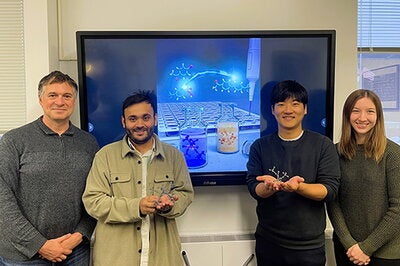
Newswise — Researchers at the University of Illinois Urbana-Champaign have reported a breakthrough in nickel catalysis that harnesses a rare oxidation state of nickel that has proved challenging to control yet is highly valued for its potential to facilitate important chemical reactions.

The researchers, led by Liviu Mirica, a professor of chemistry at Illinois, explain in a recently published paper in Nature Catalysis how they have overcome a long-standing challenge in the field of nickel catalysis by developing a new method for synthesizing thermally stable Ni(I) compounds that opens new avenues for building complex molecules.

“We have developed shelf-stable Ni(I) compounds that could dramatically change the playing field of nickel catalysis. And that’s why we have an international patent for it, and we’re working with pharmaceutical companies and chemical vendors who want to license it,” Mirica said.

Nickel-catalyzed cross-coupling reactions are widely used to form carbon–carbon and carbon–heteroatom bonds, essential steps in producing pharmaceuticals, agrochemicals, and advanced materials. Traditionally, these reactions rely on two forms of nickel – Ni(0) or Ni(II) – as catalysts. Catalytically competent Ni(I) sources have remained elusive, but attractive.

“This form of nickel is highly desirable partly because it may open up new avenues of reactivity that have remained elusive with traditional sources of nickel,” said Sagnik Chakrabarti, co-author and former graduate student in the Mirica group who worked on the project with graduate students Jubyeong Chae and Katy A. Knecht.

Mirica said previous approaches by chemists have used specialized ligands that limit the generality of Ni(I) in a reaction the way one would use Ni(II) or Ni(0) sources. By tapping into the unique properties of organic compounds called isocyanides, the Mirica group has developed a simple system that gets the chemistry to work.

In their study, they demonstrated how the commercially available isocyanides function as simple supporting ligands, which connect to the nickel atom and form stable, powerful catalysts that can be used to snap molecular pieces together with exceptional speed and precision, opening an untapped chemical space for reaction discovery.

Their Ni(I) complexes are readily available, shelf-stable, easily prepared, and easily handled catalysts that are efficient for a wide variety of chemical reactions. This is unique because most Ni(I) complexes tend to be rather unstable, which has limited their use in catalytic settings.

“We were able to put Ni(I), ‘nickel one’, in a bottle so people can use it on a wider scale for various synthetic applications,” Mirica said.

In the study, the researchers demonstrate that these new catalysts work in several of the most important reactions used to make pharmaceuticals, electronics, advanced materials, and more. They report the synthesis, characterization, and catalytic activity of two classes of Ni(I) isocyanide complexes: coordinatively saturated homoleptic compounds and coordinatively unsaturated Ni(I)-halide compounds. One is slightly more reactive than the other.

Their complexes exhibit rapid ligand substitution and demonstrate exceptional performance in Kumada, Suzuki–Miyaura, and Buchwald–Hartwig cross-coupling reactions, according to the study, and notably, they exhibit chemo-selectivity, displaying their versatility.

According to Mirica and Chakrabarti this new class of catalysts could be a game changer in nickel catalysis. Chakrabarti said there could be new reactions that could be discovered by directly introducing Ni(I) into reactions.

“And in fact, in the paper, we do talk about a new class of reactions that we developed and that has not been achieved with Ni catalysts before,” he said. “It’s just a snippet of reactivity, not like a full vignette in itself, but it still shows that by synthesizing something that’s different from what’s out there, we can maybe coax unique reactivity.”

The research team also found that a tiny amount goes a long way. 

“The interesting thing that we found is that we can use very, very tiny amounts of the nickel catalyst, which is unusual in Ni catalysis, which typically needs higher amounts of the catalyst,” Mirica said.

The study also highlights the structural diversity of isocyanides and their potential as spectator ligands for reaction discovery. Their study showed that this chemistry is not limited to just the one class of isocyanide they used, the tert-butyl isocyanide, but it’s broadly applicable to other classes of isocyanides as well.

“So, the generality in using a bunch of different isocyanides bodes well for the future development of this chemistry,” Chakrabarti said.

Future work in the Mirica group will explore the fundamental structure and bonding of these unusually stable compounds, their new reactivity, and the differences in reactivity between alkyl and aryl isocyanide-supported complexes, which, according to their study, exhibit divergent catalytic behavior.

Original release:


New Computer Simulation Could Light the Way to Safer Cannabinoid-Based Pharmaceuticals | Newswise


Newswise — New psychoactive substances, originally developed as potential analgesics but abandoned due to adverse side effects, may still have pharmaceutical value if researchers could nail down the causes of those side effects. A new study from the University of Illinois Urbana-Champaign used deep learning and large-scale computer simulations to identify structural differences in synthetic cannabinoid molecules that cause them to bind to human brain receptors differently from classical cannabinoids.

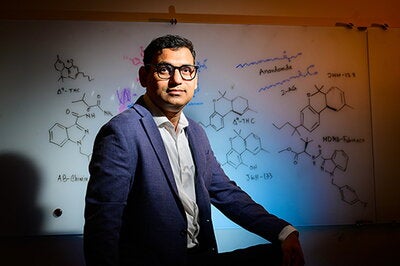
“The largest class of NPS are often sold as the street drugs Fubinaca, Chimica and Pinaca,” said chemical and biomolecular engineering professor Diwakar Shukla. “In addition to the adverse side effects, the formulas used to produce NPS vary, making them challenging to detect in standard drug screenings.”

New psychoactive substances are synthetic compounds; one class mimics the effects of classical cannabinoids. However, the study found that NPS tend to activate distinct signaling pathways in the human brain compared to classical cannabinoids. Specifically, they often trigger what’s called the “beta arrestin pathway” rather than the “G protein pathway.” This switch in signaling can lead to more severe psychological effects.

The study’s findings are published in the journal eLife.

“New psychoactive substances bind very strongly to cannabinoid receptors in the brain and are slow to unbind, making them difficult to observe and simulate in standard laboratory or computer experiments,” Shukla said. “It can take a huge amount of computer time to see these rare binding and unbinding events.”

In the lab, graduate student Soumajit Dutta used a new simulation approach, the Transition-Based Reweighting Method, to estimate the thermodynamics and kinetics of slow molecular processes. The team found that TRAM can also be used to observe the rare, slow molecular processes involved in the unbinding of NPS from cannabinoid receptors — by efficiently sampling these events that would otherwise require massive computing resources.

The researchers also used the Folding@Home platform, which enables millions of volunteers worldwide to donate computing power. This approach allowed the team to run many simulations in parallel, stitching the results together and using algorithms to decide which simulations to run next. It allows for the study of very long or rare events that would be nearly impossible with a single computer or a small cluster.

Together, these methods allowed the researchers to uncover new physical insights into how NPS interact with receptors — insights that were previously out of reach due to computational limitations — pointing the way toward the design of safer cannabinoid-based drugs that could avoid harmful side effects.

By revealing the NPS signal via pathways associated with more adverse effects, researchers can now focus on designing new molecules that avoid triggering these pathways for medical use. Shukla said their findings could direct more researchers to aim for compounds that bind less tightly or unbind more readily, potentially reducing the drugs’ harm.

The National Institutes of Health award R35GM-142745 and the National Science Foundation supported this research. Shukla is also affiliated with chemistry, bioengineering, the National Center for Supercomputing Applications, the Center for Digital Agriculture and the Carl R. Woese Institute for Genomic Biology.

Original release: