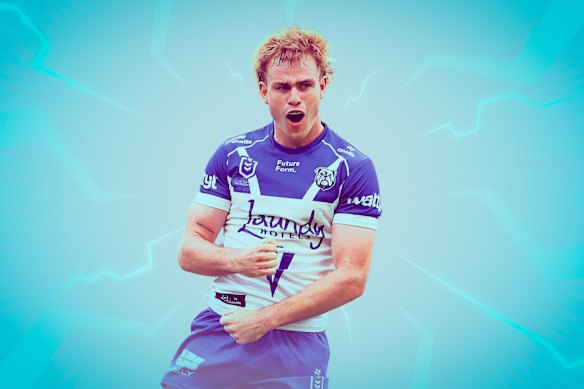

Lachie Galvin’s turbulent career hit a high point against Penrith last week. This is why
Canterbury’s attack was floundering two weeks ago – and Lachlan Galvin was part of the problem.
The promising playmaker was guilty of doing too much: too many touches, too many runs – a kid in the infancy of his career who is still learning the craft of watching, waiting and knowing when to pull the trigger.
But last week against Penrith was a turning point for Galvin, who helped orchestrate an upset against the unbeaten competition favourites.
This week presents a new challenge for Galvin as he comes up against Parramatta – the club that tried to poach him from Wests Tigers before he ended up at Canterbury. He faces another challenge, too: finding that game-winning form week in and week out.
The difference with Galvin against Penrith last week, even compared to two or three weeks ago, is that he was watching and responding to what he was seeing from the defence. It’s the cliche footballers love to use: “eyes-up footy”. But that’s exactly how Galvin was playing, and he finally found the balance between running and passing the ball.
The Bulldogs ran the ball early against Penrith, and they were pulled up for an obstruction after Jacob Preston ran into Blaize Talagi, denying him the chance to stop a charging Connor Tracey.
Rather than let it rattle them, the Bulldogs reloaded, went again and swung over to the left to put Viliame Kikau across for the first try of the night.
Once Galvin had identified the weakness in Penrith’s left-edge defence, he kept going back there all night and terrorised Talagi – an old school friend and rising talent on a similar trajectory. By full-time Talagi had racked up a remarkable nine missed tackles.
Galvin’s combination with Preston has been particularly important for Canterbury this year, but it hasn’t happened overnight.
They’ve been working together on the right edge for about 10 months now, and they’re finally starting to see the fruits of their labours.
“I loved the combination on the right side with Preston – just put that on all the time, the short passing,” Andrew Johns said of Galvin after the match.
“Look, there are still some flaws in the way he plays, but what I love about him, he wants the ball in his hands. He stands up [and says], ‘Give me the ball’. He’s still learning his game. He’s only a really young guy.
“He’s not a natural halfback, but he’s learning his trade. And if he’s learning his game, he’s learning the players around him. That combination there is building and building and building. So they got their plays.”
When Penrith hit back with an equaliser just after half-time, Galvin went back to Preston.
While they had targeted Talagi’s outside shoulder early on – slipping between him and Casey McLean – this time Galvin went for Talagi’s inside shoulder after seeing a gap open up between the five-eighth and Isaiah Papali’i. He ran the ball to the line and then passed short to Preston who went across to put the Dogs ahead once more.
Penrith didn’t score another point.
After 17 minutes of back and forth grind – the kind of footy that Penrith love – and of Canterbury making sloppy errors, the Panthers also started to make uncharacteristic mistakes.
While Penrith’s left-edge attack had been the talk of the town all year, defensively it was the chink in their armour.
With field position in Canterbury’s favour, it was a Galvin short ball to Preston once again on Talagi’s inside that opened up the Panthers again, and a supporting Sitili Tupouniua went across to score the match-winner.
With that combination seemingly humming, the next step in Galvin’s game is to form those combinations across the field.
“He has to get to the other side and build his game with Viliame Kikau,” Johns said in commentary.
“He has to work out how to get to Tupouniua into space. He has to work on his plays for the dummy half. He has to work on his plays here with Bailey Hayward. That’s the part of the halfback.
“You’ve got different parts of the field. You need to work your game out from [those] different parts of the field, but what compliments the players in the back row and the centres and the fullback. But [it was a] big game for him tonight, big game.”
Coach Cameron Ciraldo was hesitant to label the performance Galvin’s best in the NRL. But he couldn’t deny the improvement in his young half’s decision-making.
“It was his 50th game tonight – a lot of people say it takes 50 games to feel like an NRL player or understand it a lot. I thought he was brilliant,” Ciraldo said after the match.
“He controlled the game for long periods, he did what he needed to do, he didn’t overplay his hand, he’s improving every week. And, he has to deal with a fair bit, Lachy. There’s always question marks asked about him and he’s handled it great.”

