
Glass vs. PVC Ant Farm: The Real Differences Every Ant Keeper Should Know
Ant keeping has come a long way from the flat sand-filled plastic frames sold in toy stores. Modern formicariums are precision-built environments designed to support queen-right colonies of hundreds to thousands of workers — with humidity gradients, ventilation systems, modular expansion ports, and materials chosen deliberately for colony health.
Two materials dominate serious ant keeping: glass (including acrylic, which is often sold alongside glass as a “clear” option) and PVC. Both have dedicated followings in the hobby, and both have genuine strengths. But they differ meaningfully across observation clarity, humidity behavior, escape security, modularity, weight, and species suitability.
Whether you’re setting up your first colony of Lasius niger or scaling up a Camponotus collection, understanding what each material actually does for your ants — and for you as a keeper — is the foundation of a successful setup.
Table of Contents
Understanding Formicarium Materials: The Landscape
In the ant keeping hobby, “ant farm” and “formicarium” are used interchangeably — the formicarium is the structure where the colony lives, nests, and raises its brood. The outworld (foraging arena) is a separate connected space where ants feed, explore, and deposit waste.
The material of the formicarium — its walls, base, and cover — determines:
-
How well humidity is retained in the nest chambers
-
How clearly you can observe the colony
-
How effectively ants are prevented from escaping
-
How the system connects, expands, and scales
-
How the nest responds to heating and moisture over time
The two dominant choices for the nest body are glass/acrylic and PVC. Both are non-toxic, durable, and widely available from dedicated ant keeping retailers. They are not interchangeable, and the differences matter for long-term colony health. (Best Ants UK)
Glass and Acrylic Ant Farms: What They Are
Glass and acrylic formicariums share one defining property: transparency. Both materials allow full, unobstructed observation of the nest interior from outside. In the ant keeping hobby, these two are often grouped together because their functional behavior is similar — though they differ in scratch resistance and weight.
Glass is harder, heavier, and more scratch-resistant. It maintains optical clarity over years of use, does not yellow with age or UV exposure, and is chemically inert. Higher-end glass formicariums are machined or cast with pre-formed tunnel networks, often filled with plaster, sand, or moisture-retaining substrate between the glass panels.
Acrylic (PMMA/plexiglass) is lighter, easier to machine and customize, and cheaper to produce — making it the dominant material in commercially manufactured transparent formicariums. Quality acrylic is optically clear and strong, but it scratches more easily than glass and can develop surface hazing over time with repeated cleaning or contact with rough substrate. (Best Ants UK)
For purposes of this guide, “glass” refers to the category of fully transparent formicariums — both true glass and acrylic — since their relevant properties for ant keeping are closely aligned.
PVC Ant Farms: What They Are
PVC (polyvinyl chloride) formicariums are purpose-built ant habitats with solid, opaque PVC panels forming the body of the nest — typically with a transparent front panel (acrylic or glass) for viewing. The interior of the nest is carved, routed, or cast into the PVC material itself, or fitted with a removable inner layer containing tunnel networks.
PVC’s key functional properties in this context are:
-
Very low moisture permeability — it does not absorb or release water
-
High chemical resistance — tolerant of cleaning products and disinfectants
-
Structural rigidity — resistant to warping, cracking, and impact
-
Opaque sides — blocks ambient light from all but the viewing panel
-
Excellent compatibility with silicone-sealed fittings and tube connector ports
Modern PVC formicariums are typically modular — designed with standardized connector ports (usually 9mm or 12mm diameter) that accept ant-proof tubing to link nests, outworlds, additional chambers, and water ports. Brands like AntsCanada’s Hybrid Nest system, ANTCUBE, and numerous dedicated ant keeping retailers offer PVC-based systems with strong ecosystem compatibility.
Observation Clarity and Visibility
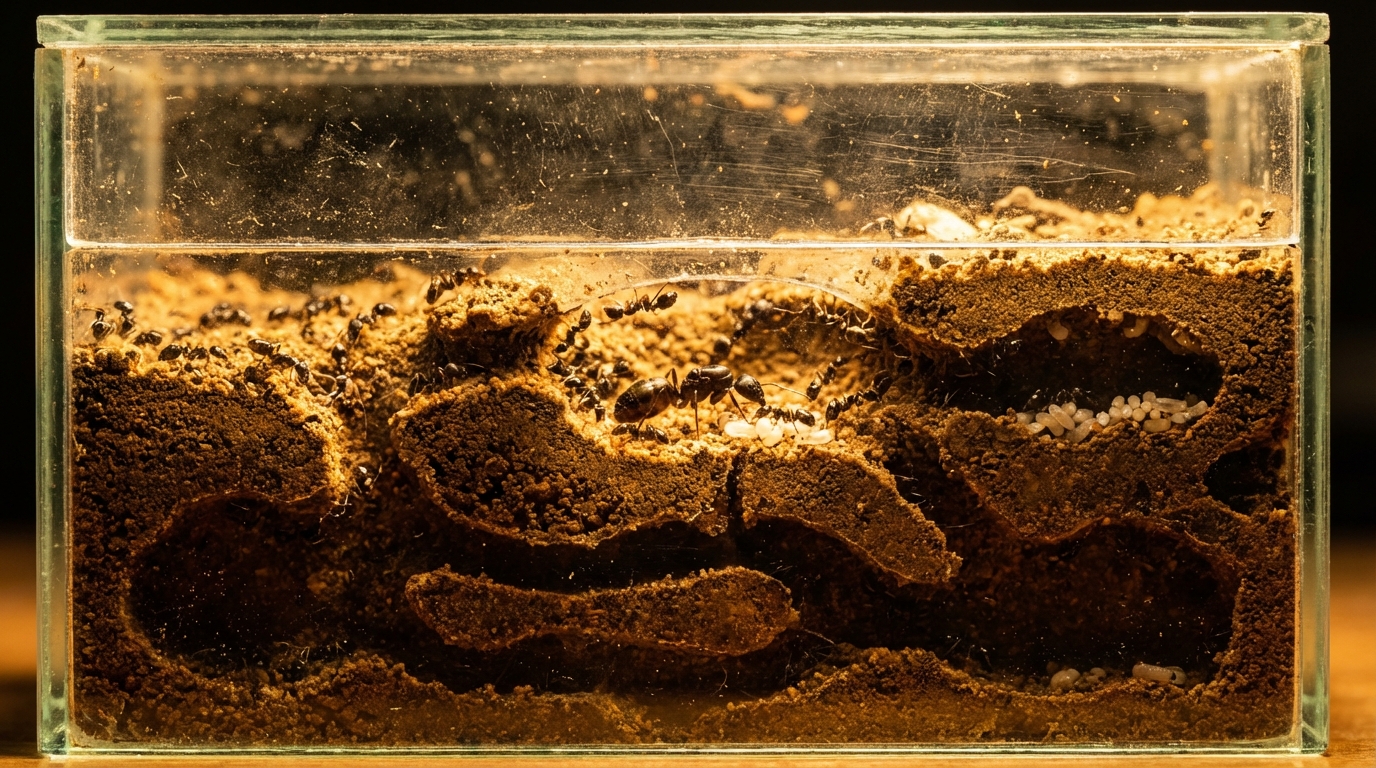
Glass/acrylic wins clearly here. Full transparency allows observation of colony activity from every angle — you can watch individual workers, track brood development stages (eggs, larvae, pupae), monitor the queen’s position and egg-laying activity, and observe complex tunnel architecture in real time.
For many ant keepers, this observability is the primary reason they keep ants. Being able to watch a functioning colony from the outside — the movement of workers, the care of brood, the organization of chambers, the coordination of foraging trails — is the entire point of the hobby. Glass formicariums make this possible at the highest level of detail.
PVC offers limited visibility. The solid opaque body means you can only observe ants through the single viewing panel. This significantly restricts what you can see at any given moment. Workers along the back or side channels, the queen in an interior chamber, or early-stage brood development may be entirely out of view. Many PVC formicariums compensate with thoughtful chamber layout that routes primary activity areas toward the front panel — but it remains a fundamental constraint compared to glass.
The light consideration: Ants are sensitive to light. Most ant species naturally nest in complete darkness, and exposure to ambient light can cause the colony to avoid nest chambers, increase stress behavior, and reduce brood survival in some sensitive species. Glass formicariums that are fully transparent on all sides expose the colony to light from multiple angles simultaneously.
Best practice for glass formicariums: Cover three sides with a removable dark cloth, foam sheet, or opaque cover when not actively observing. This creates a dark resting environment and only exposes the colony to light during observation windows. This is standard practice in the ant keeping community and effectively addresses the light sensitivity issue without sacrificing visibility. (Reddit r/antkeeping)
PVC’s opaque sides inherently solve the light problem — but at the cost of all-angles visibility.
Humidity Control: The Most Critical Variable
This is where the two materials diverge most significantly — and where the choice most directly affects colony health.
Why humidity is paramount in ant keeping: Ant colonies require precise humidity gradients within the nest. The brood chamber — where eggs, larvae, and pupae are kept — typically needs 70–85% relative humidity depending on species. Desiccation of brood is a leading cause of colony failure in captive setups. At the same time, excess moisture without adequate airflow encourages mold and bacterial growth that can devastate a colony. The balance between adequate humidity and appropriate ventilation is the core husbandry challenge in ant keeping.
Glass/acrylic formicariums and humidity: Glass and acrylic are non-porous and do not absorb or retain water. Humidity is typically managed through substrate materials packed between or beneath the glass panels — plaster of Paris, compressed earth, or moistened cotton. These materials act as humidity reservoirs, releasing moisture slowly into the nest chambers. The keeper waters the substrate periodically by adding water to a designated port or water zone.
This system works well when the substrate is correctly chosen and properly maintained. Plaster of Paris is particularly effective — it absorbs water and releases it gradually, maintaining a stable humidity gradient without puddling. The challenge is that glass/acrylic nests with pure plaster substrate require the keeper to monitor moisture levels carefully and re-wet regularly. The glass walls themselves do not contribute to humidity regulation.
PVC formicariums and humidity: PVC is also non-porous. However, PVC formicariums are typically designed with a dedicated hydration port — a side or back entry point through which water is added directly to a water reservoir or wet cotton zone within the nest. Because PVC’s opaque walls seal the interior more completely than glass (which often has micro-gaps at seams or covers), PVC systems tend to maintain humidity more passively, with less frequent keeper intervention.
PVC’s sealed construction also reduces the evaporation rate from the nest environment, helping maintain stable interior humidity even in dry ambient room conditions. For high-humidity species — many tropical ants, carpenter ants (Camponotus spp.), weaver ants (Oecophylla spp.) — PVC’s more closed environment is a genuine advantage.
Important note on substrate: The nest body material (glass or PVC) is the outer shell — the actual humidity regulation happens through the internal substrate and water management system. Both glass and PVC formicariums can house plaster substrates, compressed earth, or other moisture-retaining materials. The material choice affects how easily humidity is maintained and how much keeper intervention is required, not whether humidity regulation is possible. (Best Ants UK)
Escape Security
Ant escapes are a universal concern in the hobby — particularly with small-bodied species that can fit through micro-gaps, or strong-jawed species like Messor barbarus (harvester ants) that can physically chew through soft materials.
Glass/acrylic security: Glass itself is indestructible by ants. Acrylic is also effectively impossible for most species to breach by chewing. The escape risk in glass formicariums comes from gaps and seams — anywhere two components meet, where a lid connects, where tubing enters, or where silicone sealant has degraded over time. Micro-gaps at covers and access points are the primary escape routes.
Quality glass formicariums use precision-fit lids with silicone gaskets, anti-escape barriers (PTFE/Fluon applied to the outworld walls as a slippery zone ants cannot cross), and sealed access ports. When properly assembled and maintained, glass systems are highly escape-proof.
PVC security: PVC body panels present a different risk: some strong-jawed ant species (Messor species in particular) are physically capable of chewing through or enlarging gaps in soft materials adjacent to PVC, including silicone sealant. However, PVC itself is resistant to ant chewing.
PVC formicariums typically feature threaded or press-fit connector ports with friction-fit ant-proof tubing, which creates secure connections less prone to micro-gap formation than flat-panel glass seams. Most quality PVC systems integrate escape prevention into the design — including port caps, mesh-screened ventilation slots, and anti-escape fluid application points.
Both materials require Fluon/PTFE application in the outworld (foraging arena) to prevent ants from climbing out over the walls. This is standard practice regardless of nest material. Apply a 2–3 cm band of PTFE anti-escape barrier around the upper interior of any outworld that isn’t fully enclosed. (Best Ants UK)
Modularity and Colony Expansion

This is one of the strongest practical advantages of modern PVC systems.
Ant colonies grow. A founding queen may start with a handful of workers and grow to thousands over months and years. A formicarium that fits a colony of 50 workers is severely inadequate for a colony of 2,000. The ability to expand the system — adding nest chambers, connecting additional foraging arenas, linking water stations — is a core requirement for long-term keeping.
PVC modularity: Quality PVC formicariums are engineered around standardized port sizes (typically 9mm or 12mm) that accept ant-proof tubing. Adding a new nest section, a larger outworld, or a secondary feeding chamber is as simple as connecting a new unit with tubing. Systems like AntsCanada’s Hybrid Nest series, ANTCUBE by ANTSTORE, and many custom fabricators design their entire product lines around interconnection — so a starter nest can grow into a multi-chamber complex without replacing the original unit.
Glass/acrylic modularity: Many glass and acrylic formicariums also incorporate connector ports — this is increasingly standard in the hobby. However, glass systems are generally less consistently modular across brands, and the rigidity of glass panels makes custom expansion more difficult. Some glass formicariums are designed as sealed, standalone units with no port provision, requiring ants to be physically moved (a stressful and risky process) when the colony outgrows the space.
For long-term keeping, modularity matters more than most beginners anticipate. Colonies grow faster than expected. Investing in a modular system from the start — whether glass or PVC — saves the disruption and colony stress of repeated forced migrations.
Weight, Durability, and Handling
Glass: Heavier. A larger glass formicarium can be unwieldy to move, clean, or reposition. True glass panels are breakable — a dropped glass nest can shatter, potentially releasing the colony and destroying months of work. Tempered glass reduces (but doesn’t eliminate) this risk. Acrylic is lighter than true glass but more prone to surface scratching.
PVC: Significantly lighter than equivalent glass units. Impact-resistant — PVC does not shatter. Easier to handle, reposition, and transport. PVC can potentially deform near improperly positioned heat mats or excessive heat sources, but this is manageable with a calibrated thermostat.
Long-term surface condition: Glass maintains optical clarity indefinitely and does not yellow. Acrylic can develop micro-scratches over time from cleaning, substrate contact, or ant mandibles — gradually reducing viewing clarity. PVC panels are not transparent, so surface condition is less critical; the viewing panel (often acrylic) is the component to protect.
Condensation and the Glass Problem
One practical challenge specific to fully transparent glass/acrylic formicariums is condensation — moisture beading or filming on interior glass surfaces when humidity inside the nest is higher than ambient room temperature.
Condensation obscures observation, makes photography difficult, and can mislead keepers into thinking humidity is adequate when the actual nest substrate may still be underwatered. It also creates water droplets on interior walls that worker ants can become trapped in or drown in if accumulated.
Causes: Condensation forms when warm, humid air inside the nest contacts cool glass walls. It is most common in enclosed glass nests with high-humidity species, in cooler rooms, or when the formicarium is placed near air conditioning.
Solutions:
-
Ensure adequate (but not excessive) ventilation in the lid or cover
-
Avoid overcooling the ambient room below nest temperature
-
Use plaster or earth substrate (which absorbs excess moisture) rather than relying solely on water pooling
-
Tilt the formicarium slightly so condensation runs toward the substrate rather than pooling in chambers
PVC formicariums, with their opaque solid walls, do not produce visible condensation — though moisture management remains equally important internally.
Species-Specific Recommendations
Different ant species have different environmental requirements that favor one material over the other:
Glass/Acrylic Is Well-Suited For:
-
Lasius niger (Black garden ants) — moderate humidity needs (75–85% in nest), manageable in glass with plaster substrate; excellent observation of their tunnel-building behavior
-
Formica species — require strong ventilation and open tops; glass formicariums with well-ventilated lids are appropriate; Note: Formica species will perish in fully sealed setups
-
Myrmica rubra — moderate requirements compatible with glass plaster nests
-
Small to medium beginner colonies — glass formicariums are ideal for the founding stage (queen + first workers), where close observation is especially rewarding
-
Display and photography-focused setups — glass’s optical clarity is unmatched for documentation
PVC Is Well-Suited For:
-
Camponotus species (Carpenter ants) — high humidity requirements; PVC’s sealed construction and water port system maintains the sustained moisture these ants need
-
Messor barbarus (Harvester ants) — strong jaws require robust materials; PVC resists chewing; separate humidity zones (damp brood area, dry seed storage) are easier to engineer in PVC
-
Ball python-equivalent setups for tropical ant species — any species requiring consistently high humidity (70–85%+ in nest, lower in outworld) benefits from PVC’s passive humidity retention
-
Large, mature colonies — PVC’s modularity, weight advantage, and stackability make it practical for managing multi-thousand-worker colonies
-
Multi-colony collections — consistent port sizing across PVC systems simplifies management of several colonies simultaneously
Either Works For:
-
Tetramorium caespitum (Pavement ants) — adaptable, moderate requirements
-
Pheidole species — flexible keepers that do well in both glass and PVC
-
Most beginner-friendly European species — glass for observation focus; PVC for lower-maintenance humidity management
What About Other Materials? Plaster, Ytong, and Sand
The ant keeping hobby uses several other nest materials worth understanding in context:
Plaster of Paris / Gypsum: One of the most recommended internal nest materials. Absorbs and releases moisture evenly, creates a naturally cool microclimate, and is workable (can be hand-carved). Often used as the filling between glass or acrylic panels, or as a standalone cast nest. Ants cannot chew through cured plaster. Excellent humidity regulation. Widely recommended for beginners.
Sand-loam substrate: Used in natural/bioactive ant farms. Allows ants to excavate their own tunnels — closer to natural behavior. Excellent for Messor barbarus and other burrowing species. Requires more monitoring (tunnels collapse, humidity distribution is uneven) but provides rich behavioral observation.
Ytong (aerated concrete): A porous building material once popular in DIY formicariums for its softness and ease of carving. Currently not recommended by experienced ant keepers. Ytong can emit toxic gases when repeatedly exposed to moisture, and its structural integrity degrades with repeated wetting and drying cycles. Avoid. (Best Ants UK, Best Ants UK — Beginners Guide 2025)
Gel farms: The blue or clear gel formicariums popular as children’s toys. Not recommended for living colonies. Gel does not provide adequate nutrition, lacks proper humidity gradients, and colonies housed in gel farms consistently show reduced brood survival and premature colony failure. The gel serves as both food and substrate, which creates toxic byproduct buildup as colonies grow.
Concrete formicariums (mass-market imports): Often sourced from overseas marketplaces and marketed cheaply. Generally avoid — similar toxic gas concerns to Ytong when exposed to moisture, inconsistent quality, and poor humidity regulation. (Best Ants UK — Beginners Guide 2025)
Complete Comparison Table
| Feature | Glass / Acrylic | PVC |
|---|---|---|
| Observation clarity | Excellent — 360° transparency | Limited — front panel only |
| Light exposure to colony | High (requires covering) | Low (naturally dark) |
| Humidity retention | Moderate (substrate-dependent) | Good (sealed construction) |
| Humidity management effort | Higher — more frequent monitoring | Lower — more passive |
| Condensation risk | Yes — can obscure viewing | No — opaque walls |
| Escape security | High (gap-dependent) | High (port-designed) |
| Modularity / expandability | Variable (brand-dependent) | Excellent (standardized ports) |
| Weight | Heavier (glass) / lighter (acrylic) | Lighter than glass |
| Impact resistance | Moderate (glass breaks; acrylic doesn’t) | High — impact resistant |
| Scratch resistance | High (glass) / moderate (acrylic) | High on PVC; moderate on view panel |
| Suitable for Ytong? | N/A — avoid Ytong regardless | N/A — avoid Ytong regardless |
| Best substrate | Plaster, sand-loam, earth | Plaster, cotton, earth |
| Species range | Broad — especially low–moderate humidity | Broad — especially high humidity |
| Upfront cost | Lower to moderate | Moderate to higher |
| Long-term scalability | Moderate (varies by design) | Excellent |
| Best for | Observation, beginners, small colonies | Humid species, large colonies, collections |
Who Should Choose Glass vs. PVC?
Choose glass/acrylic if:
-
Observation and photography are your primary goal — watching your colony is the whole point
-
You’re keeping a beginner-friendly species with moderate humidity needs (Lasius niger, Tetramorium, Formica with ventilated lids)
-
You’re in the founding stage (queen + first workers) where close monitoring of brood development matters most
-
Budget is a priority — glass formicariums are generally lower cost for starter sizes
-
You want a display setup that looks impressive from all angles
Choose PVC if:
-
You’re keeping high-humidity species (Camponotus, Messor barbarus, tropical ants)
-
You’ve struggled with maintaining consistent humidity in glass
-
You’re planning to expand — PVC’s modular port system grows with your colony
-
You’re keeping multiple colonies and want consistent system compatibility
-
You value lower daily maintenance over maximum visibility
-
You’re scaling up to a serious collection
The honest bottom line: Neither glass nor PVC is universally superior. Glass delivers unmatched colony observation at the cost of more active humidity management. PVC simplifies moisture control and expansion at the cost of visibility. The best keepers often use both — glass for high-observation founding chambers and smaller display colonies, PVC for established high-humidity colonies and scalable multi-unit setups.
Browse the ant keeping collection at Talis-us — including quality formicariums, colony starter kits, plaster substrates, and ant keeping accessories curated to our Talis Curated standards.
Shop the Best Ant Farm Kits at Talis-us
Ready to start your first colony — or upgrade your current setup? Talis-us carries the full line of ANTCUBE professional formicariums, precision-crafted in Germany and trusted by ant keepers worldwide. Each kit ships with everything you need to get started: a glass nest, outworld arena, connector tubing, and a hydration system. No sourcing individual parts, no guesswork.
Here are our top-selling starter sets, hand-selected to our Talis Curated standard:
🏆 #1 Best Seller — ANTCUBE Starter Set L – Combi (20×20cm)
The most popular ant farm kit we carry — and for good reason. The Combi configuration pairs the ANTCUBE glass nest with a matching arena and all connection essentials. The “L” size gives your colony room to grow through the early to mid-growth stages without needing an immediate upgrade. Ideal for Lasius niger, Camponotus species, and most beginner-friendly colony sizes.
-
✅ Full kit: glass nest + arena + tubing + hydration system
-
✅ Expandable with additional ANTCUBE modules
-
✅ Made in Germany — precision-fit glass panels, anti-escape design
-
💰 $121.99
$149.99— Save 19%
👉 Shop ANTCUBE Starter Set L – Combi
🥈 #2 — ANTCUBE Starter Set M – Combi (20×20cm)
The medium Combi kit is the go-to choice for keepers starting with a founding queen or a small colony of 10–50 workers. The 20×20cm footprint is compact enough to fit comfortably on a desk or shelf, while the glass construction delivers unobstructed views of every tunnel, chamber, and brood pile.
-
✅ Perfect for founding colonies and small starter setups
-
✅ Same premium ANTCUBE glass quality as the L size
-
✅ Connects directly to larger modules as your colony grows
-
💰 $121.99
$149.99— Save 19%
👉 Shop ANTCUBE Starter Set M – Combi
🥉 #3 — ANTCUBE Starter Set S – Combi (20×20cm)
The small Combi is purpose-built for founding queens housed in test tubes transitioning to their first true formicarium. If you’ve caught a queen or received a colony of fewer than 10 workers, the S kit provides the right-sized environment — not too large, not too small — for the critical early colony growth phase.
-
✅ Ideal for single founding queens and very small colonies
-
✅ Compact footprint — easy to monitor and maintain
-
✅ Grows with your colony via ANTCUBE’s modular system
-
💰 $121.99
$149.99— Save 19%
👉 Shop ANTCUBE Starter Set S – Combi
🌿 Premium Pick — ANTCUBE Starter Set L – Cork (20×20cm)
For keepers who want a naturalistic aesthetic alongside professional performance, the Cork nest delivers. The cork insert creates a visually stunning, biologically active nest surface — ants interact with the textured cork substrate for a more enriched, natural behavior environment. A favorite among experienced keepers and photography enthusiasts.
-
✅ Natural cork nest insert for enriched colony behavior
-
✅ L-size capacity for growing colonies
-
✅ Stunning appearance — a display piece as much as a formicarium
-
💰 $339.99
$399.99— Save 15%
👉 Shop ANTCUBE Starter Set L – Cork
🔬 Advanced Pick — ANTCUBE Starter Set M – Digfix (20×20cm)
The Digfix configuration features a specialized digging substrate insert — a mineral compound that lets ants excavate and construct their own tunnel network inside the nest, just as they would in the wild. The result is a living, ever-changing architecture that reflects your colony’s real behavior and preferences. Best suited for intermediate keepers comfortable with active humidity management.
-
✅ Ants build their own tunnels in the Digfix substrate
-
✅ Unmatched naturalistic behavior observation
-
✅ Substrate can be rehydrated and re-excavated over time
-
💰 $320.99
$349.99
👉 Shop ANTCUBE Starter Set M – Digfix
🏛️ Large Scale — Ytong Nest + Arena Set (40×20cm)
For keepers ready to house an established mid-to-large colony, the Ytong Nest + Arena Set at 40×20cm provides serious capacity. The aerated concrete nest body is hand-carved with interconnected chambers and tunnels across a full 40cm footprint — enough space for colonies of several hundred to a few thousand workers. The accompanying arena gives foragers ample space to explore and feed.
Note: While Ytong carries a caution in some DIY contexts, this is a commercially manufactured, properly cured ANTCUBE product designed and tested for safe ant keeping use. It differs from raw DIY Ytong applications.
-
✅ Full 40×20cm nest — generous capacity for growing colonies
-
✅ Pre-carved tunnel network ready for colony introduction
-
✅ Includes matching arena
-
💰 $199.99
$249.99— Save 20%
👉 Shop Ytong Nest + Arena Set
Not Sure Which Kit to Choose?
| Your Situation | Recommended Kit |
|---|---|
| First-ever ant, founding queen | Starter Set S – Combi |
| Small colony, beginner keeper | Starter Set M – Combi |
| Growing colony, most keepers | Starter Set L – Combi ⭐ Best Seller |
| Nature-focused, display setup | Starter Set L – Cork |
| Ants-build-their-own tunnels | Starter Set M – Digfix |
| Established colony, 200+ workers | Ytong Nest + Arena Set 40×20 |
👉 Browse the full ANTCUBE ant keeping collection at Talis-us →
Setup Tips for Either Material
Both glass and PVC:
-
Always use distilled water for hydration — tap water contains minerals that promote mold growth and can harm the colony over time
-
Apply PTFE/Fluon anti-escape fluid to the interior upper walls of the outworld — a 2–3 cm band that ants cannot grip or cross
-
Use a digital hygrometer placed at nest level to verify actual humidity, not just estimate it
-
Never disturb the queen during observation — minimize direct lighting on the queen chamber; if possible use infrared cameras for queen monitoring
-
Maintain consistent temperature between 20–26°C for most species; use a heat mat covering one quarter of the nest area connected to a calibrated thermostat
-
Start small — a colony of 10–50 workers needs a small formicarium. Over-sizing a nest for a small colony causes ants to avoid the nesting area and increases difficulty controlling the microclimate
-
Avoid Ytong, gel farms, and cheap concrete imports — the cost savings are not worth the risk to your colony
Glass-specific:
-
Cover three sides with dark foam or cloth between observation sessions
-
Re-wet plaster substrate before it shows visible drying or color lightening
-
Watch for condensation buildup — if persistent, improve lid ventilation slightly
-
Inspect seams and lid gaskets regularly for micro-gaps
PVC-specific:
-
Confirm all port connections are fully seated before introducing ants
-
Use a thermostat with any heat mat — PVC’s insulation means heat builds quickly
-
Clean the viewing panel with a microfiber cloth only — abrasive cleaners scratch acrylic viewing panels
FAQs
Is glass or PVC better for a first ant farm? For most beginners with common species like Lasius niger or Tetramorium, glass/acrylic is a great starting point — the visibility makes learning the hobby genuinely rewarding. For beginners specifically keeping Camponotus or other higher-humidity species, PVC is the more forgiving choice from day one.
Can ants chew through glass or PVC? No ant species can chew through glass, acrylic, or PVC. The escape risk in glass comes from seam gaps and lid fittings, not the material itself. Messor barbarus (harvester ants) are strong enough to enlarge small gaps in soft materials adjacent to the nest — but not through the primary nest body.
Why is Ytong no longer recommended? Ytong (aerated concrete) releases toxic compounds when repeatedly moistened and dried, which can harm or kill ant colonies over time. Its structural integrity also degrades with repeated wet-dry cycling. Modern plaster, sand-loam, and earth substrates are safer and perform better for humidity regulation.
What is the best substrate to put inside a glass formicarium? Plaster of Paris (gypsum) is widely considered the best starter substrate for glass formicariums — it absorbs and releases moisture gradually, maintains stable humidity, and allows clear observation through the glass. For natural/bioactive setups, a sand-loam mixture is excellent, particularly for burrowing species.
Do I need a hygrometer for an ant farm? Yes — a digital hygrometer placed at nest level is strongly recommended for any serious setup. Estimating humidity by feel or visual inspection of the substrate is unreliable. Most ant keepers also use a digital thermometer at the same time, since both temperature and humidity directly affect brood development.
What is a Hybrid Nest formicarium? A hybrid nest (popularized by AntsCanada) combines a moisture-retaining internal substrate (such as plaster or compressed earth) housed within a PVC outer shell, with an acrylic or glass viewing panel on one side. The result is a system that delivers the humidity-retaining and modular advantages of PVC with front-facing visibility comparable to acrylic nests — widely regarded as one of the best all-around formats for intermediate and advanced keepers.
Are gel ant farms safe? Gel formicariums are not recommended for living ant colonies. While ants will initially dig tunnels in the gel, the material does not provide adequate nutrition, creates toxic byproduct buildup as colonies grow, and gel farms consistently show poor brood survival and colony failure. They are best regarded as novelty observation devices, not serious ant keeping setups.
How often do I need to water a glass formicarium? This depends on the substrate, the species, the ambient room humidity, and the seal quality of the formicarium. As a rough guideline: check the plaster substrate color every 2–3 days — when it lightens noticeably from its wet color, add a small amount of distilled water through the water port. During summer or in dry climates, this may be every 2–3 days; in humid winters, once a week may be sufficient. Always use distilled water.
This article is for informational and educational purposes. Ant keeping requirements vary by species — always research the specific needs of your colony, and consult experienced keepers in established communities for species-specific guidance.