
Artemis II astronauts are ‘bonded forever,’ Reid says
‘We launched as friends and came back as best friends’
Article content
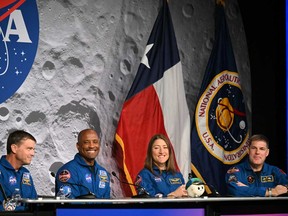
Six days after returning to Earth following the historic Artemis II mission, the four astronauts who embarked on the lunar fly-around shared a message of camaraderie and optimism for the future during their first press conference since their splashdown last Friday.
Advertisement 2

Article content
“We launched as friends and came back as best friends,” said Cmdr. Reid Wiseman, reflecting on spending 10 days with his crewmates in a tight space.
Article content
Article content
The 50-year-old led the four-person crew, consisting of pilot Victor Glover, and mission specialists Christina Koch and Canada’s Jeremy Hansen.
“We are bonded forever,” the naval aviator-turned-astronaut later said of his crew. “No one down here is ever going to know what the four of us just went through, and it was the most special thing that will ever happen in my life.”
The commander kicked off Thursday’s news conference at NASA’s Johnson Space Center in Houston, sharing the crew’s immense gratitude to the world.
“We’re just going to start by thanking the world,” said Wiseman. “We were certainly hooked on this mission, but when we came home, we were shocked at the global outpouring of support, of pride, of ownership of this mission.”
Space flight broke barriers in more ways than one
It was the first lunar mission in more than 50 years, with the journey being the furthest ever travelled in human spaceflight, clocking in at 400,171 km from Earth.

Your Midday Sun
Article content
Advertisement 3
Article content
Glover also made history as the first Black astronaut to pilot a lunar mission, while Koch became the first woman to travel to the far side of the moon.
London, Ontario’s Hansen became the first non-American to fly around the moon.

It was a ‘team effort’
“Everything we did was a four-person activity — a minimum of everything; how we ate, slept, flew the vehicle. And some of it was on purpose, but a lot of it was realized in real-time,” Glover said.
“It was a team effort to the last period,” he added.
Hansen reacts to how the mission united the public
Canadian Hansen described his hopefulness in humanity when he found out later how the public was following along on their mission.
“Humans are just great people, in general. We don’t always do great things … but our default is to be good and to be good to one another, he said.
“And what I’ve seen has brought me more joy … more hope for our future. And I just can’t wait to see what we do with it next.”
In the days since the crew have been back, they’ve been undergoing mandatory medical checks and technical debriefings.
Advertisement 4
Article content
Koch said the impact the mission had on everyone on earth meant a lot to the crew.
“It was every bit as important as accomplishing the (mission’s) technical goals,” she said.
Read More
-

ARTEMIS II SPLASHDOWN: Crew makes dramatic return to Earth
-

WARMINGTON: Carney lauds Jeremy Hansen’s French from space on Artemis II
-
NASA releases ‘Earthset’ shot after Artemis II makes lunar flyby
-

Canadian astronaut Jeremy Hansen, Artemis II crew make space travel history
Smoke detector going off was ‘tense’
Aside from the infamous space toilet issue, Wiseman said the crew had to deal with a problem with their smoke detector on the second-last day, and “a few cautions and warnings” that came up during the flight.
“You want to get somebody’s attention really quick? Make the fire alarm go off in your spacecraft when you’re still about 80,000 miles from home,” he said. “It wasn’t scary, but it was tense for a few minutes until we got things reconfigured.”
But Wiseman also expressed his faith in the future Artemis projects being completed safely based on this flight.
Advertisement 5
Article content
“They could put the Artemis III Orion on the space launch system tomorrow and launch it and the crew would be in great shape,” he said.
Regarding the toilet, Wiseman spoke highly of it, calling it “wonderful” and saying, “it worked great,” but a clogged vent line meant that the crew couldn’t “flush” it.
What comes next?
Artemis II was meant to test out the Orion spacecraft, making sure its life-support, communication and navigation systems would work for future NASA-led moon missions.
The space agency is already planning Artemis III, with a targeted launch of 2027, to test rendezvous and docking capabilities between Orion and a commercial spacecraft needed to land astronauts on the moon. Four astronauts are expected to make up the crew.
NASA says Artemis IV, scheduled for 2028, will see two astronauts landing on the moon’s south pole.
Article content