
Wallaby the guinea pig in Super Rugby’s new pre-game concussion protocol
“The whole intent is to continue to strengthen our approach in the competition to player welfare,” Mesley said. “It [the Katoa incident] was obviously a really visible incident, which I guess just strengthened our resolve to make sure that we are looking at warm-ups and putting the player’s wellbeing right up front.
“The fact that we have all the expertise on the field in stadiums during warm-up, and we’ve got all the technology there as well with the mouth guards, it seems like a logical step to make use of our match-day doctors, our team doctors, the technology and to take it into warm-ups.”
While acknowledging the trial changes may have caught teams on the hop early in the season, Mesley said the Donaldson incident was, overall, a good outcome.
“It’s a fantastic result for the process and fantastic result for the player that it was dealt with. And that’s precisely its intent,” he said. “For our first crack at it, the ultimate goal was achieved. We put the players’ wellbeing up as the priority. That is the key success factor.”
But a big part of the Force’s panicky scramble in the minutes before kick-off was whether they should roll the dice on Donaldson passing, or withdraw the No.10 from the game before kick-off, given a player who fails an HIA during a game is counted as a replacement.

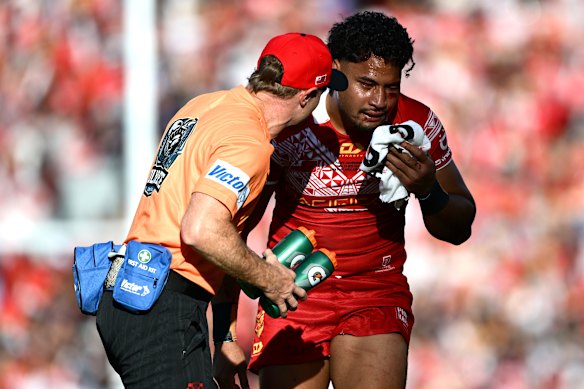
Eli Katoa’s career is under a cloud after suffering three head knocks playing for Tonga.Credit: Getty Images
Some argue it should be a free substitution for a concussed player, so there is never a disincentive for players and teams to be transparent and co-operative around head knocks.
“Being a global first and a trial in partnership with World Rugby, we’ll look at all of those things,” Mesley said.
“There’s been some good discussion since and feedback from teams and questions from teams. Our guys, led by our CMOs, will continue to look at those things and just make sure they’re as streamlined as possible.
Loading
“Obviously being the first one with a new process, there’s also probably a job to do around communication, so everyone knew what was happening.”
The NRL is reportedly also looking to introduce extend concussion protocols to pre-game warm-ups as part of its response to the Katoa incident. The NRL is yet to finalise the outcome of its investigation, which resulted in breach notices – and potential two-year bans – to the Tonga team’s head and assistant doctors, and head trainer. The trio appealed the sanctions.