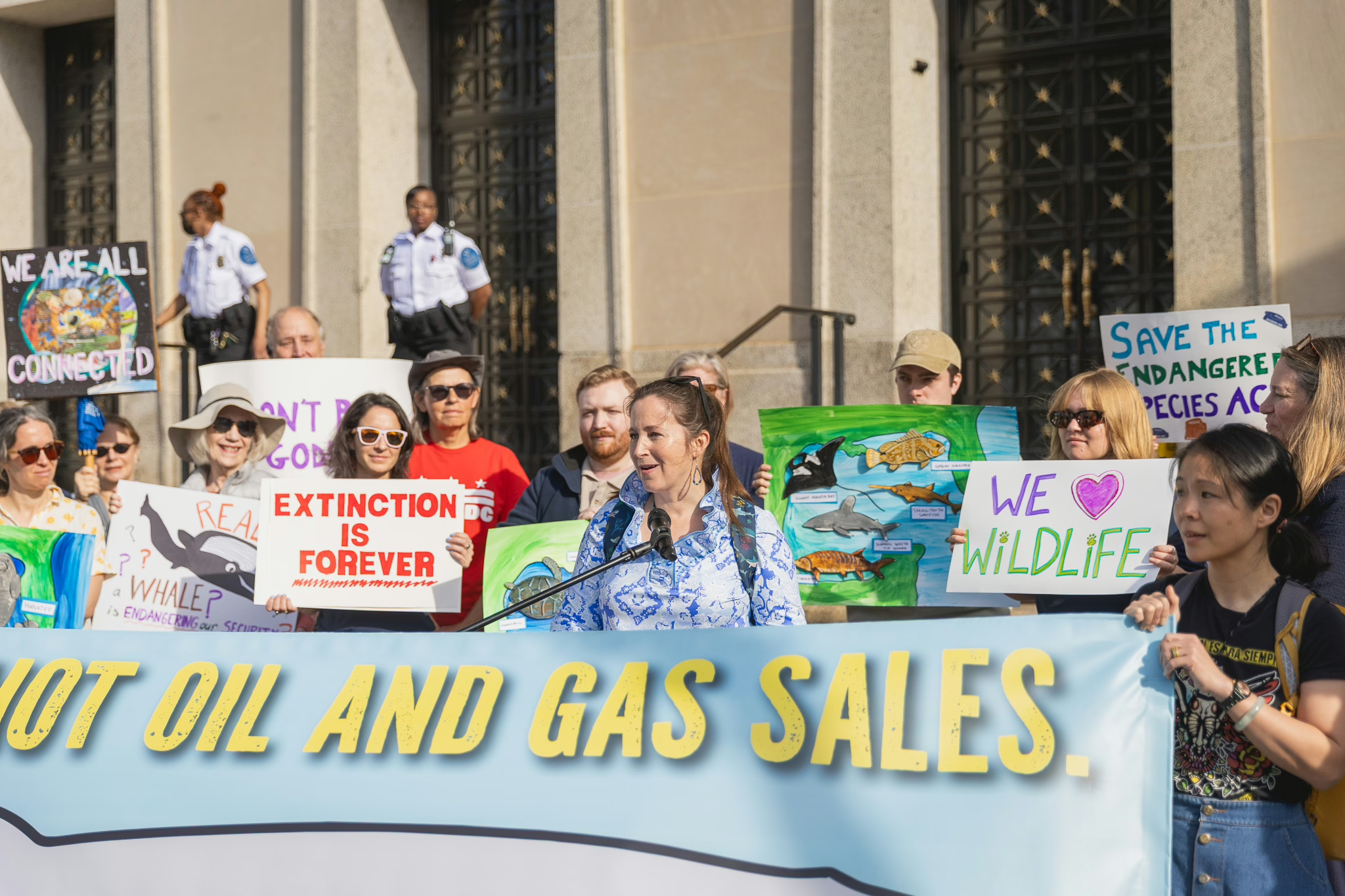

Voices for the ESA: Sara Gonzalez-Rothi on the Gulf and the Fight for Wildlife
“Today, I’m not speaking to you as a professor or a lawyer, a former political appointee or a former Hill staffer. I’m speaking to you as the little girl whose heart was full when her feet were wet and her hands muddy. The mailman would deliver yellow spined National Geographic magazines. When I was 5, one arrived with an image of a seabird wrapped in cloth, completely coated in black tar.
I learned how the Exxon Valdez struck Bligh Reef and fouled the Prince William Sound. And I was mad: grownups were making choices about a place I might never see, but I sure had feelings about.
Far from seals and killer whales, I grew up in the springs of North Central Florida, dodging the riverbanks where the alligators basked in the sun. One Valentine’s Day before dawn, my parents carried our sleepy bodies to the minivan everyone seemed to drive those days, headed west. Our destination was Three Sisters Springs, where Crystal River meets the Gulf of Mexico: the Nature Coast.
We put on wetsuits and loaded into a boat, out into the estuary. The air temperature might have cracked 50, but the water was 72. We slipped in before the sun was up. Getting my bearings, my parents encouraged us to put our mask in the water. And so I did.
Below teemed another world: tarpon, and gar. Shafts of sunlight began to glimmer through eelgrass beds interspersed with sandy bottom.
I looked up to see I had drifted further than I wanted, so I made a turn and headed back for the boat.
When I put my mask down again, a massive and silent creature—the size of a Volkswagen—began to ride beneath me. It is Holy Week, but when I tell you that I walked on water, I mean it.
Through the morning, I’d see more of these magnificent animals.
And I knew something innately that day: a manatee is not a speed bump—it is a mirror.
Fast forward 20 years or so, and I was completing what I believed would be 1 year in DC. It’s been 16.5, but who is counting
I was serving as a fellow in the office of Senator Bill Nelson, who people called “no-drill Bill” because he worked across the aisle with Senator Mel Martinez to pass a law prohibiting oil and gas drilling in the eastern Gulf of Mexico.
Nearly exactly 16 years ago this month, I sat in a committee hearing room on the House side of the Capitol as Interior staff showed us why they believed they could safely drill closer to Florida’s coast.
They had maps of the loop current, which, they said, would protect the Nature Coast from oil spills. I diligently took notes. But my heart remembered the Exxon Valdez.
And so, when a small ticker came across the TV screen weeks later that an oil rig was on fire off the coast of Louisiana, I thought of the maps.
I felt horror at learning that 11 men perished. And then for 87 days, crude oil flowed into the Gulf of Mexico: a crown jewel of biodiversity.
The pace of the response was unrelenting. One of my primary jobs was to call anyone who might know how to limit the damage. Marine biologists, oceanographers, toxicologists on speed dial. And they kept saying the same thing—all we can do now is learn.
And so it was that over the next 2 years, as we negotiated the bipartisan RESTORE Act, Senator Nelson championed a Gulf of Mexico science program. It was important to him that we learn from this preventable and catastrophic tragedy.
And some of us did learn things: that the loop current wasn’t going to spare Florida, that if you let them, industry will put profits over safety, that there is a lot we don’t know about the Gulf of Mexico.
It was the science after Deepwater Horizon that led to the discovery of one of the rarest whales in the world: the Endangered Rice’s Whale. Deepwater Horizon is estimated to have affected nearly half of its habitat.
And the Joni Mitchell lyrics rang truer than true: Don’t it always seem to go that you don’t know what you’ve got ‘til it’s gone? How quickly some of us have forgotten.
After Deepwater Horizon, I became a mom. My babies love nothing more than combing the shores of the Chesapeake Bay. Their favorite animals are not dolphins or some charismatic megafauna. They are oysters and crayfish and tiny indelible links in the web of life.
They don’t need to see an Exxon Valdez or a Deepwater Horizon in their lifetime to know the value of these things.
By the way, I’m still the little girl with a heart full when my feet are wet and my hands are dirty. And I believe deep in my soul that so, too, are the people meeting in the building behind me. We just have to remind them: that the choices we make to support a healthy ecosystem are choices to sustain our own lives; that a manatee isn’t a speedbump, it is a mirror.”