
Velocity, whiffs putting journeyman Connor Seabold in Blue Jays bullpen mix
DUNEDIN, Fla. — Well-travelled right-hander Connor Seabold signed a minor-league deal with the Toronto Blue Jays in late January, joining his sixth MLB organization in a career that began nearly a decade ago following a stint as Cal State Fullerton’s Friday night starter.
During Seabold’s spring-training entry meeting, the Blue Jays discussed leaning on his rotation experience — of his 142 career outings, 103 have been starts — to build him up for a bulk role as part of the Buffalo Bisons starting staff or merely as a multi-inning reliever. At triple-A, where pieced-together bullpen days are a regular occurrence, a flexible arm like Seabold’s is valuable.
But that was before he got on a mound and began regularly touching 96 m.p.h. Not even Seabold himself saw that coming. The hardest pitch he’d thrown in the majors previously was 95 in 2023, when his fastball averaged 92.6. Last year at triple-A, it averaged 92. But so far this spring, he’s sitting over 94. Last week, while striking out the side in the seventh inning against the Minnesota Twins, Seabold threw the two hardest pitches of his career.
So, plans have changed. Forget building volume. Seabold’s now entering his outings with a one-inning mindset. That’s given him licence to truly let his stuff eat.
Which is how he’s getting in-zone whiffs with fastballs like these:
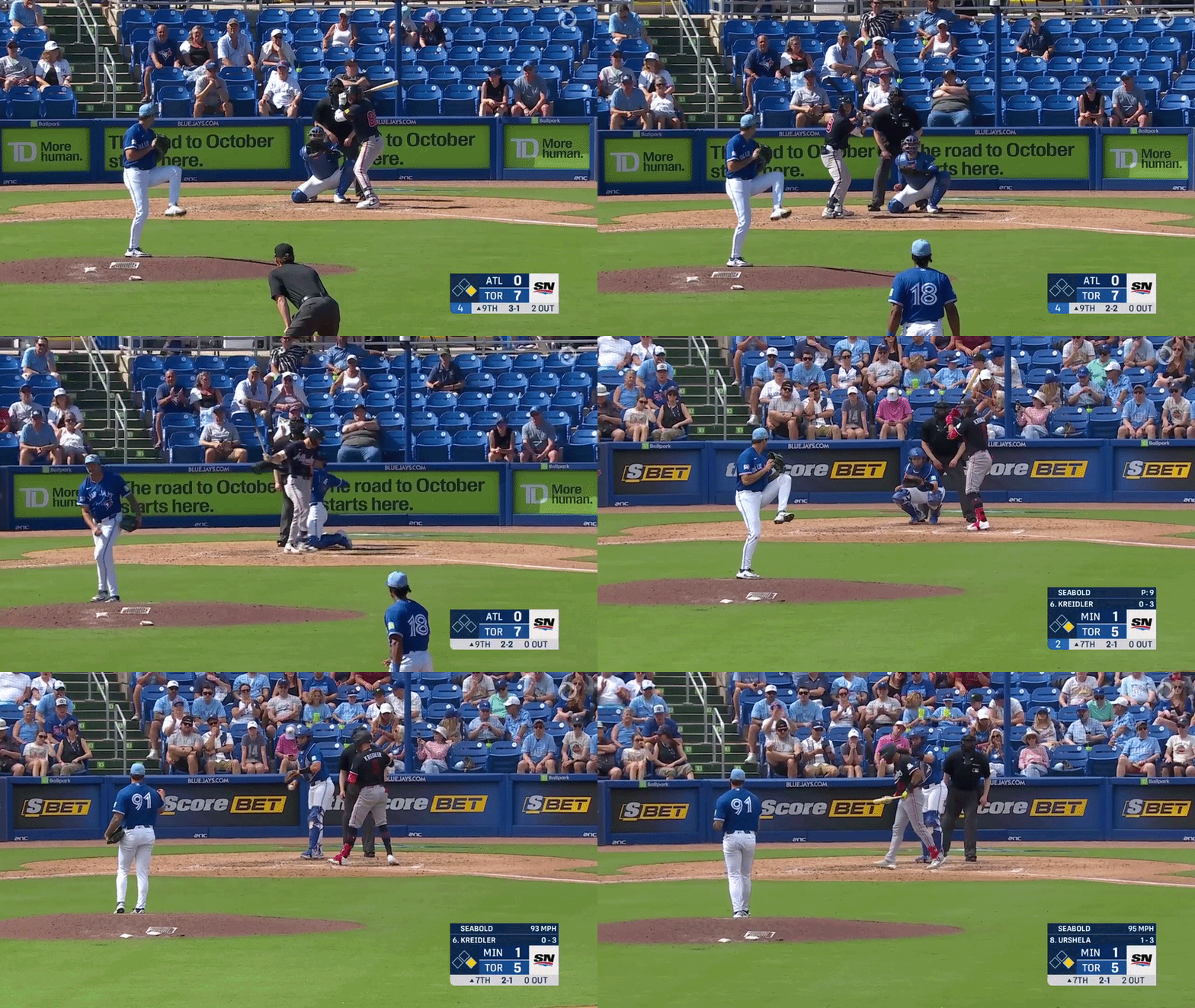
“It’s fun when you can throw fastballs and not get hurt by it,” Seabold said. “At this point in camp, you’re kind of living and breathing on every outing. Guys are getting sent to minor-league camp. You want to show what you can do every time out. So, I’m just taking it all in stride. I like where my stuff’s at. Velo helps.”
And the Blue Jays bullpen could use some of it. In 2025, the average four-seam fastball velocity of MLB relievers was 94.8 m.p.h, rising to 95.3 m.p.h. for right-handers. Among relievers currently on Toronto’s 40-man roster, only Louis Varland (98.1 m.p.h.), Jeff Hoffman (96.4), Yimi Garcia (96) and Braydon Fisher (95.6) threw fastballs harder than average last season.
Brendon Little’s flashed a new 98 m.p.h. four-seamer this spring, which is a significant development. But Garcia will begin the year on the injured list and won’t be ready until several weeks into the season. There’s a reason the Blue Jays are trying to catch lightning in a bottle with a pair of Rule 5 picks — Angel Bastardo and Spencer Miles — who throw in the upper 90s.
Seabold’s fastball isn’t only firm — it appears to rise in the eyes of a hitter. That’s thanks to an average induced vertical break of 17.2 inches, which means the pitch doesn’t drop as much as typical fastballs do. An exceptionally low release height of 5.4 feet off the ground — partially created by Seabold’s low three-quarters arm slot — magnifies this effect by flattening the pitch’s plane.
He has a secondary fastball shape, as well — an 88 m.p.h. cutter that pitch trackers have so far been misidentifying as a slider. It drops more than his four-seamer and darts late to his glove side, which lets him dodge barrels and even get whiffs in fastball counts when hitters are selling out for his heater.
Then there’s his changeup, a low-80s weapon that sinks and tails late to his arm-side almost like a slider in reverse. As a natural pronator — the direction you’d move your wrist to rotate your palm from facing up to down — Seabold can generate an unusual amount of depth and run with the pitch by releasing it from inside the baseball.
It’s uncommon and effective, forcing uncomfortable swings when Seabold stays off the heart of the plate:
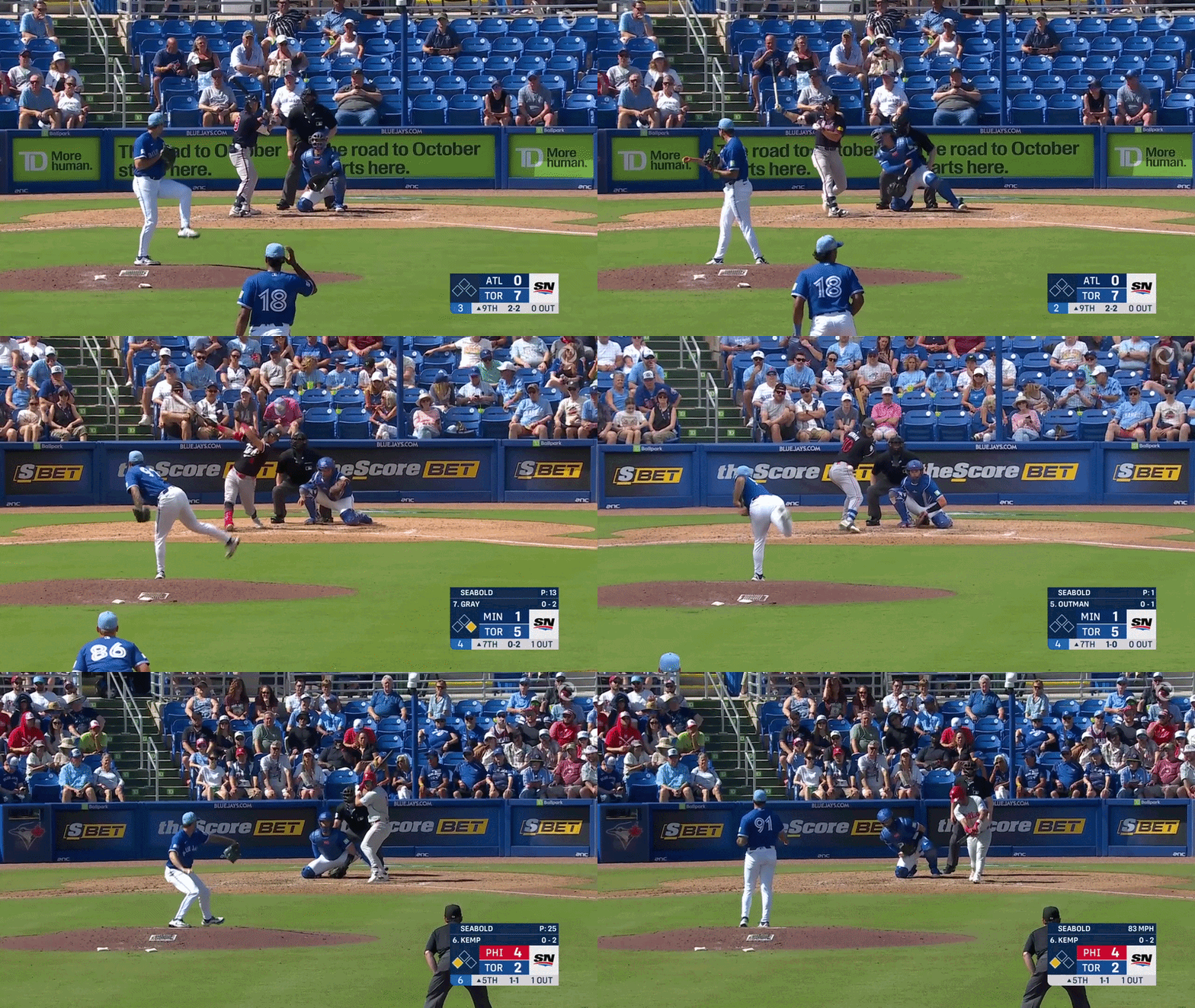
And finally, a new pitch the Blue Jays have helped Seabold develop this spring could be the one to tie it all together — a mid-80s slider (you’ll currently see it listed as a sweeper on pitch trackers) featuring the same drop as his changeup, only in the opposite direction. He’s thrown it just 22 times in games this spring. Yet of the 11 swings against it, seven have come up empty.
All told, Seabold has a 46.8 per cent whiff rate across six spring outings so far — 29 whiffs on 62 swings. Grapefruit and Cactus League play is the land of small samples and wacky results. But of the 412 pitchers across MLB to throw at least 100 pitches this spring, only one — Miami Marlins fireballer Eury Perez — has a higher whiff rate.
You can think of what Seabold’s trying to do like painting an upright triangle within the strike zone and forcing hitters to guess which vertex he’ll target. Back-spinning fastballs riding up at the top of the box, fading changeups sinking arm-side and biting sliders spinning down glove-side. And just enough cutters to keep hitters from selling out to his fastball up.
“If the fastball’s got good vert that day, it helps the changeup out a lot. And then vice versa if the changeup’s good that day,” Seabold says. “And then adding the slider, anything that goes left will help. I’ve had one before. But it’s been a while since I’ve had a good one.”
Seabold first started incorporating a breaking ball in 2022, a year after he made his big-league debut with the Boston Red Sox, who acquired him along with Nick Pivetta from the Philadelphia Phillies in 2020. The results weren’t great, and a year later he was shipped to Colorado, where he received his best MLB opportunity yet in the worst possible environment for a right-handed changeup artist to get one.
Seabold allowed 19 homers over 87.1 innings that season and, a year later, wound up in Korea. That proved a much more favourable setting for Seabold to find success, and after pitching to a 3.43 ERA over 160 innings, he returned to North America in 2025 on a minor-league deal with the perpetually-searching-for-untapped-potential Tampa Bay Rays.
He fared well in three major-league appearances with Tampa but had some homer-fuelled blowups at triple-A and was designated for assignment in August, ending up with the Atlanta Braves via waivers. Disappointingly, his season ended where it began — in the minors, a step back from where he was prior to heading overseas.
Yet, getting kicked around at triple-A had a benefit — it convinced Seabold he needed to try something new. Some friends in the game set him up with private coach Ryan Chapman, a former New York Mets minor-leaguer who opened a player development facility in Irvine, Calif., after his playing career ended. Through a series of movement assessments, Chapman identified inefficiencies in Seabold’s pitching motion and helped him form better habits with his lower half.
Previously, Seabold was drifting forward from his drive leg early, which leaked power and compromised stability. Now, he’s focused on staying stacked atop his back leg with taller posture, which allows him to generate more force from the mound. Diligent repetition, coupled with an aggressive off-season strength training program, has manifested in two-to-three ticks on the radar gun.
“Seeing all that hard work come to fruition and working really well, it’s awesome,” Seabold says. “It’s just continued to build upon itself. It feels like it’s only getting better.”
Meanwhile, the Blue Jays have responded to this pleasant surprise by adjusting the way they’re utilizing Seabold. His first outing of camp was 25 pitches. In his next, he returned after a clean inning to pitch a second, stretching out to 28. But he was only used for a single frame in his next three outings, twice finishing victories with clean ninth innings.
The frequency of his outings has increased as well. Seabold went five days between his first and second appearance, then six more before his third. But he’s only had two days’ rest prior to his last three. It looks a lot like a team examining how an unexpectedly big arm fares in short-stint leverage relief, knowing Seabold can always lengthen back out if needed.
Seabold’s pitched out of the bullpen before, but never consistently. He’s been through some of the adjustment process, learning how to get ready to enter a game quickly and lock in mentally at the ring of a phone. But he’s pitched on back-to-back days only once in his career. There are still relief realities he’ll need exposure to in the coming weeks and months if he continues this transition.
It’s a process that can move quickly. Take Fisher, originally acquired by the Blue Jays in a 2024 trade for Cavan Biggio and re-signed to a minor-league deal the subsequent off-season.
Fisher entered 2025 spring training well off the MLB radar. But some tweaks to his pitch mix and usage patterns unlocked a high-whiff, breaking-ball-heavy approach that he continued to hone with Buffalo throughout the first six weeks of the season. By mid-May, Fisher’s rapid development got him to the big leagues, where he threw 50 innings of 2.70 ERA ball with a top-20 strikeout rate among relievers.
In this game, you never know when something’s going to click. Seabold chose the Blue Jays from a selection of minor-league contract options this off-season because the opportunity to pitch for the defending American League champions was tantalizing. Entering his 30s, he didn’t know if another chance like that would come along. And every contending club needs depth that can pitch bulk innings at some point.
Then he saw the radar gun flash 96. And the Blue Jays saw the whiffs pile up. Before long, he was auditioning for a different role than the one he’s filled his entire career. Suddenly, that opportunity appears a lot closer. Only in a different form.
“I don’t care what I do. I’ll pitch out of the pen, I’ll start. If they want me up to three innings, I’ll give it a go. If they want more, I’ll do that. If they want less, awesome,” Seabold said. “I’ll do whatever gives me the best opportunity to get up there and help the team. I’m not picky. As long as there’s opportunity, I’ll take it.”