
Canada poised to become ‘one of the largest suppliers of LNG in the world’: Energy minister | CBC News

Listen to this article
Estimated 5 minutes
The audio version of this article is generated by AI-based technology. Mispronunciations can occur. We are working with our partners to continually review and improve the results.
Canada’s energy minister says the country is poised to become one of the world’s biggest suppliers of liquefied natural gas, exporting as much as 100 million tonnes per year.
Tim Hodgson delivered that optimistic outlook to a parliamentary committee earlier this month, noting that countries such as Japan, South Korea, China and India all want Canadian gas.
“If we deliver, as we hope proponents would deliver, up to 100 million tonnes per annum, that would make us one of the largest suppliers of LNG in the world,” he said.
Hitting that goal would require more than just the LNG projects currently underway — which at full capacity would provide less than 50 million tonnes for export each year.
Hodgson’s comments came ahead of Prime Minister Mark Carney’s trip to India where LNG is expected to be a focus.

Exporting LNG requires specialized facilities that allow shippers to cool standard piped natural gas to -162 C before it can be loaded onto ships. The country’s first and only export terminal, LNG Canada, began operating in June in Kitimat, B.C.
But other B.C. projects are either under construction or being proposed.
“From a Canadian perspective, just from an economic perspective, they are amongst the most impactful projects we can do,” said Hodgson.

Appearing at the Standing Committee for Natural Resources Thursday, Energy Minister Tim Hodgson said if Canada delivers on its liquified natural gas targets ‘as we hope, proponents will ultimately increase our production to as much as 100 million tonnes per annum.’
Hodgson did not elaborate on which specific projects would help Canada become one of the top LNG exporters. Canada is currently the world’s sixth-largest exporter, behind countries including Australia and Qatar.
Among the projects that could add significantly to Canada’s GDP are LNG Canada’s second phase and Ksi Lisims, both of which have been referred to Canada’s Major Projects Office. Ksi Lisims is a proposed floating facility owned by the Nisga’a Nation on the B.C.’s North Coast, near the community of Gingolx.
These projects could bring LNG export capacity to up to 40 million tonnes annually. Another five million tonnes could be added through the Woodfibre and Cedar LNG projects, both also under construction in B.C.
But even if all those projects get up to full capacity, Canada would be less than halfway to Hodgson’s target. From the minister’s comments, it’s unclear how Canada would more than double that capacity, but there are a variety of projects still in their early stages that could help.
Marinvest Energy Canada is pursuing a project in Baie-Comeau, Que. The proponent hasn’t released many details publicly, but it wants to build a plant and a pipeline.
A project to export Newfoundland’s offshore reserves is also in the works. Fermeuse Energy Limited wants to develop trillions of cubic feet of natural gas and process it into LNG.
Low-emission LNG?
Canadian allies view LNG as a “transition fuel” — a cleaner alternative to burning coal, especially as artificial intelligence becomes an electricity hog, Hodgson said.
He added that Canadian LNG is viewed as “low emission.” This is partly because the country’s colder climate requires less energy to chill the gas until it becomes liquid. The shorter distance between B.C. and Asian markets also means less tanker fuel is required than shipping LNG from the Atlantic.
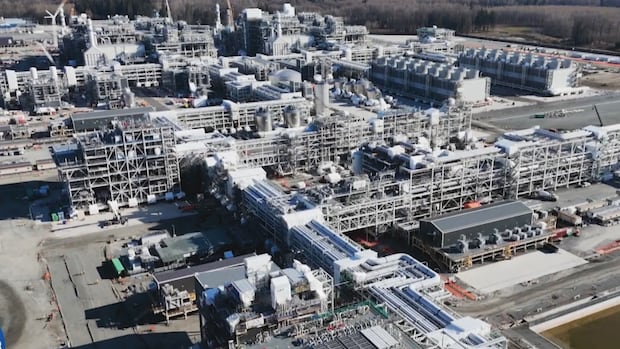
Global demand for liquified natural gas is growing, and Canada is trying to reinvent itself as a major player with several energy infrastructure projects in development. CBC’s Paula Duhatschek breaks down what it could take and why some worry Canada is making the move too late.
But an analysis by a clean energy think-tank suggests Canadian officials may be overplaying the green credentials of its LNG.
According to the International Institute for Sustainable Development, LNG Canada Phase 1 burns natural gas to power equipment. It’s expected to emit 2.1 million tonnes of greenhouse gas pollution annually at its full capacity.
That’s roughly equivalent to 450,000 passenger vehicles, making “LNG Canada Phase 1 one of the most climate-polluting projects in all of B.C,” according to the institute.
B.C.’s other proposed LNG projects — Woodfibre, Cedar and Ksi Lisims — are expected to be powered by hydroelectricity, which will help them achieve net-zero operational emissions.

The B.C. government, though, no longer requires these projects to be net-zero by 2030, but only net-zero ready.
Most of LNG’s emissions don’t actually come from those facilities, either. Far more pollution comes from its extraction, shipment and burning — what’s known as life-cycle emissions.
”It’s important to remember here that LNG is a fossil fuel,” said Steven Haig, a policy adviser from the International Institute for Sustainable Development. “It emits greenhouse gas emissions across its entire value chain, accelerating global climate change, and simply put, it is not a climate solution in its own right.”