
Tiger Woods deserves better than voyeuristic police video humiliation
Oliver Brown
Quite why the Martin County Sheriff’s Office feels compelled to document Tiger Woods’ arrest in such excruciating detail, from the discovery of heavy-duty painkillers in his pocket to his stupefied 17-minute journey to the local police station, is a matter best left to the Florida justice system.
The only certainty is that the footage is a harrowing watch, a window into the private torment of a man whose life, much like the Range Rover left lying on that residential side street, has been flipped on its axis.
Until the release of these videos, the gory details had been rendered in clinical terms, with an affidavit revealing his “bloodshot and glassy” eyes, not to mention his “extremely dilated” pupils.
Now we see his addled state laid bare, as he fights off hiccups in the back of a police car, his head lolling back and his chest heaving slightly.
Even with the pronounced muscles of his upper body, sculpted through a fitness regime so fanatical he has been known to frequent the gym at 3am on nights when he cannot sleep, he looks all of his 50 years, his face puffy and his drowsiness magnifying the mortifying scene.
Not even Woods’ most committed detractors could wish to watch him like this. He is no longer the swaggering 15-time major champion, but a figure clearly in acute physical and psychological distress.
Just a few days earlier, he had been appearing in his simulated indoor golf league, teasing a return at the Masters. Now police body-cam footage shows him unable to pass even a routine acuity test, with officers observing “several signs of impairment”, including lethargic movement and sweating in the back of an air-conditioned car. For anyone who has charted his rise and fall, it is as pitiful as it is upsetting.
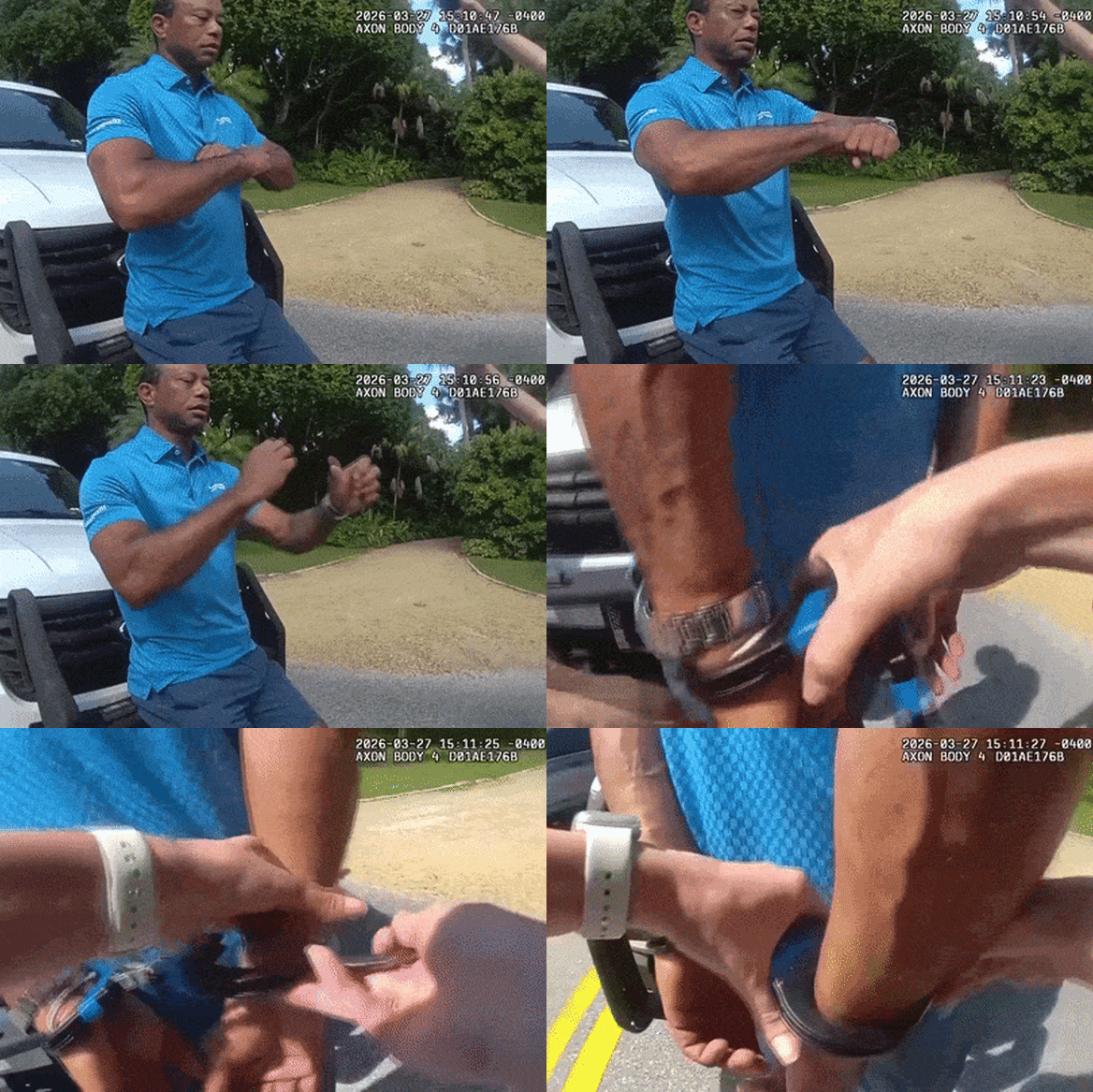
It is unnerving to see the time on the video when the arrest is made: 3.11pm last Friday. The sky is blue and the setting unthreatening, in the middle of an affluent neighbourhood on a road lined with palm trees.
By all accounts, he is in a happy and stable relationship with Vanessa Trump, the US president’s former daughter-in-law. Astonishingly, in the moments immediately after the accident, he claims to have called the commander-in-chief himself.
“Just talking to the president,” he says to officers vexed by him wandering off down the street. The president, for his part, has been unusually muted about the episode. “Very close friend of mine,” he said, in his only public comments about Woods.
“Amazing man. But some difficulty. I don’t want to talk about it.”
The awkward question is what Woods is doing dazed and confused on a quiet weekday afternoon, carrying hydrocodone, a potent opioid. That is just one of several drugs he lists for police, confirming the worst fears that he has been addicted, since a catalogue of surgeries, to popping strong painkilling medication.
Not for the first time, the pharmacological assistance that Woods needs just to navigate the day is released for all the world to see.
In 2017, when he was first arrested on suspicion of driving under the influence, police found not just hydrocodone in his system but hydromorphone, another painkiller, as well as Xanax and Ambien, two sleep drugs, plus THC (tetrahydrocannabinol), the active ingredient in marijuana.
His police mugshot that night, depicting him glazed and broken, would become the most vivid counterpoint to his coronation at the Masters two years later, punching the air to celebrate his fifth green jacket and perhaps the most improbable comeback in sport.
No such redemption arc suggests itself here. Woods has not been in any serious competitive environment since 2024, when he shot 79 and 77 in the Open at Royal Troon before withdrawing. He was a combined 44 over par for his four major tournaments that year, even signing for an 82 at Augusta, the stage of his most stirring triumphs.
Since then, he has seemed incapable of filling the void, appearing only fleetingly to promote his glorified video-game league.
“And then, all of a sudden, boom.”
This is how Woods describes his most recent car crash when questioned, but he could just as easily be talking about the immolation of his career.
There are far wider questions than golf for him to contemplate now. Ever since 2021, when he drove 87mph (140km/h) in a 45mph zone in Los Angeles before ending up upside-down in a ravine, the notion of him challenging at a major again has been a flight of fancy.
Exceptionally fortunate not to have killed either himself or somebody else that day, he is perilously close to the ragged edge once more. A study of the latest videos once more conveys this in the bleakest terms, showing him gasping and gulping, veering between agitation and a drug-induced daze.
The only comfort is that he is promising to seek medical help outside the United States, where he labours under a merciless microscope.
Whatever you might think of Woods, the decision by county police to publicise these tapes feels voyeuristic and unnecessary. The greatest golfer of his generation, having reached his nadir, deserves better than to have his humiliation compounded.
Telegraph, London