
This nation’s population is 60 times smaller than the USA. It topped the Olympic medal tally
Sweden, for instance, has an exceptional ice hockey team, but it’s not in the same Winter Olympic-success postcode of Norway despite almost double the population and some shared geographic advantages.
Norway has owned cross-country skiing, partly through Klaebo’s six gold, but Norwegian depth in that field, is formidable. They’ve brained everyone in Nordic combined – a mix of cross-country and ski-jumping – and still taken golds in ski-jumping, speed skating and freestyle skiing; they are far more than just a nation who cornered the cross-country and biathlon markets.
What emerges, from what Norwegian Olympic officials say, is that they have an approach to sport, and particularly the sports that their climate renders easier to master, that is, well, unusual.
The Wall Street Journal, when pondering the quandary of Norwegian supremacy – which, for Americans really means, ‘why can’t we do this’? – noted that Norway’s sporting method or philosophy “is the exact opposite of America.”
Unlike many nations, who identify talent early and shove the gifted into specialised programs or full-bore coaching as soon as decently possible, the Norwegians don’t push kids into competition.
“We try not to focus on winning too early,” Tore Oevreboe, Norway’s head of its Olympic delegation, told Reuters. “We should not create losers. We should create young small winners … The winning part is to be part of the sport and have joy.

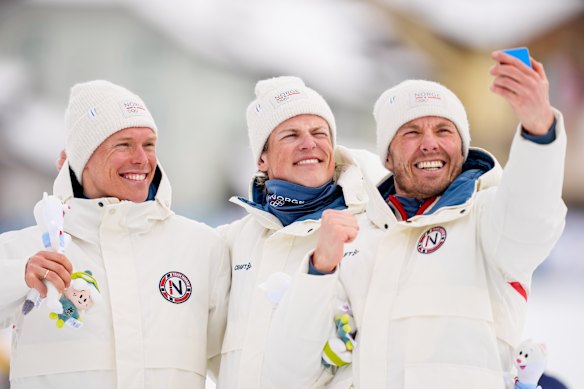
Norway had a podium clean-sweep in the men’s 50km mass start on Saturday.Credit: AP
“The point of doing sport in Norway is to lead a good life. So you start young and learn motor skills, social skills, and then you learn how to use your body in a physical setting.”
Children are encouraged to play multiple sports. Klaebo, taught by his grandfather to ski, played a variety of sports – much like Roger Federer – before settling on the field that he would conquer.
Norway’s Confederation of Sports has enshrined a policy of “children’s rights” in sport, which the nation says is unique in global sport. There are eight rights laid down, like commandments.
“The rights and provisions are unique in a global context and are designed to help children have a positive experience every time they participate in training, competitions, or other activities,” the NIF (Norges Idrettsforbund) says in its children’s rights mission statement.

Norway three medallist break away from the pack to win bronze, silver and gold in the men’s 50km mass start.Credit: Getty Images
“When participating in sports, children should experience a friendly environment, feel safe, want to try new things and not be afraid to make mistakes.”
Norway’s participation rate is 90-plus per cent for children aged 6-12 in at least one sport. This more holistic approach from early in life runs counter to the specialised, hyper-driven culture of tennis academies et al.
It all sounds wholesome, healthy and holistic, in a country that has a sovereign wealth fund generating hundreds of billions via oil and gas reserves, and is invariably on or near the podium for social measures, such as democracy, health and freedom.
Loading
The only outbreak of weirdness that Norway produced came early in the Games, when biathlete Sturla Holm Lægreid volunteered that he had been unfaithful to his partner in “the biggest mistake of my life.”
In what he also deemed his worst week, Laegreid called the partner he’d failed “the gold medal in my life.”
For Norway, Laegreid’s loss was about the only gold medal missed.
The Winter Olympic Games is broadcast on the Nine Network, 9Now and Stan Sport.
News, results and expert analysis from the weekend of sport sent every Monday. Sign up for our Sport newsletter.