
The world’s supply of helium is being threatened by the Iran war
The war in the Middle East has disrupted the world’s supply of helium. Qatar produces about a third of global helium, but attacks on its gas infrastructure have forced production to stop.
At the same time, Iran is blocking the Strait of Hormuz, one of the world’s busiest shipping channels, through which Qatar exports both natural gas and helium. Losing 30% of global helium could have major consequences for science, medicine and industry.
Helium is used to cool the superconducting magnets used in MRI (magnetic resonance imaging) scanners, which help diagnose conditions through high-resolution, 3D imaging of human tissues.
Superconducting magnets enable the sustained, intense currents needed for high resolution imaging. A superconductor is a material that conducts electricity with zero resistance (defined as the opposition to current flow in a material).
In order to do this, however, the magnets need to operate at extremely low temperatures.
Helium is the ideal coolant for these magnets because it has the lowest boiling point of any element: -268.9°C. At this temperature or below, helium is liquid and can be used to bathe the magnetic coils used by MRI scanners.
Some particle accelerators, such as the Large Hadron Collider at Cern in Geneva, also use liquid helium to cool their superconducting magnets. These magnets are used to bend and control proton beams.
The processors in quantum computers need to be cooled to similarly low temperatures in order to operate and, here too, helium is the coolant of choice.
A versatile element
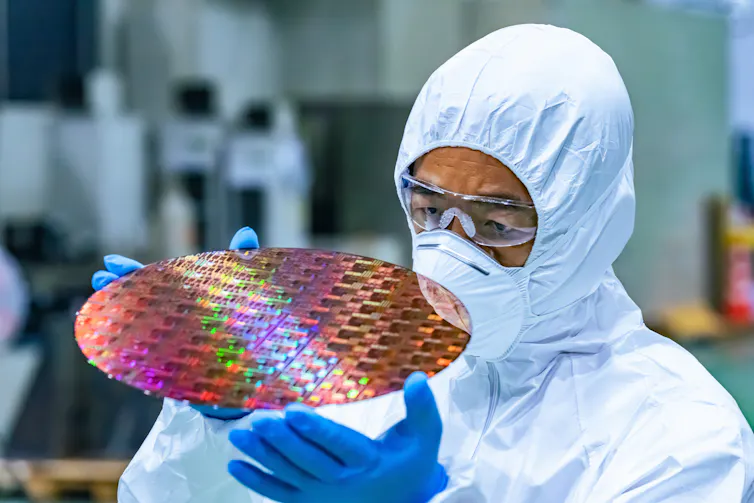
Helium is used in computer chip production to displace oxygen and moisture within fabrication facilities, where conditions are tightly controlled to avoid contaminating delicate microprocessors.
The element is also used as a coolant during high-temperature stages of chip production. These include the etching process, where unwanted material is removed from semiconductor wafers – the substrates on which circuits are assembled.
Metamorworks / Shutterstock
In space rockets, the non-flammable gas is used to flush out fuel lines and to pressurise fuel tanks.
Welding and fibre optic production requires helium to create inert, controlled environments.
Helium’s value comes from physical properties that are very difficult to substitute. In addition to its low boiling point, which makes it an excellent coolant, helium is inert and extremely light.
Its tiny molecules make it ideal for detecting the smallest leaks in pipelines and equipment.
Despite being the second most abundant element in the universe, helium is extremely rare on Earth. It forms underground over billions of years from the radioactive decay of uranium and thorium.
Because it is lighter than air, it escapes easily into the atmosphere and eventually into space, making it effectively non-renewable.
Manufacturing helium
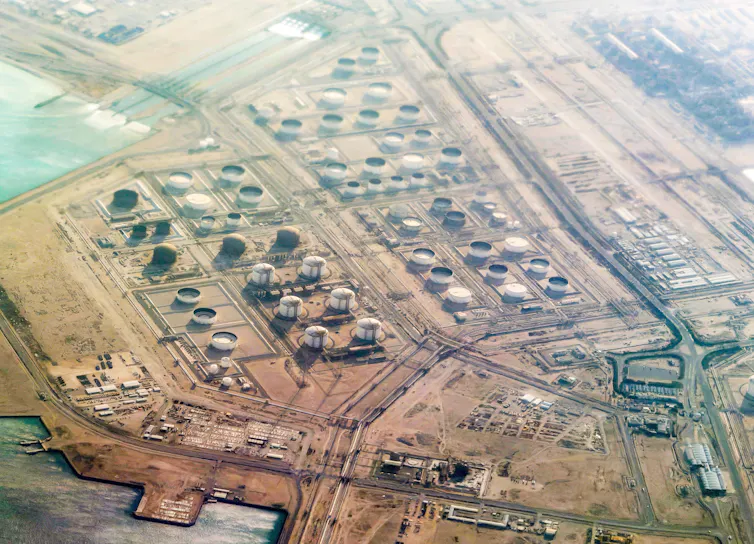
Unlike most resources, helium is rarely produced on its own. In Qatar and other countries, helium is produced as a by-product of liquefied natural gas (LNG) production.
That means the supply of helium depends entirely on the production of natural gas: when gas production drops, so does helium output.
This is exactly what has happened in Qatar, where attacks on gas facilities have suspended both gas and helium production.
Hannibal Hanschke / EPA Images
Exporting helium is not simple. It requires highly specialised cryogenic containers to keep it extremely cold during transport. These shipments must pass through narrow trade routes such as the Strait of Hormuz, making the supply chain vulnerable to political conflict.
The specialised containers are insulated, but not refrigerated. This means that, due to the physical properties of helium, the element will escape from the containers over time.
Other countries have tried to develop helium production to reduce reliance on Qatar. Iran has worked to extract helium from its South Pars Gas Field, but sanctions have made this difficult. China, meanwhile, has been building the infrastructure to make its own helium and is prospecting for new reserves to diversify supply.
The US has the world’s largest helium reserves, stored in Amarillo, Texas. Originally established in 1925 to supply the airship industry, the reserve became a global strategic buffer that helped stabilise prices.
In recent decades, however, the US sold off much of the stockpile under the Helium Stewardship Act of 2013, reducing this safety net.
With semiconductor supply chains threatened, there is a risk that helium shortages could act as a constraint on the AI revolution. Taiwan, the global leader in chipmaking, has said that its stocks of helium are stable due to a diverse supply. South Korean officials, however, have said that the country’s supplies will run out until June.
Adapting to pressure
However, there are ways that countries could adapt to a squeeze in global helium stocks.
Stockpiling: keeping reserves of helium for critical applications.
Substitution: limiting helium use to applications where its unique properties are essential.
Recycling: recovering helium from industrial or scientific processes, though this is difficult because helium easily escapes containment.
Diversification: Expanding production in multiple countries and exploring new reserves, as China is currently doing.
These measures could help alleviate future fluctuations in helium supply. But none are quick fixes. That’s why the disruption to supplies caused by the situation in the Strait of Hormuz is being felt around the world.