
The unseen challenges of life on the Moon
For the first time since the Apollo era, humans are preparing not just to visit the Moon, but to live and work there for weeks, months – and eventually years.
But what would it really be like to spend an extended period on the lunar surface? The answer is exhilarating – and brutally unforgiving. An exciting new era of deep-space exploration is opening up. The US Artemis programme aims to set up an outpost on the Moon’s surface. It marks a fundamental shift in how we explore space.
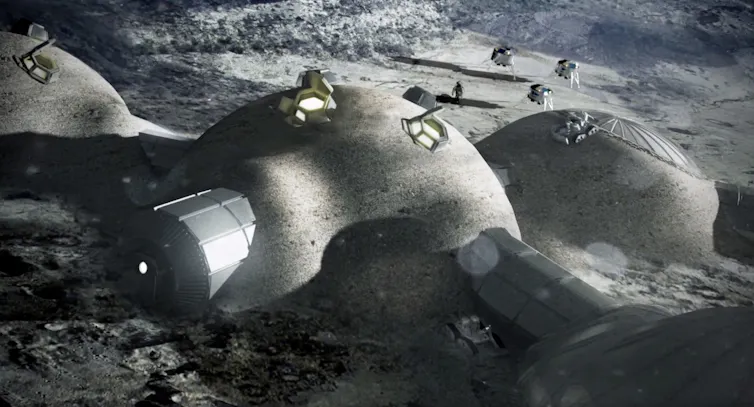
Rather than just leaving “flags and footprints” as the Apollo missions did, Nasa wants to establish a sustained human presence on the Moon, beginning at the lunar South Pole.
The programme unfolds in stages. In 2022, the Artemis I mission successfully tested the Space Launch System (SLS) rocket and Orion spacecraft as an integrated system on an uncrewed mission around the Moon.
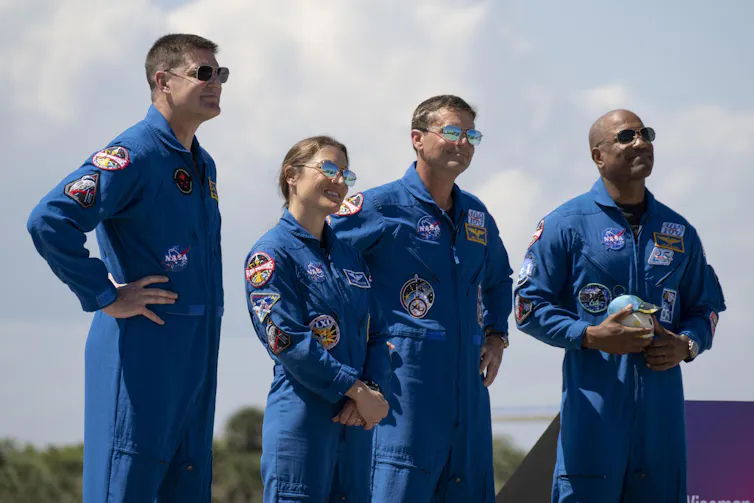
On April 1, 2026, Nasa launched Artemis II a ten-day mission, carrying four astronauts around the Moon.
NASA/Jim Ross
As Nasa’s first crewed flight of Orion and SLS, Artemis II is a pivotal mission designed to verify that life-support systems, navigation, thermal protection and deep-space operations all function safely with humans onboard.
Before astronauts can live on the Moon, the journey there must be proven reliable.
Beyond these early missions, Nasa’s long-term vision extends far beyond a single landing. Nasa plans to spend US$20 billion (£15 billion) on a lunar surface base, intended to support repeated and progressively longer surface stays. This is designed to teach us how to operate sustainably beyond Earth – knowledge that will ultimately feed forward to future human missions to Mars, the horizon goal.
Health challenges
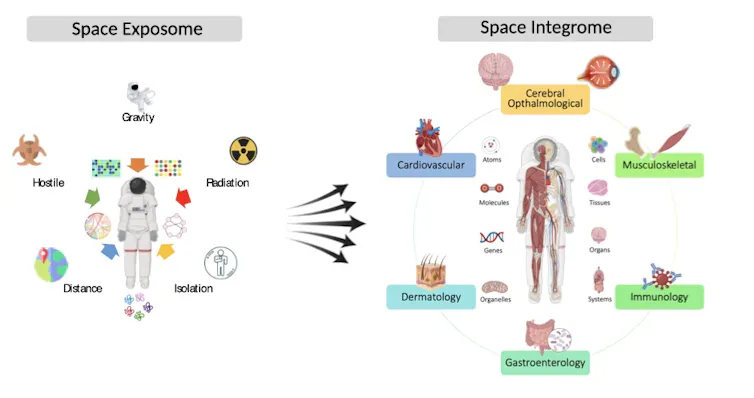
Living on the Moon will challenge every organ system in the human body. The lunar environment exposes astronauts to a unique space exposome – the combined set of
physical, chemical, biological and psychological stressors encountered beyond Earth.
Nasa
These include reduced gravity (about one-sixth of Earth’s), chronic exposure to cosmic radiation, extreme temperature swings, toxic lunar dust, isolation, disrupted sleep-wake cycles, and prolonged confinement.
Unlike astronauts in low-Earth orbit, lunar crews operate largely outside Earth’s protective magnetic field. This increases exposure to space radiation, which can damage DNA, disrupt immune function and affect the brain and cardiovascular system in subtle but potentially serious ways.
Reduced gravity also fundamentally alters how blood, oxygen and fluids move around the body. Microgravity can disrupt how blood, oxygen and glucose are delivered to the brain, potentially increasing vulnerability to neurological and vascular dysfunction over time.
The physiology of survival: Space.
To properly understand these risks, we need to look beyond individual organs and instead consider the space integrome – the way that the brain, heart, blood vessels, muscles, bones, immune system and metabolism interact as an integrated whole under space conditions. A small disturbance in one system sends ripples through others.
One of the most challenging aspects is that many space-related physiological changes develop insiduously. Astronauts may feel well while complications simmer beneath the surface, only becoming apparent months or even years later.
That is why Nasa places such emphasis on long-term physiological monitoring and human risk mitigation in its Artemis science strategy.
Read more:
Nasa plans to have a permanent base on the Moon by 2030 – how it can be done
Reducing the risk
The encouraging news is that humans are remarkably adaptable. The challenge is guiding that adaptation in safe and sustainable ways. Space countermeasures are the tools used to reduce risk and preserve astronaut health.
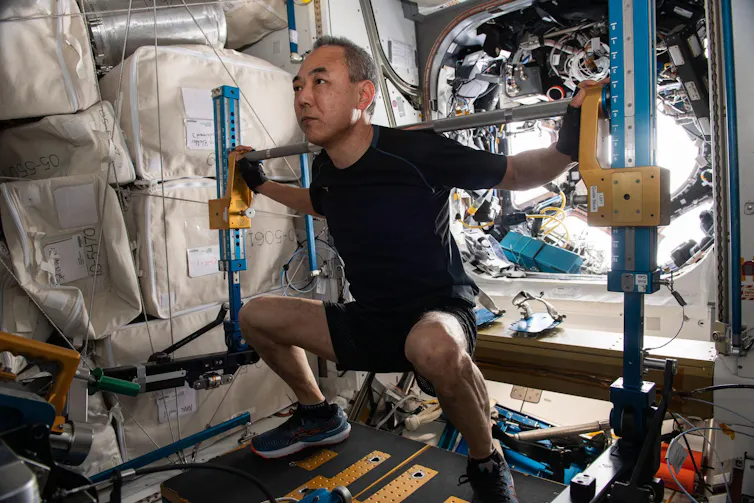
Exercise remains the cornerstone. On the International Space Station, astronauts spend around two hours per day exercising to protect muscle mass, bone density and cardiovascular function. On the Moon, however, exercise systems must be redesigned for partial gravity, where familiar Earth-based loading no longer applies.
Foster + Partners
Nutrition is another powerful countermeasure. Diet influences bone health, muscle maintenance, immune resilience and even how the body responds to radiation.
Personalised nutrition strategies, tailored to individual physiology rather than a “one-size-fits-all” menu, are likely to become increasingly important during long lunar missions.
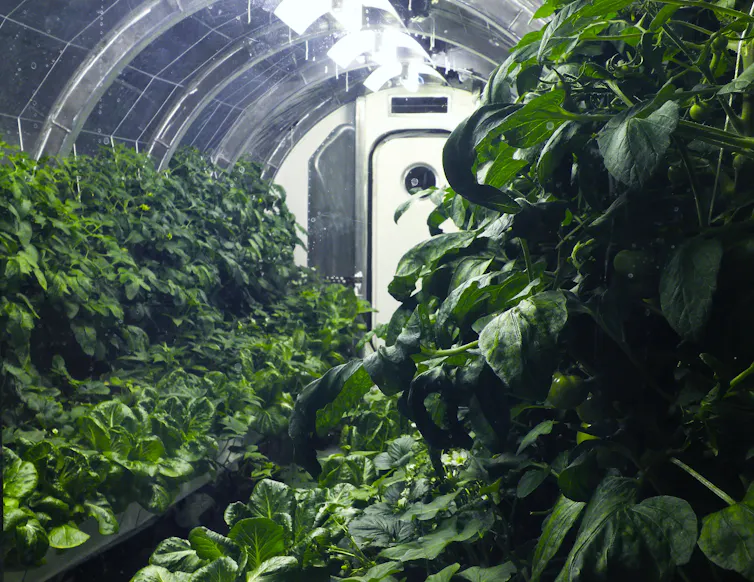
Artificial gravity is also being explored. Short-radius centrifuges could expose astronauts to brief periods of increased gravitational loading, potentially helping stabilise cardiovascular and neurovascular systems. While still experimental, this approach may prove valuable for future surface missions.
Nasa
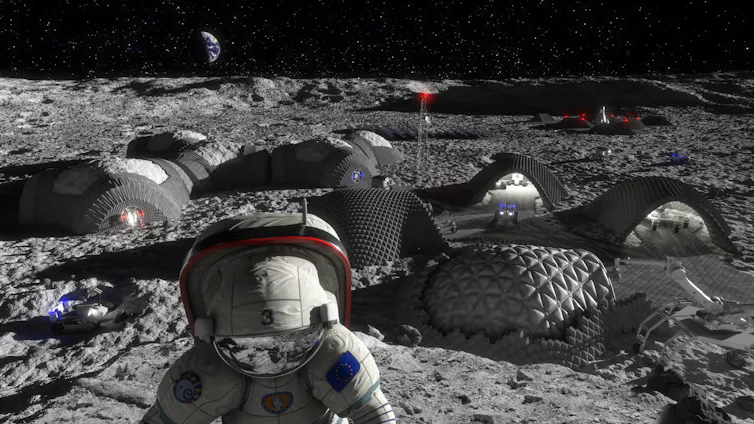
Radiation protection will rely on multiple layers of defence: habitat shielding – potentially using structures made of lunar soil – early warning systems for solar storms, and operational strategies that limit exposure during high-risk periods.
Crucially, countermeasures should be proactive rather than reactive. Continuous physiological monitoring, wearable sensors and advanced data analytics may allow mission teams to detect early warning signs and intervene before small problems become mission-limiting ones.
Spending extended time on the Moon will be awe-inspiring. Imagine watching Earth hang motionless above a stark, silent horizon, or working under a sky that never turns blue.
RegoLight, visualisation: Liquifer Systems Group, 2018
But it will also be demanding, uncomfortable and unforgiving. The Moon is not just a destination – it is a test of our biology.
If we can learn how to keep humans healthy, resilient and productive on the lunar surface, we take a decisive step toward becoming a truly spacefaring species. Artemis shows that exploration is no longer about brief heroics.
It is about sustainability, adaptability and understanding ourselves as deeply as the worlds we seek to explore.
In learning how to live on the Moon, we may ultimately learn as much about life on Earth as we do about our future beyond it.