
The relentless cycle of violent news is leading to trauma for journalists, even those not in war zones
The news agenda of the last few years has been relentless, from war in Ukraine, Gaza and Iran to political polarisation and violence. The constant flow of distressing images and developments can lead to anxiety and dread for readers and viewers. Many even avoid the news altogether.
For those whose job is to review and edit such stories in newsrooms, the impact can be even more distressing. Often it is younger journalists, working long shifts monitoring online images, who are the most affected by what has been called the “digital frontline”.
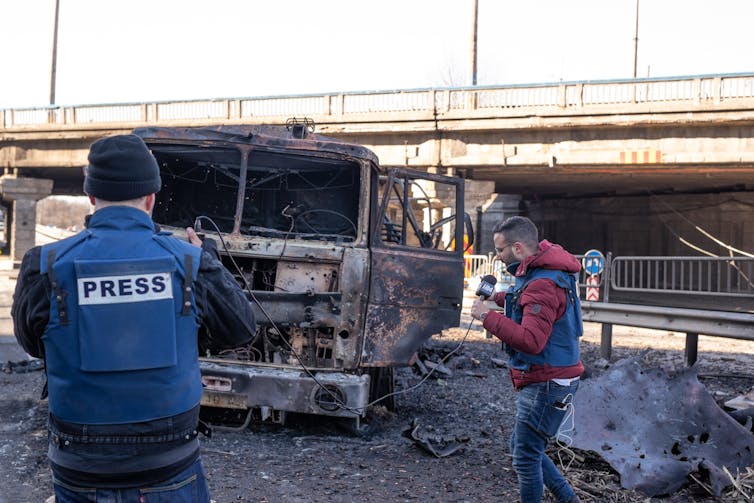
Newsrooms have long recognised the dangers of sending staff into war zones and to report on hazardous events. They provide journalists with safety training and equipment, and have well established protocols. Now, they are having to consider how to protect the mental health of staff based in the newsroom, as they see increasing numbers of journalists suffer from post-traumatic stress disorder (PTSD) or related conditions.
The International News Safety Institute and Cardiff University recently conducted a confidential survey of some two dozen newsrooms in the UK and Europe, along with 30 interviews with newsroom leaders and trauma experts. In the survey, more than three-quarters of them were aware of staff suffering PTSD, with an average of four out of ten staff seeking help within their news organisations.
All of those surveyed or spoken to agreed there was increasing potential for trauma to affect newsroom staff, given the issues and images they are expected to deal with on a daily basis. As one newsroom leader commented: “I often think our teams are the ‘invisible’ first responders and we tend to overlook the psychological challenges that come with the job.”
Another said they had not seen a time with so many heavy and traumatic stories coming at once and having an impact on all staff in their newsroom. The traumatic impact of frontline reporting has been recognised for some time. But research is now identifying the risk of trauma to newsroom-based teams and to content moderators, which itself is now a more central news function.
Management response has been patchy. Larger organisations such as Reuters, The New York Times and the BBC have developed sophisticated and proactive approaches to managing the mental health of staff.
Others rely on a basic employee assistance programme provided by a third party – often not tailored to the specific experiences in newsrooms. And some have yet to consider even that. Others have developed peer-to-peer networks within newsrooms, with more experienced editors trained to look for signs of trauma. Some have psychologists in the newsroom or visiting regularly for staff to talk to confidentially.
Only 10% of newsroom leaders surveyed said they had proactive measures in place, preparing staff before they took up roles exposing them to frequent distressing images. Barriers to change include a legacy of “macho” culture, restricted funding or simply a lack of focus on the issue.
The new frontline
Discussion in the media industry still focuses mainly on physical safety for staff in hostile environments, and has not caught up with the rapidly evolving digital landscape. In many ways the situation mirrors the development of safety protocols for war zones developed by the media 30 years ago.
The BBC, with others, developed the first hostile environment training in the early 1990s, providing helmets and flak jackets and armoured vehicles for those reporting the Bosnian war. Other newsrooms took longer to catch up. Today, there are still some reporting teams in war zones without training or equipment – but very few. Adapting to the new digital risks seems to be following a similar trajectory.
Honcharuk Andrii/Shutterstock
It isn’t simply looking at distressing images of suffering which is a problem. It’s increasingly recognised that what’s known as “moral injury”, which comes from witnessing, or failing to prevent events that violate one’s own moral values, can be distressing. Examples include the guilt of being unable to help those in danger or being expected to frame stories in ways the journalist may personally disagree with, violating their personal ethics.
Helplessness can also be a factor. Some reporters covering climate change, for example, refer to it as “the apocalypse beat”. Moral injury is distinct from PTSD, but can be equally debilitating.
The digital environment of most news coverage today also means journalists are more directly exposed to abuse and harassment from readers, or from those who disagree with their coverage. This may be exacerbated when covering controversial or polarising conflicts.
Online harassment of journalists is rising steeply as a consequence of social polarisation and the legitimising of attacks on the media by populist politicians.
Women in journalism are already deeply affected by this. Almost 90% of respondents to a 2025 survey for the European Federation of Journalists, said their female journalists had experienced online harassment and abuse. Such levels of abuse directly affect physical, emotional and mental wellbeing, and have also been found to spill into real-world violence.
The increase in vicarious trauma is a business risk. “As news cycles accelerate and conflicts proliferate, unaddressed trauma will worsen, threatening staff wellbeing, retention and the integrity of journalism itself”, observed one newsroom editor.
The news industry is starting to respond to these challenges. Newsroom leaders and trauma experts recommend using tools like audio muting, screen minimisation and grayscale filters, which can minimise the visceral impact of graphic content. And there is greater support for staff suffering regular harassment as employers increasingly recognise their duty of care with a legal responsibility to manage psychosocial risks. But there is still a sense that news management culture must adapt more rapidly to the changing risks experienced by desk-based staff processing a violent and stressful news agenda.