
Taking Churchill off the banknote isn’t ‘erasing history’ – but it is a matter of identity
News of the intended removal of Winston Churchill’s image from the five pound note by the Bank of England has outraged some commentators and politicians. Reform UK’s Nigel Farage called it “the definition of woke”. Conservative leader Kemi Badenoch said the plans to replace historical figures with wildlife would be “erasing our history”.
As an anti-counterfeit measure, the Bank of England is replacing the historical figures on the next series of banknotes with wildlife. The wildlife to appear will be chosen after a public consultation.
Technically, of course, removing Churchill from a banknote would not erase him from history. Even if his reputation is at times questionable, the fact of his leadership through the second world war is not. What removing him from a banknote does threaten is something far more personal: the collective memory through which many people understand not just Churchill and Britain, but themselves.
Crucially, the Churchill presented in popular culture is not meant to be understood in historical terms. History involves research, debate and revision. The Churchill that most people encounter through television, school and national commemoration has instead entered mythology.
Empirical scrutiny of Churchill’s political record or his personal character becomes irrelevant. What matters is his image: hero, saviour of the free world, bastion of empire, epitome of the “bulldog spirit”. For those who have internalised this image, any criticism of Churchill is an attack on the very foundations of British identity.
It’s notable that this foundational identity does not seem to apply to Jane Austen or Alan Turing – the other famous images on British banknotes.
The late philosopher Bernard Stiegler has a useful way of understanding how these images become formative. Stiegler argued that human experience is constructed through three layers of attention. The first is our direct perception of a situation. Our second is personal memory, through which we organise our understanding of the past. The third layer, what Stiegler calls tertiary retentions, are external recordings of memory such as archives, media and institutions. It’s this third layer that shapes our collective, national identity.
What Churchill means to Britons
It’s baby boomer Britons who think positively of Churchill more than other generations. For those who grew up in the mid-20th century, mass media created a national narrative through shared cultural experiences. In the 1970s and early 1980s, there were still only three TV channels, meaning millions watched the same events simultaneously. Major sporting finals, royal weddings and state funerals became the cultural glue that held British identity together.
Churchill’s state funeral in January 1965 illustrates the scale of this. Around 25 million Britons watched on television, while another million lined the streets of London for the funeral cortege. Globally, an estimated tenth of the world’s population tuned in. For many viewers, the event – and the attention given to it – reinforced Churchill not just as a historical figure, but a symbol of national greatness. Such formative memories continue to shape that generation’s take on contemporary society.
This massified behaviour, as Stiegler calls it, blurs the boundaries between personal and national identities as the viewer is caught up in a synchronised memory. Media, schools and family life repeat the same narratives, reinforcing memory until they become part of the cultural fabric. Over time, the figure at the centre of that narrative ceases to be a complex historical figure, and becomes more of a cultural product. Debates over how Churchill is represented become a contestation of how people understand Britain’s past and their own place in it.
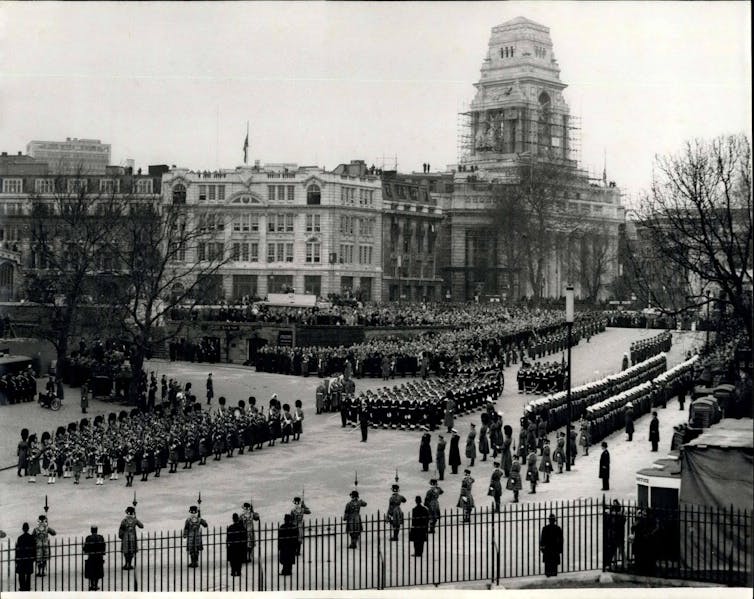
Keystone Pictures USA/ZUMAPRESS.com
It is precisely such performance that we have seen this week. Those protesting the removal of Churchill’s image – much like those outraged at the defacing of Churchill’s statue in Parliament Square – are really protesting the undermining of their identity, which is constructed through these memories.
We see these memories and the identities they construct as universal truths or common sense. Yet they are memories that are both forged – in the sense of produced through participation – and forgery – in the sense that they are partly engineered by media narrative, and as such are inauthentic. Memories are not pictures of past events. They are images mediated by institutions: schools, newspapers, technology and their preferences.
Where once a handful of broadcasters shaped national memory, social media now channels audiences into competing communities, each with its own values and preferred memories. In this age of digital memory formation. Churchill’s image is – like all collective memory – not fixed. The Churchill myth, once widely shared, now sits within a contested cultural landscape.
The claim that history is being rewritten is better understood as a cry of defiance that a collective memory is being erased, and with it a personal identity, integrity and validity. The Churchillian identity is one that valorises domination and military strength as a measure of success. As new memories shape new expectations and identities evolve, we would do well to find new measures for understanding ourselves.