Last year, fellow Jane Austen fans had a bumper harvest of new shows and audiobooks as part of the 250th anniversary of her birth.
And though the response to Emerald Fennell’s 2026 film version of Wuthering Heights has been pretty mixed, there’s no denying it’s brought about a bit of a Brontë boom; sales of the book have skyrocketed.
(If you ask us, that’s a good reason to adapt the two Brontë novels that have never had a TV or movie version made).
To me, that also means we’re long overdue for an Elizabeth Gaskell revival. After all, the author is said to have been influenced by Austen’s Pride & Prejudice when writing North & South (to great success, IMO).
She also wrote the world’s first controversial Brontë biography, The Life of Charlotte Brontë; she had been friends with the subject.
Who is Elizabeth Gaskell?
The writer, born in 1810 (six years before Charlotte Brontë, eight years before Emily, and 10 years before Anne; she was seven when Jane Austen died) was a Victorian novelist.
Her father, William Stevenson, was a journalist, and her mother, Elizabeth, died when she was just over one. After that, the author-to-be moved to her aunt Hannah’s home in Cheshire (this home would serve as the basis for Cranford).
She was exceptionally well-connected to the great minds, literary and otherwise, of her time. She had connections to Florence Nightingale, was mates with Charlotte Brontë, and also hung out with the likes of John Ruskin, the Carlyles, and Charles Kingsley.
Gaskell passed away suddenly in 1865. That’s nine years after Charlotte Brontë.
Which novels did she publish?
Gaskell’s longer works include:
Mary Barton (1848)
The Moorland Cottage (1850)
Ruth (1853)
Cranford (1853)
North and South (1855)
The Life of Charlotte Brontë (1857)
My Lady Ludlow (1858)
Sylvia’s Lovers (1863)
A Dark Night’s Work (1863)
Cousin Phillis (1864)
Wives and Daughters (incomplete,1866).
So why should I read her?
Sometimes I think that Gaskell’s work was treated in her day the way Austen’s is often treated in ours; she was deemed a little prim, a little traditional, a little sentimental, even regressive and unintellectual.
But any serious reader ought to be able to spot her wit and even subversion, or at least playfulness, a couple of books in.
Like George Eliot and Jane Austen, she dealt with the question of women’s place in the world – probably not uninformed by her close circle of accomplished women friends – in her correspondence, articles, and novels.
Her disagreement with Florence Nightingale, about the ability of brilliant women to run a household – or more precisely, their ability to be brilliant while running a household – feels strikingly relevant.
She thought the two could be reconciled, which shows in her books; I found Cranford clever in that I ridiculed its older, posher, slightly deluded characters at first, and then chided myself for doing so at its tender end.
Still, nobody sane reads a book because it’s worthy. I love Gaskell because she’s as funny as Austen, though less bit, and sometimes as able as Eliot to capture rural life well.
Plus, you could argue North & South is a very successful Pride & Prejudice knockoff, which fans of Bridget Jones know should never be sniffed at.
I think The New York Times were right to call her a “very Victorian feminist”. And I reckon fans of Brontë and Austen will enjoy her novels immensely; I certainly did.
Whether you loved it or you hated it, Emerald Fennell’s sexually-charged reimagining of Emily Bronte’s Wuthering Heights – featuring a brooding Jacob Elordi – still has us all talking over a week after its cinematic release. While the original 1847 novel didn’t feature any sex scenes, Fennell’s film is far more ‘Heathcliff, it’s me, it’s Cathy, I’m horny.’
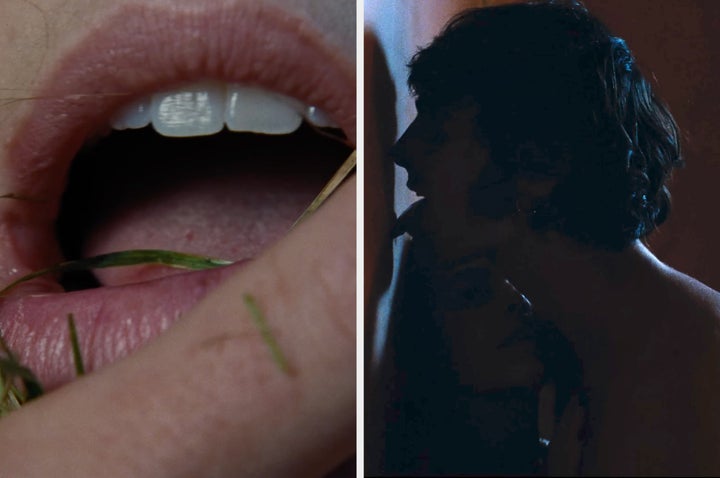
But for all the sneaking out of bedroom windows, romping in carriages, grinding in the moors, finger sucking and… puppy play that Fennell portrays in her take of Wuthering Heights, how much of this raunchery was actually going on during the period in which the original novel was set?
When you think of sexy periods of time in history, we tend to think of the promiscuity of the Ancient Romans or even the more recent free love movement of the 1970s – not the late Georgian era. So before we all start wishing that we could jump in a time machine to 1770 and find our own Heathcliff to romp about the moors with, we asked leading UK historians what sex and relationships back then were actually like.
Social Class Dictated Your Sex Life
Right from the first opening scene, Fennell’s version of Wuthering Heights features public hand jobs at the gallows and crowds snogging during a frenzied public hanging in an impoverished town centre – and you’ll be surprised to know the film was actually onto something historically accurate.
As the London Museum explains, public executions were more like a fair and a party atmosphere would be in the air as thousands of people gathered to watch someone’s final moments. Gruesome, we know – however, apparently it wouldn’t be enough to turn the Georgians off.
You see, according to Dr. Ruth Larsen, Senior Lecturer in History at the University of Derby, pre-marital sex was really common among poorer classes during the time in which Wuthering Heights was set (1770 to around 1801). “Poorer people tended to marry older and engage in sexual activity prior to that, especially those living in urban areas,” she tells HuffPost UK.
So: thousands of people, likely from poorer classes, gathering en masse in an urban area with drinking and partying going on? You do the math – it would appear that this is a big old tick for Fennell’s uninhibited Wuthering Heights adaptation.
But what about those lucky enough to be born into aristocracy? Unfortunately you wouldn’t be ‘getting lucky’ as often as your less well-off counterparts.
“For the wealthier classes, it was very unusual for women to have sexual relations before wedlock,” Dr. Larsen explains. For people like Cathy, pre-marital sex would be off the cards as “the usual form of courting would have been through assemblies, formal gathering and family acquaintances.”
The sense of familial obligation, to uphold the positive reputation of the family, was felt by many, not just the richest in society – and the film yet again gets this right with Edgar Linton, whom Cathy marries, despite her love for Heathcliff in order to improve her family’s social standing.
And her choice wouldn’t have been uncommon in the late Georgian era either. As Dr. Larsen adds: “For most young women, marriages were an opportunity to find their place in society, to become mistress of the house and, if they were landed, of the estate. To decide to take a different path would have been seen by most people as unwise.”
The Logistical Nightmare Of Affairs In Georgian Britain
Of course, the sauciness in Fennell’s Wuthering Heights really ramps up when Heathcliff and Cathy give up yearning and instead start a steamy affair (cue the famous sex scene montage).
However, as easy as the duo make it look, having an affair in the late 18th century was far from plain-sailing.
“The scenes where Heathcliff crawls in through Cathy’s window are very much representative of the literary tropes we love today, but this might have been difficult to pull off in historical reality,” Lauren Good, Senior Content Producer from HistoryExtra, tells HuffPost UK.
If you were rich enough, you’d be lucky enough to have a separate bedroom to that of your spouse (as Margot Robbie’s iteration of Cathy thoroughly enjoys), however your bedroom would be adjoined – which, as Good points out, “isn’t ideal in allowing for a quick exit from your illicit lover!”
And if you did manage to get some time alone with your ‘bit on the side’, trying to then have sex wasn’t straightforward thanks to the fashion of the era.
“Women’s dress of the era wouldn’t have been so easy to get into,” Nichi Hodgson, author of the Curious History of Dating: From Jane Austen to Tinder explains.
“Women typically wore a chemise, corset, under petticoat, hoop skirt or crinoline, over petticoat and long sleeved gown – plus gloves.” Good luck trying to remove all of that while your husband snores next door.
At least Cathy wouldn’t have had to try and get her knickers off, as Hodgson points out that drawers did not come into fashion until the 1870s: “If a hooped skirt tipped to one side, you may have got an eyeful!”
In fairness to Fennell, we don’t see a nude Cathy in any of the film as Heathcliff navigates her many, many layers of opulent clothing during the daytime sex scenes in the montage – so once again, we have another historical accuracy win!
The Surprising Sadomasochism Of The Late 18th Century
Excuse our phrasing but buckle up – this might be the most surprising historical accuracy of the entire film.
Arguably the most shocking portrayals of sex in Fennell’s film come in the shape of sadomasochistic relationships, namely two servants enjoying off screen flagellation in the stables and Isabella Linton’s submissive role to Heathcliff’s dominant. And it turns out, in the words of Hodgson, “bondage and kink were alive and well in the 18th century!”
“We often assume that the stricter societal expectations placed upon those who lived centuries before us translated into their intimate lives, but that wasn’t always the case,” Good explains.
“We might dismiss this as shock factor in Wuthering Heights but flagellation, as Hilary Mitchell told us at HistoryExtra, ‘played a prominent role in English sex work from about 1700 onwards’.”
But before we get ahead of ourselves, it’s worth noting that BSDM-inspired activities were most likely services that men paid for, or engaged in with women in their service (female maids were often treated as household sex workers) as Hodgson explains.
And as for Isabella panting on a lead, you can forget about it happening in real life she adds – “not because those sort of dynamics didn’t exist but because no middle class gentleman and woman would ever be that brazen in front of a visitor like Nelly Dean in the film.”
While the release of Wuthering Heights has us yearning for moody Georgian era romance, it’s surprising how much of it is rooted in reality. If we do hop in that time machine, we’ll just have to remember to pack easier to remove clothing.
Whether it’s people swooning over Margot Robbie and Jacob Elordi’s on-screen romance or critics furiously speaking out against the changes made from the original book, Wuthering Heights is the film the whole world is talking about right now.
Based on Emily Brontë’s iconic gothic novel, Emerald Fennell’s new movie follows the story of Cathy and Heathcliff, two childhood friends who become star-crossed lovers, only for their toxic bond to lead to their downfall.
Divisive though the film may be, Wuthering Heights has all the hallmarks of Emerald Fennell’s past work, from the elaborate costumes to the meticulous detail of the sets.
For those who’ve already seen it, we’ve pulled together some surprising facts on how this latest take on Wuthering Heights made its way to the big screen…
Emerald Fennell chose to adapt Wuthering Heights because she was obsessed with the novel as a teenager – though that also came with its own issues.
Speaking at the Brontë Women’s Writing festival in September 2025, Emerald recounted how the iconic gothic novel had “cracked [her] open” when she first read it at the age of 14.
However, her reverence for the source material also made adapting it for the big screen all the more difficult.
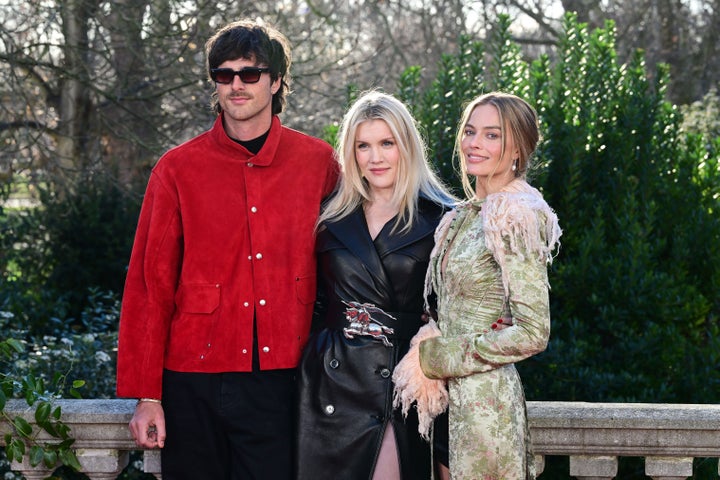
Emerald Fennell with Wuthering Heights stars Jacob Elordi and Margot Robbie earlier this month
Anthony Harvey/Shutterstock
“[It is] an act of extreme masochism to try and make a film of something that means this much to you,” she shared. “There’s an enormous amount of sado-masochism in this book. There’s a reason people were deeply shocked by it.”
During a subsequent appearance on the Penguin podcast, Emerald revealed she had re-read the book almost yearly since first discovering it as a teen, and was still impressed at how timeless the story was.
“The thing that strikes you [is] how humane and how timeless something is, and how much you feel that people have always sort of been the same,” she told interviewer Rhianna Dhillon.
Part of the appeal of the book for the filmmaker was the lack of consensus on whether it’s a toxic love story or a transcendental romance.
“Wuthering Heights is the ultimate book club book,” she told W Magazine, “because everyone can argue about it till the cows come home. And so I’m always just like, ‘You tell me’.”
The film is actually called “Wuthering Heights” – with added quotation marks – because director Emerald Fennell penned her script from memory
Much has been said about the changes the Oscar-winning filmmaker has made to the beloved source material, with some critics even branding the movie a “mockery of a classic”.
Alongside chopping the entire second half of the novel, one of the biggest changes Emerald made to the book is removing several minor characters, so the film focuses entirely on Cathy and Heathcliff.
Emerald admitted this came about when she started writing the script for Wuthering Heights from memory, as she wanted her film to be a “response and interpretation to that book and to the feeling of it” rather than a faithful adaptation.
“I think the things that I remembered were both real and not real,” she told Entertainment Weekly. “So there was a certain amount of wish fulfillment in there, and there were whole characters that I’d sort of forgotten or consolidated.”
During her chat on the Penguin podcast, Emerald admitted she loved adaptations that “exist as a response,” rather than a straight-up adaptation.
“For me, it was always about saying, ‘this is a sister or a cousin to the original text’,” she remarked. “It can’t be a twin.”
When the poster dropped, fans wanted to know why the film was called “Wuthering Heights” with quotation marks, which she explained was because the film is so different from the “untouchable” source material.
“I wanted to say early on […] I can’t make a perfect thing out of this because it’s too difficult, but I can hopefully make some people feel the same way that I felt when I read it,” she told Penguin Penguin.
One very significant Wuthering Heights character is missing from the film
While numerous characters from the book are missing in Emerald’s movie, the absence that has drawn the most criticism is that of Hindley Earnshaw.
Emerald has explained that Cathy’s brother, Hindley, was not featured in her film so the narrative could focus more on the central romance. Hindley’s antagonist role within the story is instead replaced by Martin Clunes’ Mr. Earnshaw, whose character is tweaked considerably in this adaptation.
Martin Clunes plays a reimagined version of Mr Earnshaw in Wuthering Heights
“Hindley still exists, I believe, but in the form of Earnshaw,” Emerald told Entertainment Weekly.
“It’s such a complicated structure, the novel, that really it would have been very, very difficult to turn that into a coherent movie because it would just be much more time.”
Emerald Fennell wanted to make the story’s ending more dramatic, so she made some big structural changes to Wuthering Heights
Of all the changes Emerald made to the source material, one of the biggest is undoubtedly the ending. While in the film, Cathy dies of sepsis before she ever has the chance to see Heathcliff again, in the book, she does get to see her lover one last time.
Emerald explained to Entertainment Weekly that this edit was “partly structural” – but there was something else behind the decision.
“We talk a lot about Romeo & Juliet,” she pointed out. “And, obviously, when we meet Isabella, she’s talking about that kind of story and about that missed thing, and I feel so much that Cathy and Heathcliff’s [romance] was about missing each other.”
In Emerald Fennell’s Wuthering Heights, Heathcliff does not get a chance to see Cathy again before she dies
Emerald Fennell had Jacob Elordi in mind to play Heathcliff from day one – for one very specific reason
Jacob Elordi’s casting as Heathcliff caused significant backlash, with many declaring it to be a case of “whitewashing” a character many believe was written as a person of colour in the novel.
Opening up about the controversial decision to cast Jacob in the role last year, Emerald claimed she first had the idea to cast Jacob while they were still working together on Saltburn, after noticing that he “looked exactly like the illustration of Heathcliff on the first [copy of Wuthering Heights] that I read”.
“It was so awful because I so wanted to scream,” she told the BBC. “[That would not have been] the professional thing to do, obviously.”
She added: “I had been thinking about making [a film version of Wuthering Heights], and it seemed to me he had the thing… he’s a very surprising actor.”
Reacting more directly to the “whitewashing” accusations in January 2026, the Promising Young Woman director defended her choice, telling The Hollywood Reporter: “Everyone who loves this book has such a personal connection to it, and so, you can only ever kind of make the movie that you sort of imagined yourself when you read it.”
Jacob Elordi in Saltburn – his first collaboration with Wuthering Heights director Emerald Fennell
While Jacob has not yet addressed the controversy, he did tell Vogue Australia that playing Heathcliff caused him to doubt himself.
More recently, Jacob defended the changes Emerald made to the novel more generally, describing the film as “her vision”, and echoing her past claim that it was based on “the images that came to her head” when she read the book as a teen.
“Someone else’s interpretation of a great piece of art is what I am interested in,” he said.
Margot Robbie suggested herself for the role of Cathy in Wuthering Heights
Margot and Emerald Fennell’s professional relationship began when the Once Upon A Time In Hollywood actor’s production company, LuckyChap Entertainment, became an early backer of the director, producing her films Promising Young Woman and Saltburn.
Jacob had already been cast in Wuthering Heights by the time Emerald’s script landed on Margot’s desk, and the Barbie star was instantly captivated and felt connected to Cathy.
“I both understood her and didn’t, in a way that drew me to her. It’s this puzzle you have to work out,” she told Vogue.
So, Margot threw her hat in the ring to play the role, although she didn’t “want Emerald to feel like she had to say yes”.
“I’ve always wanted to be one of Emerald’s actors and fortunately, she felt the same way. It worked out wonderfully,” she mentioned on The Graham Norton show.
Emerald seemingly didn’t need too much convincing, instantly casting the Oscar-nominated actor.
“Margot comes with big dick energy. That’s what Cathy needs,” the British director told Vogue.
Wuthering Heights star Alison Oliver was offered the role of Isabella by text
Wuthering Heights has been divisive among critics and audiences, but one thing that has been near-unanimously praised is Alison Oliver’s portrayal of Isabella.
The Irish actor previously worked with Emerald Fennell in Saltburn, where she played the spoilt-but-complicated sister of Jacob Elordi’s Felix.
Emerald was so impressed with Alison’s work in her previous film that she offered her the role of Isabella via text, to which Alison immediately replied with a “yes”.
“I just love her so much that I would do anything she was doing,” Alison told Elle.
Alison Oliver at the premiere of Wuthering Heights earlier this month
Charli XCX was sent the script after only meeting Emerald Fennell once
Alison Oliver wasn’t the only person involved in Wuthering Heights to be asked to participate over text.
Charli XCX, who soundtracked the gothic romance, got a message out of the blue from Emerald Fennell, despite only meeting the director once.
“I had heard through the grapevine that she was making an adaptation of Wuthering Heights, and so when she sent me the script to read, I devoured it instantly,” Charli wrote on her Substack in November 2025. “I was in London at the time, it was freezing and miserable and getting dark at around 4pm, which felt fitting.”
The Grammy winner recalled: “I began to sink into this reimagined world of Wuthering Heights and I suddenly began to feel… inspired.”
While it was Emerald’s idea for Charli to contribute a song to the soundtrack, it was the singer who suggested a whole companion album could work, too.
“I wanted to dive into persona, into a world that felt undeniably raw, wild, sexual, gothic, British, tortured and full of actual real sentences, punctuation and grammar,” the Brat star explained.
Jacob Elordi’s beard had to be tested to make sure it could handle the Yorkshire weather
When audiences first see Jacob Elordi in character as Heathcliff, he has long scruffy hair and a beard.
Although Jacob was able to grow his own beard, Wuthering Heights was filmed out of order, meaning the makeup team had to recreate his real facial hair in some scenes by laying on every individual hair by hand. And because much of the film takes place on the wet, windy moors, the team had to test-run the fake beard to ensure it could handle the conditions.
“It was a very kind of nail-biting [experience],” hair and makeup department head, Sian Miller, told Variety. “And Emerald, outside the studio at Elstree, got the effects guys to hose him with, I likened it to a water cannon with a Rolls-Royce engine.”
Later, when Heathcliff returns in the film, he has had a glow-up, appearing clean-shaven with a new sleek haircut, prompting the nickname “Darcy Elordi” behind the scenes, in a nod to Pride & Prejudice.
“[Jacob] has great hair to work with and the sideburns. We just knew it was going to suit him, and he would look amazing,” Miller revealed to Variety.
Because Wuthering Heights was not filmed in order, Jacob Elordi needed to don a fake beard for certain scenes
Jacob Elordi used poetry to help him master that Northern accent
Australian actor Jacob Elordi had already been praised for his accent work in both Saltburn and Frankenstein, but his impressive Yorkshire accent in Wuthering Heights still came as a surprise to many viewers.
Around the film’s release, he told the BBC how he religiously practiced the very specific Northern English accent in the bath.
“I like the ‘meks’ and the ‘teks’, instead of ‘take’. I like the ‘M-E-K’, ‘T-E-K’,” he explained of the Yorkshire dialect.
The former Euphoria actor teamed up with dialect coach William Conacher – who worked on Oppenheimer and Nosferatu – and listened to Ted Hughes’ poem Lovesong to help him work on the accent.
“You don’t want the dialogue from the script to become dull by repetition, so you try to avoid getting too much into it,” Conacher told The Observer. “We went through the poem a lot, and there are patterns that you work out and there are rules.
“It’s easy to fall into the trap of doing a general wash of northernness… I think I pushed it in a direction that was stronger than Jacob was originally intending.”
Historical accuracy came second to emotion when it came to Wuthering Heights’ costumes
While some critics have called out Wuthering Heights’ costumes for not being accurate to its 1800s setting, Emerald has insisted that silhouette and overall vibe were more important factors to her than achieving realism.
She pointed out to the V&A: “We’re not making a realistic costume. We’re referencing it as a costume. It’s only a period drama, to a point. The suspension of disbelief is why it’s so fun.”
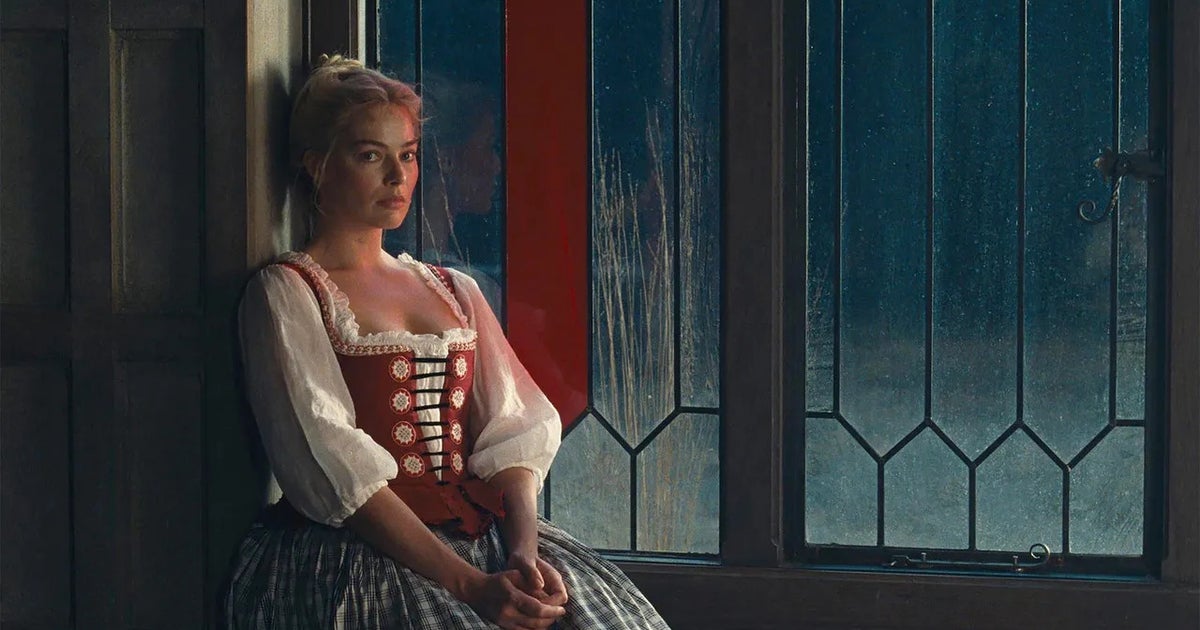
The team behind Cathy’s elaborate costumes for Wuthering Heights say they made 45 to 50 looks for Margot to wear in the film, which were more inspired by 1950s melodrama, fairytales and paperback book covers than Brontë’s source novel.
“Our references ranged from Elizabethan through to Georgian and Victorian, and from paintings and historical dress to contemporary fashion and representations of period costume in 20th-century films,” Oscar-winning costume designer Jacqueline Durran told Vogue.
“The challenge was to distill that into looks that told the story that Emerald wanted to tell.”
Emerald Fennell had an unusual inspiration for a certain period-inappropriate dress in Wuthering Heights
Emerald had a very specific vision in mind when speaking to Jacqueline Durran about creating the garment, which was worn on Cathy’s wedding night.
The gown was inspired by a 1950s photo Emerald had of a woman wrapped up in cellophane with a bow around the middle, with Durran telling Vogue: “It’s about Cathy being a gift on her wedding night, making herself a gift.”
Cathy’s hair mimics the different stages of her life over the course of Wuthering Heights
Margot wore more than 35 styles of hair throughout Wuthering Heights, which help tell the story as much as the script and the performances.
“It’s really about trying to show as many emotions and as many stages of the story arc as possible, and hair really sings out, and says so much about people and where they’re at and what’s going on,” Miller explained to Variety.
At dinner, after she first marries Edgar, Cathy has a unique halo braid – but behind the scenes it had a much more colourful nickname.
“I’d seen something reminiscent of this style in my search – this plait at the back of the head. I thought, ‘If I make it smaller and we dress the hair around it.’ We just called it a ‘Vagina plait’,” Miller revealed.
“That’s what’s great about working with Emerald, you show her things, ‘Oh, vagina plait. Yes, I love that.’ And we gave the hairstyles names. We really spur each other on.”
Margot Robbie’s hairstyles in Wuthering Heights echo Cathy’s character development
This look was softer and more subtle than the style Cathy wore previously, indicating she had grown up.
“There are ribbons in there, and they match the ribbons on the rose dress,” Davies added.
Wuthering Heights’ opening scene was originally thought to be much more graphic
Wuthering Heights begins with a gallows scene, in which a young Cathy and Nelly watch a man being hanged. The unidentified man kicks his legs as he dies, with his thin robe failing to hide his erection.
It’s a pretty unusual way to start a period romance, but the director has made it clear she wanted to create a specific atmosphere early on in the film.
“With the first moments of a film, you need to set the tone and say what it is,” Emerald told USA Today. “This is a deeply felt romance. But I also wanted people to understand that it would be surprising and darkly funny and perhaps stranger than they would expect.”
This opening sequence was allegedly much more shocking in the version shown at early test screenings, with one report claiming it included a shot of a nun masturbating and fondling the hanged man’s erection.
According to The Telegraph, this scene prompted some viewers to walk out in disgust. Emerald Fennell has not addressed these rumours about her opening scene, so it’s unclear whether she edited the final cut in light of these test screenings, or if these early reports were inaccurate or exaggerated.
Emerald Fennell’s Wuthering Heights opens with a public hanging, in stark contrast to the original novel
Emerald Fennell’s Wuthering Heights was filmed on the actual Yorkshire moors
Anyone who has read Brontë’s novel knows that the Yorkshire moors are almost as important to the story as Cathy and Heathcliff’s love. While the Wuthering Heights property is not a real location, the film was actually shot in Yorkshire.
Multiple scenes – including the opening, in which a horse-drawn carriage trundles through a narrow valley – were filmed at the remains of Yorkshire’s early 19th-century lead mining industry, known as Old Gang Smelt Mill.
Other parts of the movie were also filmed in Bouldershaw Lane, Booze Moore and Melbecks Moor in Swaledale. You can see these locations in the external shots, where Cathy paces the fields in billowing gowns, surrounded by fog.
Much of Wuthering Heights was actually filmed in the Yorkshire moors
The rock where Cathy waits for Heathcliff is Healaugh Crag, a jutting formation found on the Reeth Estate in North Yorkshire.
However, there were some scenes not filmed in Yorkshire.
The hanging scene, for example, was filmed at Knole House in Kent, with the 500-year-old National Trust property appearing at the start of the adaptation and later doubling as Gretna Green when Heathcliff and Isabella elope.
Some interior shots – as well as select moments just outside Wuthering Heights – were filmed at Leavesden Studios and Sky Studios Elstree in Hertfordshire, home of projects like Harry Potter and Barbie.
Wuthering Heights’ infamous ‘skin room’ is based on Margot Robbie’s actual complexion
One of the most memorable sets in this new adaptation is the “skin room” at Thurshcross Grange, where the walls and floor mimic Cathy’s complexion (veins, moles, and all). In fact, this design is based on Margot Robbie’s own skin.
“For that, we took photocopies of Margot’s arm, printed that onto stretchy fabric, padded it and laid latex over the top,” production designer Suzie Davies told Vogue.
Cathy’s bedroom in Wuthering Heights is inspired by Margot Robbie’s actual skintone
In an interview with the V&A, Emerald said she saw the Lintons’ home as a body more than a building, where the walls could glisten, bulge and even host leeches.
She claimed: “If you look a bit closer, there are hairs growing out of the moles. That’s what the Gothic is to me, and that’s what interests me – pulling a hair out of a mole in a wall.”
In a Variety interview, Davies added: “We had a go at doing her belly button as well, above the fireplace, but that looked a little bit too weird, believe it or not.”
In the closing scene of the film, there’s an overhead shot of Cathy lying on the bed, where you can see veins running across the entire room.
“We printed her veins and everything into the carpet as well, just for that top shot,” Davies explained.
Jacob Elordi improvised one of the film’s most low-key romantic moments
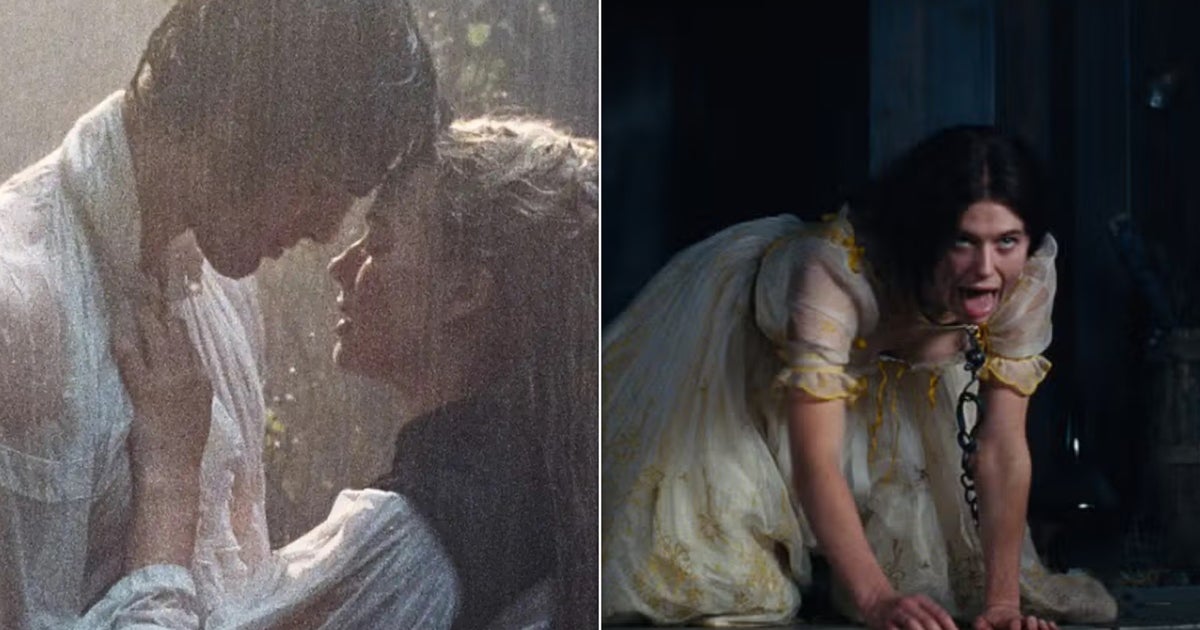
During one romantic scene in which Heathcliff and Cathy get caught in the rain, he covers her face so they can speak without her getting water in her eyes. This scene was actually improvised by Jacob Elordi during rehearsals.
Heathcliff shields Cathy’s eyes from the rain in Wuthering Heights, in a moment that was actually improvised by Jacob Elordi
In a recent interview with Screen Rant, Margot revealed that her co-star instinctively moved to cover her face from the spray of the rain machine, and the director loved the gesture so much that she asked him to do it in the film.
Margot described the moment as “one of the most romantic things I’ve ever experienced”, although Jacob admitted he didn’t see why the women were swooning over his actions – as he thought it was actually a “rude” gesture.
Emerald Fennell took inspiration from reality TV when making Wuthering Heights
When making an epic Gothic romance like Wuthering Heights, Emerald Fennell found inspiration in an unusual place.
Alongside citing cinematic pioneers Powell and Pressburger, the legendary artist and filmmaker Peter Greenaway, and Baz Luhrmann’s Romeo + Juliet, she name-checked one popular reality TV show as a major influence on her script.
“What I’m always reminded of when I watch shows like First Dates is how transparent we all are,” she said during the V&A panel.
“No matter how in our minds we think we’re really clever, – and not showing that we love someone, or that we’re angry – people aren’t good actors.”
Margot Robbie recreated Kate Bush’s iconic Wuthering Heights choreography behind the scenes – in full costume
If you’ve had Kate Bush’s 1978 song, Wuthering Heights, stuck in your head since seeing the new film, you’re clearly not the only one.
In a clip shared by dialect coach William Conache, Margot recreated Kate’s iconic music video choreography, in full costume, in the Yorkshire moors.
“Cathy may not have a great time in the movie but we had a lovely time making it,” Conache wrote his social media caption. “Here is the joyous Margot on our last day of shooting.”
We all know that Wuthering Heights is not about a love that we should aspire to, right? We know that their bond was eventually very toxic, that they mistreated each other and everybody around them, and it ended anything but happily ever after.
All of that being said, watching Emerald Fennell’s take on the novel can definitely remind you of a certain ex. Not the one you had an amicable split with, not the ‘fun summer fling’. No. This ex is the one that you had the senselessly passionate relationship with. Everything was aflame and when it ended, you went no-contact. Probably because your friends begged you to.
It’s not romantic but it’s definitely alluring: the thrill of the chase, the passion between you, the way they took up residence in your head and squeezed into every thought… they’re pretty unforgettable, probably quite toxic, and seeing a highly stylised version on-screen with this blockbuster can easily reignite certain memories.
Why you can’t get over your toxic ex
On paper it should be easy, but getting over this kind of ex is not simple, much like the bond itself – as divorce coach Carol Madden notes on Medium: toxic relationships take longer to heal from than healthier ones.
Speaking to Business Insider, relationship expert Jessica Alderson explained that these kind of relationships are a bit like an addiction, saying: “They are often characterised by extreme highs, during which relationships seem perfect and magical, followed by crashing lows, which are usually caused by a partner pulling away or acting out – this can make people feel alive.”
Once the relationship finally ends, your body can still crave this unpredictability. She added: “The emotional rollercoaster can make it harder to move on and accept that the relationship wasn’t meant to be.”
How to get over an ex
Clinical psychologist Dr Ruth Ann Harpursuggested that after a relationship breaks down, people will naturally try to seek answers about where it all went wrong – and while it’s a “crucial step” in the early moments of the breakup, it’s important not to keep going over every detail of the relationship and your ex’s behaviour.
If you get stuck ruminating, you become “tied to the past” and end up reliving the pain, she suggested. So, her advice is to: “Understand that ruminating on past abuses may feel safe but it keeps you from living fully in the present and building healthier relationships.”
She also urges people to focus on activities they really enjoy to keep busy and connect with themselves again, and to open themselves to new friendships and relationships.
From hit series such as Heated Rivalry and Bridgerton to the most talked about movie of the moment, Emerald Fennell’s Wuthering Heights, yearning is everywhere right now. Falling in love and living happily ever after? BORING – we want storylines with long, drawn out power dynamics, tortuous emotional restraint and hopefully, a moment of release.
Yearning, as the Cambridge Dictionary defines it, is “a strong feeling of wishing for something, especially something that you cannot have or get easily” – and we can’t get enough of it.
You only have to search #yearning on TikTok to be flooded with videos (245k posts, in fact) to find romanticised clip after clip of Jacob Elordi’s Heathcliff looking miserable on the Moors or videos of Jonathan Bailey’s Anthony Bridgerton staring down a camera with misty-eyes.
Meanwhile, the phrase ‘best yearning scenes’ has been Googled so many times in the last 30 days that it’s been classified as a ‘breakout’ term (Heathcliff’s finger sucking has a lot to answer for).
However, according to new research from Tinder, it turns out that many of us don’t just want these intense feelings in our pop culture, we want them mirrored in our own dating lives too.
Not content with yearning being restricted to screen, stage and page (yes, we see you too A Court of Thorns and Roses readers), 71% of UK singles aged 18-25 want love that feels as intense as it does in films or books, while two thirds (67%) say they love the feeling of being yearned after, and 61% enjoy yearning for someone they like.
However, is yearning really all it cracks up to be in practice in the real world?
Well, as chartered psychologist Dr Tracy King explains, one of the main issues with yearning is that a lot of it is based around uncertainty and it can actually lead us to have an unrealistic idea of the person we’re yearning for.
“When someone is just out of reach, the mind fills in the gaps,” she says. “You are not relating to a full, consistent picture of a person, you are relating to fragments and possibility. That creates intensity, but intensity is not the same thing as compatibility.”
In other words, you’re so wrapped up in this feeling of want and longing that you might be blind to the pitfalls of the person themselves – that this idea of them is actually more attractive than the reality of who they are.
We’ve all been there, when the thrill of the chase and the ‘will we, won’t we’ element of dating is absolutely intoxicating, but then when things eventually work out after painful uncertainty, everything feels a little… flat.
Tinder’s data actually echoes this, with 28% of UK singles saying they enjoy having a crush even if it doesn’t go anywhere i.e. the whole point is the feeling of longing over the actual fruition of a relationship.
And unfortunately the reason it can feel so delicious is because yearning sits in the brain’s same learning mechanism as intermittent reinforcement – and for this example, Dr Tracy uses rats (sorry Heathcliff).
“We can look at the effects of intermittent reinforcement from past behavioural psychology experiments using rats. When a reward was delivered consistently to the rats, their behaviour stayed steady.
“However, when the reward was delivered unpredictably, the behaviour became far more embedded. The uncertainty drove the animal to keep trying. Unpredictable rewards embed action and need far deeper.”
Apart from desperately trying not to make a joke about our exes and rats, how does this relate to our dating lives? Time to reintroduce our dating trend friend breadcrumbing, something which yearning relies upon, according to Dr Tracy.
“Yearning is exactly how breadcrumbing is able to work. A message arrives after silence. Interest appears and disappears. There is just enough contact to keep hope alive, but not enough consistency to create security. People may call this romance, or proof of how much they need and want the other but what is happening is nervous system activation plus a reward loop.”
Yearning suddenly isn’t as sexy when you think of it as a weapon for shitty dating behaviour, is it?
At the moment, pop culture tends to romanticise yearning because it looks like depth of feeling on screen but in real life, it is worth asking a more grounded question: is this feeling coming from mutual connection and real knowledge of the person, or is it being driven by inconsistency and the pull of possibility?
Sure, healthy love might not be as glamorous and sexy as yearning, but maybe we should leave the misery on the Moors and the unpredictable breadcrumbs for the rats.
This article contains spoilers for Wuthering Heights.
Wuthering Heights director Emerald Fennell is opening up about one of the biggest changes she made to the original story for her new big-screen adaptation.
Much has already been made of Emerald’s fast-and-loose approach to staying faithful to the source material in her new spin on Wuthering Heights, so much so that the title of her film is listed in quotation marks to indicate how much it’s her version of events.
One of the most polarising aspects of the new film involves Alison Oliver’s character Isabella, and what transpires between her and Heathcliff.
In the original film, Isabella and Heathcliff’s relationship is depicted as coercive, violent and abusive, with the latter even killing the former’s dog as an act of cruelty shortly after marrying her.
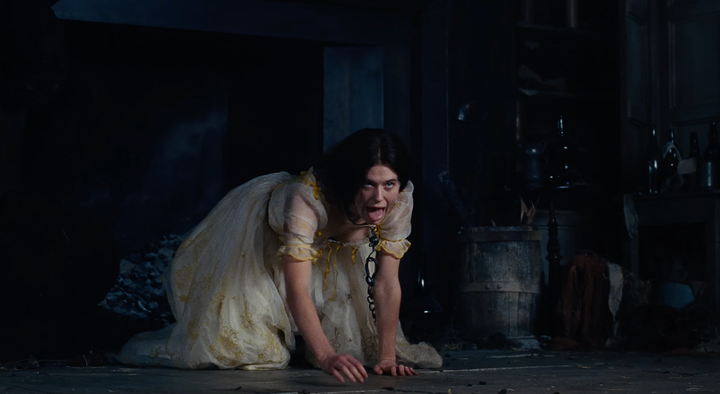
However, in the film, when Nelly drops in on Isabella and Heathcliff, it’s suggested that their relationship is more of a consensually submissive one, with Isabella chained up and acting like a dog, even quietly winking at her former housekeeper to indicate that she’s happy with the arrangement.
Alison Oliver as Isabella in Wuthering Heights
This transformation to the character of Isabella has not sat well with all fans of the Emily Brontë novel, with Digital Spy recently sharing a piece lamenting that “what Wuthering Heights did to Isabella is unforgivable”, and LadBible pointing out that this “BDSM scene” has “sparked controversy”.
During a recent interview with Entertainment Weekly, Emerald Fennell pointed out that while the circumstances of the scene might be different in her adaptation, the dialogue largely remains from the novel.
“That scene in the book, I think that’s the reason why [the novel] was eviscerated when it came out because I think it was just so shocking to people,” she said.
“Because there’s so much in what happens there that is… very, very complicated. Very transgressive – even for now, it’s shocking. And, obviously, I visually added some things to that scene, but it is almost all Brontë.”
Jacob Elordi also said in the same piece that he thinks the scene represented “Emerald kind of taking the killing of the dog and these really dark parts of the novel and putting them into this scene”.
“I had so much fun because it’s at that point that Isabella and Heathcliff are completely off the deep end. They’re living in a kind of hell, you know?” he continued.
“For him, it’s a self-generated hell. It’s the moment that his obsession clicks over into something else – into a rabid desperation – and he loses any semblance of composure. It’s a nice point for the character, I think.
“You can see it in his face when it’s Nelly at the door, and it’s not Cathy. And it’s not working anymore, and the joke is over, which means it’s real, you know? And they have to face it.”
While promoting her new movie, Emerald has insisted that she stands by the changes she made to the original story.
Before the film had even begun shooting, Emerald’s Wuthering Heights had sparked backlash over her casting of Jacob as Heathcliff, a character who is heavily implied in the book to be a person of colour.
Reacting to to these “whitewashing” accusations last month, the Oscar winner said: “The thing is, everyone who loves this book has such a personal connection to it, and so, you can only ever kind of make the movie that you sort of imagined yourself when you read it.”
As Wuthering Heights continues to dominate conversation, has anyone else found themselves listening to a certain 1978 Kate Bush hit on a near-constant loop?
Well, it turns out that Kate’s chart-topper was hard for the cast of Emerald Fennell’s new film to get out of their heads, too.
In fact, a new clip shows the movie’s lead Margot Robbie, who plays Cathy, recreating the British music legend’s iconic choreography while shooting on the very moors that inspired it.
Dialect coach William Conacher shared the behind-the-scenes footage of the Oscar nominee performing the moves on his Instagram page on Monday, to celebrate the new movie’s box office success, and has already racked up more than one million views.
Check out Margot in action below:
And, just for good measure, here’s Kate Bush performing her original choreography as we’re more used to seeing it in the late 1970s:
Margot’s co-star Jacob Elordi, who plays Heathcliff, previously teased to 10 News Sydney that the Barbie star “knows the whole dance top to bottom”, and claimed to have “16mm footage of her doing the dance on the moors”.
Wuthering Heights was Kate Bush’s debut single, and was inspired by the BBC’s adaptation of the Emily Brontë novel which first aired in 1970, starring Timothy Dalton as Heathcliff and Anna Calder-Marshall as Cathy.
The track became Kate’s first and only number one single – that is, until the fourth season of Stranger Things saw a surge in popularity for her track Running Up That Hill almost 40 years on from its original release.
Emerald Fennell’s spin on Wuthering Heights does not make use of Kate Bush’s signature song, instead featuring new music by Charli XCX inspired by her script.
Charli recently unveiled a companion album to go alongside the film, featuring the singles Chains Of Love and Wall Of Sound, as well as the previously-released John Cale collab House, which is used in the film’s opening sequence.
Jacob Elordi has opened up about the racy scenes we can expect from his new film Wuthering Heights.
Helmed by Saltburn director Emerald Fennell, the new movie is based on the iconic gothic novel and stars Jacob as Heathcliff, while fellow Australian actor Margot Robbie takes on the role of Cathy.
Ever since the film’s first test screening over the summer, much has been made of its more sexually-charged content, with its numerous steamy scenes being heavily referenced when the first reviews for Wuthering Heights were released earlier this week.
During a recent interview with USA Today, Jacob insisted that any sexual scenes that Emerald added to her version of the story are still “entirely in the spirit” of Emily Brontë’s original novel.
“Any image that comes from Emerald’s head is inspired by that depravity and love and obsession,” the Euphoria star noted.
The trailer for Wuthering Heights suggests it’s following on from Saltburn in terms of its racy content
“They’re all in the language of what Brontë was driving at with this book, so it was never really a shock or a reach.”
During the same interview, Margot spoke candidly about how different shooting a sex scene is to watching one on the big screen.
“[Viewers] forget how many people are on a film set – there are hundreds of people sometimes,” she pointed out.
“Even though something looks like, ‘Wow, that’s super-intimate! It’s just those two actors there!’ Three feet away, there’s Emerald with an iPad and watching the monitor.”
Meanwhile, Emerald added: “Things that are sexy often take us by surprise. Maybe some people would argue otherwise, but I’m not interested in anything being explicit. I’m interested in making people feel.”
Saltburn, Emerald’s last film, previously raised eyebrows due to some of its more X-rated scenes, including one grave-humping sequence, some infamous drain-slurping and, of course, a fully naked dance routine to a 2000s pop classic.
Wuthering Heights hits cinemas on Friday 13 February.