‘Malicious Compliance’ Might Be The Best Way To Deal With A Toxic Boss


When you have a bad boss keeping you down, your best way to fight back might be to try “malicious compliance,” according to a growing online movement of disgruntled workers.

For them, a maliciously compliant act is a creative form of resistance against their boss’ marching orders. You might fulfill what you’re asked in order to stay employed, but your actions will not be exactly what the person wanted.

Servers say they do it to fight back against entitled customers. If a rude customer asks for extra butter, they’ll bring back a ridiculous amount of butter to the table, for example.

According to the subreddit that documents acts of malicious compliance, it involves any act when people are “conforming to the letter, but not the spirit, of a request.” Popular examples include: If a boss asks you to dress better without specifying what that means, you wear a suit. Or if a boss orders you to be the only team to work in the office on Fourth of July, you expense a barbecue feast costing thousands of dollars.

But if you decide to try this yourself, proceed with caution. Career and legal experts say this can help you survive under a bad boss –– or it can spectacularly backfire.

For micromanagers, malicious compliance can give them a taste of their own medicine.

‘Malicious Compliance’ Might Be The Best Way To Deal With A Toxic Boss

Yana Iskayeva via Getty Images

A maliciously compliant act is a creative form of resistance against a boss’ marching orders.

Micromanagers can often be insecure, rigid bosses who need constant unwarranted check-ins for reassurance that you’re working.

“Malicious compliance can work well against an insecure manager,” said Ryan Stygar, an employment attorney and author of the upcoming book, Get It in Writing: The Ultimate Guide to Your Rights at Work.

In this case, your malicious compliance is going above and beyond to comply with a micromanager’s demands. If they want a list of your daily tasks, you send long, bulleted emails.

“When you follow their instructions exactly, it exposes how inefficient those instructions really are,” he said. “For example, if they want to approve every email, their inbox quickly becomes a mess. I compare this [as] holding up a mirror to the micromanager. Once they see how burdensome the micromanagement has become, they typically back off.”

It helps to confirm that this is what they wanted. You might reply to a micromanager with, “Thank you for your instructions today. This confirms I will submit every client-facing email to you for approval before sending,” Stygar said. This response works because it “creates a paper trail,” he said. “It also locks in their expectations…It prevents them from ‘moving the goalposts’ and claiming you did not comply with their orders.”

“Now there is no confusion. If work slows down, you have proof showing why its not really your fault. With a reasonable manager, this may get them to back down,” Stygar said. “With a toxic one, it may not. But it will make it much harder for them to twist the facts either way.”

And if timing matters, mention that you sent their request by noon, per their last email, in your malicious compliance. “Now any delay is clearly tied to the process the micromanager imposed on you — not your performance,” Stygar said.

And this kind of strategic resistance might not be so malicious after all. If you do go above and beyond for a micromanager it might actually be “exuberant compliance,” said Mary Abbajay, president of leadership development consultancy Careerstone Group and author of Managing Up: How to Move Up, Win at Work, and Succeed with Any Type of Boss. “Exuberant compliance is when you’re giving them what they want and it’s not reflecting on your work,” she said.

For toxic bosses, it can be a protective response – but it can also have consequences.

Bad bosses can be difficult, but a toxic boss is a dismissive, demeaning boss that is trying to ruin your mental health.

A toxic micromanager, for example, is “trying to control you,” Stygar said. “They’re probably hoping you make a mistake so they can enjoy the power trip of jumping all over you.”

Typically, in these cases, malicious compliance is when you know what you’re doing will lead to a less efficient, more chaotic outcome for your team, but your preferred alternatives got rejected by your boss. If your horrible boss has a new workflow that is doomed to fail, you follow it because you had no choice, for example.

In these cases, your malicious compliance might actually be “protective compliance,” Abbajay said. “All you can do is survive a toxic boss. And if…giving them what they want is going to protect you until you can get yourself out of there, then I’m all for it.”

Ideally, you only do this kind of protective compliance while you actively job hunt for a better opportunity, because if you keep doing this, “you are never going to actually thrive, and you’re never going to get to find out your full potential,” Abbajay said.

But don’t be snarky about it or this defiance will backfire.

People who need to resort to malicious compliance to push back against their boss’ orders are not happy employees. They’re often scared, overworked employees who are just trying to get through each day. But don’t let your negative emotions seep into your malicious compliance. Stygar said that “malicious compliance works best as a defensive measure, not a revenge tactic.”

In his view, the “deadly sins” of malicious compliance are if you’re sarcastic in your response, if you purposefully slow work down, and if you try to embarrass or mock your boss.

“A toxic manager is often looking for ‘insubordination,’” Stygar said. “If you give them that opportunity, even by accident, they will take it.”

Instead, the safer but tedious approach is to maintain a neutral tone and document what nonsense your boss is asking you to do in case you need to prove yourself later.

“Keep copies of these exchanges for yourself. Build a record that shows exactly what they told you to do and how you followed it,” Stygar said.

And don’t do malicious compliance that makes it seem like you’re not good at your job.

“If your malicious compliance is delivering substandard work, then that actually isn’t going to reflect very well on you, because it’s still your work and your name is attached to it,” Abbajay said.




Five Signs Your Work Burnout Is Actually A ‘Competence Hangover’


Additional comment provided by Peter Duris, CEO of Kickresume.

Burnout is alarmingly common in UK workplaces. It’s expected to affect about 65% of workers (20% of employees have taken time off for work-related stress).

That can be caused by high workload, low pay, a lack of support, and unrealistic expectations.

But if you ask Peter Duris, CEO of Kickresume, some of those people are experiencing something called a “competence hangover,” too.

What is a competence hangover?

It’s a form of burnout that happens when a worker feels solely, or mostly, responsible for keeping their workplace afloat.

You might feel that standards would drop to unacceptable levels without you, or that serious mistakes would be made in your absence – leading to immense perceived pressure.

“If you feel responsible for other people’s well-being at work, you might be more likely to push yourself further, taking on extra tasks or working later, potentially to the point of burnout,” said Duris.

Who is most likely to get a “competence hangover”?

“You can develop this issue in any kind of job, but there are some career paths where people might be more vulnerable to a ‘competence hangover,’” Duris told HuffPost UK.

“This includes jobs where workers can find themselves under a lot of emotional strain,” like medicine, teaching, and social work.

And, Duris added, personality matters too.

Studies have shown that people who are highly conscientious are more likely to take on extra work, describing themselves as feeling exhausted and emotionally drained.

“Because they’re seen as reliable, these employees are often asked by managers to take on extra tasks on top of helping their coworkers. Managers should be mindful of this to avoid overloading their teams.”

How can I tell if I have a competence hangover?

Per Duris, some signs include:

  1. Feeling exhausted,
  2. Coming back to work after the weekend as if you haven’t had a proper rest,
  3. Struggling with decision-making can feel harder,
  4. Low creativity,
  5. Feeling resentful of coworkers.

“On the other hand, if you’re a manager who’s worried about one of your team members, it might come out in a one-to-one meeting, so make sure that you’re making time for these catch-ups,” he added.

When should I leave because of burnout?

Competence “hangovers” are a form of burnout that can make you feel like you need to switch jobs.

“Sometimes a couple of days off can help take the pressure off a bit. But people whose exhaustion is deeper than this might find themselves needing to use sick leave, or consider leaving their job,” he said.

“Even if you love your work and you’re a high performer, it’s not worth risking your wellbeing and your health.

If you have a supportive manager and workplace, he added, relying on the people you work with more could help to ease your stress.

“But if you can’t rely on the other people at your company to pick up the slack after you’ve been giving it your all to keep everything going – to the point that you’ve burned out – it might be time to start thinking about a change of direction,” he ended.


Girls Get Better Grades, But That ‘Advantage’ Doesn’t Seem To Lead To Fair Pay


Expert comment provided by the European Institute for Gender Equality.

A Cambridge study found that in the UK, boys typically perform worse than girls in exams, from early years through to university.

Some researchers, including those commissioned by parliament’s Education Committee, have sought to find out why that is, while headlines posit that schools might be “biased” against boys.

We aren’t seeking to explain that difference here. Instead, we wanted to know whether the higher grades girls tend to get in school actually translate to better wages once they enter the workplace.

Here, we asked a spokesperson for the European Institute for Gender Equality (EIGE) about the topic.

“These stronger school outcomes do not automatically translate into equal outcomes later in life”

An EIGE spokesperson said that girls’ academic achievements are a “long-standing achievement in the EU”.

Women increasingly outnumber men in completing third-level education, they added.

But “these stronger school outcomes do not automatically translate into equal outcomes later in life.

“Evidence consistently shows that structural inequalities in households, the labour market and public life continue to shape women’s opportunities, earnings, and career progression.”

Indeed, the author of the Cambridge study we mentioned earlier said that “apparent advantages” suggested by girls’ academic successes “are not necessarily carried through to employment”.

At its current rate, the Trade Union Congress says, the UK’s gender pay gap is not expected to close for another 30 years.

Why don’t girls’ higher grades appear to lead to better pay?

The EIGE spokesperson said that one-third of young men aged 15-24 believe men are better leaders than women, compared to 15% of young women.

“These attitudes shape unequal outcomes over the life course, [and] contribute to a persistent divide in the labour market, where women are overrepresented in public sectors such as education, health, and care – roles that are essential but often undervalued and lower paid,” they added.

Men, meanwhile, are likelier to work in higher-paying sectors.

Additionally, when women choose lucrative jobs, these tend to become lower-paid if others join them and the career is deemed “feminine”. The inverse appears to have happened in e.g. programming, when a formerly feminised role became male-dominated.

And “even when women enter the workforce with strong qualifications, they face barriers to career progression. Women remain underrepresented in senior and decision-making positions, which has a direct impact on earnings,” the spokesperson said.

For instance, in education, which is 76% female, men make an average of 17% more than women in the UK. As a percentage, men are significantly more likely than women to be headteachers (5.8% vs 3.9%).

“In addition, unequal sharing of care responsibilities means women are more likely to work part-time, take career breaks, or adjust their working patterns, all of which can slow career advancement and reduce lifetime earnings,” the EIGE spokesperson said.

“Women are also twice as likely as men to provide over 35 hours of childcare per week and, on average, receive only 75% of men’s pensions.”

Ultimately, “the assumption that better school results lead to better professional outcomes does not hold in reality. Addressing these gaps requires tackling structural inequalities that continue to limit women’s economic equality.”


‘Key jammers’ are the thorn in the side of UK HR departments


‘Key jammers’ are the thorn in the side of UK HR departments
People are faking work by holding one key on their keyboard down continuously (Picture: Getty Images)

‘When I want a little break, I put a small weight on the spacebar and open a blank notepad file, and let it sit for a while,’ confessed one employee.

The work-shy hire admitted they’re monitored on their work laptop when they WFH via MS Teams, which shows an ‘inactive’ label after five minutes of idling.

So, to get some time to themselves, they put an object on their keyboard that’s heavy enough to press down the spacebar, to make it appear like they’re working.

But this isn’t just for a 10-minute tea break, the staffer confessed they do this for more than an hour every day.

Those who do this have earned the title ‘keyboard jammers’, and employee relations expert at HR consultants Hamilton Nash, Jim Moore, tells Metro these workers are well-known to HR departments.

‘Keyboarding jamming is one of the less sophisticated ways of pretending to work remotely, and we’ve known about mouse jiggling software for years,’ he says.

‘These tactics have been known in HR circles for years, but their use soared during the pandemic as millions more employees started working from home.’

It’s been a problem for years

And it’s a behaviour that’s still prevalent in the homes of countless UK employees, with the new that the police force has sacked 50 ‘keyboard jammers’ in the past three years alone.

Still life shot of a laptop on a dining table in a work from home setup. It is being powered by a battery storage system which is linked to solar panels (off camera) - sustainable energy
Workers are ‘key jamming’ while going out to the gym or to play golf (Picture: Getty Images)

In Durham Constabulary, Niall Thubron, a former detective, pressed the ‘i’ key more than 16,000 times on December 3, 2024, between 10.28am and 11.56am, while one Kent police officer used the hack to visit a gym and a golf course during the working day.

Greater Manchester police found 28 staff members were guilty of ‘key jamming’ with objects like staplers and fizzy drinks cans.

Avon & Somerset police’s, PC Liam Reakes, was caught weighing down the ‘z’ key during shifts for a total of 103 hours between June and September 2024, sometimes for more than four hours at a time.

‘There’s certainly a minority who view working from home as an easy option,’ Jim says. ‘Remote working is not a holiday, and employers are well within their rights to expect the same productivity and availability as office-based work.’

All remote workers suffer

‘Key jammers’ put those who rely on working from home in disrepute, many of whom may rely on remote working to be able to pick up their children from school.

Britons aged 25 to 49 are the most likely to have an overall favourable opinion of WFH (84%), likely in part because this is the age group most likely to have young children, according to YouGov.

‘This behaviour is bad news for genuine remote workers, the vast majority of whom are highly productive and professional,’ Jim explains. ‘It provides ammunition to flexible working sceptics and undermines the business case for remote work.

‘It’s unfair on employees like parents, carers and those with disabilities who rely on remote working to remain in employment.’

It also ruins it for those who simply enjoy a hybrid working model, and 83% of businesses in the UK say it’s boosted the productivity and wellbeing of their employees, according to Grant Thornton research.

How companies are fighting back

But if you’re guilty of jamming your keyboard, is it likely you’ll get caught? In short, there are plenty of ways your organisation can catch you out.

‘Many organisations have invested in monitoring tools that track actual work output rather than just keyboard activity, or by software that captures random screenshots,’ Jim says.

‘This has led to an arms race, where some workers become more creative at getting around controls, causing trust to plummet between both sides.’

Those on Reddit’s WFH thread also shared ways they believe employers have been catching ‘jammers’ out.

‘Screen monitoring is a thing,’ said one, while another added: ‘My employer confirmed they track keystrokes.

‘Nothing about watching the screen, but there are mentions of a) knowing which programs you’re using/have open, b) keystrokes in each program (including browser), c) when your computer was on/off.’

The repercussions for ‘keyboard jammers’

Jim says the consequences for jamming your keyboard can be ‘severe’ and put an end to your time at the company you’ve been working for.

‘In the police cases, dismissal was appropriate due to the breach of trust and the fact that these were public servants,’ he says.

‘In other organisations, this behaviour could constitute gross misconduct leading to summary dismissal without notice.

‘Employees need to be clear: this is potentially career-ending fraud.’

Do you have a story to share?

Get in touch by emailing MetroLifestyleTeam@Metro.co.uk.


Former NFL player Kendal Vickers kicks off a new career in real estate


Through hard work and dedication, Kendal Vickers got the chance to live out a dream shared by countless kids, through a seven-year career playing in the NFL.

The 6-foot-3 defensive tackle carved out a pro career in one of the toughest roles in sports, suiting up for the Las Vegas Raiders from 2020 to 2022 and later taking the field for the Buffalo Bills and the New Orleans Saints.

Now, in his first year as a real estate agent working in Florida and Tennessee, Vickers is starting over, once again chasing success in a game where the competition is fierce and victory is never guaranteed. It’s a challenge he welcomes.

“I just decided I was going to take the same work ethic and the same mentality that I had in football,” Vickers says. “I know I’m going to end up reaping the benefits of my work. I just have to control what I can control, and that’s myself.”

Vickers’ introduction to real estate didn’t come from luxury listings or celebrity pals, but rather from time spent swinging a hammer at a dusty jobsite under the hot Tennessee sun.

Kendal Vickers is in his first year as a real estate agent in Florida and Tennessee following his football career. Jason Getz-USA TODAY Sports

As a college player at the University of Tennessee, he would spend his summers working for his uncle, a longtime general contractor and developer who runs the Wright Group in the Knoxville area.

“Every offseason, when I wasn’t doing anything football-related, I’d go work for him,” Vickers recalls. “He had me getting on roofs, working on old windows, doing flips—just a bunch of stuff that, at the time, I didn’t really know what I was doing. I was just working an extra dollar.”

What started as a summer job slowly turned into an education. His uncle walked him through how the business actually works: how projects are financed, what makes a deal profitable, where the risks are. His aunt, who ran the books, helped explain the financial side.

“It was a real family dynamic,” he says. “I thought that was pretty cool, but I didn’t know I wanted to sell real estate until about a year before I retired.”

Buffalo Bills defensive tackle Kendal Vickers smiles on the bench during an NFL preseason football game in 2023. AP

Planning for life after football

Like many players who get the rare opportunity to go pro, Vickers grew up singularly focused on reaching the NFL.

“I always wanted to go to the NFL, since I was 4 or 5 years old,” he says. “It’s a 1% thing, and you hear that your whole life, that it’s not a real job, or that you’ve got to pick something more realistic … but I just wanted what I wanted, and because of my size and physical attributes, was able to mature into that.”

That single-mindedness carried him through college and into the NFL. But as his career progressed, he started thinking more intentionally about what would come next. Before his final 2024 season with the Saints, Vickers quietly began laying the groundwork for a second act.

“I was just like, ‘Hey, I think I want to get into real estate. I think I want to become an agent,’” he says. “I decided I was going to take a class and see where it got me.”

“I always wanted to go to the NFL, since I was 4 or 5 years old,” Vickers says. Getty Images

That decision turned 2024 into one of the busiest years of his life. Mornings were devoted to training and conditioning to stay ready for the season. Afternoons and evenings were spent grinding through real estate coursework. 

On top of all that, Vickers and his wife were expecting their first child.

“I’d get up in the morning, train, do everything: lift, get my cardio in. Then when I got home, I’d sit at my computer desk for the next six hours,” he says. “Luckily, I have a great support system who helped me keep everything organized.”

He finished about 60% of his coursework before the 2024 season kicked off, then completed the remainder after the year ended. He earned his Florida real estate license in June 2025, followed by his Tennessee license a few months later.

A new career in a tough market

Vickers launched his real estate career at a tough point in the market, particularly in Florida, where sales have slowed and prices have softened in the past few years.

“People tell me, ‘You picked a hell of a time to get into real estate,’” Vickers says with a laugh.

He shrugs off the concern. “Is there ever really a perfect time? My mindset was, I’m not going to worry about the market. I’m just going to outwork it.”

Vickers signed up with Compass, a brokerage he first connected with through the agent who helped him purchase a home in Tampa while he was playing for the Raiders.

He says the transition has been a smooth one, with plenty of support from the team at Compass.

“They’re very agent-centric as far as the things we need, and they listen to us,” says Vickers. “I’ve heard from a lot of people that there’s not a better one you could pick as your first brokerage.”

Vickers’ first two deals came almost simultaneously: one on the buyer side and one on the seller side.

The buyer-side referral came from a contact in Las Vegas, who connected him with a young couple seeking to buy their first home in Florida.

“To see the look on their face when they bought their home, when they came in for the walkthrough, seeing their son running in the backyard, the smile on the wife’s face,” he recalls. “That was the moment where I was like, ‘Okay, I see why people do this now.’”

The other deal was representing a listing in Tennessee, one of his uncle’s properties that had languished on the market for nearly 300 days. Vickers stepped in, tweaked the strategy, and got it under contract in a matter of weeks.

Vickers’ NFL background has also helped him make new connections in real estate. At one industry event in Tampa, mortgage broker Marcus Duane Anderson, a diehard Raiders fan, recognized him and approached him.

Anderson, the founder of MDA Financing, is now Vickers’ preferred lender.

“He just has a certain level of character that stands out,” says Anderson. “Being in the mortgage business as long as I have, I know a lot of real estate agents, and not all of them have such a good vision, a good heart.”

Early in his real estate career, Vickers says he’s made it a point to handle as much of the process himself as possible to shorten the learning curve.

“I did all the paperwork by myself, because I wanted to learn how to do everything, so I’m taking care of my clients as much as I’m able to,” he says.

Today, his work with his uncle’s firm has expanded beyond one-off listings. The family company is building two subdivisions totaling roughly 200 lots in the Knoxville area, with another subdivision coming soon near Nashville. The homes, all single-family, generally range from about $600,000 to $1.5 million, and Vickers now serves as head of sales on the projects.

Tua Tagovailoa of the Miami Dolphins is sacked by Kendal Vickers of the Las Vegas Raiders in 2020 in Las Vegas, Nevada. Getty Images

Setting the foundation for success

Vickers traces back his approach to work to his upbringing in a military household, with his father serving in the Marines for 21 years.

“I had a certain level of discipline in my home,” he says. “Anybody that grew up in a military family knows what that looks like.”

As a Marine’s son and later as an NFL player, he moved often, an experience that has given him special empathy for clients who are going through a relocation.

“You’ll be on one team one week and gone the next,” he says. “If there’s anybody that knows how to go from one place to another as seamlessly as possible, it’s definitely me. I know how stressful moving can be, and I just try to help alleviate that pressure.”

For younger people considering a career in real estate, Vickers says the field is rewarding but doesn’t sugarcoat the work involved.

“The first year sets the foundation for the rest of your career,” he says. “You’re going to make mistakes. The difference is whether you learn from them.”

He points to the top agents he’s watched at Compass and in his family’s business: “The successful people I know don’t make the same mistake twice. They listen to other agents, to their clients, and they’re always willing to learn. It’s not for the weak. You’re going to have slow months. But persistence and consistency are what set you over the top.”

That perseverance took a kid with a 1% chance of going pro all the way to the NFL. Now it’s driving his success in the real estate game as he launches his second act.


Despite Being Diagnosed And Treated, Endometriosis Still Rules My Life


Back in 2012, at the age of 21, I was finally diagnosed with endometriosis, a whole nine years after I had started to display symptoms. I had spent my school years with heavy periods that would soak through uniforms; wearing multiple sanitary towels to get through back-to-back lessons and fainting during PE lessons.

When I was finally diagnosed via laparoscopic surgery, I was told that I had stage 4 endometriosis and that it was unlikely that I’d ever conceive. I was also informed that my ovaries, uterus and bowel were ‘glued’ together with endometriosis lesions and I’d need surgery to remove them.

At the time I was told that this diagnosis and upcoming treatment was ‘gold standard’ and that I was ‘lucky’. While I understand that being diagnosed is incredibly difficult – according to Endometriosis UK, it takes on average 8 years and 10 months – I didn’t feel lucky. I felt scared but hoped that treatment would give me my life back.

In 2013, I was finally operated on and for a while, thought that the worst days of endo were behind me.

Endometriosis cannot be cured, though

The sad thing is, my story with endometriosis was just starting and I would battle for years to come to get the accommodations I needed in the workplace.

I am very skilled at what I do and I LOVE my job but when an endometriosis flare hits, I’m just not my usual super-capable self. Lil-lets describe endo flare ups as: “Endometriosis flare-ups are bursts of intense endometriosis symptoms. Increased pain is the most common symptom and flare-ups can be debilitating and unexpected.”

Which is about right. For me, it’s increased pain and sensitivity as well as fatigue. It gets really rough and the only thing I can do is take painkillers and rest, which contrasts with my usually busy professional work life.

What I’ve found is that oftentimes, employers aren’t as understanding as they would maybe like to portray that they are. I have been asked when this condition will be cured (never), how I can predict a flare up (I can’t) and if a hysterectomy is worth considering (beyond inappropriate to ask).

The sad fact of the matter is, many of us feel like we don’t matter to our employers if we are experiencing intense endo symptoms. Not even high-flyers are safe.

In fact, Sanju Pal was a high-flyer – ambitious and successful, she won the Asian Woman of Achievement Award, met the late Queen Elizabeth, had been invited to 10 Downing Street because of her work. However, when she was recovering from surgery to remove endometriosis cysts, she lost her job due to not meeting performance targets.

Speaking to the BBC, she said: “I wasn’t a high performer anymore, according to them, because I had a disability, because I was unwell and wasn’t going to be contributing to the business in the way that I had been before.”

Sanju is far from alone. In fact, according to Endometriosis UK, one in six women and those assigned female at birth with endometriosis have to leave the work place due to their condition.

The charity adds: “This is unacceptable and it’s vital that Governments and employers take action to protect those with endometriosis from unfair practices in the workplace.

“Nobody should face discrimination at work or risk losing their job because of their endometriosis, and we’re determined to work with employers and Governments to ensure this isn’t the case.”

I mourn what my career could have been without endometriosis

For the past seven years, I have worked on a self-employed basis and it has been tremendously helpful in managing my illness, as well as the debilitating bout of fibroids that I also experienced.

I am proud of what I’ve achieved in my career and know that I am great at what I do. I also really miss being part of a team, part of a workforce working together to one goal but I do still live in fear of discrimination all these years later as despite multiple surgeries, the condition is still present in my body and I still experience flare-ups.

There is some small progress in this area, though. Sanju won her employment tribunal against the employers that sacked her following surgery, offering hope for future workplace protections.

Additionally, Endometriosis UK are offering employers the opportunity to learn more about the condition so that they can better support their staff with Menstrual Health at Work resources.

I hope things get better soon.

Help and support:

  • Mind, open Monday to Friday, 9am-6pm on 0300 123 3393.
  • Samaritans offers a listening service which is open 24 hours a day, on 116 123 (UK and ROI – this number is FREE to call and will not appear on your phone bill).
  • CALM (the Campaign Against Living Miserably) offer a helpline open 5pm-midnight, 365 days a year, on 0800 58 58 58, and a webchat service.
  • The Mix is a free support service for people under 25. Call 0808 808 4994 or email help@themix.org.uk
  • Rethink Mental Illness offers practical help through its advice line which can be reached on 0808 801 0525 (Monday to Friday 10am-4pm). More info can be found on rethink.org.


I Tried Bricking My Phone And Was Shocked By The Changes In My Life


When this year started, I knew I had to make drastic changes… because my phone had taken over my life.

Screen time had skyrocketed. Humour circled around TikTok reactions. I found myself scrolling through waves of news horrors and memes before I was fully awake each day.

Enter the Brick, which has emerged as the go-to app for people looking to reset their relationships with their phones.

“Bricking” your phone has now become a verb for people to share the news that they are logging off and to tell others. I actually learned about “bricking” and “unbricking” myself through the loud declarations of other writers and influencers.

I was skeptical at first about whether an app blocker that costs over $50 could be worth it. But I had tried free ways of deleting social media apps and blocking them from my phone through features like Apple’s Screen Time or Android Digital Wellbeing, and they hadn’t worked because they are easy to bypass.

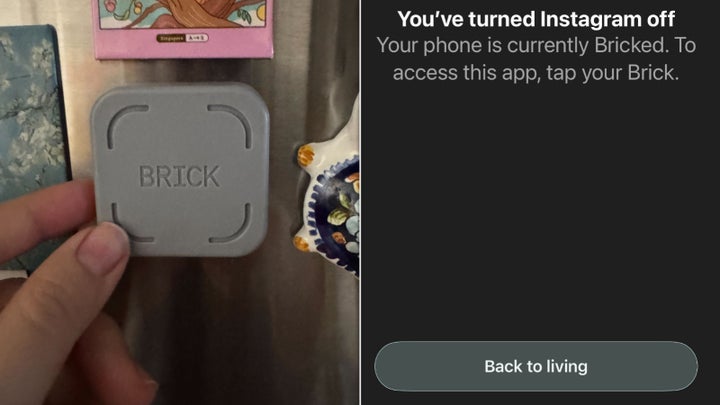
However, the Brick is a little square device that pairs with an app you download on your phone through a QR code. Once you connect your phone to your Brick, you can select which apps you need to block and for which hours of the day.

Then, the real test begins. You tap the physical Brick device with your phone to activate its app-blocking features – you need to touch the Brick again if you want to regain access to your blocked apps.

I was struck by how hard it was to leave the house for a whole day with a bricked phone. I even delayed using it at first because of this anxiety, which only strengthened my resolve that I probably needed to go through with this experiment.

So, after a day of too much scrolling, I put myself to the test and put my Brick on my fridge. Now, I would have to get up from the couch or get back home from work if I wanted to access that tantalising Reddit post.

I am happy to report that after more than a month of use, my brain feels different. I expected the strict enforcement of a Brick to change me – but even I was surprised by how much it did.

What you should know before you try a Brick

I Tried Bricking My Phone And Was Shocked By The Changes In My Life
I stuck my Brick device on my fridge. Needing to walk 10 steps from my couch to unlock Instagram has curbed my scrolling habits.

The Brick, available for iOS and Android, lets you set modes for “deep work” and “family time” hours, so bricking automatically happens during the natural rhythm of your day. It also keeps a running tally of how many hours you have been bricked each day, and on average, presumably to encourage you to stay strong and go a little longer without unbricking.

If you forget to use the Brick on your phone in your rush out the door, you can also Brick your device by pressing the Brick icon on the app’s homepage from where you are, but you will still need to go back to where your actual Brick is to unlock what you want to unlock.

What I loved about it

The first week I used it, I was surprised and embarrassed by how often my fingers would automatically tap the social media apps my Brick blocked me from accessing. My Brick bouncer would gently scold me whenever I tried to instinctively check Instagram or TikTok.

The app gives you five “emergency” unbricking workarounds if you really need to access an app you have blocked and you’re not near your Brick device, but I have yet to use one. Needing to use “emergency” unbricking to make an Instagram story about the Galentine’s party I attended really put into perspective what exactly I was doing with my one precious life.

The Brick challenged my belief that real-time social media feedback was necessary to stay connected with my friends or to be good at my job. In my opinion, this forced reflection is the Brick’s best benefit. I’ve missed a few direct messages from my friends, I’m not seeing as many funny TikTok memes anymore, and I’m out of the loop on some social media trends, but I feel more in control of what I am consuming. At the very least, I am paying more attention to how I spend my time on my phone.

What I think could be better — and why I’m sticking with my Brick

The Brick costs around $59 for one device. Though I find this little plastic box to be prohibitively expensive for what it is, I like that more than one person can use the same Brick, so you could theoretically get your roommate or partner to split the costs, too. I also like that once you buy it, you don’t need to pay a subscription fee to keep using it, unlike many other apps.

However, bricking yourself is not going to transform you completely.

Catherine Pearlman, a licensed clinical social worker and author of First Phone: A Child’s Guide to Digital Responsibility, Safety, and Etiquette, said the Brick is “a wonderful device,” but can’t be a long-term solution to endless social media scrolling on its own.

“Once you’re home [where your Brick is], the impulse still exists,” she told me. “So it doesn’t actually teach you how to work through that impulse to say…‘How do I really want to spend my time? How do I work through this emotion that I’m trying to avoid by scrolling?’”

Answering those questions is a bigger journey only you can answer. For Pearlman, it meant finding other ways to use her screen-free time.

“I knew I wasn’t going to stop using my phone, but I wanted to have an alternative,” she said as an example. “And then when the newspapers got too upsetting, I went to Kindle. So now I just read books in my Kindle, and I read eight books in January.”

If you want to get serious about blocking social media not just on your phone but on your computer as well (which your Brick cannot access), Pearlman suggested the free website blocker Cold Turkey.

As for me, I’m continuing to brick myself in the evenings, so that I can learn a new screen-free hobby of crochet. Just this past week, my phone screen time dropped 62% compared to the week before. Making loops of crochet rows with my hands feels more satisfying than the loops of TikToks I watched each night, but I don’t think I would have stuck with my new hobby without the Brick’s admonishments.

I’ve gone from my high of nine hours of daily screen time to a more reasonable five or six hours during a workday. I still have lapses where I will go a night without Bricking, but I feel much calmer when I do. When my head is not cluttered with the pulls of social media notifications and enticing Reels, I have time to figure out what I really want to do. And that’s a gift that I think is worth keeping.