Four Years After Putin’s Invasion, Can Trump Secure Peace In Ukraine?


Ukraine will mark the fourth anniversary of Vladimir Putin’s barbaric invasion on Tuesday, February 24.

The date will serve as a cruel reminder of just how long this war has been raging, especially as the third round of trilateral talks between Russia, Ukraine and the US failed to make any significant progress last week.

Moscow’s refusals to give up its maximalist goals weigh down Donald Trump’s push for a speedy peace deal – though the US president continues to falsely blame Kyiv for the stagnant talks.

Earlier this week, he told reporters that it was going to be “very easy” to reach a deal.

But he warned: “Ukraine better come to the table, fast. That’s all I’m telling you. We are in a position, we want them to come.”

Desperate to secure an agreement and consolidate his supposed reputation as a “deal-maker”, Trump has time and time again promised a truce is on the horizon – all while Russian strikes continue to target Ukraine.

But, as Ukraine enters its fifth year of war, could the president be right, and an end is in sight?

HuffPost UK asked experts just how realistic Trump’s claims are – and if there are any alternatives to a formal peace agreement.

Could 2026 Be The Year The Ukraine War Finally Turns Around?

British officials are confident that Ukraine can hold its ground on the battlefield in the east, even after a challenging winter where Russia repeatedly targeted Ukraine’s energy infrastructure.

That enables Kyiv to hold a firmer line in negotiations – like refusing to give into Putin and Trump’s demands that Ukraine gives up even more land.

But there are fears – particularly in Ukraine – that the talks themselves are just theatre to entertain Trump, with Kyiv delegates put under pressure to join.

Similarly, experts told HuffPost UK that it seems unlikely these negotiations will result in anything.

Professor Konstantin Sonin, from the University of Chicago Harris School of Public Policy said he remains sceptical that Trump could secure a peace deal because “the basic, big things remain unchanged”.

Four Years After Putin’s Invasion, Can Trump Secure Peace In Ukraine?
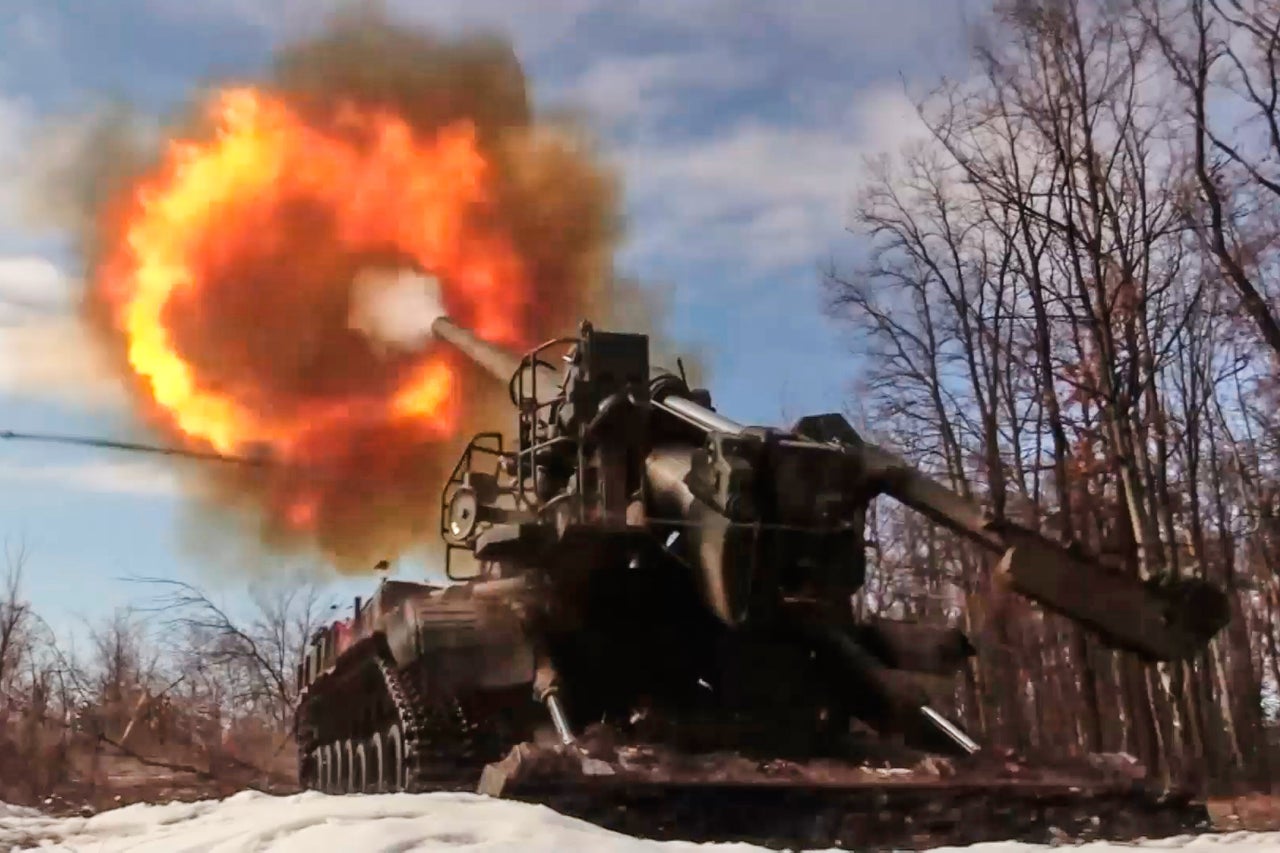
Ukrainian soldiers of the 48th separate artillery brigade fire at Russian positions on the frontline in Kharkiv region, Ukraine, Wednesday, Feb. 18, 2026.

He told HuffPost UK that Putin does not care about the cost of the war in terms of soldiers’ lives and material expenses, even though Russia is estimated to have suffered 1.2 million casualties since the conflict began.

While British officials have signalled that, beneath the surface, Russia’s economy is slowing down – with a fall in oil prices and a hike in VAT – that impact does not seem to have yet trickled through to the battlefield.

It’s suspected that Putin has not been informed about the reality of the public finances, or the eroding public support for the war.

But, at the same time, the Ukrainian army and state is nowhere near the state of collapse. In fact, its defence sector has been boosted over the last four years.

“A couple of more years of grinding warfare, in which the Russian army exchanges dozens of thousands of men for villages and townships in Eastern Ukraine, are totally possible,” Sonin, a Russian citizen and Kremlin critic, said.

“And then a new US president, a Republican or a Democrat, will be able to push Putin towards peace.”

Dr Simon Bennett, from the University of Leicester’s civil safety and security unit, also suggested it seemed pretty unlikely Trump’s efforts would result in a peace deal.

He said: “The upshot of this in 2026 is likely to be that Russia’s gains will come at an even greater cost, and, occasionally, will be partially reversed, albeit on a small scale in terms of square miles retaken by Ukraine.”

Bennett predicted Putin’s ongoing bid to control the whole of Ukraine’s eastern region, the Donbas, will likely mean the territory continues to be “the same bloody quagmire in 2026 as it was in 2025.”

“A couple of more years of grinding warfare… are totally possible”

– Professor Konstantin Sonin, the University of Chicago Harris School of Public Policy

Could Anything Force Trump To Crack Down On Putin?

Kurt Volker, who stepped down as Trump’s special envoy to Ukraine in 2019, claimed this week that the president has done a lot towards ending the war.

For instance, he has encouraged Ukraine to accept the idea of a ceasefire, and forced European allies to increase defence spending.

But speaking to the Centre for European Policy Analysis (CEPA) think tank, Volker said: “He still needs to get an end to the war. We need to be demanding a ceasefire and putting pressure on Russia to do that as soon as possible.”

The president’s annual State of the Union address is set to be on February 24 this year, the fourth anniversary of Russia’s full-scale invasion.

But experts do not expect him to use the opportunity to finally recognise the extent of Russia’s aggression against Ukraine.

As Bennett said, Trump is too “inconsistent” – and his approach to policy-making is a “crisis or war waiting to happen”.

The specialist also pointed out that “Putin has no intention of negotiating a peace deal” and claimed he is playing “demonstrably gullible” Trump.

Meanwhile, when asked if the US president could crack down on Russia in a bid to boost his ratings before the midterm elections in November, Sonin said: “There will be more pressure on Trump from the Congress Republicans, because both the US population and the elite have been consistently supportive of Ukraine through the years of war.

“So, I’d expect Trump to do small things against Putin.”

President Donald Trump, right, and Ukraine's President Volodymyr Zelenskyy shake hands at the start of a joint news conference following a meeting at Trump's Mar-a-Lago club, Dec. 28, 2025, in Palm Beach, Fla.
President Donald Trump, right, and Ukraine’s President Volodymyr Zelenskyy shake hands at the start of a joint news conference following a meeting at Trump’s Mar-a-Lago club, Dec. 28, 2025, in Palm Beach, Fla.

Could It Be Possible To Agree To A Ceasefire, but Not A Peace Deal?

Kurt Volkner told CEPA that it could be possible to strike up a deal comparable to the one which stopped the war between North and South Korea.

That non-aggression pact has – for the most part – held for more than 70 years, even though neither side technically agreed to a sustainable peace.

Volkner said: “Someday, I do believe there will be a ceasefire. I don’t believe there will ever be a peace agreement.

“I don’t believe Vladimir Putin will ever accept that there is an independent and sovereign Ukraine.

“Again, of the West, of governments, of investors, businesses, needs to be one that assumes that we will have a strong, growing, prosperous democratic European Ukraine that is safe and worthy of investment and business growth, very much like South Korea, without a final peace agreement with Russia, that’s just going to be where we are.”

But Sonin disagreed with this idea.

He said that while the North-South Korea deal was “one of the most durable, effective peace agreements despite never being finally ‘settled’”, it’s clear from previous attempts that written agreements between Russia and Ukraine do not work.

He also pointed out that such an agreement relies on the US commitment to help South Korea if North Korea invades, and China’s commitment to help North Korea if South Korea invades.

Sonin said: “A ‘peace agreement without a peace agreement’ between Russia and Ukraine is totally possible, but it will require Polish, German, Swedish, Baltic, etc, troops on the ground in Ukraine and a firm US commitment to get involved immediately if a new conflict starts.”

Bennett also dismissed Volker’s argument, as Putin still wants to restore Ukraine into a satellite state for Moscow.

“Few western leaders mention the fact that Putin’s war aims have not changed, first, because it does not fit with the Trump-the-Peacemaker-Extraordinaire narrative and secondly, because, when it comes to dealing with Trump, most western leaders are spineless,” Bennett said.

President Donald Trump, right, shakes the hand of Russia's President Vladimir Putin during a joint press conference at Joint Base Elmendorf-Richardson, Alaska, Friday, Aug. 15, 2025.
President Donald Trump, right, shakes the hand of Russia’s President Vladimir Putin during a joint press conference at Joint Base Elmendorf-Richardson, Alaska, Friday, Aug. 15, 2025.

Can Anything Be Done In The Pursuit Of Peace?

It’s widely believed that, in the absence of a stronger response from Trump, only a firmer intervention from Europe can actually stop the war.

But Ukraine allies across the continent have so far refused to commit to sending troops unless they operate in a peace-keeping capacity, as they want to avoid direct conflict with Russia.

Sonin told HuffPost UK: “I think that European countries will have to get involved into the military defense of Ukraine – sending ground troops, drone operators, etc. Of course it is a heavy lift politically.

“However, for the elites in Poland or Germany or Czech Republic or Romania or Baltic countries a scenario of Russia-controlled Ukraine (with Ukrainian army under maybe influence of the Russian masters) should be so scary that even a political heavy lift might become reality.”

He warned that without such an intervention, “the only hope is an internal collapse of Putin’s regime”.

Similarly, Bennett said Europe must resolve the issue by sending arms to Ukraine urgently, while the Russian army is weak.

“The cost in blood and treasure will be great,” Bennett said. “But nowhere near as great as allowing Russia to regenerate its armed forces for a final push on western Europe in five to 10 years’ time.”

Bennett said he saw this year’s Munich Conference as a “watershed moment”, as US secretary of state Marco Rubio reiterated that the White House primarily sees the Ukraine conflict as a problem for Europe not for the US.

Similarly, Volker said: “Europe can do a lot and can do a lot more than it is currently doing. And as I said, I picked up in Munich a realisation among a lot of European leaders that they’re not doing enough, that they need to step in and fill a gap that the US is leaving. So there are there’s a lot they can do.”

“The US sees itself as more of an arbiter than a prime mover in respect of European security,” Bennett said, adding: “I shall put it bluntly: the only way to end this war is through war. Europe must take Russia down.”

With nothing within Russia threatening to slow Putin’s ongoing aggression, and Trump’s efforts still – for now – amounting to mainly showmanship, ending the war in 2026 seems like a pipe dream, unless Europe gets directly involved.

As Bennett said: “Our fate is in our hands, and no-one else’s.”


Make Putin pay for killing my jailed husband with frog poison, says Alexei Navalny’s wife


The widow of Russian opposition leader Alexei Navalny on Sunday night said Vladimir Putin ‘must be held accountable’ after it emerged her husband was killed by a frog poison.

Yulia Navalnaya thanked Britain and its allies for establishing that Mr Navalny’s death two years ago is likely to have been caused by neurotoxin epibatidine.

The poison is only found in nature on the skin of the Ecuadorian dart frog and results in a painful death of paralysis and respiratory arrest if ingested.

Ms Navalnaya said: ‘I was certain from the first day that my husband had been poisoned, but now there is proof: Putin killed Alexei with [a] chemical weapon.

‘I am grateful to the European states for the meticulous work they carried out over two years and for uncovering the truth. Vladimir Putin is a murderer. He must be held accountable for all his crimes.’

On Saturday, the UK, along with Sweden, Germany, the Netherlands and France, accused the Russian state of killing 47-year-old Navalny in a Siberian colony.

Navalny had been sentenced to 19 years’ imprisonment on dubious embezzlement charges. His death was announced by the Russian state on February 16, 2024. At the time, his allies accused the Kremlin of murdering him because of the political threat he posed.

In their joint statement, the five nations said laboratory analysis found traces of epibatidine in Navalny’s body, a toxin associated with South American dart frogs.

Make Putin pay for killing my jailed husband with frog poison, says Alexei Navalny’s wife

The widow of Russian opposition leader Alexei Navalny on Sunday night said Vladimir Putin ‘must be held accountable’ after it emerged her husband was killed by a frog poison

It is not clear how the frog poison was allegedly administered to Mr Navalny (Pictured during his imprisonment)

It is not clear how the frog poison was allegedly administered to Mr Navalny (Pictured during his imprisonment)

Navalny's death was the result of poison from a South American dart frog toxin called epibatidine (Pictured: Ecuadorian poison dart frog)

Navalny’s death was the result of poison from a South American dart frog toxin called epibatidine (Pictured: Ecuadorian poison dart frog)

The statement read: ‘Epibatidine is a toxin found in poison dart frogs in South America. It is not found naturally in Russia.

‘Russia claimed that Navalny died of natural causes. But given the toxicity of epibatidine and reported symptoms, poisoning was highly likely the cause of his death. Navalny died while held in prison, meaning Russia had the means, motive and opportunity to administer this poison to him.’

US Secretary of State Marco Rubio on Sunday described the report as Epibatidine, which is classed as a chemical weapon, is said to be 200 times stronger than morphine and can cause paralysis, respiratory failure and death.

It is used by indigenous South American tribes in blow darts or blowguns when they hunt.

It is not clear how the frog poison was allegedly administered to Navalny.

On Sunday morning, Foreign Secretary Yvette Cooper confirmed for the first time that Russia has had possession of the toxin, pointing out that ‘it can be produced synthetically’.

Ms Cooper also said work has taken place over the last two years ‘on pursuing the evidence and pursuing the truth’ around Navalny’s death. She said: ‘They wanted to silence him because he was a critic of their regime.’ 

Roman Abramovich has been warned ‘time is running out’ for him to hand over £2.5billion from the sale of Chelsea FC before it’s taken out of his hands.

He agreed to transfer the cash – earmarked for humanitarian causes in Ukraine – after selling the Premier League club when he was sanctioned nearly four years ago following Putin’s invasion. But the funds remain frozen in a bank account.

Mr Abramovich was told in December that ministers would take legal action if he failed to hand over money. ‘The clock is ticking on him,’ Yvette Cooper said on Sunday.


Vladimir Putin ‘doesn’t have too much time left’ says Zelensky as 73-year-old Russian leader disappears mysteriously for a week


Ukraine’s president has said Vladimir Putin ‘doesn’t have too much time left’ amid questions over the Kremlin leader’s whereabouts as he has not been seen in over a week. 

Speaking to Politico during the Munich Security Conference on Friday, just days before the fourth anniversary of Moscow’s invasion, Volodymyr Zelensky said: ‘I’m younger than Putin…He doesn’t have much time, you know.’

While his remarks prompted a laugh from the audience, the Ukrainian president added: ‘No, no, believe me, this is important.’

The 48-year-old also described his rival, 73, as a ‘slave to war’ earlier today as he drew parallels between the current conflict and the 1938 Munich Agreement.

The agreement forced Czechoslovakia to surrender its bordering region with Germany, the Sudetenland to Adolf Hitler – a year before World War II began. 

Zelensky’s recent comments come as Putin has mysteriously vanished from the public eye for over a week, with Russian state media broadcasting pre-recorded footage of the Kremlin leader meeting officials in recent days. 

The Kremlin leader was last seen by the public delivering a speech on February 5, and it remains unclear what has caused his latest absence. 

It is not the first time Putin has disappeared from public view, with the dictator having cultivated a reputation for vanishing for periods of time with no explanation.  

Vladimir Putin ‘doesn’t have too much time left’ says Zelensky as 73-year-old Russian leader disappears mysteriously for a week

Ukraine’s president has stated that Vladimir Putin ‘doesn’t have too much time left’

The Kremlin leader was last seen by the public delivering a speech on February 5

The Kremlin leader was last seen by the public delivering a speech on February 5

Pictured: Firefighters at the site of a Russian drone strike in Ukraine on February 13

Pictured: Firefighters at the site of a Russian drone strike in Ukraine on February 13

Pictured: Damaged cars in Odesa, Ukraine, after they were hit by a Russian strike

Pictured: Damaged cars in Odesa, Ukraine, after they were hit by a Russian strike

However, such absences have led to speculation of Putin undergoing secret medical treatment.

Zelensky’s statement comes as the United States continues to strive for Russia and Ukraine to end the almost four-year war, with Trump recently setting a June deadline for the two sides to negotiate peace.

On Friday, Trump said Zelensky would miss an opportunity if he doesn’t ‘get moving’, and claimed Russia was willing to end the war through a peace deal.

‘Russia wants to ‌make a deal, and Zelensky’s going ‌to have to get ⁠moving. Otherwise, he’s ⁠going to miss a great opportunity. He has ‌to move,’ he said.

Between February 17 and 18, a new round of peace negotiations involving Ukraine will be conducted by the US and Russia in Geneva.

The Kremlin has confirmed Vladimir Medinsky, a presidential aide to Vladimir Putin, will lead the Russians. 

More recently, Kyiv and its Western allies have accused Moscow of deliberately freezing Ukraine’s population with its attacks on the energy grid.

‘There is not a single power plant left in Ukraine that has not been damaged by Russian attacks,’ Zelensky said. ‘Not one.’

‘But we still generate electricity,’ he added, praising the thousands of workers repairing the plants.

The Ukrainian President appealed once again to his Western allies to deliver air-defence systems to Ukraine more quickly.

Taking a brutal swipe at the Kremlin leader, Zelensky added: ‘He may see himself as a tsar, but in reality he is a slave to war.’

Russia and Ukraine are set to hold US-brokered talks next week, as Zelensky maintains Kyiv is doing ‘everything’ to end the almost four-year war.

It comes as questions over Putin’s health were raised in November when he met with Yekaterina Leshchinskaya, 22, the chair of the Russian Healthy Fatherland movement.

As he reached to shake the woman’s hand, the Russian leader’s right hand was seen with visible bulging veins, prominent tendons, and thin, wrinkled skin.

Pictured: The State Emergency Service of Ukraine on February 13, 2026

Pictured: The State Emergency Service of Ukraine on February 13, 2026

Pictured: A house destroyed in a Russian airstrike in Ukraine on February 13

Pictured: A house destroyed in a Russian airstrike in Ukraine on February 13

Ukraine President Volodymyr Zelensky speaks at a panel discussion during the 62nd Munich Security Conference (MSC) at the hotel 'Bayerischer Hof', in Munich, Germany, 14 February 2026

Ukraine President Volodymyr Zelensky speaks at a panel discussion during the 62nd Munich Security Conference (MSC) at the hotel ‘Bayerischer Hof’, in Munich, Germany, 14 February 2026

Footage saw the Russian leader appear to nervously move his fingers and clench them into a fist under his blazer sleeve.

Following the circulation of the clip on X, and later in Polish media, Ukrainian sources suggested that the Russian dictator may be suffering from pain.

Prominent interviewer, and media personality Dmytro Gordon said: ‘Putin clenches his hands into something resembling fists.

‘They look swollen and sore, with veins bulging prominently on one hand.’

Another source said that Putin merely exhibits the normal signs of male ageing which he seeks – through alleged cosmetic surgery – to hide from Russians after more than a quarter of a century in power.

Questions over Putin’s whereabouts come as a group of European countries on Saturday said Russian opposition leader Alexei Navalny was poisoned by the Kremlin. 

The foreign ministries of the UK, France, Germany, Sweden and the Netherlands said analysis of samples taken from Navalny’s body ‘conclusively confirmed the presence of epibatidine’ – a neurotoxin found in the skin of dart frogs in South America. 

A joint statement said: ‘Russia had the means, motive and opportunity to administer this poison.’

Putin has mysteriously vanished for more than a week, while Moscow state media has been using pre-recorded footage of the dictator

Putin has mysteriously vanished for more than a week, while Moscow state media has been using pre-recorded footage of the dictator 

The five countries said they were reporting Russia to the Organisation for the Prohibition of Chemical Weapons for a breach of the Chemical Weapons Convention.

The announcement came as Navalny’s widow, Yulia Navalnaya, attended the Munich Security Conference in Germany as the second anniversary of Navalny’s death approaches.

Navalny, who crusaded against official corruption and staged massive anti-Kremlin protests as President Vladimir Putin’s fiercest foe, died in an Arctic penal colony on February 16, 2024, while serving a 19-year sentence that he believed to be politically motivated.

‘Russia saw Navalny as a threat,’ British Foreign Secretary Yvette Cooper said. ‘By using this form of poison, the Russian state demonstrated the despicable tools it has at its disposal and the overwhelming fear it has of political opposition.’

It comes after five European countries today claimed that Russian opposition leader Alexei Navalny was poisoned by Russia. Pictured: Navalny attends a hearing at a court in Moscow in 2017

It comes after five European countries today claimed that Russian opposition leader Alexei Navalny was poisoned by Russia. Pictured: Navalny attends a hearing at a court in Moscow in 2017 

Navalny pictured with his wife Yulia in 2020

Navalny pictured with his wife Yulia in 2020 

‘Putin killed Alexei with a chemical weapon,’ she wrote on social network X. She said Putin was ‘a murderer’ who ‘must be held accountable’.

Russian authorities said that the politician became ill after a walk and died from natural causes.

Epibatidine is found naturally in dart frogs in the wild, and can also be manufactured in a lab, which European scientists suspect was the case with the substance used on Navalny. It works on the body in a similar way to nerve agents, causing shortness of breath, convulsions, seizures, a slowed heart rate and ultimately death.

Navalny was the target of an earlier poisoning in 2020, with a nerve agent in an attack he blamed on the Kremlin, which always denied involvement. His family and allies fought to have him flown to Germany for treatment and recovery. Five months later, he returned to Russia, where he was immediately arrested and imprisoned for the last three years of his life.

The U.K. has accused Russia of repeatedly flouting international bans on chemical and biological weapons. It accuses the Kremlin of carrying out a 2018 attack in the English city of Salisbury that targeted a former Russian intelligence officer, Sergei Skripal, with the nerve agent Novichok. Skripal and his daughter became seriously ill, and a British woman, Dawn Sturgess, died after she came across a discarded bottle with traces of the nerve agent.

The poisoning of Navalny shows ‘that Vladimir Putin is prepared to use biological weapons against his own people to remain in power,’ French Foreign Minister Jean-Noël Barrot wrote on X.

Yvette Cooper pictured with Navalny's widow Yulia today during the Munich Security Conference

Yvette Cooper pictured with Navalny’s widow Yulia today during the Munich Security Conference 

Yulia Navalnaya, human rights activist and wife of Russian opposition leader Alexei Navalny, gives a press statement on the death and circumstances of her husband's death on the sidelines of the Munich Security Conference in Munich, Germany, Saturday Feb. 14, 2026

Yulia Navalnaya, human rights activist and wife of Russian opposition leader Alexei Navalny, gives a press statement on the death and circumstances of her husband’s death on the sidelines of the Munich Security Conference in Munich, Germany, Saturday Feb. 14, 2026

Navalny’s widow said last year that two independent labs had found that her husband was poisoned shortly before he died. She has repeatedly blamed Putin for her husband’s death. Russian officials have vehemently denied the accusation.

Yulia Navalnaya said Saturday that she had been ‘certain from the first day’ that her husband had been poisoned, ‘but now there is proof’.

A British inquiry concluded that the attack ‘must have been authorised at the highest level, by President Putin’.

The Kremlin has denied involvement. Russia also denied poisoning Alexander Litvinenko, a former Russian agent turned Kremlin critic who died in London in 2006 after ingesting the radioactive isotope polonium-210. A British inquiry concluded that two Russian agents killed Litvinenko, and Putin had ‘probably approved’ the operation.

At the Munich Security Conference this weekend, Zelensky also poked fun at Hungarian leader Victor Orban’s belly, saying Ukraine’s fight against Russia allowed Europe to live freely. 

Zelensky was describing how Europe gains from having Ukrainian forces battling Russian troops in Ukraine.

Ukraine’s relations with neighbouring Hungary have been strained by Orban’s support for Russia and have deteriorated further in recent weeks as the veteran leader has ramped up attacks on Ukraine ahead of a closely fought parliamentary election in April.

‘There can be a sovereign Moldova and a Romania without dictatorship and even one Victor can think about how to grow his belly, not how to grow his army to stop Russian tanks from returning to the streets of Budapest,’ Zelensky said.

‘But look at the price. Look at the price, look at the pain Ukraine has gone through, look at the suffering Ukraine has faced. It’s Ukrainians who are holding the European front,’ he said.

Although Ukraine applied to join the European Union days after Russia invaded, it has been unable to advance accession talks because of Orban’s vetoes.

Unlike other European countries, Hungary has not diversified its imports from Russia since Moscow’s assault on Ukraine.


Zelenskyy Has A Theory As To Why Trump Is In Such A Hurry To End Ukraine War


Volodymyr Zelenskyy has said Donald Trump is determined to secure a peace deal to end the Ukraine war before the US midterm elections later this year.

The Ukrainian president previously claimed that the White House wants the conflict to draw to a close by June.

He has since warned that the US needs to put apply more pressure to Russia if it wants the war to end by summer.

Moscow is allegedly still deliberating over attending the next round of trilateral talks in Miami.

Trump started his second term in office last year by declaring that he would end the Ukraine war within 24 hours.

The conflict is now approaching its fourth anniversary at the end of this month, and Russia continues to drag its feet over negotiations.

The US president has continually blamed Ukraine for the delay, however.

He is desperate to get some kind of deal over the line, as soon as possible – even if that means rewarding Vladimir Putin’s aggression.

Speaking to The Atlantic, Zelenskyy said the most “advantageous situation for Trump is to do this before the midterms” in November.

He added: “Yes, he wants there to be less deaths. But, if you and I are talking like adults, it’s just a victory for him, a political one.”

Zelenskyy also claimed ending the Russia-Ukraine war would be Trump’s “no.1 legacy”.

The Republican Party is expected to take a beating at the midterms.

However, the Ukrainian president continues to hold onto his red lines in the negotiating process – while trying to offer up something new to keep the US president on side.

Trump has repeated Kremlin claims that Zelenskyy is a “dictator” for staying in his post longer than his term, even though Ukrainian martial law imposed during wartime prohibits elections.

So Zelenskyy said Ukraine will hold elections once it has security guarantees in place and a ceasefire with Russia.

He said the idea of holding the election during the war came from Moscow because “they want to get rid of me”.

The Ukrainian president continued: “No one is clinging to power.

“I am ready for elections. But for that we need security, guarantees of security, a ceasefire.”

“We’ve never been against ending the war. It’s the Russians who have shown they are not ready for a dialogue,” he said.

Zelenskyy said Moscow should use this time before the midterms to “end the war while President Trump is really interested in that”.

The president also acknowledged elements of Trump’s peace deal – such as US security guarantees – have not been nailed down yet, and called for all of their terms to be “written out.”

It should then be put to the Ukrainian people in a public vote, according to Kyiv.

“I don’t think we should put a bad deal up for a referendum,” Zelenskyy added, noting that while Ukrainians are “in a hurry to end the war” they do not want to rush to cut a deal.

Zelenskyy will meet with prime minister Keir Starmer, US secretary of state Marco Rubio, Nato secretary general Mark Rutte and French president Emmanuel Macron at the annual Munich Security Conference, where peace in Ukraine is set to be discussed.

But Russia continues to hold onto its maximalist goals with Ukraine, insisting on taking more territory.


Europe has ‘failed’ in the face of Trump and Putin’s ‘wrecking ball’ politics, top security official says


US President Donald Trump holds a bilateral meeting with European Commission President Ursula Von der Leyen on the sidelines of the United Nations General Assembly in New York City on September 23, 2025.

Brendan Smialowski | Afp | Getty Images

Europe is “totally on the sidelines” on the global stage as “wrecking ball” politics has become the norm, the head of the continent’s biggest security forum has said.

Speaking to CNBC’s Annette Weisbach ahead of the Munich Security Conference (MSC), Wolfgang Ischinger, the organization’s chairman, said it was Europe’s “own fault” that its power on the global stage has been diminished.

“Europe has failed to speak with one voice to China and about China, Europe has failed with one voice, to come up with a clear concept about the future of the Middle East, including about how to deal or not to deal with the Iranian nuclear question,” said Ischinger, who is a former German ambassador to the U.S.

Earlier this week, the MSC published its 2026 report, for which Ischinger wrote the foreword. It warned that “the world has entered a period of wrecking-ball politics,” where “sweeping destruction … is the order of the day.”

The report said that U.S President Donald Trump was “at the forefront of those who promise to free their countries from the existing order’s constraints and rebuild stronger, more prosperous nations,” arguing he was just one movement “driven by resentment and regret over the liberal trajectory their societies have embarked on.”

Ischinger told CNBC that Europeans were “totally on the sidelines” on negotiations around Gaza and Ukraine.

“We have no role. Things have been decided by others,” he said. “When I look at the war in Ukraine, Europe has no place,” he said, adding the U.S. and Russia were leading discussions.

U.S. delegates have been helming peace talks with officials from Ukraine and Russia since late 2025, with European officials scrambling to maintain a say on how to end the four-year war between the two countries.

“Why the hell do we not have a place at the table? This is our continent. It’s our future,” Ischinger said on Friday. “The answer, of course, is not that Donald Trump is making a mistake. The answer … is that we have failed to speak with one voice.”

Ischinger added that he rejected “the blame game regarding the United States,” but for areas where Europe “clearly failed” to adopt a strategic position.

Delegates from all over the world are gathering for the Munich Security Conference on Friday. The event runs through Sunday.

Ischinger told CNBC that the “wrecking ball” was “being used by many” in addition to Trump, including right-wing extremist parties across Europe and Russian President Vladimir Putin.

But he called Trump “the single most prominent example” of someone who “questions existing arrangements and tries to replace them.” “That is for countries like Germany, which have been so dependent on the existing international rules … a worrisome development,” he added.

CNBC reached out to both the White House and the Kremlin for responses to the MSC’s commentary.

Transatlantic trust had also been damaged by Trump’s push for the U.S. to annex Greenland, Ischinger said.

After weeks of rhetoric on bringing the Arctic island — a Danish territory — under Washington’s control, Trump threatened to impose tariffs on European allies who stood in his way, before announcing a “deal” on Greenland had been reached.

Since Trump’s return to the White House, European leaders have been making commitments to drastically increase security spending. Last summer, European members of NATO agreed to raise defense spending to 5% of their individual national GDP — a move Trump had been pushing for for some time.

The spending plans have bolstered European defense primes, some of which have seen their shares more than double in value, while order backlogs have hit record levels.

Ischinger told CNBC Europe needed “to create a more consolidated, a more competitive, a more unified defense industry.”