What to expect from the next round of U.S.-Iran talks as Trump threatens Tehran


U.S. President Donald Trump delivers the State of the Union address during a joint session of Congress in the House Chamber at the Capitol on February 24, 2026 in Washington, DC. Trump delivered his address days after the Supreme Court struck down the administration’s tariff strategy, and amid a U.S. military buildup in the Persian Gulf threatening Iran.

Pool | Getty Images News | Getty Images

The U.S. and Iran are poised to hold further nuclear talks in the Swiss city of Geneva on Thursday, amid persistent fears about the prospect of military action in the oil-rich Middle East.

The upcoming round of negotiations over the future of Tehran’s nuclear program come as the U.S. continues to build up military forces in the region and as President Donald Trump warns of “bad things” if Iran doesn’t agree to a nuclear deal.

The U.S. president on Tuesday spoke briefly about Iran during his nearly two-hour State of the Union address but primarily focused on domestic policy and other political issues.

“We are in negotiations with them. They want to make a deal, but we haven’t heard those secret words: ‘We will never have a nuclear weapon,'” Trump said.

“My preference is to solve this problem through diplomacy. But one thing is certain, I will never allow the world’s number one sponsor of terror, which they are by far, to have a nuclear weapon.”

What to expect from the next round of U.S.-Iran talks as Trump threatens Tehran

For some, the comments boosted expectations of an imminent diplomatic breakthrough.

Trump “basically wants the optics of a win, which is why he talks about why he’s ended eight wars. I think it’s pretty clear he hasn’t. He has helped navigate, you know, skirmishes … but he hasn’t ended these conflicts,” said George Pollack, U.S. policy analyst at Signum Global Advisors.

“For him, I think it is more about how he’s exerting U.S. strength, U.S. force and trying to make the world more peaceful but that’s more optics than it is a substantive policy,” Pollack told CNBC’s “Europe Early Edition” on Wednesday.

“And that’s why, for us, we do think this Thursday meeting will likely be a success and bring about some more diplomatic opportunities,” he added.

The USS Gerald R. Ford aircraft carrier docks at Souda Bay on Crete Island, Greece on February 24, 2026.

Anadolu | Anadolu | Getty Images

For others, however, the absence of a deal means the likelihood of military action appears to be both high and growing.

“President Trump’s 10-to-15-day deadline for Iran works out to a date sometime in very early March,” strategists at Dutch bank ING said in a note published Wednesday.

“This uncertainty means the market will continue to price in a large risk premium and remain sensitive to any fresh developments,” they added.

Iran FM: An agreement is ‘within reach’

Iran, for its part, has talked up the prospect of a deal this week, saying an agreement is “within reach.”

Iranian Foreign Minister Abbas Araghchi said on social media Tuesday that the country would resume talks with the U.S. in Geneva this week “with a determination to achieve a fair and equitable deal — in the shortest possible time.”

Araghchi added: “Our fundamental convictions are crystal clear: Iran will under no circumstances ever develop a nuclear weapon; neither will we Iranians ever forgo our right to harness the dividends of peaceful nuclear technology for our people.”

Vehicles move along a highway near Tehran’s landmark Azadi (Freedom) Tower in Tehran on February 23, 2026. The 45-metre-tall marble-clad Azadi Tower, formerly known as Shahyad Tower (Shah’s Memorial Tower’), was commissioned by Mohammad Reza Pahlavi, the last Shah of Iran, to mark the 2,500-year celebration of the Persian Empire, and completed in 1971. It was erected at the westernmost entrance to the city of Tehran.

Atta Kenare | Afp | Getty Images

Oil prices traded near seven-month highs on Wednesday morning as energy market participants continued to closely monitor potential supply disruptions.

International benchmark Brent crude futures with April delivery rose 0.6% to $71.13 a barrel, while U.S. West Texas Intermediate futures with April delivery, traded 0.6% higher at $66.02.

Iran, a member of OPEC, is a major player in the global oil market, producing more than 3 million barrels of crude a day.

The Islamic Republic has recently conducted military drills in the strategically important Strait of Hormuz, as well as joint naval drills with Russia in the Gulf of Oman, also known as the Sea of Oman.
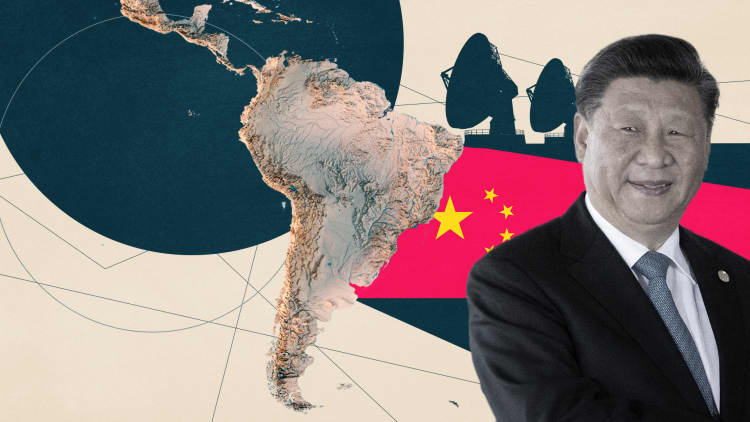

Why Chile is the latest LATAM country to be caught in a U.S.-China power struggle


View of the city of Santiago and the Andes Mountains, taken from the Metropolitan Park on July 2, 2024.

Rodrigo Arangua | Afp | Getty Images

Chile is the latest Latin American country to have become embroiled in a U.S.-China power struggle.

The country, which counts Washington as its top foreign investor and Beijing as its largest trading partner, is facing pressure from the White House over a subsea cable project with links to China.

In a surprise move, U.S. Secretary of State Marco Rubio said late last week that the Trump administration would impose visa restrictions on three Chilean officials tied to a digital cable project proposed by Chinese firms, alleging a security threat.

Chilean President Gabriel Boric, who will leave office on March 11, condemned the visa sanctions and rejected the notion that the country “promotes any action that threatens our security or that of the region.”

Chile’s outgoing left-wing government later said one of the sanctioned officials was the country’s Minister of Transport and Telecommunications Juan Carlos Muñoz, without commenting on the identities of the other two.

The U.S. ambassador to Chile, Brandon Judd, defended the visa restrictions on Monday, telling reporters that it is Washington’s “sovereign right to take actions when we feel that the region’s security is being threatened,” according to The Associated Press.

The spat comes just days before a Latin American leader’s summit in Miami, Florida — and two weeks before Chile’s incoming right-wing government takes over in Santiago.

Chile’s President-elect Jose Antonio Kast speaks to journalists after meeting with the Italian Prime Minister at Palazzo Chigi in Rome on Febuary 5, 2026.

Filippo Monteforte | Afp | Getty Images

It also represents a major test for José Antonio Kast‘s administration, following the right-wing candidate’s election victory late last year.

Analysts say U.S. President Donald Trump, who is seeking to counter China’s strategic influence in the region, is sending an unequivocal message to Latin American countries.

‘A calibrated warning’

The U.S.-Chile tensions were, above all, “a calibrated warning” to the Kast administration that strategic infrastructure decisions will be treated as geopolitical alignment choices — rather than neutral tenders, according to Mariano Machado, Americas principal analyst at risk intelligence company Verisk Maplecroft.

To be sure, digital undersea cables are the backbone of the world’s internet and telecommunications infrastructure, enabling everything from international phone calls to financial transactions. By some estimates, as much as 95% of international traffic passes through these largely unseen data super-highways.

A map of the world’s undersea communication cables.

CNBC | Jason Reginato

“The near-term external consequence is that Kast’s upcoming Washington engagements – chief among them, in the Shield of the Americas summit – will become early tests of how Chile balances partners under pressure,” Machado said.

“As US-China competition intensifies in the region, Chile’s ‘digital hub’ ambition becomes investable only if geopolitical concerns are addressed upfront, not retrofitted after a crisis,” he continued. “Winning deals will be those that lock in clear governance and credible security assurances early enough to preserve bankability.”

China’s embassy in Chile has reportedly accused Washington of “obvious contempt for the sovereignty, dignity, and national interests of Chile” following the Trump administration’s visa restrictions against Chilean officials.

China’s strategic and economic influence in Latin America is well established, although it is thought to be the target of Trump’s so-called “Donroe Doctrine” — a portmanteau of Donald Trump and the Monroe Doctrine, which refers to a 19th century foreign policy position that asserted Washington’s influence over the Western Hemisphere.

Why Chile is the latest LATAM country to be caught in a U.S.-China power struggle

In just the last few weeks, for example, Panama’s top court ruled against Hong Kong-based CK Hutchison, saying a concession held by a subsidiary of the firm to operate ports at either end of the Panama Canal was unconstitutional. The outcome was widely seen as a victory for Trump’s regional security ambitions.

The U.S. has also ratcheted up pressure on Cuba’s communist-run government, threatening to impose tariffs on any country that provides oil to Havana, and recently conducted an extraordinary military operation to depose Venezuelan President Nicolás Maduro.


Say hello to ‘Bye America!’: Three trades to navigate U.S. Big Tech disruption


Tesla’s Europe problem keeps getting worse. Here’s why


Elon Musk, chief executive officer of Tesla Inc., during the World Economic Forum (WEF) in Davos, Switzerland, on Thursday, Jan. 22, 2026.

Bloomberg | Bloomberg | Getty Images

U.S. electric vehicle maker Tesla‘s sales in Europe were down for a 13th consecutive month in January, while its biggest Chinese rival saw another surge.

Data published Tuesday by industry lobby group ACEA, or the European Automobile Manufacturers Association, found that Tesla’s new car registrations fell to 8,075 in January, down 17% from a year ago, representing the 13th consecutive month in which sales have shrunk.

Tesla’s market share across the European Union, Britain, Switzerland, Norway and Iceland fell to 0.8%, meanwhile, down from 1% in the same month last year.

It marks another “very weak” start of the new year for Elon Musk’s company, Rico Luman, senior sector economist for transport and logistics at Dutch bank ING, told CNBC by email.

“Tesla’s image has deteriorated in Europe last year and people have much more choice now with the range of new affordable EVs (including those of BYD and others like MG and ZEEKR) entering the market, while Tesla lacks new models,” he added.

Tesla’s focus on autonomous driving, rather than introducing new vehicles and expanding its range of mass models, is likely a factor too, Luman said.

“Another thing in Europe is that large numbers of first generations of Tesla’s are remarketed at the moment (after being leased for 4-6 years), this has driven second hand prices down,” Luman said, adding that there’s an abundance of competitively priced Tesla’s available on the used market.

A Tesla car is being charged at a Tesla electrical vehicle charging station in Norheimsund, Norway, Aug. 22, 2025.

Sergei Gapon | Afp | Getty Images

Tesla has been beset by challenges in Europe, including robust competition, particularly from Chinese car brands. It’s also struggled to shake off reputational damage from Musk’s rhetoric and close relationship with the Trump administration after the U.S. president returned to office last January.

Musk spent nearly $300 million to help elect U.S. President Donald Trump to a second term and subsequently led a tumultuous initiative to slash federal agencies. Protests erupted at Tesla dealerships across Europe at the height of Musk’s involvement with the White House.

Musk’s relationship with Trump later cooled, following a bitter online feud with the U.S. president.

Shares of Tesla were 0.5% lower in premarket trading on Tuesday. The company is off by around 11% year-to-date.

BYD continues its rapid growth

Chinese EV giant BYD continued its rapid growth in Europe at the start of 2026, per the ACEA data. New car registrations for the company rose by 165% year-on-year to 18,242 in January.

BYD also more than doubled its market share across the region, hitting 1.9% last month, up from 0.7% in January 2025. Tariffs have largely kept the company out of the U.S., including a 100% levy on Chinese EVs.

Tesla’s Europe problem keeps getting worse. Here’s why

Michael Field, chief equity strategist at Morningstar, said one of the main problems for companies such as Tesla is that Chinese automakers like BYD have an insurmountable cost advantage.

“The big question now is ‘will this trend continue?’. The answer, unfortunately for European automakers and Tesla, is yes,” Field told CNBC by email.

“Even looking 5 years out, we don’t believe the cost advantage will be completely breached because of China’s structurally lower labour costs,” he continued.

“There is some good news however, that European automakers and Tesla are learning. The cost gap in terms of battery and auto production is slowly closing, and these firms are introducing more models at lower price points, which should help reduce the hemorrhage in market share.”

Overall, sales in the European Union, Britain and European Free Trade Association (EFTA) countries, fell 3.5% to 961,382 cars in January.

Petrol car registrations fell about 26% year-on-year in January, while battery-electric, plug-in hybrid and hybrid-electric cars were up nearly 14%, 32% and 6%, respectively.


Making it rain: Why more and more countries are turning to cloud seeding


Commuters make their way past India Gate amid smoggy conditions in New Delhi, India, on October 29, 2025.

Anadolu | Anadolu | Getty Images

Countries across the globe are increasingly turning to a decades-old weather modification technique as part of a push to control when and where it rains.

Alongside the U.S. and China, which boasts the world’s largest weather modification program, France, Russia, India and Saudi Arabia are among a growing list of countries to have experimented with cloud seeding.

For many, the embrace of rain-making operations stems from the need to boost water supplies as global demand continues to rise amid the climate crisis.

Others have sought to use cloud seeding to disperse fog at airports, tackle air pollution, reduce hail damage or even to manipulate the weather for major events, such as the 2008 Summer Olympics in Beijing.

Cloud seeding aims to improve a cloud’s ability to produce rain or snow by introducing tiny particles, usually silver iodide. The process is limited both in area and duration and, over time, is estimated to increase local precipitation by 5% to 15%.

The concept is not without controversy, however. Since first taking place in the 1940s, cloud seeding experiments have raised concern over potential environmental and ecological risks and stoked regional security tensions, with countries accusing each other of stealing rain.

Augustus Doricko, CEO of Rainmaker, a California-based cloud seeding company, said there are two dynamics at play that seem to be rekindling people’s interest in the technology — both in the U.S. and across the world.

“One is truly just circumstance, a lot of these countries and regions are suffering from more volatility in climate and precipitation patterns and their water supply, and so it’s leading them through necessity to be more creative than they were in the past,” Doricko told CNBC by telephone.

“Two, and I think this is like the real meat and potatoes of why Rainmaker got started, it’s because in the last few years there have been some fundamental breakthroughs in how to do measurements and attribution of cloud seeding effects.”

Despite an 80-year legacy, Doricko said interest in cloud seeding “really fell off” in the 1970s and 1980s because it had been difficult to accurately measure how much precipitation derived from cloud seeding deployments.

Recent technological improvements now make it possible to verify the success of these deployments in real time, Doricko said.

The company, which says it intends to arrest the aridification of the American West, has grown rapidly in recent months, from just 19 employees at the beginning of 2025 to 120 today, a trend that appears to underscore the booming interest in cloud seeding.

Yet, despite its name, Doricko said the company’s cloud seeding projects are mostly designed to make it snow.

“I misnamed the company it turns out, and ‘Snowmaker’ probably would have been more apt. It doesn’t sound as good for what it’s worth,” Doricko said.

He added: “I think that the most important thing for Rainmaker to do this season is just to make unambiguous evidence of manmade snow — and do it so often that it is undeniably a viable and scalable technology.”

Other U.S.-based cloud seeding companies include Weather Modification Inc. in North Dakota and North American Weather Consultants in Utah, although some U.S. states, such as Florida and Tennessee, have banned weather modification activities.

‘A viable water source’

There are two key reasons for why more countries are embracing cloud seeding operations, according to Frank McDonough, a research scientist at the Nevada-based Desert Research Institute (DRI).

Firstly, the scientific research and validation efforts that have been conducted on cloud seeding projects around the world over the past several decades “have provided enough data and cost-benefit analysis for stakeholders to use this tool with confidence,” McDonough told CNBC by email.

“The other concept of why more countries may be embracing cloud seeding technologies is that it’s currently one of the only options to enhance increasingly stressed localized water resources or help mitigate regional air pollution by using Earth’s natural atmospheric systems as a viable water source,” McDonough said.

Making it rain: Why more and more countries are turning to cloud seeding

Mixed results

Authorities in Iran reportedly sprayed clouds with chemicals over the Urmia lake basin late last year, seeking to boost rainfall to combat the country’s worst drought in decades.

Such projects are not always successful, however. Together with the Delhi government, a team at the Indian Institute of Technology (IIT) Kanpur recently reported mixed results following a cloud seeding trial to tackle air pollution in India’s capital city.

The IIT said in a statement at the time that its attempt was “not completely successful” due to a lack of moisture in the air, before adding that there had been a measurable reduction in particulate matter following the experiment.

People watch as an airplane flies during an operation of cloud seeding at Adi Soemarmo air force base in Boyolali, Central Java, Indonesia, Feb. 24, 2023.

Xinhua News Agency | Xinhua News Agency | Getty Images

Diana Francis, head of the Environmental and Geophysical Sciences lab at Khalifa University in Abu Dhabi, said cloud seeding can “modestly enhance” precipitation in the right conditions.

“But it is incremental, not transformative, and works best as part of a broader water and air-quality strategy,” Francis told CNBC by email.

Cloud seeding operations might typically cost between $1 to $10 per hectare-meter of additional water, Francis said, noting that while this remains highly variable, it works out to be much cheaper than desalination.

There are also other key caveats to consider, such as a strong dependence on cloud microphysics (given cloud seeding only works on existing clouds), problems with attribution and potential geopolitical and legal issues regarding downwind impacts, Francis said.

Studies have shown no significant impact on either human health or the environment from previous silver iodide cloud seeding projects, according to the World Meteorological Organization, while further investigation is needed to assess downwind effects.

The U.N. weather agency has also acknowledged that significant challenges in public, social and local acceptance of rain-making operations remain widely evident.


FedEx sues for refund of Trump tariffs, days after Supreme Court ruling


A worker unloads packages from a FedEx truck on Cyber Monday in New York, US, on Monday, Dec. 1, 2025.

Bess Adler | Bloomberg | Getty Images

Federal Express on Monday sued the U.S. government, seeking a “full refund” of the money the shipping giant paid for tariffs unilaterally imposed last year by President Donald Trump, which the Supreme Court ruled last week were illegal.

FedEx’s suit appears to be the first filed by a major American company seeking a refund for tariffs after Friday’s Supreme Court decision.

Other companies filed lawsuits staking claims to their refunds before the high court ruled that the tariffs Trump imposed under the International Emergency Economic Powers Act are illegal.

Those suits, whose plaintiffs include retail warehouse club giant Costco, remain pending at the U.S. Court of International Trade in New York, the same court where FedEx filed its lawsuit.

Read more CNBC politics coverage

The Supreme Court, in its ruling on Friday, said the Court of International Trade has “exclusive jurisdiction” over the IEEPA tariffs.

“Plaintiffs seek for themselves a full refund from Defendants of all IEEPA duties Plaintiffs have paid to the United States,” Federal Express Corp, and its associated company, FedEx Logistics, say in the new lawsuit.

The 11-page complaint names as defendants U.S. Customs and Border Protection, which collects tariffs, its commissioner, Rodney Scott, and the U.S. government.

CNBC has requested comment on the suit from CBP and the White House.

The suit does not say how much FedEx has paid in IEEPA tariffs since Trump imposed them on most U.S. trading partners last year.

But in September, FedEx had said that it expected it would take a $1 billion hit to its earnings for the fiscal year because of U.S. trade policies, not all of which involved IEEPA duties. That dollar amount represents 16% of total earnings for the prior fiscal year.

In a note on its website, FedEx said, “While the Supreme Court did not address the issue of refunds, FedEx has taken necessary action to protect the company’s rights as an importer of record to seek duty refunds from U.S. Customs and Border Protection.”

“At this time, however, no refund process has been established by regulators or the courts,” the company said. “We will communicate any relevant information and updates in a timely manner, and we appreciate your patience as we wait for additional guidance and clarity from the U.S. government and the courts.”


UK companies seek deeper ties with Europe as Trump tariffs fuel uncertainty, business groups say


The MSC Emma container ship on the dockside at the Port of Felixstowe in Felixstowe, UK, on Thursday, Nov. 20, 2025.

Bloomberg | Bloomberg | Getty Images

British companies are seeking deeper trade ties with Europe, business groups told CNBC, as U.S. President Donald Trump unveiled a sweeping 15% tariff on all imports after the Supreme Court struck down previous levies.

New tariffs would mark a 50% increase on the level negotiated last year in a trade deal between the U.K. the U.S., making the country one of the worst hit, according to analysis from think tank Global Trade Alert.

While U.S. Trade Representative Jamieson Greer said the administration “expects” to stand by trade deals, the U.K. government is reportedly in ongoing discussions with counterparts in America.

The seesawing uncertainty is increasingly forcing U.K. businesses to look to closer alignment with the European Union and European countries, as they hunt for predictable trade partnerships, groups which represent U.K. businesses told CNBC.

“There’s just no certainty or consistency and companies are very weary of this,” said William Bain, head of trade policy at the British Chambers of Commerce (BCC), which represents 50,000 businesses.

“They’re potentially looking at other options in terms of doing more trade with Europe or with the Indo-Pacific [region], where there seem to be less risk of fluctuations,” he told CNBC.

Uncertainty

Trump’s announcement that there would be blanket tariffs on all imports to the U.S. over the weekend brought further headaches to Europe’s business sector, which had seen the longstanding global trading order torn up last year.

In April, the U.S. upended the status quo by imposing a range of tariffs on trading partners across the world.

UK companies seek deeper ties with Europe as Trump tariffs fuel uncertainty, business groups say

U.S. President Donald Trump inspected an honour guard during a welcome ceremony at Buckingham Palace in central London on June 3, 2019, on the first day of their three-day State Visit to the U.K. 

Mandel Ngan | Afp | Getty Images


U.S. importers still paying Trump’s illegal tariffs even after Supreme Court ruling


Despite Friday’s Supreme Court decision that ruled President Donald Trump’s “reciprocal” tariffs are illegal, U.S. importers are still paying duties on goods entering the country.

U.S. Customs and Border Protection (CBP) has yet to update its Cargo System Management Service to remove the duties imposed by Trump under the International Emergency Economic Powers Act (IEEPA). Under U.S. trade policy, Customs must post updates on tariff changes and other trade-related information on its Cargo Systems Messaging Service.

On Friday, Customs posted a bulletin on the decision saying, “[T]he CBP is working with other government agencies to fully examine the implications of the SCOTUS decision. CBP will provide additional information and technical guidance for Automated Commercial Environment (ACE) filers as soon as it becomes available.”

CNBC was told by Customs that this is the latest update for importers for now.

The paperless Automated Commercial Environment is the Customs system used for processing imports and exports. An executive order signed by Trump in March charged the CBP with modernizing its manual payment system.

“Customs has not removed the requirement to report the IEEPA tariff codes in order to obtain a release of goods, so for cargo to continue moving, the IEEPA tariffs are still being reported on entries,” explained Lori Mullins,  director of operations at Rogers & Brown Custom Brokers. “We are still anticipating a CSMS message confirming that a change to now accept entries without these tariffs, but as of now, that change has not been made, and Customs still requires them.”

An estimated 211,000 containers of goods, valued at some $8.2 billion, arrived in U.S. ports between Friday and Sunday, according to Vizion’s trade platform Tradeview.

Mullins said importers have a 10-day window to pay the tariffs.

“No money is actually being transferred until day 10, so Custom entry summaries can be amended up until 9 days after cargo release, before the payment must be paid on day 10. After that, you’d be required to post payment and then file a post summary correction for a refund.”

The question, Customs brokers and trade attorneys say, is how CBP will handle entries for cargo release over the last 10 days that will pay next week.

“It’ll likely take Customs some time to reconfigure their system to reflect the Court’s ruling,” explained Michael Lowell, partner and chair of the Global Regulatory Enforcement Group at law firm Reed Smith. “So, this weekend importers file paperwork with the tariff on there, and then when Customs updates their system, the importer files a post summary correction (before payment), removing the tariff. The goods then come in this weekend without the tariff.”

The enormity of the corrections, though, will slow down the process, cautioned Lowell.

“Corrections usually take within a couple of weeks, up to 30 days,” he said. “However, we may see some delays given the scale of the issue this weekend.” 

This is just one layer of uncertainty weighing on importers. The questions surrounding refunds, which the Supreme Court did not rule on, will be decided by the U.S. Court of International Trade (CIT).

“This is the first time a tariff has been declared unconstitutional with this amount of money at stake,” said Ben Bidwell, senior director for Customs for CH Robinson. “So there are still a lot of questions about whether the Court of International Trade will take steps opening the door for widespread refunds, for some companies to get some refunds or whether refunds are even on the table.”

In a customer Q&A on the Supreme Court ruling, transportation and fulfillment services giant Kuehne + Nagel urged its clients to have all customs documents in order when the CIT weighs in on refunds.

“The CIT is expected to handle any refund mechanisms, but no timelines exist; high volumes of claims could create years-long delays,” Kuehne + Nagel said.

CIT has yet to return CNBC’s request for comment.


DHS abruptly reverses suspension of TSA PreCheck


Passengers walk through the entrance of a TSA PreCheck in Terminal One at O’Hare International Airport Wednesday, Feb. 1, 2017, in Chicago. (Armando L. Sanchez/Chicago Tribune/Tribune News Service via Getty Images)

Armando L. Sanchez | Chicago Tribune | Getty Images

The Transportation Security Administration said on Sunday that its PreCheck airport screening lanes are operational, an about-face hours after the Department of Homeland Security said the faster security checkpoints were paused amid the partial government shutdown.

Travel industry leaders said they received little, if any, warning of the changes to PreCheck, a program that allows its 20 million pre-screened members to pass through airport security faster than at standard lanes. Industry members spoke with DHS officials in the past few hours and expressed alarm about the sudden decision, people familiar with the matter said.

“At this time, TSA PreCheck remains operational with no change for the traveling public,” TSA officials said in a statement. “As staffing constraints arise, TSA will evaluate on a case by case basis and adjust operations accordingly. Courtesy escorts, such as those for Members of Congress, have been suspended to allow officers to focus on the mission of securing America’s skies.”

DHS early Sunday said that PreCheck and Global Entry and other program suspensions were scheduled to take effect at 6 a.m. ET on Sunday. As of 12:40 p.m. ET, its updated statement still included a suspension of Global Entry but it had removed its mention of PreCheck.

“We are glad that DHS has decided to keep PreCheck operational and avoid a crisis of its own making,” Geoff Freeman, chief executive of U.S. Travel, an industry group whose members include major airlines, hotel chains like Hyatt and Marriott International and tourism boards around the country.

The move comes as a partial U.S. government shutdown that has left thousands of DHS workers, including TSA airport screeners, working without pay since it started on Feb. 14.

“TSA and CBP are prioritizing the general traveling population at our airports and ports of entry and suspending courtesy and special privilege escorts,” DHS Secretary Kristi Noem said in a statement.

Noem blamed Democrats for the shutdown.

“Shutdowns have real world consequences, not just for the men and women of DHS and their families who go without a paycheck, but it endangers our national security,” she said. “The American people depend on this department every day, and we are making tough but necessary workforce and resource decisions to mitigate the damage inflicted by these politicians.” 

Senate Minority Leader Chuck Schumer, (D-N.Y.), pushed back, saying the Trump administration is “choosing to inflict pain on the public instead of adopting common sense” reforms of Immigration and Customs Enforcement, or ICE.

DHS did not say whether it expected to reverse its suspension of Global Entry or what prompted the change. The White House referred an inquiry from CNBC to DHS.

Travel industry experts sharply criticized the move before it was reversed, which comes just months after last year’s record federal government shutdown cost airlines millions of dollars and hurt bookings, according to executives. The sector’s leaders have repeatedly complained about how air travel has ended up at the center of repeated shutdowns and have pushed lawmakers to ensure that essential government workers are paid during funding lapses.

The government shutdown in the fall, the longest ever, cost the travel industry and other sectors $6.1 billion, the group said. Those disruptions affected about 6 million travelers.

“A4A is deeply concerned that TSA PreCheck and Global Entry programs are being suspended and that the traveling public will be, once again, used as a political football amid another government shutdown,” said Airlines for America CEO Chris Sununu. The group represents American Airlines, Delta Air Lines, Southwest Airlines, United Airlines and other major carriers.

“The announcement was issued with extremely short notice to travelers, giving them little time to plan accordingly, which is especially troubling at this time of record air travel,” he added.

Read more CNBC airline news

The U.S. Travel Association said earlier: “We are disgusted that over the last 90 days, Democrats and Republicans have used air traffic controllers, TSA, CBP and the entire travel experience as a means to achieve political ends,” it said in a statement.

The measures come as a massive winter storm bears down on the Northeast U.S., which could disrupt airline flights for days.

Airlines have canceled thousands of flights through Monday and waived cancellation and change fees for airports spanning Virginia to Maine ahead of the East Coast blizzard.

CNBC’s Garrett Downs contributed to this article.

This story is developing. Please check back for updates.


Airlines start canceling flights ahead of another monster winter storm on the East Coast


Travelers look at a flight status board as flights are delayed and cancelled following a significant winter storm at Ronald Reagan Washington National Airport in Arlington, Virginia, January 26, 2026.

Saul Loeb | Afp | Getty Images

U.S. airlines began canceling Sunday flights and waiving cancellation and change fees for airports from Virginia to Maine ahead of another massive winter storm on the East Coast, set to once again put carriers to the test at the tail-end of winter break.

Delta Air Lines, American Airlines, JetBlue Airways, United Airlines and Spirit Airlines waived fees and fare differences for passengers if they can travel as late as Feb. 26. Southwest Airlines said customers are eligible for a change without paying a difference in fare if they can rebook to fly or fly standby within two weeks.

The storm could bring between 13 and 18 inches of snow to parts of southern Connecticut and southeast New York, as well as winds of up to 55 miles per hour, according to the National Weather Service. The blizzard warning is set to begin at 6 a.m. ET Sunday.

As of 4:30 pm ET Saturday, close to 400 U.S. flights were canceled, according to FlightAware. Delta had the most, with 174 cancellations or 5% of its mainline schedule. New York airports, which make up a major Delta hub, were the most affected by Sunday’s disruptions.

The National Weather Service raised its initial assessment of the potential severity of a storm. The weather service now says 1 to 2 feet (about 30 to 61 centimeters) of snow is possible in many areas. Blizzard warnings were also issued for New York City, Long Island, southern Connecticut and coastal communities in New Jersey, Delaware, Rhode Island and Massachusetts.

The weather service warned that the storm’s steady winds of 25 to 35 mph (40 to 56 kph) would “make travel dangerous, if not impossible.”

Winter Storm Fern in January, followed by bitter cold, caused mass travel disruptions across a large swath of the U.S.

Read more CNBC airline news

American Airlines had struggled to recover, drawing harsh criticism from flight crews, some of whom were stranded and had to sleep at airports, heightening tension between frontline employees and the company’s CEO, Robert Isom.

The storm cost American between $150 million and $200 million in revenue, the carrier said last month on an earnings call.

The Associated Press contributed to this report.