By Carlos Méndez, Mrinmay Dey & Mike Scarcella
Reuters
Posted April 7, 2026 10:47 am
1 min read
U.S. agriculture equipment maker Deere (DE.N), opens new tab on Monday agreed to pay $99 million into a settlement fund for farms and farmers that are part of a class action over costs and access to repairs.
The case is part of broader scrutiny in the U.S. over so-called right-to-repair practices, with regulators and plaintiffs arguing that some manufacturers limit competition by controlling access to repair tools and software.
The settlement fund covers eligible plaintiffs who paid Deere’s authorized dealers for repairs to large agricultural equipment from January 2018, according to a document filed on Monday in the federal court in Chicago, Illinois.
Get daily National news
Get daily Canada news delivered to your inbox so you’ll never miss the day’s top stories.
In the settlement, Deere also agreed to make available to farmers for 10 years “the digital tools required for the maintenance, diagnosis, and repair” of large agricultural equipment, including tractors, combines, and sugarcane harvesters, the filing showed.
Story continues below advertisement
The proposed accord requires a judge’s approval.
“This settlement addresses the issues raised in the 2022 complaint and brings this case to an end with no finding of wrongdoing,” Deere said in a separate statement.
Deere also faces a separate lawsuit brought by the U.S. Federal Trade Commission. A U.S. judge ruled in 2025 that Deere must face that lawsuit, which accused the company of forcing farmers to use its authorized dealer network and driving up their costs for parts and repairs.
Deere is blocking farmers from acquiring the “tools and information necessary to repair their equipment in a timely and cost-effective manner,” the FTC had said in a court filing in April. Deere has denied the wrongdoing.
U.S. President Donald Trump last year acknowledged he wouldn’t be able to easily annex Canada as he has repeatedly threatened, according to a British Royal biographer who cites Trump’s praise for King Charles III as a factor.
In an excerpt of Robert Hardman’s upcoming biography of Queen Elizabeth II published Monday in the Daily Mail, Hardman recounts meeting with Trump at Mar-a-Lago in December 2025, where the two discussed Trump’s multiple state visits with both the Queen and her son and heir as president.
During one of their conversations, Hardman writes, Trump “mischievously” asked if he should “go to war with” Denmark, a NATO ally, in order to take over Greenland.
“I replied that this would probably destroy NATO and, while we were on the subject, could he please leave Canada alone, too,” Hardman writes.
“It had been a staunch ally throughout history, a gallant D-Day partner and attempting to acquire it would undoubtedly make the King of Canada unhappy.”
Story continues below advertisement
According to Hardman, Trump paused and then asked, “Do they still recognize the King? Or have they stopped doing that?”
After Hardman confirmed the British monarch remains Canada’s head of state, Trump went on to complain about Canada’s “terrible politicians.”
“They’re nice to my face and then they say bad things behind my back,” Trump told Hardman, who then writes the U.S. president noted a majority of Canadians live just above the Canada-U.S. border due to the cold weather in northern Canada.
“The problem is some guy drew that straight line to make a border,” Hardman says Trump told him. “He should just have drawn it 50 miles further north and then there wouldn’t be a problem.”
However, Hardman writes that Trump conceded redrawing that border would be a difficult task to achieve during his final term as president, and acknowledged Canada’s history and sovereignty.
“I suppose Canadians have got 200 years of history and all that, ‘Oh, Canada’ thing,” Trump told Hardman. “You can’t deal with that in three-and-a-half years. I guess it’s not going to happen!”
Get breaking National news
Get breaking Canada news delivered to your inbox as it happens so you won’t miss a trending story.
“This was the closest I had heard to an acknowledgement that, as long as Canada had the King, Mr. Trump was not going to usurp him,” Hardman then writes.
Trumps given royal treatment in 2nd UK state visit
King Charles and Queen Camilla will undertake a state visit to the U.S. late this month, Buckingham Palace and Trump have announced. It will come after the royals hosted Trump for a state visit in London last September.
Story continues below advertisement
Trump praises both Queen Elizabeth and King Charles throughout the book excerpt, calling them “unbelievable” and “fantastic,” as well as Prince William and Princess Kate.
The excerpt mentions King Charles’ historic throne speech in Canada’s Parliament last year at Prime Minister Mark Carney’s invitation, which came at a time when Trump’s threats to make Canada the “51st state” were at their peak.
“The True North is indeed strong and free,” the King said during the speech, a line that drew a sustained standing ovation.
Although Trump’s threats to annex Canada have subsided since last year, Canadians remain on edge about the possibility of a U.S. takeover attempt.
Asked by Ipsos in January to what extent they agreed or disagreed with various statements on a possible U.S. military invasion, 56 per cent of Canadians said they either strongly agree (16 per cent) or somewhat agree (40 per cent) that the U.S. would never invade.
However, the same number said they were fearful an invasion could happen, with 17 per cent strongly agreeing and 39 per cent somewhat agreeing with the statement: “I am fearful Trump will use military force against Canada.”
That same month, Trump raised alarm bells in Canada by posting an AI-generated image of himself in the Oval Office with a map showing the American flag covering Canada, the U.S. and Greenland, as well as Venezuela and Cuba.
Story continues below advertisement
The Economist and the Globe and Mail reported at the time that Canada’s military planners have gamed out what an American military invasion could look like — and how long the Canadian side could hold out.
‘It’s not easy’: Carney speaks frankly about dealing with Trump
Trump’s relationship with Carney has deteriorated somewhat since the two leaders held multiple friendly in-person meetings last year, including two at the White House and one at the G7 Summit in Alberta.
Trump reacted angrily to Carney’s widely praised speech at the World Economic Forum in Davos in January, where Carney declared an end to the rules-based international order and urged middle powers like Canada to band together against large “hegemons.”
Although Carney did not mention Trump or the U.S., the speech was seen as a reaction to Trump’s global trade wars and aggressive approach to diplomacy, as well as his threats against NATO allies.
Story continues below advertisement
Trump told the World Economic Forum the next day that “Canada lives because of the United States. Remember that, Mark, the next time you make your statements.”
Trump has also begun referring to Carney as “governor” in social media posts, a title he used for former prime minister Justin Trudeau while threatening to make Canada a U.S. state.
Carney and Trump have continued to speak, however, most recently on Wednesday when the two discussed the successful Artemis II space launch and the ongoing war in the Middle East.
Carney acknowledged during an event in Australia last month that “it’s not easy” to deal with Trump, particularly in negotiations around trade.
Those trade talks are ongoing ahead of the scheduled review of the Canada-U.S.-Mexico Agreement this summer.
As the four Artemis II astronauts prepare for their historic flyby of the moon on Monday, Roberta Bondar, Canada’s first female astronaut, says this mission signals a leap in developments for future space travel.
Speaking with Global News, Bondar said the mission will push humans farther into deep space than they have travelled in decades, exposing the crew to conditions not experienced since the Apollo era.
The mission, known as Artemis II, will send four astronauts around the moon before returning to Earth on April 10, 2026.
The crew, made up of three Americans and one Canadian, will travel a total of more than 400,000 kilometres from Earth — farther than any human has travelled before — and then loop behind the moon and return home.
“People liken this to Apollo 8, but they were much closer,” she said. “This flyby will be about 4,000 miles out (from the moon), so they’ll be exposed to the background radiation of space and subjected to any solar wind or solar storms.”
Story continues below advertisement
Bondar said that distance will give the astronauts a rare vantage point, both scientifically and visually.
Get breaking National news
Get breaking Canada news delivered to your inbox as it happens so you won’t miss a trending story.
“They are really out there in deep space, where we haven’t been before,” she said. “They are going to be looking at the dark moon differently and take pictures of the sun in ways we have not been able to see because human beings have not been there.”
The crew has recently passed a new milestone of being closer to the moon than to Earth in their deep space journey.
“The Earth is quite small and the moon is definitely getting bigger,” pilot Victor Glover said from space.
Beyond the visuals, the mission is also a test of how the human body responds to space flight over longer distances.
“They look pretty good actually,” Bondar said of the crew. “They do have these smartwatches on now that will be looking at aspects of their physiology, their sleep cycle and some of the stresses they will face.”
That data will help researchers better understand how to prepare astronauts for future missions deeper into space.
Bondar also pointed to well-documented physical changes astronauts experience in orbit, including what is often referred to as “bird leg syndrome.”
Story continues below advertisement
“Your body gets rid of about two litres of blood volume through the kidneys,” she said. “In space, you don’t need as much, whereas on Earth you need about five litres because gravity pulls blood into your legs.”
She said Artemis II is part of a broader effort to refine how humans and technology work together in space.
“They’re trying to look at ways of making these kinds of missions not just smarter, but safer.”
“These early flights are all about trying to understand the technology,” she added. “These are really early days and about learning to make things smarter for the next flight, and the next flight.”
The Artemis II crew is expected to splash down in the Pacific Ocean following its lunar flyby, marking a key milestone in NASA’s plan to return humans to the moon and eventually travel to Mars.
Live updates can be followed on NASA’s official website, including a stream of the Orion’s journey through space.
RIVERSIDE, Calif. — A fast-growing wildfire Friday in windy Southern California has prompted multiple evacuation orders and warnings.
The Springs Fire broke out at around 11 a.m. Friday and by 2:30 p.m. had grown to 2.34 square miles (6.06 square kilometers). The cause of the fire east of Moreno Valley in Riverside County is under investigation. It was not immediately known how many households are under evacuation warnings or orders.
“It’s windy out there,” said Maggie Cline De La Rosa, a public information officer for Cal Fire Riverside.
A Cal Fire map showed the fire burning in a recreational area near the city of Moreno Valley, which has a population of roughly 200,000. The city is 64 miles (103 kilometers) east of Los Angeles.
The National Weather Service issued a wind advisory for San Bernardino and Riverside County valleys through Saturday afternoon, with gusts of up to 50 mph (80 kph) expected.
“Tree limbs could be blown down and a few power outages may result,” the advisory read.
A former Penticton mother and her seven-year-old daughter have now been released from ICE detention in Texas, more than two weeks after they were detained.
On March 14, Tania Warner and her daughter Ayla were stopped at a Customs and Border Patrol checkpoint and taken to a processing facility for deportation.
They were both born in B.C. but have been living in Texas with Warner’s husband for the past five years.
In an update posted on X on Thursday, Amelia Boultbee, the Independent MLA who represents Penticton-Summerland, said that the mother and daughter were released at 1 p.m.
She said the duo’s bond hearing took place “significantly faster” as a result of the public pressure surrounding the case.
Get daily National news
Get daily Canada news delivered to your inbox so you’ll never miss the day’s top stories.
“Thank you to everyone who spread awareness of this case, donated money, and sent your support and well wishes to the family,” Boultbee wrote.
Story continues below advertisement
“Your kindness and willingness to speak loudly against injustice and oppression made a difference.”
Update from B.C. mother detained by ICE
Warner described the conditions inside the ICE detention centre in Texas as being similar to “prison.”
Warner had applied for immigration four years ago, but was denied because her husband is a registered sex offender in the state of Texas due to an incident from when he was a teenager.
Warner said their lawyer found a way to self-sponsor and his name is not attached to any of his wife’s or stepdaughter’s documents.
Immigration lawyer and policy analyst Richard Kurland, who is based in Vancouver and not directly connected to the case, said that even if Canadians have their paperwork up to date, they are still in jeopardy in the U.S.
Story continues below advertisement
“For any reason, the American immigration system can question your documents,” he said.
“Until those questions are answered, you may find yourself in a detention centre.”
Body-worn camera footage of Tiger Woods‘ arrest last week has been released after he was involved in a rollover crash and charged with a DUI in Jupiter Island, Fla.
In the video, the famous golfer is seen kneeling on a patch of grass speaking with a Martin County police officer.
Tiger Woods’ DUI body cam footage shows the golf legend kneeling at the scene and describing what led to his rollover crash 🗣️ pic.twitter.com/rT1Z5Sy3Jg
“I looked down at my phone and all of a sudden, boom,” he tells the deputy.
Get breaking National news
Get breaking Canada news delivered to your inbox as it happens so you won’t miss a trending story.
His Land Rover, which landed on its side, is visible in the background.
The officer can also be heard talking to the driver of the vehicle — a truck — that Woods hit.
“Are you OK?” he asks, to which the man replies, “I’m fine.”
According to an earlier incident report, the driver of the truck, who has been identified as 43-year-old Jeromy Bullard, said he noticed a car approaching him at “high speeds” as he was manoeuvring onto a driveway.
The truck sustained about US$5,000 in damage to the rear-left fender and wheel of the trailer, according to the incident report.
Woods was arrested at the scene on suspicion of driving under the influence of an unknown substance and was described by police as “lethargic” after crawling out of the passenger door of his SUV.
Police also noted that the golfer had “glassy” eyes and two white pills in his pocket, which were later determined to be hydrocodone, an opioid prescribed to treat chronic pain. The pills were found inside his left pocket, according to the report. It did not specify if they had been prescribed to Woods.
Story continues below advertisement
Authorities charged Woods with driving under the influence with property damage and refusal to submit to a lawful test. Both charges are misdemeanours.
Tiger Woods had glassy eyes and opioid pills in his pocket when he was arrested by Florida police following a car crash on Friday, and told investigators with the Martin County Sheriff’s office he was distracted by his phone when the crash occurred, according to an incident report.
The golf star said he was looking down at his cellphone and changing the radio station, and didn’t notice that the truck in front of him had slowed down, the report said. He crossed lanes in order to overtake the vehicle and his Land Rover clipped the rear of the trailer attached to the truck, causing his car to roll onto its side, police said.
Tiger Woods arrested, suspected of DUI in rollover car crash: police
The truck Woods hit was turning into a driveway not far from where he lives on Jupiter Island, according to the report.
Story continues below advertisement
The driver of the truck, who has been identified as 43-year-old Jeromy Bullard, said he noticed a car approaching him at “high speeds” as he was manoeuvring onto the drive, it added.
The truck had about US$5,000 in damage to the rear-left fender and wheel of the trailer, the incident report says.
Get breaking National news
Get breaking Canada news delivered to your inbox as it happens so you won’t miss a trending story.
Woods, 50, was arrested at the scene on suspicion of driving under the influence of an unknown substance and was described by police as “lethargic” after crawling out of the passenger door of his car.
Woods’ eyes were “bloodshot and glassy,” and his pupils were “extremely dilated,” the report said. Police stated that he was “sweating profusely” in an air-conditioned vehicle and “extremely alert” during their investigation.
The report also noted that Woods stumbled during a sobriety test, where he was described as “limping and stumbling to the right,” and as moving his head from side to side after being told to keep it straight.
He told the officer executing the field checks that he had seven back surgeries and more than 20 leg surgeries, and that his ankle tightens up when he walks.
Golfer Tiger Woods stands by his overturned vehicle in Jupiter Island, Fla., on Friday, March 27, 2026.
AP Photo/Jason Oteri
Woods informed officers he had not been drinking alcohol, but that he takes a “few” prescription pills, which he had consumed earlier in the day, according to the report.
Story continues below advertisement
He advised that he takes medication for high blood pressure and cholesterol, as well as ibuprofen and Vicodin. Woods had hiccups during the entire investigation, the report noted.
Two white pills, determined by police to be hydrocodone — an opioid prescribed to treat chronic pain — were found inside his left pocket, according to the report.
Woods later submitted to a breath test at the jail but refused to do a urine test, authorities said. He was seen on video leaving the jail late Friday night.
Deputies said Friday they believed Woods was impaired by “some kind” of medication or drug at the time of the crash, but was cleared for driving under the influence of alcohol. There were no drugs or medication found in his vehicle.
The golfer was previously injured in a 2021 crash in Rolling Hills Estates in Southern California.
Story continues below advertisement
He was driving at twice the speed limit in a 45-mile-per-hour (74 kilometres per hour) zone when he lost control of his SUV and struck a tree, flipping the car onto its side.
Woods seriously injured his right leg in that crash and underwent multiple surgeries.
The golf star has played 11 tournaments since that 2021 crash, not finishing within 16 shots of the winner on any of the four occasions he completed 72 holes.
He was also arrested on a DUI charge in 2017 when South Florida police found him asleep behind the wheel of his car that was parked awkwardly with damage to the driver’s side. Woods said he had taken a bad mix of painkillers. He later pleaded guilty to reckless driving.
Hours after announced its , reaction poured in from politicians, the public and on social media, including from billionaire Elon Musk.
The announcement about Michael Rousseau came after days of calls for him to resign amid controversy over his English-only video condolence following a deadly Air Canada crash at LaGuardia Airport that killed the pilots, one of whom was from Quebec.
The company said in a statement that its board had a “longstanding focus” on CEO succession planning. It added an external global search started in January 2026 to identify potential candidates to lead the airline.
But while Rousseau’s announced retirement was welcomed by political leaders, Musk took to the social media platform he owns to call the departure “crazy.”
Story continues below advertisement
“That’s crazy,” Musk wrote in reply to a post on X about the retirement. “Moreover, it is not not reciprocal at all. There are many one-sided laws in Canada that mandate French at the expense of English. Extremely hypocritical and unfair!”
Get breaking National news
Get breaking Canada news delivered to your inbox as it happens so you won’t miss a trending story.
Musk’s post was accompanied by a screengrab showing Grok, the AI chatbot, being asked, presumably by the X owner, to list all French mandate laws in Canada and how it’s “hypocritical” compared to no English mandate laws.
Grok notes Quebec’s Charter of the French language and, more recently, Bill 96, which includes requiring French to be used in government communications and to be “markedly predominant” on store signs.
Calls for resignation of Air Canada CEO following his failure to speak French
The AI chatbot also noted the Canadian government’s legislation that guarantees the right to be served and to work in French in businesses under federal jurisdiction in Quebec.
Story continues below advertisement
The federal government’s bill was focused on strengthening protections around the French language and recognizing it as the only official language in Canada that is under threat and thus must be protected in federal workplaces.
Quebec’s laws have drawn the ire of people in the past, including the U.S., which last year listed Premier Francois Legault’s French-language reform as a barrier to trade. The U.S. reasoning focuses on the requirement by Quebec on companies to translate into French any part of their trademark on product packaging that contains generic terms or descriptions of items.
The province stressed at the time it wouldn’t be softening its language laws despite the U.S. criticism.
Following Rousseau’s video last week, Prime Minister Mark Carney was one of the first to criticize it, saying he was “very disappointed.”
“It doesn’t matter the circumstances but particularly in these circumstances: a lack of judgment and a lack of compassion,” Carney told reporters last Thursday.
“We live in a bilingual country. Companies like Air Canada, particularly, have a responsibility to always communicate in both official languages, regardless of the situation.”
Quebec’s legislative assembly also voted unanimously, with one abstention, demanding Rousseau resign.
Rousseau has previously apologized for being unable to express himself adequately in French.
Story continues below advertisement
— With files from Global News’ Adriana Fallico and Sean Boynton, and The Canadian Press
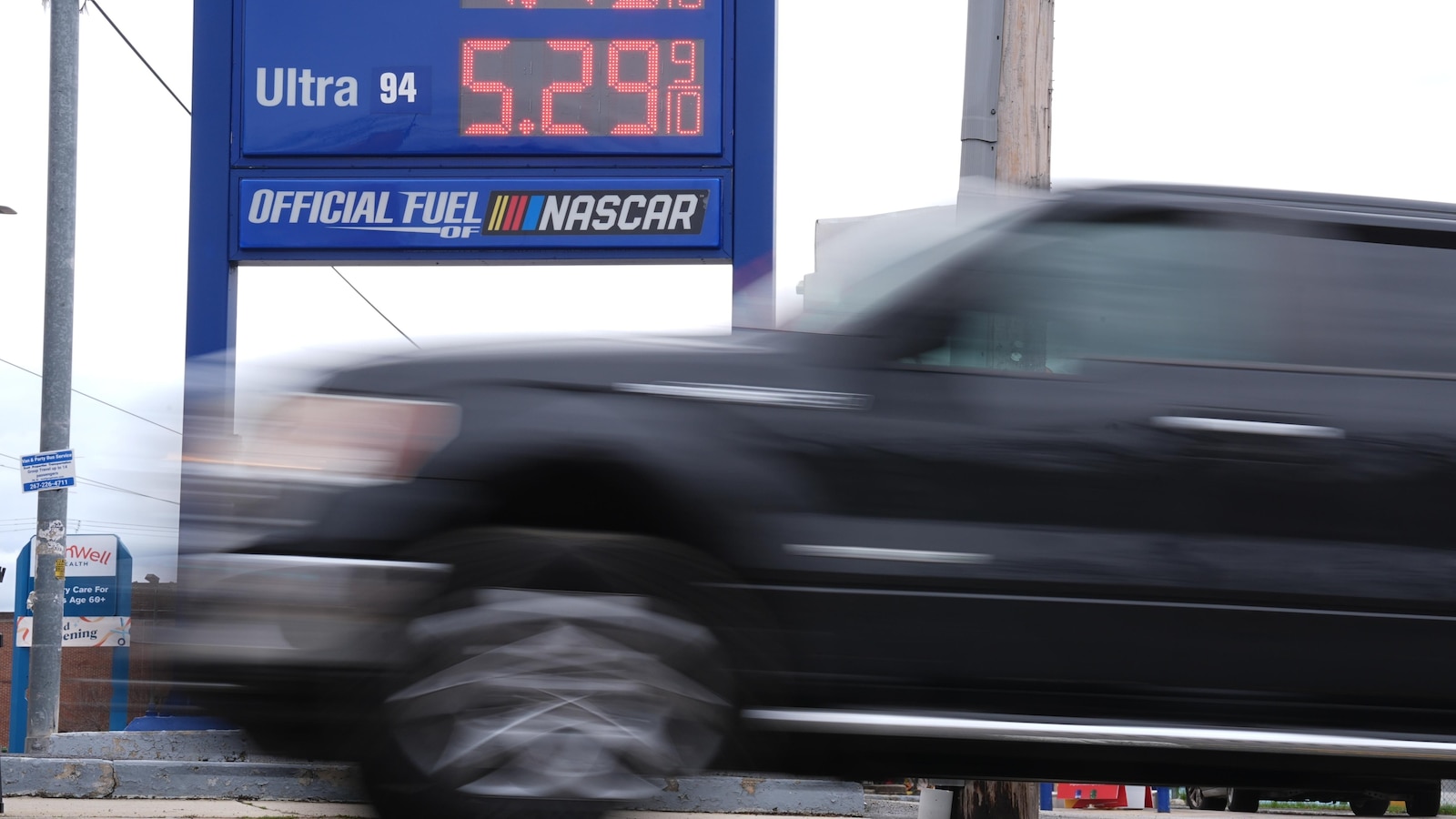
NEW YORK — U.S. gas prices jumped past an average of $4 a gallon for the first time since 2022 on Tuesday as the Iran war pushed fuel prices to soar worldwide.
According to motor club AAA, the national average for a gallon of regular gasoline is now $4.02 — over a dollar more than before the war began. The last time U.S. drivers were collectively paying this much at the pump was nearly four years ago, following Russia’s invasion of Ukraine.
The price is a national average, meaning drivers in some states have been paying well over $4 a gallon for a while now. Prices vary from state to state due to factors ranging from nearby supply to differing tax rates.
Since the U.S. and Israel launched a joint war against Iran on Feb. 28, the cost of crude oil — the main ingredient in gasoline — has spiked and swung rapidly. That’s because the conflict has caused deep supply chain disruptions and cuts from major oil producers across the Middle East.
Higher gas prices are impacting consumers and businesses as many households continue to face wider cost of living strains. And as drivers pay more to cover necessities like gas, many may be forced to cut their budgets in other places.
More expensive fuel can also push up other spending, from utility bills to the price of many goods consumers buy each day.
In the immediate future, analysts point to groceries, which have to be restocked frequently and could also see price hikes as businesses’ transportation costs pile up.
But hauling other cargo and packages has also been impacted. The United Postal Service, for example, is seeking a temporary 8% added charge on some of its popular products including Priority Mail.
Diesel, the fuel used for many freight and delivery trucks, is now going for an average of $5.45 a gallon, up from about $3.76 a gallon before the war began, per AAA.
If the war drags on, it’s possible that those prices could tick up even higher. Most tanker movement in the key Strait of Hormuz, where roughly one-fifth of the world’s oil typically sails through, remains at a halt. That’s led to cuts from major producers in the region who have no way of getting their crude to market. Meanwhile, Iran, Israel and the U.S. have all struck oil and gas facilities, worsening supply concerns.
In a search for some relief, the International Energy Agency pledged to release 400 million barrels of oil from emergency stockpiles of member nations. That includes the U.S., despite Trump initially downplaying the need for reserve oil.
It’s not yet clear if those efforts will bring relief for consumers. A lot of factors contribute to gas prices.
Refineries buy crude oil in advance, meaning some could be work with more expensive oil for a while, and it will take time for any new supply to trickle down to consumers.
And while steep crude prices are a leading driver behind today’s surge, U.S. gas prices typically tick up a bit at this time of year. More drivers are hitting the road and trying to fuel up while they can, so there’s higher demand. Warming weather also brings a shift to summer blend fuel, which is more expensive to produce than winter blend.
The U.S., which is a net oil exporter, hasn’t seen as stark a shock as other parts of the world that rely more heavily on fuel imports from the Middle East, notably Asia. But that doesn’t mean America is immune to price spikes.
Oil is a globally-traded commodity. And most of what the U.S. produces is light, sweet crude — but refineries on the East and West coasts are primarily designed to process heavier, sour product. As a result, the country also needs imports.
Escalating geopolitical conflicts have disrupted oil flows and contributed to a surge in gas prices in the past. The U.S. average for regular gasoline climbed to its highest level of more than $5 a gallon in June 2022, nearly four months after the Ukraine war began and world leaders imposed sanctions against Russia, a leading oil producer.
Prices at the pump later fell from that record. Before Tuesday, per AAA data, the national average had stayed below the $4 mark since mid-August of 2022.