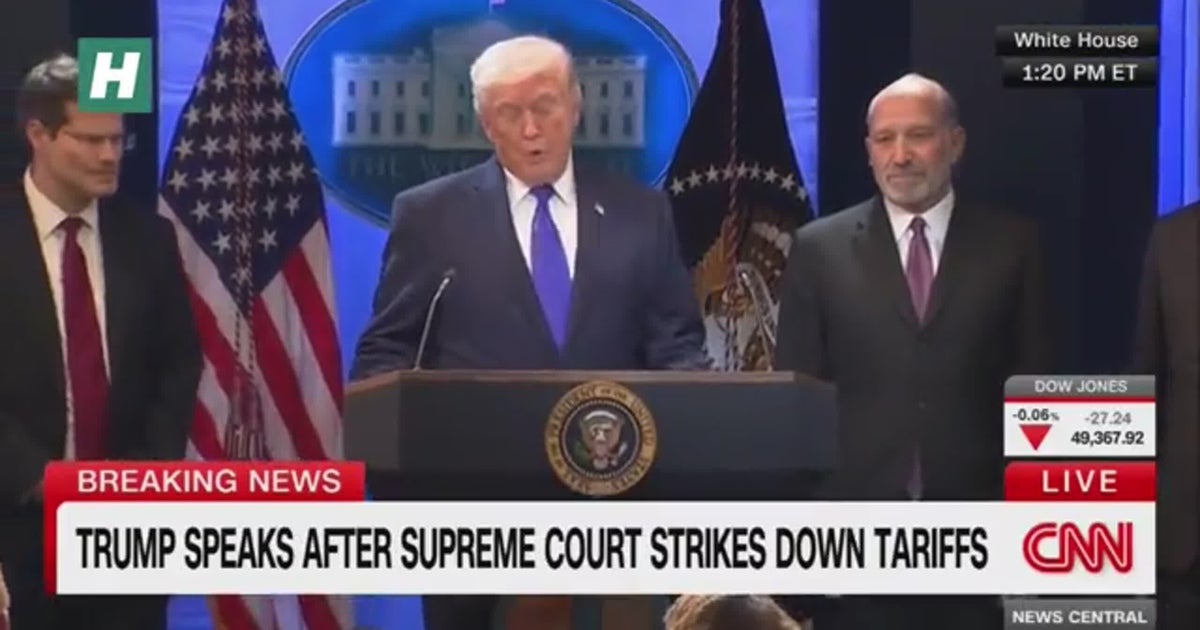
President Donald Trump started the weekend on a more upbeat note following his Friday vitriol against the Supreme Court justices who constrained his ability to impose global tariffs in a 6-3 decision.
He criticised Barrett and Gorsuch again, along with Chief Justice John Roberts, in a Truth Social post later that night. “At least I didn’t appoint Roberts,” he noted.
His cheerier Saturday morning message, on the other hand, was reserved for the justices who voted in favor of Trump’s “emergency” tariffs on the rest of the world.
“My new hero is United States Supreme Court Justice Brett Kavanaugh and of course, Justices Clarence Thomas and Samuel Alito,” he wrote. There is no doubt in anyone’s mind that they want to, MAKE AMERICA GREAT AGAIN!”
The president’s positivity didn’t last long, though. About an hour and a half later, Trump declared he would actually be raising global tariffs to 15%, rather than the 10% he had previously announced, and he used the announcement as an opportunity to take another swipe at the Supreme Court, saying he made the decision after “a thorough, detailed, and complete review of the ridiculous, poorly written, and extraordinarily anti-American decision on Tariffs issued yesterday.”
President Donald Trump revealed which Supreme Court justice he considers to be his “new hero” after a high court ruling rejected his sweeping tariff powers on Friday.
Trump made the declaration in a post on his Truth Social platform on Saturday morning, a day after the Supreme Court voted 6-3 to block Trump’s tariff powers under the International Emergency Economic Powers Act (IEEPA).
“My new hero is United States Supreme Court Justice Brett Kavanaugh and, of course, Justices Clarence Thomas and Samuel Alito,” the post read. “There is no doubt in anyone’s mind that they want to, MAKE AMERICA GREAT AGAIN!”
While all three justices voted with the minority, Kavanaugh wrote a fiery dissent that called the high court’s decision “illogical.”
“As they interpret the statute, the President could, for example, block all imports from China but cannot order even a $1 tariff on goods imported from China,” Kavanaugh wrote. “That approach does not make much sense.”
Kavanaugh asserted that the IEEPA “does not draw such an odd distinction between quotas and embargoes on the one hand and tariffs on the other,” but rather empowers the president to regulate imports during national emergencies using tools such as quotas, embargoes and tariffs.
President Donald Trump speaks at a press conference at the White House after a Supreme Court ruling on tariffs on Feb. 20, 2026. Kyle Mazza/ShutterstockBrett Kavanaugh testifies before the Senate Judiciary Committee during his Supreme Court nomination hearing on Sept. 27, 2018. AP
Trump last year bypassed Congress and unilaterally levied tariffs on nearly every country in the world by invoking the IEEPA.
The president argued that an influx of illicit drugs from China, Mexico and Canada and a trade deficit that has decimated American manufacturing constituted emergencies that justified the tariffs.
Trump, in a Friday speech remarking on the decision, praised Kavanaugh for “his genius and his great ability,” adding he was “very proud of that appointment.”
Here’s the latest on President Trump’s tariffs following Supreme Court ruling:
Kavanaugh wrote in his dissent that while he disagrees with the court’s ruling, its decision may not “substantially constrain” a president’s ability to order tariffs going forward because of “numerous other federal statutes” that allow the president to impose tariffs.
The justice added that the court’s decision may, however, have substantial interim effects.
“The United States may be required to refund billions of dollars to importers who paid the IEEPA tariffs, even though some importers may have already passed on costs to consumers or others,” Kavanaugh wrote. “As was acknowledged at oral argument, the refund process is likely to be a ‘mess.’”
President Donald Trump reveals his “reciprocal tariffs” during an event in the Rose Garden of the White House on April 2, 2025. Getty ImagesThe Supreme Court voted 6-3 to block Trump’s tariff powers under the International Emergency Economic Powers Act. AP
He added that the high court’s decision could “generate uncertainty” regarding what the government has said were trade deals worth trillion of dollars with foreign nations, including with China, the United Kingdom and Japan.
Trump on Saturday raised the global tariff to 15% — up from the 10% global tariff he announced Friday in the wake of the Supreme Court ruling.
He cited Section 122 of the Trade Act of 1974 in announcing the new levy.
B.C.’s Premier David Eby is set to speak at 12:45 p.m. PST on Friday to respond to the U.S. Supreme Court ruling on President Donald Trump’s tariffs.
The U.S. Supreme Court on Friday ruled that Trump overstepped his presidential authority by imposing tariffs on Canada, Mexico and other countries under emergency powers, striking down a central economic and diplomatic strategy that has upended global trade.
A majority of the justices sided with lower courts that had found Trump improperly used tariffs to respond to national emergencies he declared over fentanyl trafficking in North America and international trade deficits, the latter of which led to so-called “reciprocal” tariffs against dozens of nations.
Get daily National news
Get the day’s top news, political, economic, and current affairs headlines, delivered to your inbox once a day.
The law Trump used to exercise that authority, the International Emergency Economic Powers Act (IEPPA), “does not authorize the President to impose tariffs,” Chief Justice John Roberts wrote in the majority opinion.
Story continues below advertisement
B.C. reaction to tariff deal with China
Trending Now
Trump accuses Obama of releasing classified info on aliens: ‘Big mistake’
Danielle Smith promises Alberta referendum over immigration, Constitution changes
Eby has always been very vocal against Trump’s tariffs and the impact on B.C.’s economy.
“We are not going to accept these continual threats, this continued uncertainty. We are going to stand up for Canadians. This is unacceptable,” Eby said last March.
Trump can still impose tariffs under other authorities, including a national security clause known as Section 232 that targets specific industries rather than countries. Those tariffs on goods, including steel, lumber and automobiles, remain in place.
This story will be updated following Eby’s press conference on Friday afternoon.
— With files from Global News’ Sean Boynton and Ariel Rabinovitch
An organization that represents pea, lentil and bean growers in Saskatchewan says it supports a new federal investment intended to spur diversification among its trading partners.
Canada’s agriculture minister announced Tuesday a $75-million investment over five years to expand export activities into new, non-traditional markets and support sectors most affected by trade barriers.
“This added investment will help our sector access new markets, strengthen interprovincial trade and build more resilience in the face of global challenges,” said Heath MacDonald, minister of agriculture and agri-food, at an unrelated policy breakfast in Ottawa.
The program builds on the existing AgriMarketing Program and adds funding for two new streams: national industry associations and small and medium-sized enterprises.
Organizations can apply for funding to expand export activities, with priority given to sectors most impacted by trade barriers, such as pulses and canola, according to a news release from Agriculture and Agri-Food Canada.
Story continues below advertisement
“There are opportunities all over the world, but we can’t spread ourselves too thin. We have to target our markets and go after them,” said MacDonald.
Get breaking National news
For news impacting Canada and around the world, sign up for breaking news alerts delivered directly to you when they happen.
The federal government’s investment is being well-received by the national industry association representing pulse growers.
“Any investment in helping us diversify and helping us find new avenues, new uses, new ways to put more pulses on more plates around the world is something that we support,” said Jeff English, vice-president of public affairs at Pulse Canada.
In January, Canada struck a trade deal with China to remove the 100 per cent tariffs on Canadian yellow peas, effective March 1 through the end of the year.
China imposed this tariff in March 2025 in response to Canada’s previously imposed 100 per cent tariff on Chinese electric vehicles and a 25 per cent import tax on steel and aluminum.
But India’s 30 per cent tariff on Canadian yellow peas remains in place, something local pulse producer associations say is a reason the industry needs to diversify its trading partners.
Trending Now
Carney says he had ‘positive’ call with Trump on Gordie Howe bridge threat
Air Canada suspends all flights to Cuba, effective immediately
“The more diversified we are, the less of an impact that will be, and we’ll have stronger prices for farmers at the end of the day,” said Carl Potts, executive director of Saskatchewan Pulse Growers.
Potts said his association is exploring strategies to tap into other markets worldwide, including the Indo-Pacific and Latin America regions.
Story continues below advertisement
Alongside diversifying its trading partners, the organization is also focused on increasing demand for other products in new markets, such as pet food and animal feed. This, according to Potts, was a strategy that helped bolster pea imports into China 20 years ago.
“At the time, they might have been importing maybe 200,000 tonnes a year, but we worked with local industry and consultants in the market to help develop more demand for peas,” said Potts.
“We’ve grown that into a market of over two million tonnes in some areas.”
Alongside finding new markets, the pulse grower associations say they are also continuing to advocate for strengthened relations with current trading partners and look forward to new opportunities to do so — from CUSMA renegotiations to a potential India trip by Prime Minister Mark Carney.
“As the government does its job in terms of building a stronger relationship with India, we’re doing things in lockstep as well,” said English.