SCOTUS conservatives signal readiness to curb late-arriving mail ballots


NEWYou can now listen to Fox News articles!

The Supreme Court’s conservative majority on Monday appeared poised to overturn state laws from Mississippi and other U.S. states that allow for the counting of mail-in ballots received after Election Day — a major case that could upend voting laws for millions of Americans just months before the 2026 midterm elections.

At issue is a Mississippi voting law that allows the state to count mail-in ballots that are received up to five days after the election, so long as they are postmarked by or before Election Day. 

President Donald Trump has focused on mail-in voting during his second White House term, and has argued that such laws undermine voter confidence. Similar laws are currently on the books for at least 13 states and the District of Columbia, in a sign of the wide-ranging nature of the case. 

During roughly two hours of oral arguments Monday, conservative justices appeared sympathetic to the argument made by the Trump administration’s lawyer, U.S. Solicitor General D. John Sauer, who noted that the Mississippi law and similar voting laws in other states could erode voter trust in election results.

SCOTUS TO REVIEW TRUMP EXECUTIVE ORDER ON BIRTHRIGHT CITIZENSHIP
SCOTUS conservatives signal readiness to curb late-arriving mail ballots

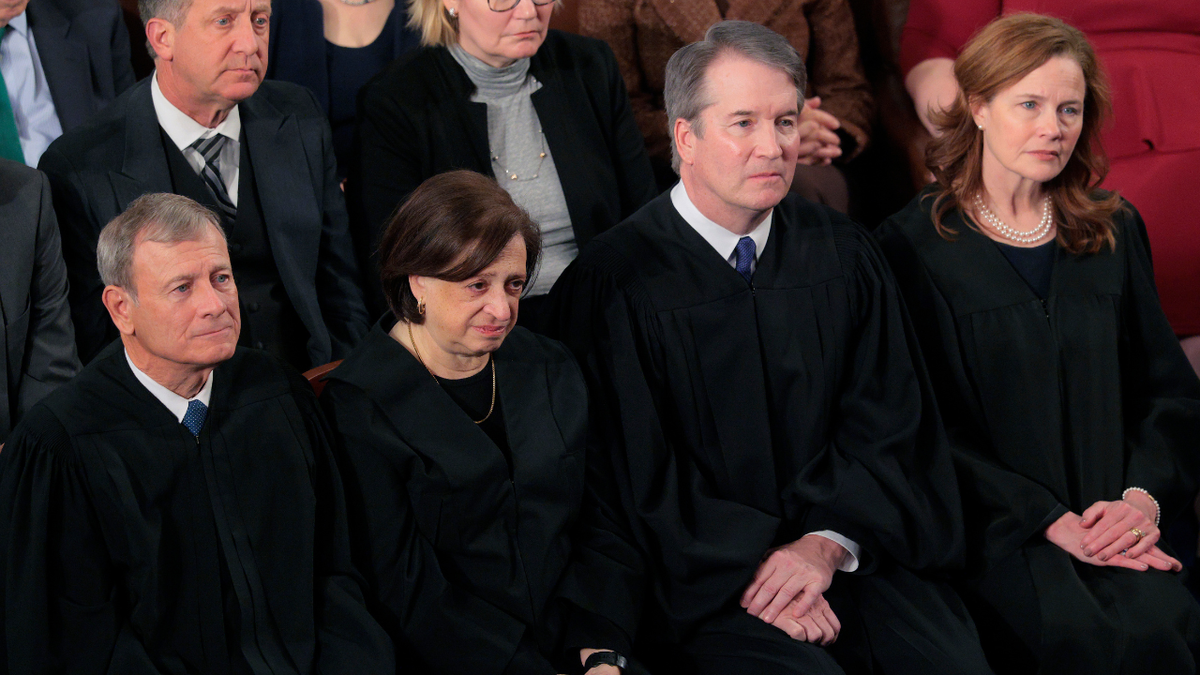
Supreme Court justices are seen at the State of the Union. ( Chip Somodevilla/Getty Images)

Justice Samuel Alito pointed to concerns that “confidence in election outcomes can be seriously undermined” when results are delayed, which was echoed later by Justice Brett Kavanaugh.

“If the apparent winner the morning after the election ends up losing due to late arriving ballots, charges of a rigged election could explode,” Kavanaugh noted. 

The case comes as Trump has targeted mail-in voting efforts in his second presidential term. He previously signed an executive order seeking to end mail-in ballots in federal elections, with which several GOP-led states have complied.

That action was separate from the current Supreme Court appeal, however, which centered on the Republican National Committee’s lawsuit brought against Mississippi over its mail-in voting statutes, enacted after the COVID-19 pandemic. The law allows mail-in voting ballots to be received up to five days after the election.

Mississippi officials sought to defend their law against questions from conservative justices regarding a “slippery slope,” and other hypothetical questions raised by conservative justices, including questions centered on early voting, and votes sent by U.S. service members stationed overseas.

SUPREME COURT SIGNALS IT MAY LIMIT KEY VOTING RIGHTS ACT RULE
Ohio voter law

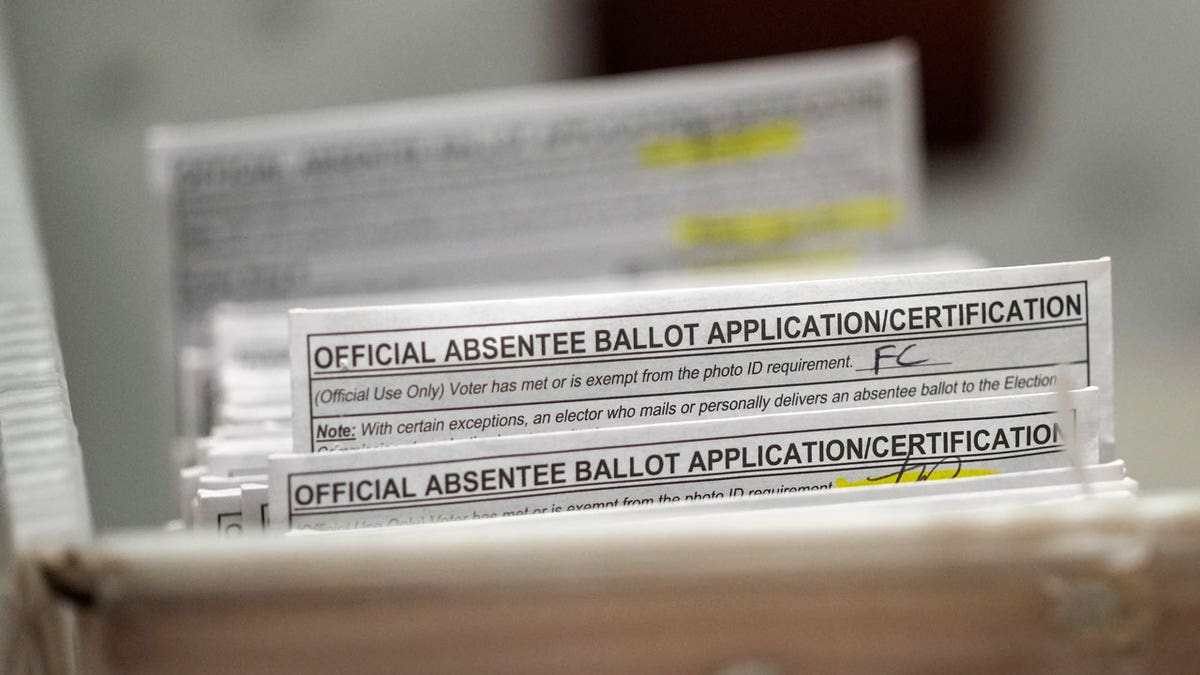
Certified absentee ballots are seen in this file photo ahead of the Supreme Court’s consideration of a Mississippi mail-in voting law. (AP Photo/Morry Gash, File)

“If history teaches anything,” Justice Neil Gorsuch noted, “[it is that] as soon as anything is allowed, it will happen.”

Gorsuch pressed lawyers on various hypothetical questions, including how far states could go in pushing their own deadlines for accepting mail-in ballots, should the Supreme Court side with Mississippi in the case.

 “If we were to rule against you, is there anything that would limit a state from allowing a receipt by election officials up until the day of the next Congress?” Gorsuch asked at one point during arguments.

Paul Clement, who presented arguments for the Republican Party and Libertarian voters, suggested that a high court ruling for Mississippi would open the door to “limitless” options. 

“Maybe the next state can figure out a way to have an election without anybody even receiving anything, I don’t know,” Clement said. “That seems to me to be a large reason why Election Day should mean ‘Election Day.’” 

FEDERAL JUDGES IN NEW YORK AND TEXAS BLOCK TRUMP DEPORTATIONS AFTER SCOTUS RULING
The Supreme Court building

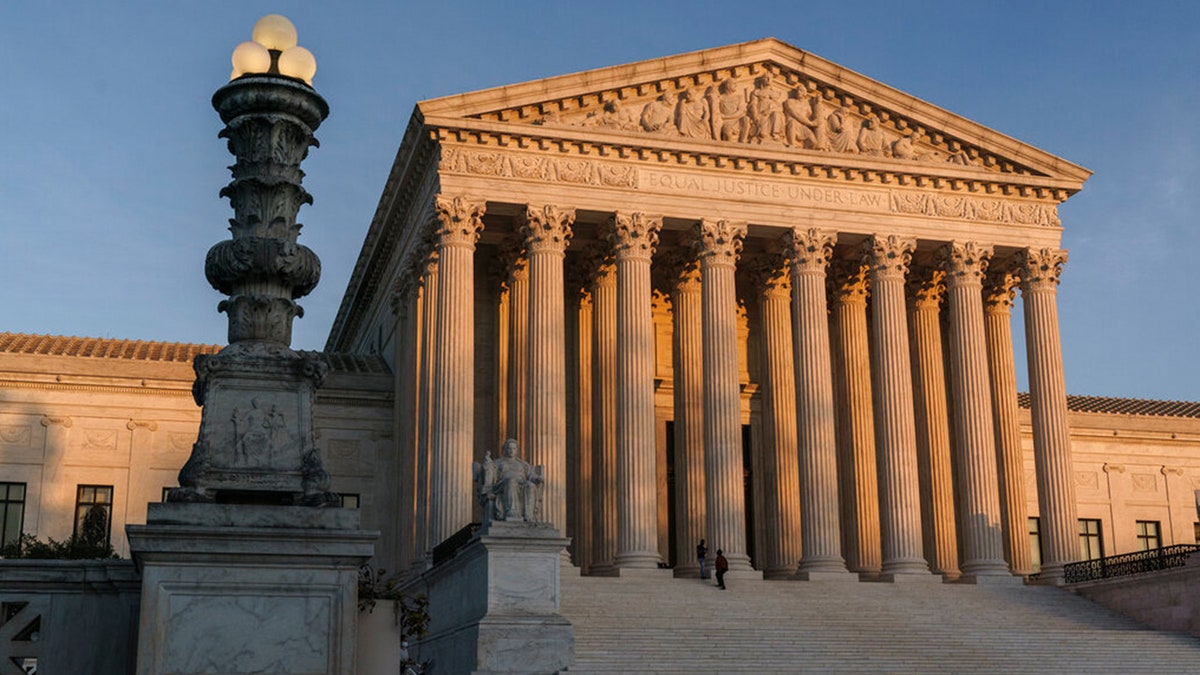
The Supreme Court building in Washington, D.C. (AP Photo/J. Scott Applewhite, File)

The high court’s consideration of the case comes amid a longstanding legal tug-of-war over how much control states should have over their voting regulations, including in elections involving both federal and local candidates.

It comes as justices are weighing other high-stakes election cases this year, including the use of race to draw congressional voting districts, and a federal law restricting the amount of money that political parties can spend in coordination with candidates for Congress and president. 

Lawyers for Mississippi told the court that an “‘election’ is the conclusive choice of an officer…  So the federal election-day statutes require only that the voters cast their ballots by election day.”

“The election has then occurred, even if election officials do not receive all ballots by that day.”

CLICK HERE TO GET THE FOX NEWS APP 

The high court is expected to rule on the states’ counting of mail-in ballots by June.

This is a breaking news story. Check back for updates.


Supreme Court says asylum seekers entitled to subsidized Quebec daycare – Montreal | Globalnews.ca


The Supreme Court of Canada has ruled that Quebec discriminated against female refugee claimants by introducing regulations that denied them access to subsidized daycare spaces.

Supreme Court says asylum seekers entitled to subsidized Quebec daycare – Montreal | Globalnews.ca

This marks the third ruling against the Quebec government on the matter.

In a decision today, the court says that blocking refugee claimants from subsidized daycare threatens to marginalize them from society.

Get the day's top news, political, economic, and current affairs headlines, delivered to your inbox once a day.

Get daily National news

Get the day’s top news, political, economic, and current affairs headlines, delivered to your inbox once a day.

The case originated with a woman from the Democratic Republic of Congo who applied for asylum and obtained a work permit.

The province subsequently denied access to Quebec’s heavily subsidized daycare network for the woman’s three children.

They were denied because Quebec’s rules provided access to the system only once refugee status was granted by the federal government.

Spaces in the highly sought-after network cost roughly $9 a day.


&copy 2026 The Canadian Press


Supreme Court agrees to hear from oil and gas companies trying to block climate change lawsuits


Supreme Court agrees to hear from oil and gas companies trying to block climate change lawsuits

By LINDSAY WHITEHURST

WASHINGTON (AP) — The Supreme Court said Monday that it will hear from oil and gas companies trying to block lawsuits seeking to hold the industry liable for billions of dollars in damage linked to climate change.

The conservative-majority court agreed to take up a case from Boulder, Colorado, among a series of lawsuits alleging the companies deceived the public about how fossil fuels contribute to climate change.

Governments around the country have sought damages totaling billions of dollars, arguing it’s necessary to help pay for rebuilding after wildfires, rising sea levels and severe storms worsened by climate change. The lawsuits come amid a wave of legal actions in states including California, Hawaii and New Jersey and worldwide seeking to leverage action through the courts.

Suncor Energy and ExxonMobil appealed to the Supreme Court after Colorado’s highest court let the Boulder case proceed. The companies argue emissions are a national issue that should be heard in federal court, where similar suits have been tossed out.

“The use of state law to address global climate change represents a serious threat to one of our Nation’s most critical sectors,” attorneys wrote.

President Donald Trump’s administration weighed in to support the companies and urge the justices to reverse the Colorado Supreme Court decision, saying it would mean “every locality in the country could sue essentially anyone in the world for contributing to global climate change.”

Trump, a Republican, has criticized the lawsuits in an executive order, and the Justice Department has sought to head some off in court.

Attorneys for Boulder had agued that the litigation is still in early stages and should stay in state court. “There is no constitutional bar to states addressing in-state harms caused by out-of-state conduct, be it the negligent design of an automobile or sale of asbestos,” they wrote.

Follow the AP’s coverage of the U.S. Supreme Court at https://apnews.com/hub/us-supreme-court.


Trump Welcomes Morning After Supreme Court Tirade With Praise For His ‘New Hero’


President Donald Trump started the weekend on a more upbeat note following his Friday vitriol against the Supreme Court justices who constrained his ability to impose global tariffs in a 6-3 decision.

He criticised Barrett and Gorsuch again, along with Chief Justice John Roberts, in a Truth Social post later that night. “At least I didn’t appoint Roberts,” he noted.

His cheerier Saturday morning message, on the other hand, was reserved for the justices who voted in favor of Trump’s “emergency” tariffs on the rest of the world.

“My new hero is United States Supreme Court Justice Brett Kavanaugh and of course, Justices Clarence Thomas and Samuel Alito,” he wrote. There is no doubt in anyone’s mind that they want to, MAKE AMERICA GREAT AGAIN!”

The president’s positivity didn’t last long, though. About an hour and a half later, Trump declared he would actually be raising global tariffs to 15%, rather than the 10% he had previously announced, and he used the announcement as an opportunity to take another swipe at the Supreme Court, saying he made the decision after “a thorough, detailed, and complete review of the ridiculous, poorly written, and extraordinarily anti-American decision on Tariffs issued yesterday.”


Trump reveals his ‘new hero’ Supreme Court justice after tariffs ruling


President Donald Trump revealed which Supreme Court justice he considers to be his “new hero” after a high court ruling rejected his sweeping tariff powers on Friday.

Trump made the declaration in a post on his Truth Social platform on Saturday morning, a day after the Supreme Court voted 6-3 to block Trump’s tariff powers under the International Emergency Economic Powers Act (IEEPA).

“My new hero is United States Supreme Court Justice Brett Kavanaugh and, of course, Justices Clarence Thomas and Samuel Alito,” the post read. “There is no doubt in anyone’s mind that they want to, MAKE AMERICA GREAT AGAIN!”

While all three justices voted with the minority, Kavanaugh wrote a fiery dissent that called the high court’s decision “illogical.”

“As they interpret the statute, the President could, for example, block all imports from China but cannot order even a $1 tariff on goods imported from China,” Kavanaugh wrote. “That approach does not make much sense.”

Kavanaugh asserted that the IEEPA “does not draw such an odd distinction between quotas and embargoes on the one hand and tariffs on the other,” but rather empowers the president to regulate imports during national emergencies using tools such as quotas, embargoes and tariffs.

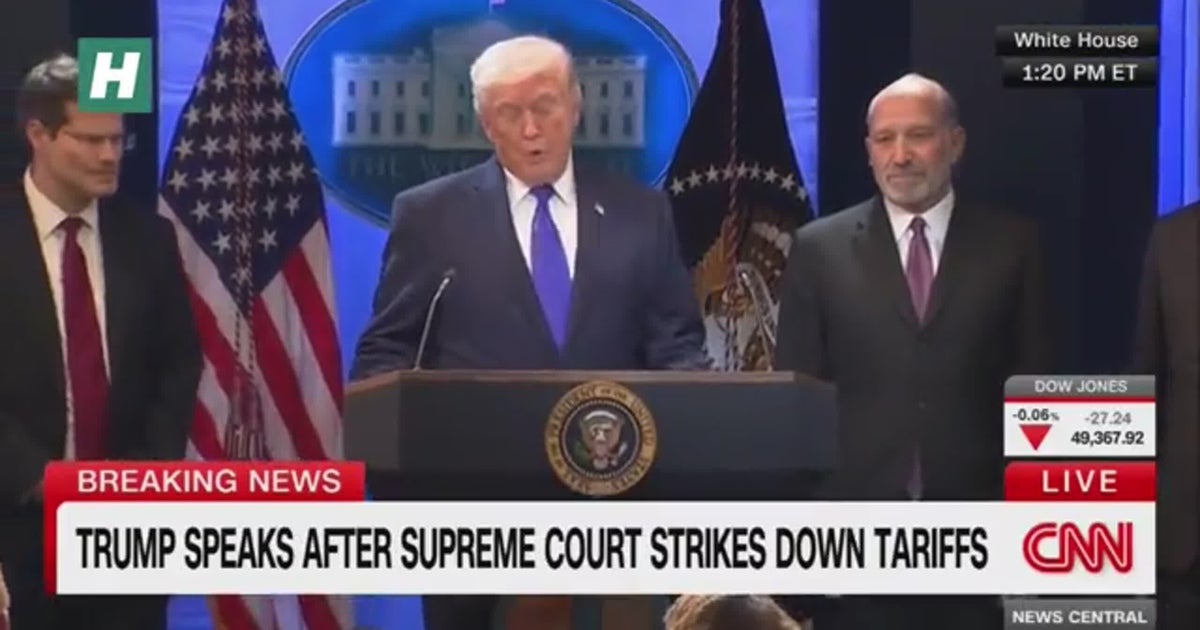
President Donald Trump speaks at a press conference at the White House after a Supreme Court ruling on tariffs on Feb. 20, 2026. Kyle Mazza/Shutterstock
Brett Kavanaugh testifies before the Senate Judiciary Committee during his Supreme Court nomination hearing on Sept. 27, 2018. AP

Trump last year bypassed Congress and unilaterally levied tariffs on nearly every country in the world by invoking the IEEPA.

The president argued that an influx of illicit drugs from China, Mexico and Canada and a trade deficit that has decimated American manufacturing constituted emergencies that justified the tariffs.

Trump, in a Friday speech remarking on the decision, praised Kavanaugh for “his genius and his great ability,” adding he was “very proud of that appointment.”


Here’s the latest on President Trump’s tariffs following Supreme Court ruling:


Kavanaugh wrote in his dissent that while he disagrees with the court’s ruling, its decision may not “substantially constrain” a president’s ability to order tariffs going forward because of “numerous other federal statutes” that allow the president to impose tariffs.

The justice added that the court’s decision may, however, have substantial interim effects.

“The United States may be required to refund billions of dollars to importers who paid the IEEPA tariffs, even though some importers may have already passed on costs to consumers or others,” Kavanaugh wrote. “As was acknowledged at oral argument, the refund process is likely to be a ‘mess.’”

President Donald Trump reveals his “reciprocal tariffs” during an event in the Rose Garden of the White House on April 2, 2025. Getty Images
The Supreme Court voted 6-3 to block Trump’s tariff powers under the International Emergency Economic Powers Act. AP

He added that the high court’s decision could “generate uncertainty” regarding what the government has said were trade deals worth trillion of dollars with foreign nations, including with China, the United Kingdom and Japan.

Trump on Saturday raised the global tariff to 15% — up from the 10% global tariff he announced Friday in the wake of the Supreme Court ruling.

He cited Section 122 of the Trade Act of 1974 in announcing the new levy.


Trump ‘Absolutely Ashamed’ Of Supreme Court


!function(n){if(!window.cnx){window.cnx={},window.cnx.cmd=[];var t=n.createElement(‘iframe’);t.display=’none’,t.onload=function(){var n=t.contentWindow.document,c=n.createElement(‘script’);c.src=”//cd.connatix.com/connatix.player.js”,c.setAttribute(‘async’,’1′),c.setAttribute(‘type’,’text/javascript’),n.body.appendChild(c)},n.head.appendChild(t)}}(document);(new Image()).src=”