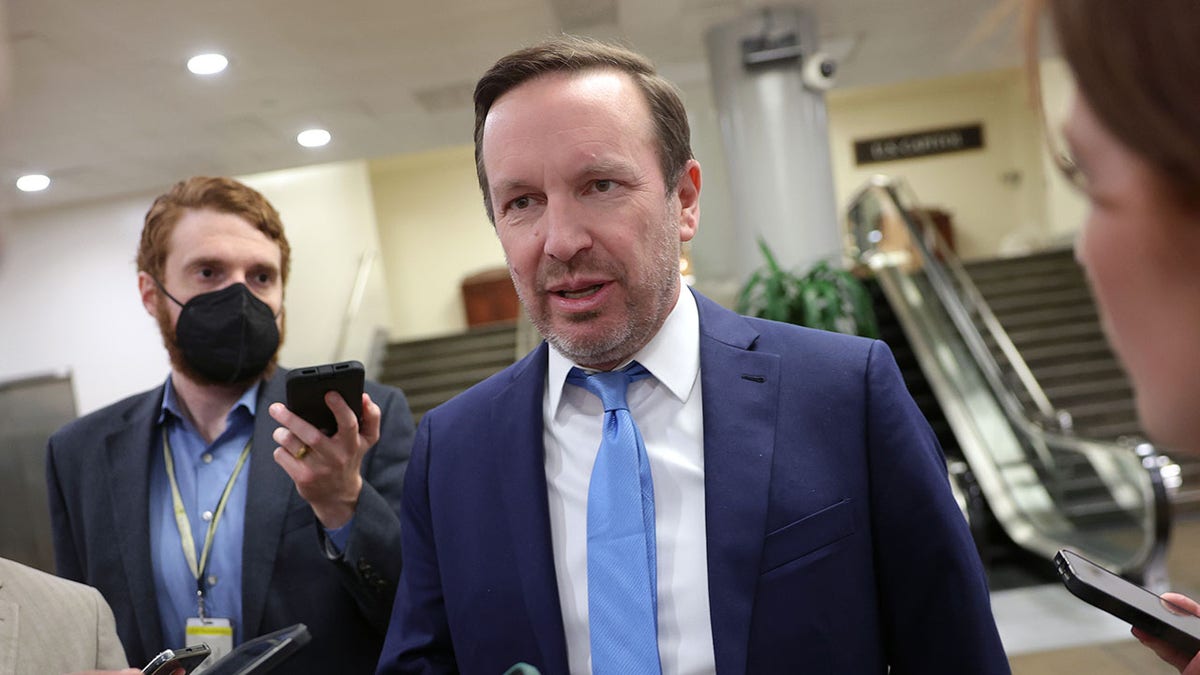
Senate Dem accuses Trump of being ‘unfit for office,’ joins growing call to impeach, oust president


NEWYou can now listen to Fox News articles!

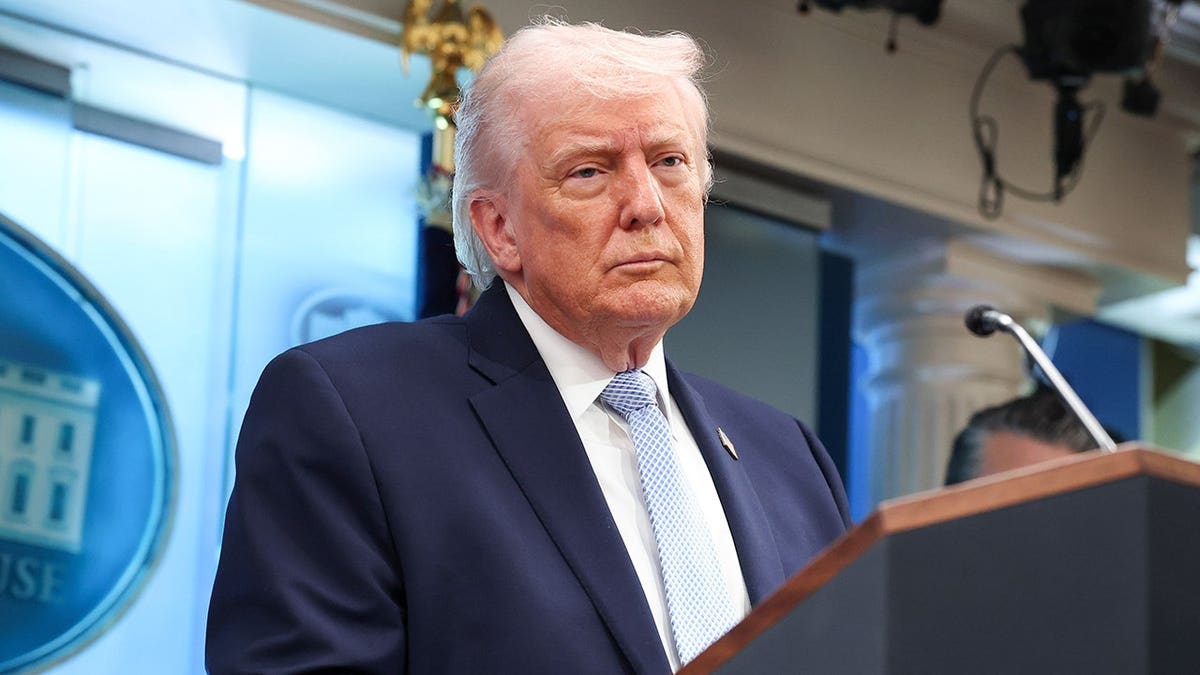
Another Senate Democrat has called on President Donald Trump to be removed from office over the Iran war.

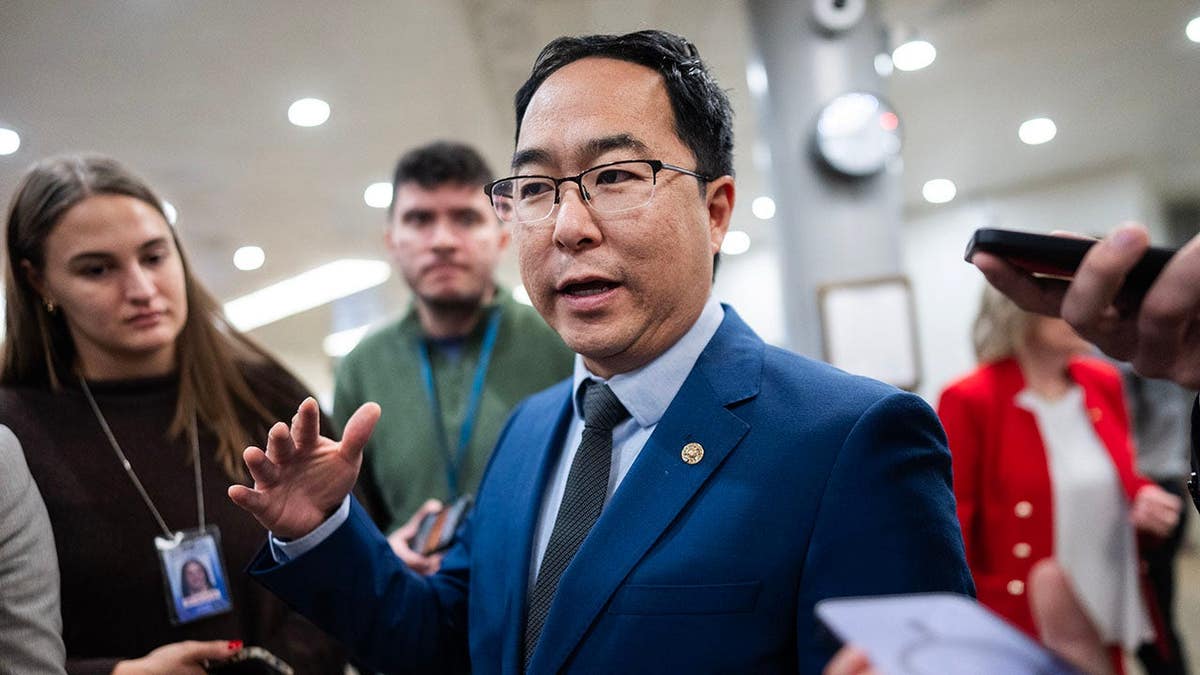
“I certainly think the president should be removed,” Sen. Andy Kim, D-N.J., said. “I mean, he’s unfit for office. I think, the 25th Amendment, and if not, then impeachment.”

Congressional Democrats, particularly in the House, recently have escalated their position against Trump’s war in Iran, shifting from pushing for Congress to reassert its authority in declaring war to demanding that the president be ousted from office.

ROGUE DEM BUCKS PARTY ON TRUMP WAR POWERS, CALLS IRAN ‘47-YEAR-OLD WAR CRIME’

Senate Dem accuses Trump of being ‘unfit for office,’ joins growing call to impeach, oust president

Another Senate Democrat has called on President Donald Trump to be removed from office over the Iran war. (Anna Moneymaker/Getty Images)

Trump’s comments in the past few days, particularly his threat against Iran that a “whole civilization will die” unless the Strait of Hormuz was reopened, sparked the latest growing push to see him removed from office.

While there is growing sentiment among House Democrats to jettison Trump from office, it’s not as widespread in the Senate. Still, Kim on Thursday joined a small group of Senate Democrats echoing the desires of their counterparts in the House.

So far, Sens. Chris Murphy, D-Conn., Ed Markey, D-Mass., and Ron Wyden, D-Ore., all either have demanded that Trump be impeached or removed through the 25th Amendment.

SCHUMER BLASTS TRUMP’S IRAN WAR AS FAILURE, MOVES TO REIN IN HIS WAR POWERS AMID CEASEFIRE

Sen. Andy Kim voting in the U.S. Capitol

Sen. Andy Kim, D-N.J., wants President Donald Trump removed from office either through impeachment or the 25th amendment over his comments and actions in Iran. (Tom Williams/CQ-Roll Call, Inc)

Senate Minority Leader Chuck Schumer, D-N.Y., has stopped short of calling for impeachment, but instead is teeing up another war powers resolution — the fourth since the war began in February — to rein in Trump’s war authorities in the region as a fragile two-week ceasefire continues.

But their calls for removal likely aren’t going to go anywhere now, given the political reality in Washington, D.C. Republicans control both chambers of Congress, meaning impeachment is all but a moot point.
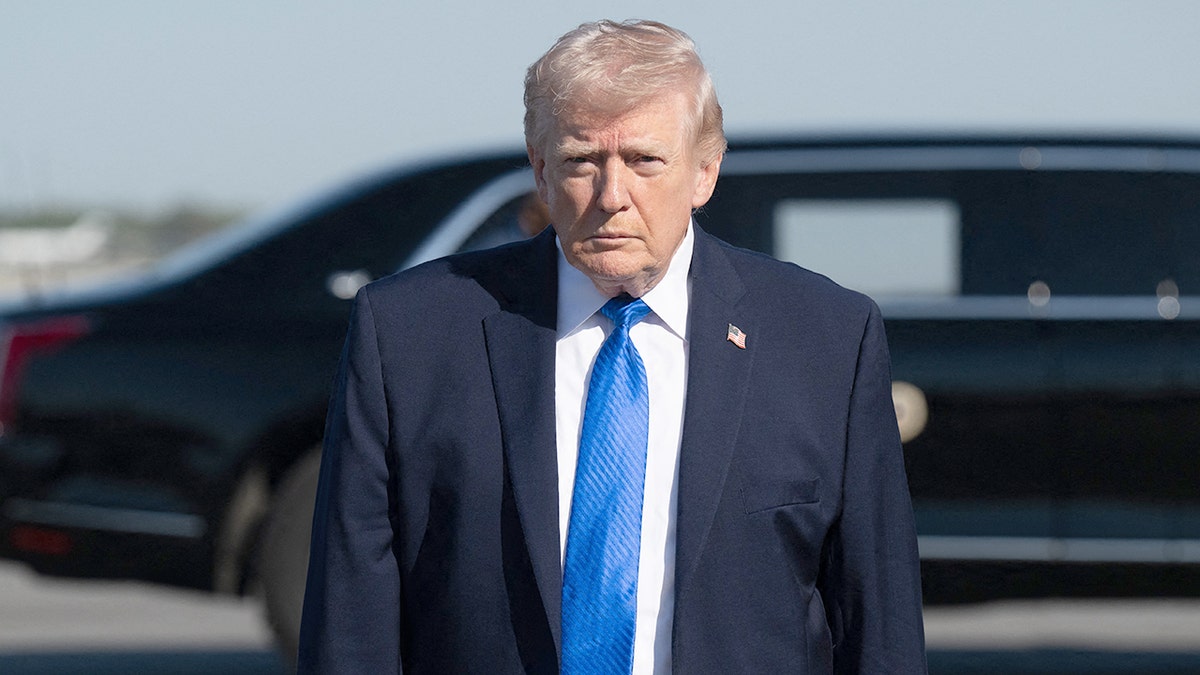
And invoking the 25th Amendment, which has never been used to remove a sitting president, is even more unlikely, given that it would require Vice President JD Vance, a majority of Trump’s Cabinet, and then a two-thirds majority vote in Congress to remove him.

TOP GOP HAWK GRAHAM WARNS IRAN DEAL HAS ‘TROUBLING ASPECTS’ AS CEASEFIRE BEGINS

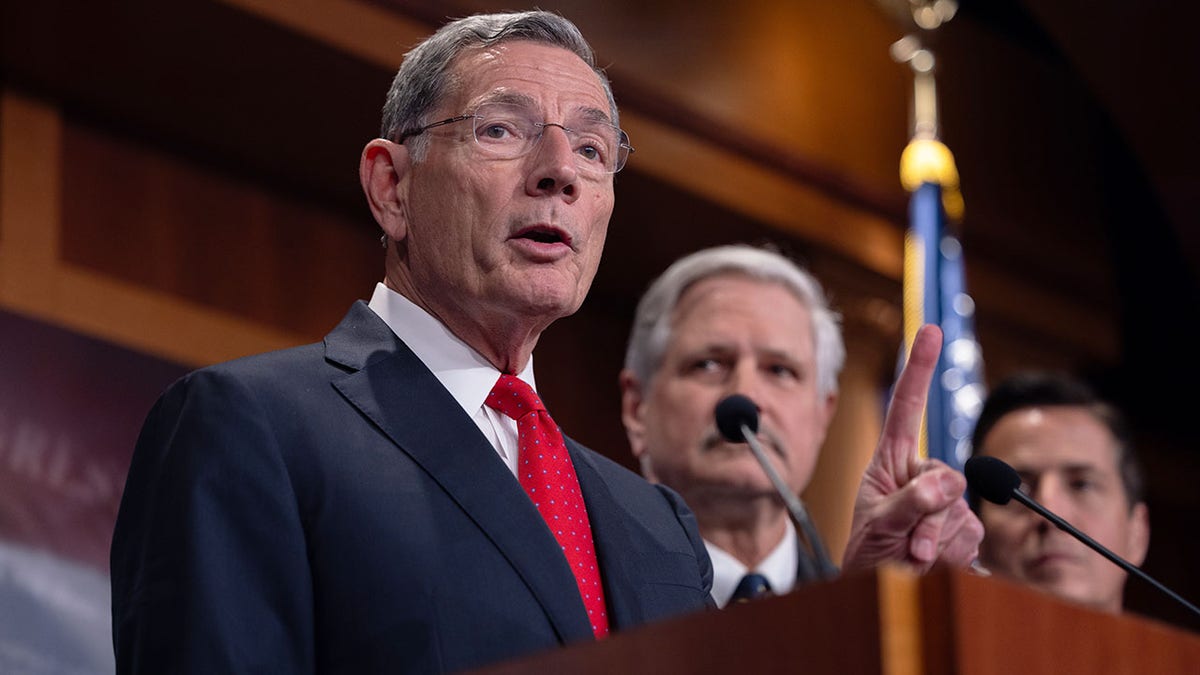
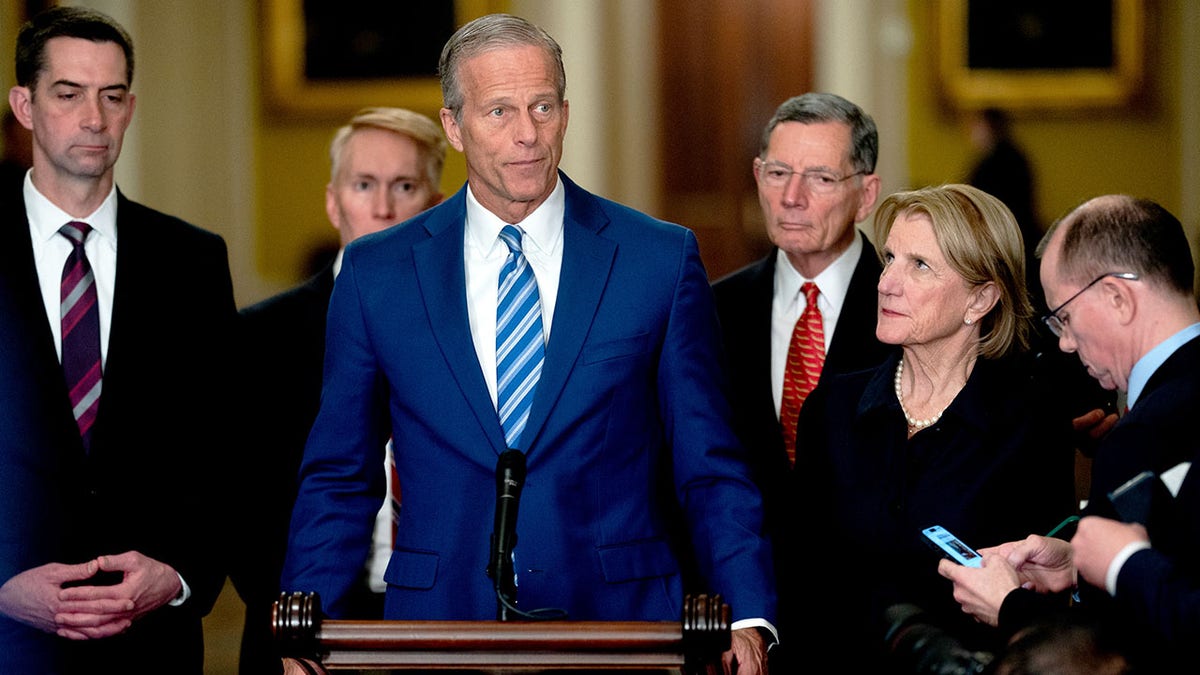
Senate Majority Whip John Barrasso speaking at a press conference in Washington, D.C.
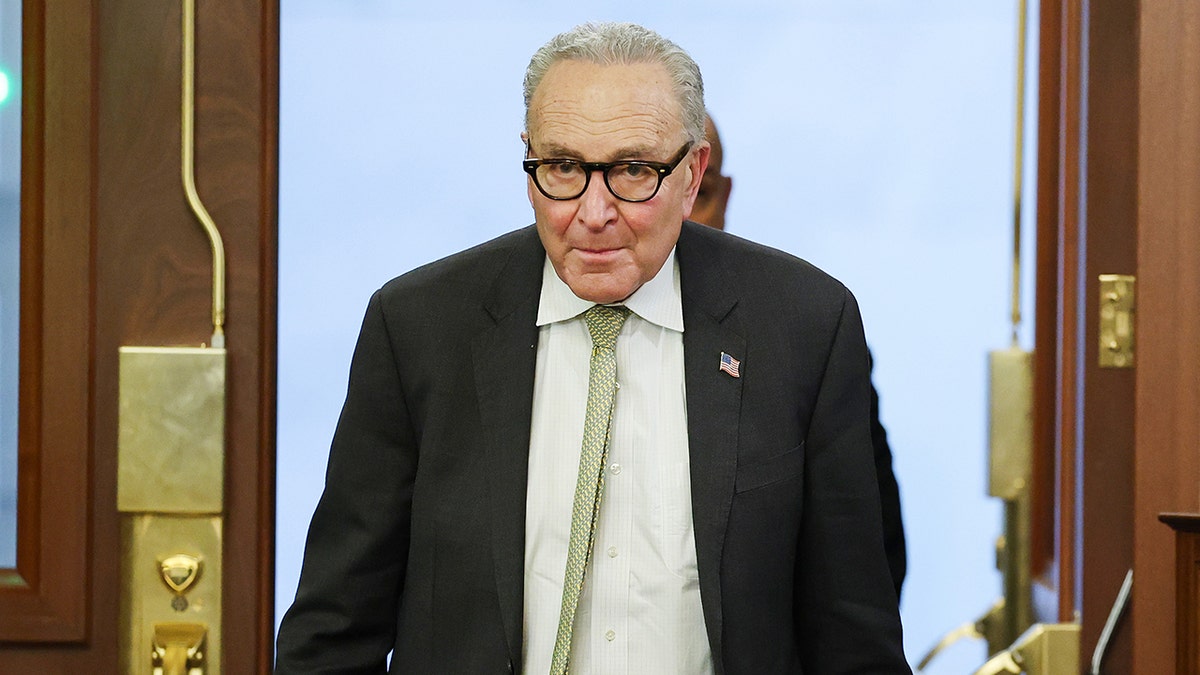
Senate Majority Whip John Barrasso, R-Wyo., railed against Senate Democrats, and accused them of trying to rip apart DHS. (Nathan Posner/Anadolu)

It’s also a desire that Sen. Sheldon Whitehouse, D-R.I., contended was “not realistic right now, given his oddball Cabinet of sycophants and eccentrics,” earlier this week.

“We’re going to have to buckle down and win this the old-fashioned way,” Whitehouse said.

Democrats’ position does provide foreshadowing for what could happen if they win big in the midterm elections this fall, however.

Meanwhile, congressional Republicans are still backing Trump’s actions in Iran, despite some straying from the party line over his recent apocalyptic comments.

CLICK HERE TO DOWNLOAD THE FOX NEWS APP

Senate Majority Whip John Barrasso, R-Wyo., said that “Iran has been at war with the United States for 47 years, and it’s time for Iran to choose peace.”

“They haven’t done it yet,” Barrasso said. “What we have seen is American peace through strength, and with this operation that is going on now, incredible success by the United States. We have done what we have talked about doing. Eliminate their missiles and eliminate their missile production and eliminate their missile firing capacity, undermine their ability to ever get a nuclear weapon, and sink the navy.”

Fox News Digital reached out to the White House for comment and has not yet received a reply. 


GOP races to pass ICE, Border Patrol funding bill as priorities pile up, divisions emerge


NEWYou can now listen to Fox News articles!

A party-line tactic to ram legislation through Congress and bypass the Senate filibuster has become a dumping ground for Republicans’ legislative priorities throughout the year.

Now, as Democrats refuse to fund immigration operations, Republicans are once again readying a budget reconciliation package. The hard part will be getting enough of the GOP on the same page to craft a bill that can pass and survive the strict rules underpinning the process.

Republicans used the same process to pass President Donald Trump’s “big, beautiful bill” last year. It’s a time-consuming, labor-intensive legislative maneuver that nearly blew up and could fail unless both the Senate and House align on what exactly they want to include.

SENATE PASSES BILL TO FUND MOST OF DHS AFTER HOUSE GOP CAVES

GOP races to pass ICE, Border Patrol funding bill as priorities pile up, divisions emerge

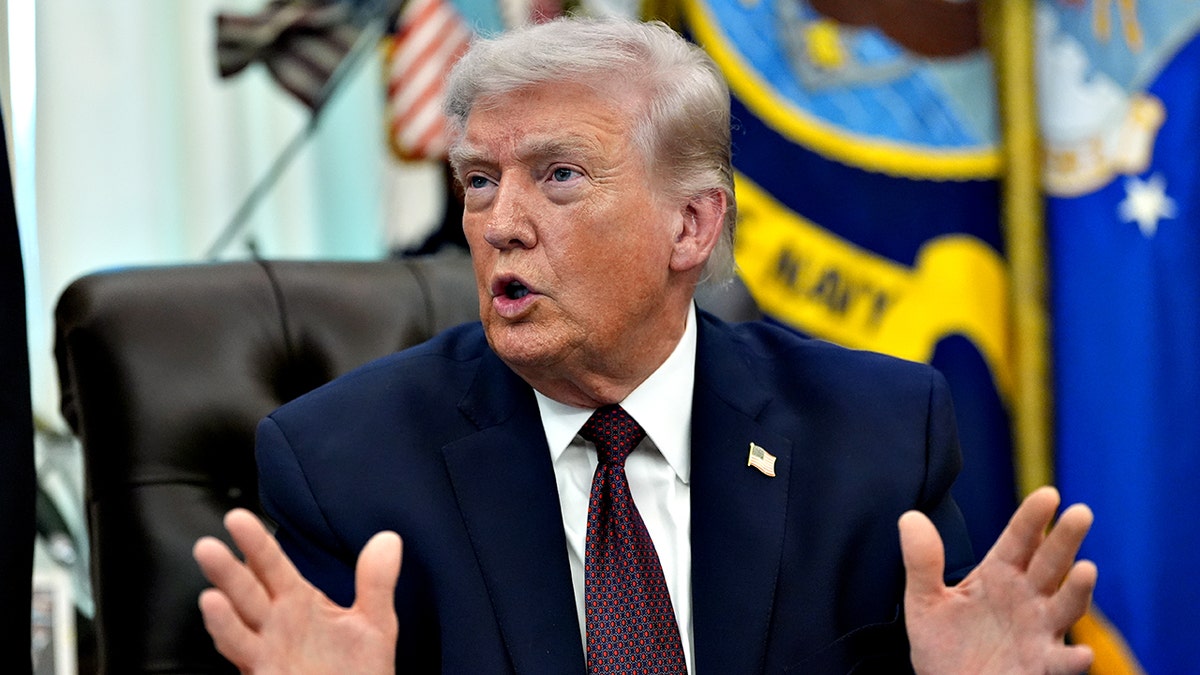
President Donald Trump answers questions from reporters after signing an executive order in the Oval Office of the White House Tuesday, March 31, 2026, in Washington. (Alex Brandon/AP Photo)

Trump officially backed using reconciliation again this week as a way to skirt Democrats’ refusal to fund Immigration and Customs Enforcement (ICE) and Customs and Border Protection (CBP), as Congress inches closer to ending the ongoing Department of Homeland Security (DHS) shutdown.

Trump demanded that Republicans get the bill on his desk by June 1.

“We are going to work as fast and as focused as possible to replenish funding for our Border and ICE agents, and the Radical Left Democrats won’t be able to stop us,” Trump said on Truth Social.

Still, Republicans have viewed reconciliation as a vehicle to tackle fraud, affordability, Trump’s tariff authorities, additional tax provisions, healthcare, funding for the Iran war, supplemental agriculture spending, and election integrity measures in the months since passing the “big, beautiful bill.”

DHS SHUTDOWN BREAKTHROUGH COMES AT COST FOR REPUBLICANS AS FUNDING FIGHTS NEARS END

DHS shutdown breakthrough comes at cost for Republicans as funding fights nears end

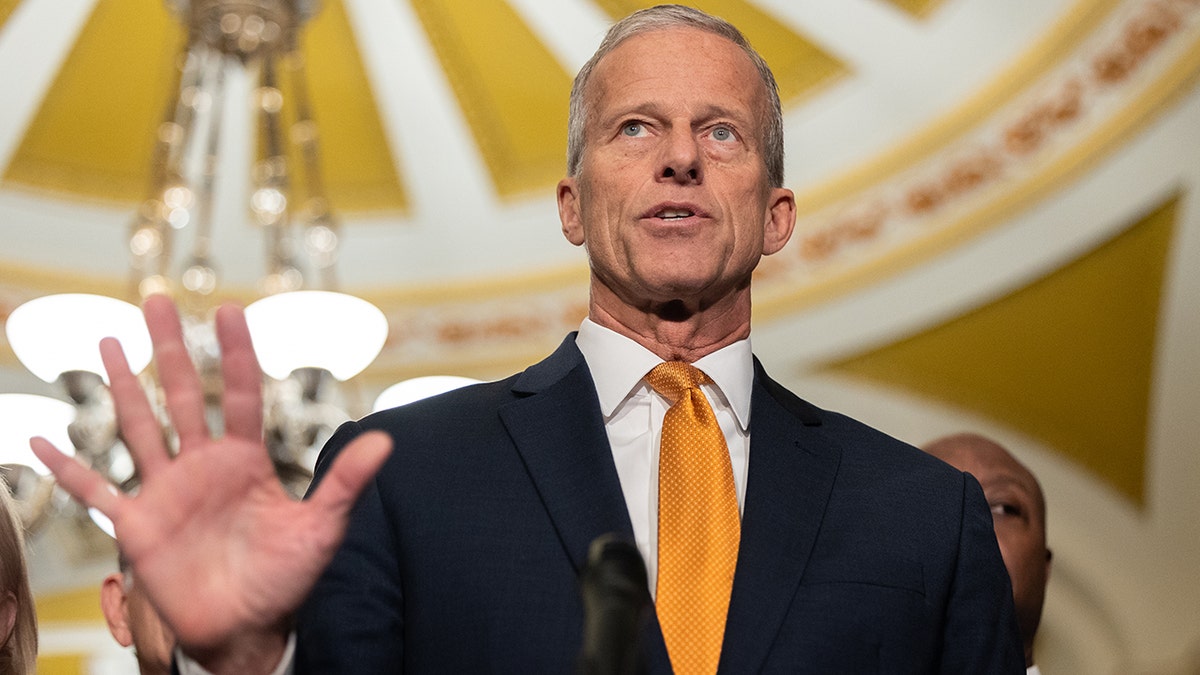
Senate Majority Leader John Thune, R-S.D., said Republicans need to “keep our expectations realistic.” (Stefani Reynolds/Bloomberg via Getty Images)

Senate Majority Leader John Thune, R-S.D., has warned that if reconciliation is going to work — especially given the limited timeframe lawmakers have to start and finish the process — Republicans need to “keep our expectations realistic.”

“Our theory of the case behind all this was to keep that thing as narrow and focused as possible, and that maximizes the speed at which we can do it and the support for it,” Thune said.

“There will probably be some attempts to add things,” he continued. “There are things out there that, obviously, many of us are interested in. But on a reconciliation vehicle like this — which we need to move with haste, as the president has pointed out — it’s probably not a likely magnet for all these other issues.”

Senate Budget Committee Chair Lindsey Graham, R-S.C., told voters at an event this week in South Carolina that he is eyeing two new reconciliation packages, which could ease concerns about cramming all the GOP’s priorities into one massive bill.

GOP RAILS AGAINST ‘S— SANDWICH’ DEAL AS ALL EYES TURN TO HOUSE TO END DHS SHUTDOWN

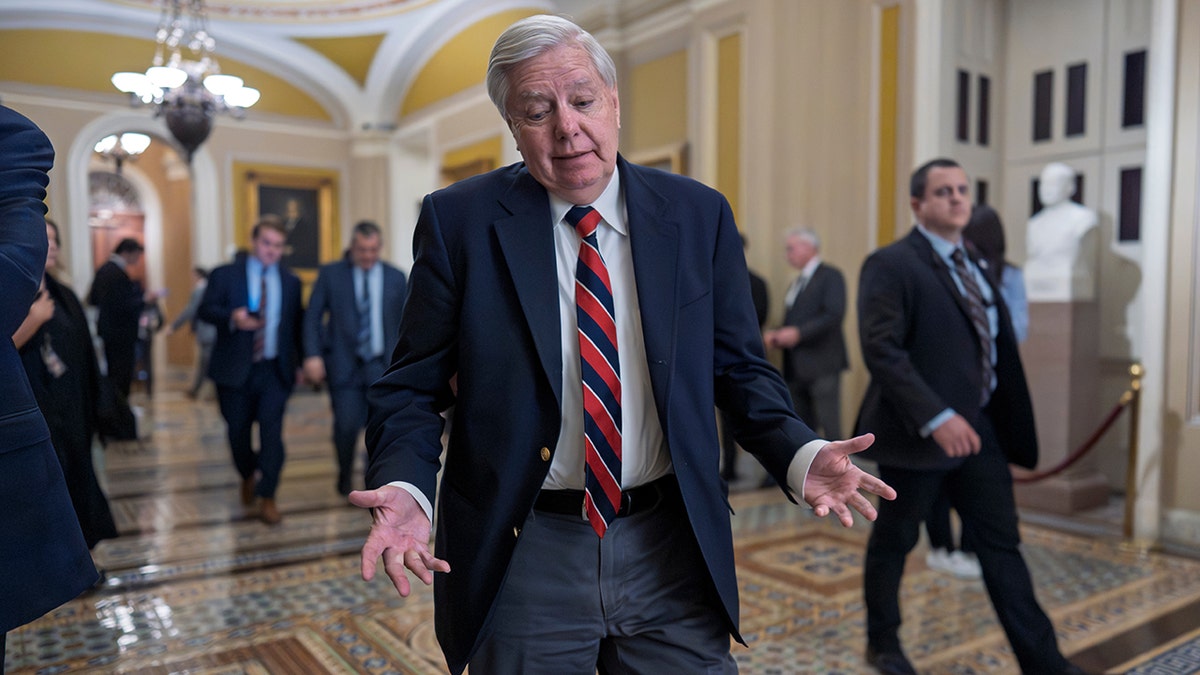
Lindsey Graham walking through a hallway toward the chamber.

Sen. Lindsey Graham, R-S.C., walks to the Senate chamber for votes after meeting behind closed doors with fellow Republicans on the Homeland Security budget stalemate, at the Capitol in Washington, March 26, 2026. (J. Scott Applewhite/AP Photo)

“We want to do it quick — ICE, Border Patrol — fund it as much as you can, multi-year,” Graham said. “Then there’s another one coming. I just made news. There’s another one coming in the fall, and that’s going to be about going after fraud.”

House Republicans spent their recent policy retreat earlier this year pushing a so-called “reconciliation 2.0,” gearing up to load the package with several provisions that could drain time and struggle to earn support in the Senate — where strict guidelines could kill proposals entirely if they don’t comply with the rules.

The Republican Study Committee (RSC), which has long called for a second reconciliation bill, also wants to add proposals addressing affordability concerns.

“We support pursuing funding for military readiness and Homeland Security through this legislative process, while simultaneously codifying the president’s agenda to deliver lower costs for working families,” the RSC Steering Committee said in a statement to Fox News Digital.

Some Republicans are also pushing to include the latest policy fight: the Safeguarding American Voter Eligibility (SAVE) Act. The voter ID and citizenship verification legislation has no chance of passing the Senate given unified Democratic opposition.

CLICK HERE TO DOWNLOAD THE FOX NEWS APP

It’s also unlikely to survive the Senate’s reconciliation rules, which allow only provisions that directly impact spending.

“I think we have to set our sights a little bit lower on this reconciliation bill,” Sen. Roger Marshall, R-Kan., told Fox News Digital. “It’s got to be targeted to fund ICE for 10 years — I think that’s the number one thing for us. If we can nibble at the edges of the SAVE Act, that would be great, but the parliamentarian is not going to let us do the SAVE Act. That’s just an impossibility.”

Some of the loudest proponents of the bill in the House GOP acknowledge that adding the SAVE Act to reconciliation would be a challenge — largely because they would prefer to keep the bill intact and push it through the Senate.

“Look, it’s time for them to do a walk-and-talk and filibuster, and let’s make this thing happen,” Rep. Ralph Norman, R-S.C., said. “The American people are watching — piecing it together just to try to get a piece.”


A de facto pro forma: Why Washington fixated these sessions as the DHS shutdown dragged on through recess


NEWYou can now listen to Fox News articles!

Carpe diem. If you’ve wondered why all of Washington buzzed so much this week about “pro forma” sessions in the House and Senate, here’s your chance to find out why.

Come on now. Tempus fugit. There’s no time like the present. Hopefully, when you finish reading this, you can declare veni, vidi, vici when it comes to your understanding of pro forma sessions in the House and Senate.

Let’s start with what pro forma means and why it holds application in Congress.

SEN. MIKE LEE URGES TRUMP TO INVOKE RARE CONSTITUTIONAL POWER TO FORCE CONGRESS BACK FROM SPRING RECESS

In Latin, “pro forma” refers to “a matter of form.” In other words, something appears real, but it’s just perfunctory. For decades, the House and Senate have used the parliamentary artifice of a “pro forma” session to adhere to the Constitutional requirement of meeting every three days.

Article I, Section 5 of the Constitution states that “Neither House, during the Session of Congress, shall, without the Consent of the other, adjourn for more than three days, nor to any other Place than that in which the two Houses shall be sitting.” That means the House and Senate must convene at three-day intervals — unless both bodies approved the same “adjournment resolution” to allow one another to depart Washington for an extended period of time. In other words, the House and Senate must vote and agree to be out at the same time. And if there’s no consensus on an adjournment resolution, the House and Senate technically must “meet” every three days.

The House and Senate often fail to sync up on an adjournment resolution because the party opposite the President wants to block him from using his power to install cabinet officials or other figures via a “recess appointment” — thus circumnavigating the Senate confirmation process. That makes it challenging to approve an adjournment resolution. But that’s another matter.

A de facto pro forma: Why Washington fixated these sessions as the DHS shutdown dragged on through recess

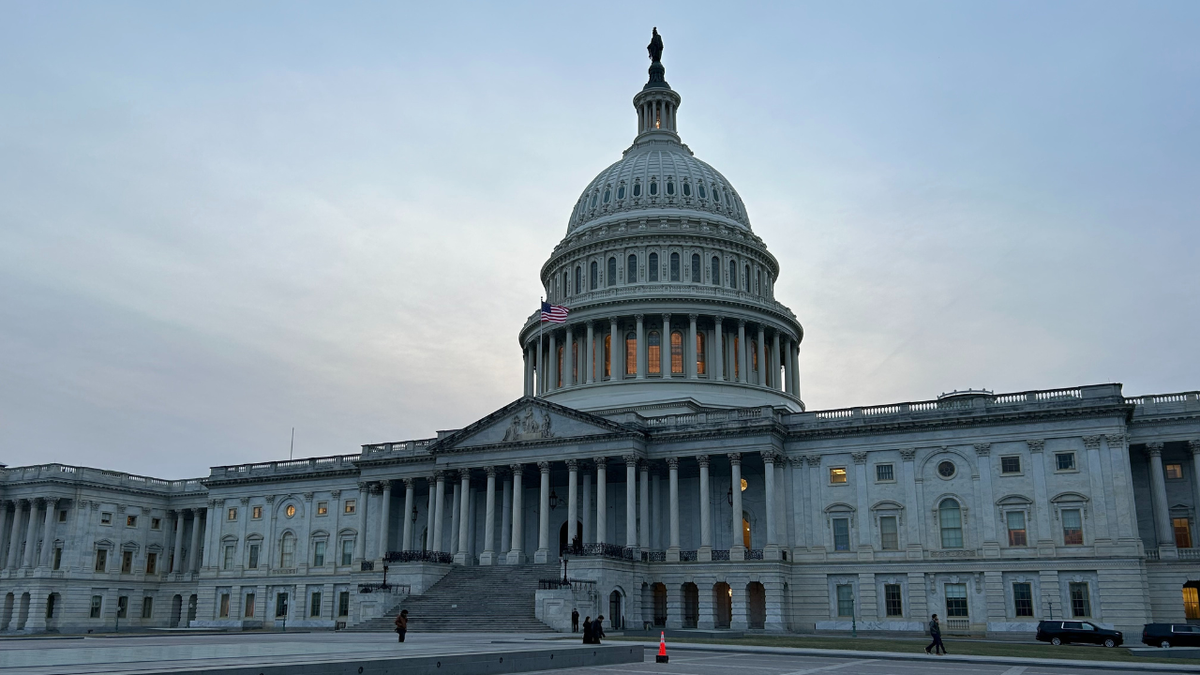
Sunrise light hits the U.S. Capitol dome on Thursday, January 2, 2025. (Bill Clark/CQ-Roll Call, Inc via Getty Images)

Back to pro forma sessions.

Sans an adjournment resolution, the House and Senate simply gavel in and gavel out every three days. There is (usually) no legislative business. These are pro forma sessions. The House and Senate meet “in form.” But don’t accomplish anything. There’s often only one lawmaker on hand — the person who presides. House pro forma sessions usually run two or three minutes. Senate sessions are even more abbreviated — usually lasting 25 to 35 seconds.

What constitutes a Congressional meeting? Just those few seconds of session time suffices.

Some years ago, senators actually held an informal competition, racing through pro formas in an attempt to see who could conduct the meeting the fastest. The quickest pro forma session clocked in at a blistering 21 seconds.

Here’s the parliamentary posture of the House and Senate last week:

The Senate adjourned for the day in the wee hours on Friday, March 28. The House followed suit just before midnight the same night. Without an adjournment resolution, both would meet the next Tuesday. Therefore, if the House or Senate wouldn’t have to meet again until Tuesday.

GOP RAILS AGAINST ‘S— SANDWICH’ DEAL AS ALL EYES TURN TO HOUSE TO END DHS SHUTDOWN

There’s nothing written prohibiting the House or Senate from conducting legislative business during a pro forma session. In other words, either body just has to conduct some legislative business to convert a pro forma session into a de facto session. So that’s why it was though that the Senate’s pro forma session on Tuesday was ripe for activity as the DHS shutdown continued.

Some House Republicans demanded that the Senate align with what the House passed Friday night: a bill which funded all of the Department of Homeland Security for two months.

The Senate gaveled to order on Tuesday morning around 10:33 am et (a couple of moments late). Sen. John Hoeven, R-N.D., presided. But after 31 seconds, Hoeven adjourned the Senate without any business. Hoeven himself — or any senator — could have tried to pass the House bill with the skeleton crew on hand. Sen. Chris Coons, D-D.E., was the only other senator in the chamber. Coons or anyone else could have sought recognition to speak. But none of that happened.

Split image of John Thune, Chuck Schumer and Mike Johnson

Amid the ongoing Department of Homeland Security shutdown, Senate Minority Leader Chuck Schumer, D-N.Y., has not had his immigration reform demands met while Senate Majority Leader John Thune, R-S.D., and House Speaker Mike Johnson, R-La., passed rival DHS funding proposals. (Photo by Alex Wong/Getty Images; Aaron Schwartz/Bloomberg via Getty Images; Photo by Chip Somodevilla/Getty Images)

And then the Senate adjourned, only to meet again Thursday morning (note the three-day interlude) at 7 a.m. for another pro forma session.

Pro forma sessions are customarily one of the most dull exercises in Congress. A skeleton crew of floor staff are there. Those asked to preside over the sessions are lawmakers who need to be in Washington for some reason over a recess or those who don’t go home often. Depending on which party has the majority, lawmakers from Maryland, Virginia or West Virginia frequently preside — simply because they are nearby. A limited number of reporters surface. They’re all thirsty for a quote or soundbite — simply because so few other lawmakers are available thanks to the recess. The whole enterprise starts and wraps up within minutes and everyone goes back home.

But that was not the case with last Tuesday’s Senate session. Everyone wanted to see if Republicans might try to approve the House-passed DHS bill. Or for that matter, if the House may attempt to align with the Senate and pass its bill. Neither happened. Even though a flood of reporters descended on the Capitol.

BEHIND THE SCENES OF CONGRESS’ ELEVENTH-HOUR RUSH TO FUND THE DHS

But the drama was higher this past Thursday morning. On Wednesday, House Speaker Mike Johnson, R-La., dramatically reversed himself and consented to the Senate-passed bill to fund all the Department of Homeland Security through Oct. 1 — except the Border Patrol and ICE. Johnson and Senate Majority Leader John Thune, R-S.D., published a joint statement endorsing the Senate’s strategy. And so around dawn on Thursday, Thune himself showed up to pass the Senate package again.

The presence of the Majority or Minority Leader on the floor during a pro forma session is nearly unprecedented. It’s a magna momemti when it comes to a pro forma meeting.

TSA agent monitors passengers at LaGuardia Airport.

A Transportation Security Administration agent watches as passengers queue for security screening at LaGuardia Airport in New York City on March 22. (Charly Triballeau/AFP via Getty Images)

This was not an ordinary pro forma. And even though nothing happened on Tuesday, neither of those sessions were far from the customary pro formas Congress usually sees during a recess.

It was presumed that the House would align in its pro forma session later Thursday morning. But consternation gripped the House Republican Conference. How was Johnson suddenly endorsing the Senate deal which he just characterized as a “joke” a few days earlier? That’s to say nothing of Johnson twisting himself in multiple knots and aggravating all wings of the GOP Conference.

So the House took no action. Which is why DHS remains shut down since the House and Senate have magnified the scope and potential for all four pro forma sessions held in recent days.

CLICK HERE TO DOWNLOAD THE FOX NEWS APP

It turns out that all of these high-profile pro forma sessions were just bona fide pro forma sessions.

Nil actum est. Congress didn’t accomplish anything. Again.


Behind the scenes of Congress’ eleventh-hour rush to fund the DHS


NEWYou can now listen to Fox News articles!

What would you say if one body of Congress didn’t take a formal roll call vote on a major piece of legislation – yet passed it at 2:19 on a Friday morning?

Would you try to outdo your colleagues across the Capitol Rotunda with some Congressional chicanery of your own? Perhaps by passing an equally important version of the same bill – while officially sidestepping a direct up/down vote on the measure – at 11:28 p.m. on that same Friday night.

That’s what happened late last week. The Senate scored approval from all 100 senators to pass a bill to fund most of the Department of Homeland Security for the rest of the fiscal year – but did it on a voice vote at 2:19 a.m. Friday with only five senators in the chamber.

House Republicans scoffed at this. So they passed their own bill – to fund all of DHS – just before the witching hour Friday. But technically, the House didn’t even vote directly on the legislation itself. The House voted to approve a “rule” (which manages debate for bills). With adoption of that rule, the House “deemed” the underlying DHS funding measure as passed.

GOP LEADERS ENDORSE TRUMP’S SHUTDOWN-PROOF MOVE TO END DHS FUNDING LAPSE

Behind the scenes of Congress’ eleventh-hour rush to fund the DHS

The Senate managed to net the approval of 100 senators to pass a bill to fund most of the Department of Homeland Security for the remainder of the fiscal year – but did it on a voice vote at 2:19 am Friday with only five senators in the chamber. (Emma Woodhead/Fox News Digital)

But despite all of this, the House and Senate weren’t aligned. They hadn’t approved the same bill. And despite the parliamentary antics, House Republicans then implored the Senate to pass the measure it approved Friday night on Monday morning – without a roll call vote and with just two senators in the chamber.

If you followed all of that, that is exactly what’s unfolded on Capitol Hill the past few days as lawmakers struggled to end the six-week Department of Homeland Security shutdown.

It was clear early Thursday evening that there wasn’t a path in the Sente to approve a partisan GOP bill to fund DHS after a lengthy roll call vote which started in the afternoon.

But something was afoot.

TRUMP ADMINISTRATION MAKES MAJOR MOVE TO RELIEVE ‘UNFAIR BURDEN’ ON DHS WORKERS AS SHUTDOWN DRAGS ON

Congress was staring at a 15-day recess for Easter and Passover on Friday. Failure to address the crisis now meant that lawmakers would leave town until the middle of April – extending the shutdown until then as airport lines swelled.

So Senate Majority Leader John Thune, R-S.D., got to work on something which could pass the Senate – and potentially pass the House – before everyone abandoned Washington for the break.

Thune suggested earlier in the week that the Senate usually has to get “to Thursday” before frozen positions may begin to thaw. He was right. There was a corridor for the Senate to approve a bipartisan bill to tackle most of the funding crisis at DHS. So Thune’s charge late Thursday night and into the wee hours of Friday morning was not necessarily to persuade bipartisan senators to support the bill he was putting on the floor. But instead, Thune’s goal was to coax skeptical senators not to object and blow the whole thing up.

Sen. John Thune

Senate Majority Leader John Thune, R-S.D., hatched a plan for something that could pass the Senate before Washington was abandoned for the Easter Recess. (Nathan Posner/Anadolu via Getty Images)

There’s something called a “hotline” in the Senate. Any time the leadership wants to set up a series of votes, make particular amendments in order and perhaps allocate wedges of time to debate, it sends around a “hotline” to all 100 senators. If any senator objects, they let the leadership know. This streamlines the process ahead of time. It also ensures that senators aren’t blindsided by something called a “unanimous consent” request. Unanimous consent requests, or “UC’s,” happen all the time in the Senate.

One of the most powerful tools in the Senate is “unanimous consent.” If you obtain the “unanimous consent” of all 100 senators, you can make the sun rise in the west. But all it takes is one objection to block a UC – even if all other 99 senators agree.

The behind the scenes hotline takes care of this in advance. Any senator could object and block Thune’s proposal to fund most of DHS. But there shouldn’t be any problem if he cleared it with all 100 senators offstage in advance.

That’s why Thune went to the floor at 2:19 a.m. Friday. Not a single senator flagged his proposal. And so the South Dakota Republican went to the floor with a team of five senators – and passed the bill. Not by UC. But by something called a “voice vote. Those in favor shout yea. Those who oppose holler nay. The louder side wins. The Senate passed the bill. There was no roll call vote.

HOUSE GOP RAMS THROUGH NEW DHS FUNDING PLAN WITH SHUTDOWN FAR FROM OVER

So, this wasn’t something snuck by in the dead of night on the sly. If any senator had a reservation, they could have flagged it. Or better yet, come down to the floor at 2:19 a.m. and contested it. In short, there were 100 senators, 100 chiefs of staff, 100 legislative directors and 100 counsels who should have known about Thune’s plan. That’s a universe of at least 400 people – if not more. So, this wasn’t an episode of someone pulling a fast one.

By morning, Sen. Rick Scott, R-Fla., said he “opposed this bill.” Same with Sen. Mike Lee, R-Utah.

Well, that’s fine. But no one objected nor pushed back on the hotline. No one went down to the floor to demand a roll call vote – or even argued that the Senate couldn’t do anything because there wasn’t a quorum present to conduct business. So anything said by Republican senators upset about the bill were simply academic or rhetorical objections. If those senators truly opposed the bill, they missed their opportunity to do something about it.

Hakeem Jeffries

Minority Leader Hakeem Jeffries, D-N.Y., even signaled support for the bill. (Roberto Schmidt/Getty Images)

It was thought that the House might take up the bill – reluctantly – the next day to end most of the shutdown and pay TSA workers. House Minority Leader Hakeem Jeffries, D-N.Y., signaled support. So did Rep. Rosa DeLauro, D-Conn., the top Democrat on the Appropriations Committee. Granted, liberal Democrats might oppose the bill because there weren’t changes at ICE. But the bill probably would have passed with some Republicans and lots of Democrats. In fact, there may have been more Democratic yeas than Republican yeas. That would have been toxic for House Speaker Mike Johnson, R-La. Former House Speaker Kevin McCarthy, R-Calif., lost his gavel over moving a bipartisan bill to avoid a shutdown in the fall of 2023.

So by Friday afternoon, Johnson strenuously lodged his opposition to the Senate bill.

“Republicans are not going to be any part of any effort to reopen our borders or to stop immigration enforcement,” said Johnson, noting that the Senate plan left out funding for ICE and the Border Patrol. “This gambit that was done last night is a joke. I’m quite convinced that it can’t be that every Senate Republican read the language of this bill.”

In other words, were they not dialed in on the hotline?

THE HITCHHIKER’S GUIDE TO WHAT TO EXPECT ON DHS FUNDING WHEN THE SENATE MEETS MONDAY

Yours truly questioned the Speaker, asking why he and Thune weren’t on the same page. Johnson accused Senate Minority Leader Chuck Schumer, D-N.Y. of being behind the bill. I pointed out that Thune “was the engineer behind this.”

“I wouldn’t call John Thune the engineer of this,” said Johnson.

“He didn’t have the accept it,” I countered.

“Let me answer the question, Chad,” sighed an exasperated Johnson.

So the House forged ahead and passed its own bill to fully fund DHS Friday night. Some House Republicans then expected the Senate to break custom and pass its bill – by unanimous consent – during a brief pro forma session Monday. In other words, House Republicans ripped the Senate for what it did early Friday morning. But those same House Republicans wanted senators to approve THEIR bill on Monday the same way they criticized the Senate for passing its bill on Friday.

Note that there was no hotline for the House bill at that point.

“We’d love to see them do that,” said Rep. Mike Haridopolos, R-Fla., on Friday.

U.S. House Speaker Mike Johnson

Speaker of the House Mike Johnson, R-La., said he “wouldn’t call John Thune the engineer” behind the bill. (Kevin Dietsch/Getty Images)

But Democrats dispatched a watchdog to guard the floor against any possible GOP chicanery as the Senate met for 31 seconds with meager attendance.

The Senate gaveled in. The Senate gaveled out. Nothing happened.

“I was there to object,” said Sen. Chris Coons, D-Del. “I was here just in case there were some shenanigans.”

Rep. Randy Fine, R-Fla., called it “insane” that Senate Republicans “didn’t even try” to pass the House bill. But the lone Senate Republican on duty said the presence of Coons doomed that to failure.

“We don’t have consent yet,” said Sen. John Hoeven, R-N.D., who presided over the session. “They declined. Obviously Sen. Coons was there to do that.”

CLICK HERE TO DOWNLOAD THE FOX NEWS APP

But by Wednesday, the bill which Johnson trashed Friday afternoon was on its way to passage. Despite a sea of opposition from conservative Republicans, the House would accept the Senate bill and end most of the DHS shutdown. The Earth shifted. President Trump was fine with this. Suddenly, Johnson and Thune were on the same page.

So the Republican House would eat what the Senate originally cooked up early Friday morning. And the House would likely approve it with lots of Republicans spread around the country. But like Senate Republicans early Friday morning, no one would likely return to block it.

And by now, this wasn’t something engineered in the dead of night that only 400 people knew about. The entire country was more than aware what happened.


The Hitchhiker’s Guide to what to expect on DHS funding when the Senate meets Monday


NEWYou can now listen to Fox News articles!

The DHS funding drama heads back to the Senate on Monday morning after the House approved a two-month stopgap spending plan for all of DHS late Friday night.

The Senate meets on Monday at 10:30 am et in what was supposed to be a brief “pro forma” session where the body simply gavels in and gavels out with a skeleton crew on hand.

But that might not be what happens Monday. As soon as the Senate gets through the prayer and pledge, it’s likely a Republican senator seeks recognition from the chair.

If that happens, we anticipate the GOP senator to ask for unanimous consent (meaning all 100 senators would agree) to take up the DHS bill passed by the House on Friday, that it be “read a third time” and passed.

REPORTER’S NOTEBOOK: THE HITCHHIKER’S GUIDE TO WHAT’S NEXT TO END THE DHS SHUTDOWN

The Hitchhiker’s Guide to what to expect on DHS funding when the Senate meets Monday

The Department of Homeland Security funding debacle heads back to the Senate on Monday morning. (Photo by Heather Diehl/Getty Images)

The chair will then ask if there is an objection.

If any senator – be they a Democrat or Republican – objects, the House bill is dead. That means that the House and Senate continue to be out of alignment on the DHS funding question. For instance, the House didn’t even consider the bill cleared by all 100 senators and passed by the Senate at 2:19 am Friday. The House simply wrote their own two-month interim bill, passed it Friday night and skipped town.

If there is no objection, the House and Senate are aligned and will have passed the same bill. That means they are on the same page.

Three different scenes of long TSA lines are shown side by side.

Approval of the House bill by the Senate would end the ongoing DHS shutdown. (WVUE)

Approval of the House bill by the Senate would end the DHS shutdown.

But if there’s an objection, everything remains frozen.

This is both the parliamentary magic – and dark underbelly of “unanimous consent” in the Senate. You could have 99 senators in favor of something. But all it takes is a solitary objection to foil a bill under “unanimous consent” or “UC” as it’s often called in the Senate.

In fact, it’s possible that Democrats could then offer their own DHS funding bill and ask the Senate to approve that by unanimous consent. It’s likely that whatever Republican senator is on duty tomorrow would object, thus blocking the Democratic request.

If the Senate blocks the House bill, it’s doubtful there’s any way to end the DHS shutdown until after both bodies return in mid-April after the Easter/Passover recess.

DHS SHUTDOWN BREAKTHROUGH COMES AT COST FOR REPUBLICANS AS FUNDING FIGHTS NEARS END

homeland security logo

Republicans genuinely want to fund the DHS – but a Democratic objection presents them with an opportunity for political finger-pointing. (Andrew Harrer/Bloomberg via Getty Images)

Republicans truly want to fund DHS. But a Democratic objection presents the GOP with a political opportunity. They can then point to that objection as the reason DHS remains shuttered, arguing that Democrats blocked the House-approved bill.

Republicans believe this helps them in the midterms. They ran on border security and won in 2024. Republicans want to point to a Democratic objection as evidence that they don’t want to fund ICE.

CLICK HERE TO DOWNLOAD THE FOX NEWS APP

But by the same token, Democrats could argue that Republicans are partly responsible for the shutdown and the long TSA lines if they object to the Democratic unanimous consent request.

And so it goes.


Dem senators dodge crucial question on illegal alien accused of killing Chicago college student


NEWYou can now listen to Fox News articles!

While Republican senators, like Texas’ Ted Cruz and Florida’s Rick Scott, were quick to condemn the policies that kept the illegal immigrant killer of 18-year-old Sheridan Gorman from being deported, Democratic senators dodged questions on whether Gorman’s killer should have previously been deported prior to this month’s murder.

Gorman, who was a student at Loyola University of Chicago at the time of her death, was allegedly killed by an illegal immigrant from Venezuela, Jose Medina, 25. Medina was apprehended by U.S. Border Patrol on May 9, 2023, but was subsequently released into the U.S. under the Biden administration, according to Trump’s Department of Homeland Security. 

A short time later, Medina was arrested for shoplifting in Chicago, but was again released on June 19, 2023, DHS said. A judge put a warrant out on Medina after he failed to appear in court for his shoplifting charge, which was still active at the time of Gorman’s killing, according to the Chicago Sun Times. 

“Shoplifting in and of itself is not a violent crime. It’s not an indicator of a person that’s leaning toward violent crime,” said Sen. Dick Durbin, D-Ill., when asked about Medina’s case and whether he should’ve been deported prior to Gorman’s murder. 

ILLEGAL IMMIGRANT ACCUSED OF KILLING CHICAGO COLLEGE STUDENT TO FACE COURT AFTER TUBERCULOSIS DELAY

Dem senators dodge crucial question on illegal alien accused of killing Chicago college student

Sheridan Gorman (L) was allegedly murdered by Jose Medina (R) (Sheridan Gorman/Instagram and Cook County Sheriff’s Office)

“You’re asking me to speculate on a bunch of things and I can’t answer that,” said Sen. Catherine Cortez-Masto, D-Nev., when asked if Gorman’s killer, and other illegal immigrant murderers who had significant criminal records at the time of their arrests, should have been deported before people got hurt. “I don’t know the cases. I trust our justice system to do the right thing and hold people accountable.”

Sen. Tammy Duckworth, D-Ill., responded that the Trump administration’s broad deportation crackdowns have prevented federal law enforcement from targeting genuinely dangerous people, an argument pushed by other top Democrats in Congress. “I think that if Trump cleared out Chicago and if ICE did their job, he wouldn’t be here, right?” Duckworth said as she got onto an elevator on Capitol Hill. “But they deported people who are not… [unintelligible].”

Meanwhile, Sen. Elissa Slotkin, D-Mich., offered a more judicious response, but also suggested the style by which the Trump administration is deporting people is problematic. 

“Do I think violent criminals should be deported? Yes,” Slotkin said, adding it is an “easy” call to deport someone who has been “accused and properly prosecuted.” But, Slotkin added, “Innocent civilians who are protesting their government and using their freedom of speech should not be fingered and booted out.” 

Democrats who spoke with Fox News Digital did quickly agree that violent criminals who entered and are residing in the country unlawfully should be deported.

U.S. Senators on Capitol Hill from the Democratic Party

From left to right: Sen. Elissa Slotkin, D-Mich., Sen. Dick Durbin, D-Ill., Sen. Tammy Duckworth, D-Ill., and Sen. Catherine Cortez Masto, D-Nev. (Getty Images)

SHERIDAN GORMAN’S UNIVERSITY NEWSPAPER TOUTS ICE TRACKER AFTER FRESHMAN ALLEGEDLY MURDERED BY ILLEGAL ALIEN

“Anybody who violates, or creates crime in this country – particularly kills somebody – should not only be held accountable in the United States, but, yes, there should be immigration enforcement against that individual,” Cortez-Masto said. 

“Every community deserves to feel safe, and I think people who commit violent crimes should not be allowed to either be in our country, or to be among our communities,” added Sen. Angela Alsobrooks, D-Md. 

Durbin, meanwhile, qualified his comments about Medina’s shoplifting charge by admitting “We ought to do a careful examination of people coming into this country and those who want to stay in this country,” adding that, “If they are dangerous to the community, they need to be denied entry or taken out of the country later.”

But Republican Senators Cruz and Scott were quick to bash Democrats for allegedly caring more about illegal immigrants than American citizens.

Ted Cruz

Sen. Ted Cruz (R-TX) holds a press conference with families who lost loved ones in the January 29, 2025 DCA plane crash on December 15, 2025 at the U.S. Capitol in Washington, DC. (Heather Diehl/Getty Images)

CLICK HERE TO DOWNLOAD THE FOX NEWS APP 

“It’s tragic and it was avoidable,” Cruz said when approached about Gorman’s death and Medina not being deported. “The Democrats are so radical they prioritize illegal immigrants over American citizens.”

“It’s disgusting that these people say, ‘Oh, they act like they care about Americans.’ But then you look at their actions – they care about people who are here violently hurting Americans,” Scott complained.


DHS shutdown breakthrough comes at cost for Republicans as funding fights nears end


NEWYou can now listen to Fox News articles!

Congress is one step closer to ending the Homeland Security shutdown after the Senate advanced a new, last-minute deal, but it came at the price of Republicans ceding ground, temporarily, to Senate Minority Leader Chuck Schumer, D-N.Y.

The Senate unanimously advanced a deal to reopen most of the Department of Homeland Security (DHS) in the wee hours of Friday morning, 42 days into the shutdown that was spurred by the Trump administration’s immigration operations in Minnesota.

It was an agreement that largely gave Schumer and Senate Democrats what they wanted — no funding for Immigration and Customs Enforcement (ICE) and parts of Customs and Border Protection (CBP). But it lacked the stringent reforms they desired, like requiring judicial warrants or requiring agents to unmask.

SCHUMER, DEMS BLOCK DHS FUNDING AGAIN, TRUMP INTERVENES TO PAY TSA AGENTS

DHS shutdown breakthrough comes at cost for Republicans as funding fights nears end

Senate Majority Leader John Thune, R-S.D., said that Republicans had made what was likely their “final” offer to Democrats to reopen DHS.  (Stefani Reynolds/Bloomberg via Getty Images)

While the deal mirrors previous attempts by Democrats to pass similar legislation that carved out immigration funding, Thune argued that Democrats are still walking away empty-handed in the policy fight over immigration enforcement. 

“We’ve been trying for weeks to fund the whole thing,” Thune said. “And, I mean, in the end, this is what they were willing to agree to. But again, it’s different that it has zero reforms in it. I mean, they got no reforms on DHS, which they could have had if they had been willing to work with us a little bit on that.”

Schumer said that if Republicans hadn’t blocked their initial attempts, “this could have been done three weeks ago.”

“This is exactly what we wanted,” Schumer said. “This is what we asked for, and I’m very proud of my caucus. My caucus held the line.”

The DHS funding deal now heads to the House, where Republicans aren’t enthusiastic about not funding key components of President Donald Trump’s immigration crackdown agenda.

The latest plan came after Senate Democrats blocked a seventh attempt to reopen DHS, after back-and-forth talks throughout the day on Thursday appeared to yield little progress toward a resolution. Trump also announced his intent to sign an order that would pay Transportation Security Administration (TSA) agents as major airports are rocked with staggering lines and eye-popping wait times amid the shutdown. 

DEMS BLOCK DHS FUNDING AFTER GOP REJECTS THEIR COUNTER, THUNE SAYS SCHUMER ‘GOING IN CIRCLES’

Senate Minority Leader Chuck Schumer, D-N.Y.

Senate Minority Leader Chuck Schumer, D-N.Y., and Democrats rejected Republicans latest deal to reopen DHS, and have promised a counteroffer with reforms in return.  (Alex Wong/Getty Images)

While a further concession to Democrats, in part, the underlying argument Republicans have made all along is that if Schumer and his caucus wanted reforms, they would have to agree to fund immigration enforcement.

And ICE and CBP are still flush with roughly $75 billion in cash from Trump’s “big, beautiful bill,” giving the agencies a buffer for a time.

“The good news is we anticipated this a year ago. I mean, one of the reasons we front loaded, pre-loaded up the ‘one big, beautiful bill’ with advanced funding for Homeland Security was because we anticipated this was likely going to happen, and it did,” Thune said. “I still think it’s unfortunate. The Dems wanted reforms. We tried to work with them on reforms. They ended up getting no reforms.”

The same process used to pass that colossal legislative package will likely be turned to again fund immigration enforcement.

DHS DEAL IN LIMBO AS DEMOCRATS DEMAND TOUGHER ICE CRACKDOWN DESPITE GOP COMPROMISE

U.S. Immigration and Customs Enforcement officer's uniform

A U.S. Immigration and Customs Enforcement officer’s badge and gear.  (Michael Siluk/UCG/Universal Images Group via Getty Images)

Sen. Eric Schmitt, R-Mo., envisions funding ICE and CBP for several years.

“Democrats are trying to shut down ICE funding for the remainder of the fiscal year — ultimately they won’t be successful,” Schmitt said on X. “In response, I’ll be pushing to lock in funding for deportation operations and salaries for a decade.”

Doing so could be difficult, still, given that Republicans want to dump several other priorities into the mix, including portions of the Safeguarding American Voter Eligibility (SAVE) America Act and funding for the Iran war.

CLICK HERE TO DOWNLOAD THE FOX NEWS APP

And some Republicans are already couching expectations on what can and can’t be accomplished in the party-line process, given that anything in the bill has to pass muster with strict rules in the Senate.

“I think we have to set our sights a little bit lower on this reconciliation bill,” Sen. Roger Marshall, R-Kan., told Fox News Digital. “It’s got to be targeted to fund ICE for 10 years, I think that’s the number one thing to us.”


Schumer, Dems block DHS funding again as Trump intervenes to pay TSA agents


NEWYou can now listen to Fox News articles!

The Senate was again unable to end the Homeland Security shutdown on Thursday despite signs of a possible breakthrough to end the long-running closure, which prompted President Donald Trump to make a move. 

Senate Democrats blocked Department of Homeland Security (DHS) funding for a seventh time as the partial shutdown entered its 41st day on Thursday after Senate Republicans made a new offer earlier in the day after late-night negotiations. 

Trump then ordered DHS to pay airport workers and accused “their ‘Leader,’ Cryin’ Chuck Schumer,” of making it clear where Democrats stand, “and that is, ON THE SIDE OF CRIMINAL ILLEGAL ALIENS, AND NOT THE AMERICAN PEOPLE.”

DEMS BLOCK DHS FUNDING AFTER GOP REJECTS THEIR COUNTER, THUNE SAYS SCHUMER ‘GOING IN CIRCLES’

“I am going to sign an Order instructing the Secretary of Homeland Security, Markwayne Mullin, to immediately pay our TSA Agents in order to address this Emergency Situation, and to quickly stop the Democrat Chaos at the Airports,” Trump said on Truth Social. “It is not an easy thing to do, but I am going to do it!”

Still, several other components of the agency, including the Federal Emergency Management Agency, are still without funding. 

Schumer, Dems block DHS funding again as Trump intervenes to pay TSA agents

President Donald Trump walks to speak to reporters before boarding Air Force One at Palm Beach International Airport in West Palm Beach, Fla., March 23, 2026. (Saul Loeb/AFP via Getty Images)

The vote stayed open for several hours to allow for talks between both sides to continue, but, by the fifth hour, Trump pulled the trigger on funding the Transportation Security Administration (TSA). 

“We’ve held the vote open for five hours to give the Democrats an opportunity to come to the table,” Senate Majority Whip John Barrasso, R-Wyo., told reporters. “They have not. And now, time is up.”

Earlier in the day, Senate Majority Leader John Thune, R-S.D., said he believed talks between the sides were making progress.

And despite Thune saying just a day earlier that there was “no point” in sending Senate Minority Leader Chuck Schumer, D-N.Y., and Democrats another compromise proposal, Republicans did just that.

“Dems are in possession of what I think is our last and final [offer],” Thune said. “So, let’s hope this gets it done.”

Thune remained mum on the details of the offer. When asked if the White House backed it, he said, “They’ve been involved in the back-and-forth that has occurred overnight and all morning, so we’ll see.”

DHS DEAL IN LIMBO AS DEMOCRATS DEMAND TOUGHER ICE CRACKDOWN DESPITE GOP COMPROMISE

Senate Minority Leader Chuck Schumer, D-N.Y.

Senate Minority Leader Chuck Schumer, D-N.Y., and Democrats rejected Republicans’ latest deal to reopen DHS. (Alex Wong/Getty Images)

Several Senate Democrats leaving their closed-door lunch meeting said they had yet to see or be briefed on the latest proposal and that the GOP’s new offer wasn’t discussed during the meeting.

A source familiar with negotiations told Fox News Digital, “Schumer needs to grow a pair of b—- and make a decision.” 

The quick shift in mood in the upper chamber, despite the latest failure, came after the prospect of a deal to end the second-longest shutdown in history appeared even further out of reach. 

Republicans had offered Democrats a framework that would carve out Immigration and Customs Enforcement (ICE) funding but lacked the reforms Schumer and his caucus want.

“I think our caucus remains united around the same premise: We’re not going to fund an immigration enforcement operation that doesn’t obey the law,” Sen. Chris Murphy, D-Conn., told Fox News Digital. 

“And I don’t think we’ve seen a proposal from them yet that meets that very simple priority.”

SENATE REPUBLICANS MOVE TO REOPEN DHS WITH NEW PLAN, WAIT FOR DEMOCRATIC BUY-IN

DHS shutdown breakthrough comes at cost for Republicans as funding fights nears end

Senate Majority Leader John Thune, R-S.D., said Republicans had made what was likely their “final” offer to Democrats to reopen DHS.  (Stefani Reynolds/Bloomberg via Getty Images)

The ICE carve-out is also a proposal Democrats have made before, one Republicans previously blocked. Given that, many Senate Republicans were frustrated that Democrats appeared to back away from an idea they once supported.

“They go on the floor, they shoot their mouths off and say we’ll fund everything but ICE,” Sen. Roger Marshall, R-Kan., told Fox News Digital. “We took them at their word. So, you know, they need to agree to ‘yes.’”

It has also forced Republicans to grapple with the idea of not funding immigration enforcement, which has been a sore subject throughout the week.

CLICK HERE TO DOWNLOAD THE FOX NEWS APP

Still, they are eyeing budget reconciliation — the same party-line tactic used to pass Trump’s “big, beautiful bill” last year — to fund immigration operations and several other priorities.

“I will not support legislation that doesn’t pay ICE agents. However, there’s a mechanism, by way of reconciliation, where we can front-load multiple years of that,” Sen. Eric Schmitt, R-Mo., told Fox News Digital. “The Democrats, I think, just handed us more certainty moving forward.”


Trump pressures GOP to scrap filibuster, says ‘desperate’ Schumer ‘will make a deal’


NEWYou can now listen to Fox News articles!

President Donald Trump pressured Senate Republicans to ditch the filibuster and claimed Senate Minority Leader Chuck Schumer, D-N.Y., will strike a deal due to concern about the prospect of the GOP scrapping the procedural hurdle. 

“Chuck Schumer, a desperate, crippled politician, who has lost control of the Radical Left Democrats, will make a deal now because he thinks that if he doesn’t, Republicans will TERMINATE THE FILIBUSTER, something which they should do whether he makes a deal or not!!!” the president asserted in a Thursday morning Truth Social post.

“TERMINATE THE FILIBUSTER!” he exclaimed in another post.

DEMS BLOCK DHS FUNDING AFTER GOP REJECTS THEIR COUNTER, THUNE SAYS SCHUMER ‘GOING IN CIRCLES’

Schumer, Dems block DHS funding again as Trump intervenes to pay TSA agents

President Donald Trump walks to speak to reporters before boarding Air Force One at Palm Beach International Airport in West Palm Beach, Fla., on March 23, 2026. (SAUL LOEB / AFP via Getty Images)

“When is ‘enough, enough’ for our Republican Senators. There comes a time when you must do what should have been done a long time ago, and something which the Lunatic Democrats will do on day one, if they ever get the chance. TERMINATE THE FILIBUSTER, and get our airports, and everything else, moving again. Also, add the complete, all five items, SAVE AMERICA ACT items. Go for the Gold!!!” he declared in another post on Thursday.

The president’s plea comes as a Department of Homeland Security funding lapse has dragged on for more than a month.

SCHUMER KNOCKS TRUMP ON IRAN, PLAN TO SEND ICE TO AIRPORTS: ‘ASKING FOR TROUBLE’

Senate Minority Leader Chuck Schumer

Senate Minority Leader Chuck Schumer, D-N.Y., returns to the U.S. Capitol Building on March 20, 2026, in Washington, D.C.  (Anna Moneymaker/Getty Images)
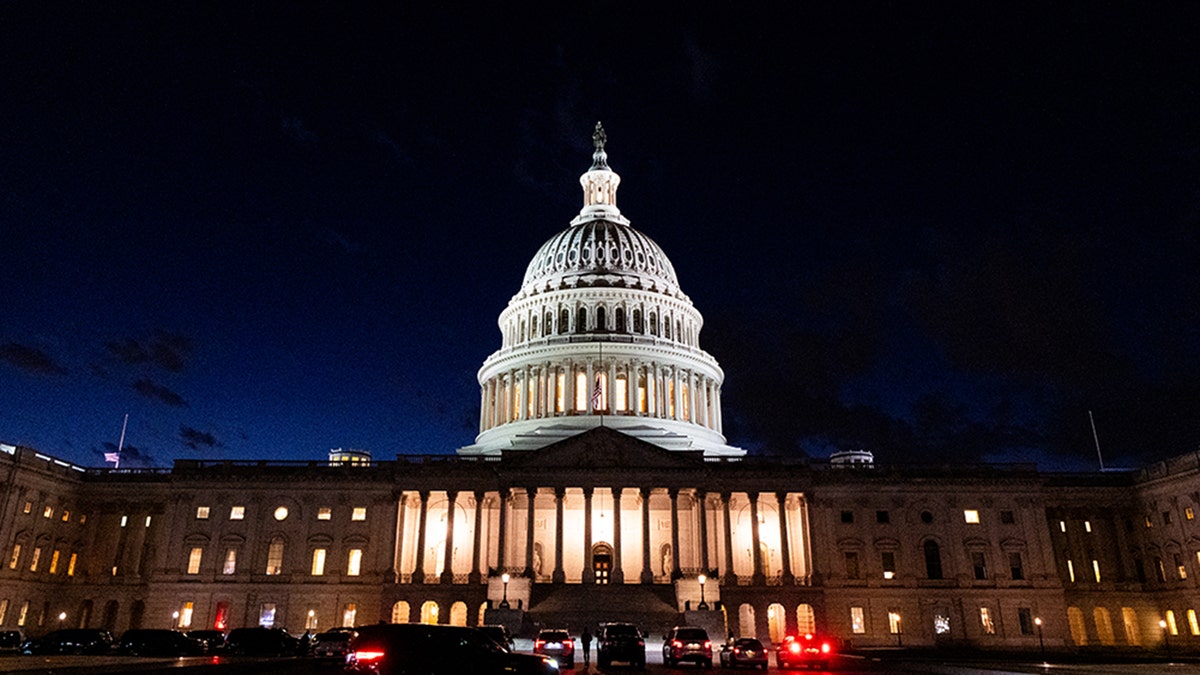
The political stalemate has snarled security lines at airports as Transportation Security Administration officers go unpaid, with some departing the workforce or calling out. 

If Republicans eliminated or weakened the filibuster, they could advance most legislation on their priorities with a simple majority, no longer needing Democratic votes to reach the 60-vote threshold required to end debate.

HOUSE CONSERVATIVES ERUPT OVER SENATE GOP, WHITE HOUSE DEAL AMID SAVE ACT FIGHT

U.S. Capitol building

The U.S. Capitol dome is illuminated as the House of Representatives returns to Washington to vote to reopen the government on Wednesday, Nov. 12, 2025.  (Bill Clark/CQ-Roll Call, Inc via Getty Images)

CLICK HERE TO DOWNLOAD THE FOX NEWS APP

Fox News Digital reached out Schumer’s office but did not immediately receive a response.


Dems vow to force weekly Iran war votes after GOP blocks latest move to curb Trump


NEWYou can now listen to Fox News articles!

Senate Republicans again didn’t budge against Senate Democrats’ bid to handcuff President Donald Trump’s war powers in Iran.

Senate Democrats again forced a vote on a war powers resolution to rein in Trump’s military authority in Iran, which Senate Republicans again blocked. It’s also been less than a week since Democrats triggered a war powers resolution in their bid to force the Trump administration to publicly explain the ongoing conflict.

The resolution, this time from Sen. Chris Murphy, D-Conn., was blocked on a largely party-line vote, save for Sen. Rand Paul, R-Ky., who joined all Senate Democrats to advance the measure.

It’s part of a flood-the-zone strategy Senate Democrats are taking to force Secretary of War Pete Hegseth and Secretary of State Marco Rubio to testify publicly before the Senate. Earlier this month, Murphy and a cohort of Senate Democrats unveiled their plan to force votes on five war powers resolutions.

DHS SHUTDOWN TIED FOR SECOND-LONGEST EVER AS DEMS AGAIN BLOCK FUNDING AMID AIRPORT CHAOS, TERRORISM CONCERNS

Dems vow to force weekly Iran war votes after GOP blocks latest move to curb Trump

US President Donald Trump walks on the South Lawn of the White House after arriving on Marine One in Washington, DC, US, on Wednesday, March 18, 2026. (Aaron Schwartz/Bloomberg via Getty Images)

“We’re not going to let the Senate be silent until they make at the very least that commitment,” Murphy said at the time. “I don’t think they can defend this war.”

Whether either Hegseth or Rubio is forced to testify before the Senate Armed Services and Senate Foreign Relations panels, respectively, remains in the air, given that neither committee chair has made the move to request the administration officials appear.

TOM COTTON PUTS BIDEN ON NOTICE WHILE DEMANDING ANSWERS ON DRAINING OF NATION’S OIL STOCKPILE

Sen. Chris Murphy, D-Conn.

Sen. Chris Murphy, D-Conn., wants the Trump administration to explain its war with Iran.  (Kevin Dietsch/Getty Images)

The latest attempt to cuff Trump’s war powers comes as his strategy in Iran dramatically shifted in a moment of whiplash from the weekend to Monday.

Over the weekend, Trump warned that unless Iran fully reopened the Strait of Hormuz, the U.S. would “hit and obliterate” the nation’s power plants. 

But then Trump shifted gears Monday and announced that the U.S. and Iran had been engaged in “very good and productive conversations regarding a complete and total resolution of our hostilities in the Middle East,” which the Iranian government denied. 

MULLIN CONFIRMED AS DHS CHIEF AS LAWMAKERS NEAR SOLUTION ON SHUTDOWN STANDOFF

Airplane targeted in strike

CENTCOM shared footage of strikes against airplanes amid Iran war (U.S. Central Command on X)

Meanwhile, Congress is still awaiting a supplemental funding package from the administration that could be to the tune of hundreds of billions of dollars. Some Republicans want to cram that funding, which could be as high as $200 billion, into another reconciliation package.

That vehicle could get busy fast, given that they are also eyeing reconciliation as a means to fund Immigration and Customs Enforcement (ICE) and to pass portions of the Safeguarding American Voter Eligibility (SAVE) America Act.

Sen. Tim Kaine, D-Va., who has led the charge on several war powers resolutions in the last several months, said that “the numbers that they’re talking about are pretty staggering in the sense of what they say about how this is going to go on.”

CLICK HERE TO DOWNLOAD THE FOX NEWS APP

And as far as letting up on war powers, Kaine said Democrats were ready to keep going round for round.

“But we’re going to keep forcing war powers resolution votes,” Kaine said. “Have you seen enough? Have you seen enough? Have you seen enough? … We’ll probably have at least one a week, and continue to ask our colleagues, ‘okay, have you seen enough yet?’”