Artemis II crew reflects emotionally on mission after safe return: ‘Bonded forever’
NEWYou can now listen to Fox News articles!
A day after splashing down in the Pacific Ocean off the San Diego coast following a historic 10-day mission around the moon, the Artemis II crew took the stage at Ellington Air Force Base in Houston, Texas, emotionally reflecting on their time in space and safe return.
“It’s a special thing to be human, and it’s a special thing to be on planet Earth,” commander Reid Wiseman said, adding that he and his three crew mates are now “bonded forever” before they all hugged.
“Welcome home Artemis II,” NASA Administrator Jared Isaacman said before introducing the crew members:
Weisman, pilot Victor Glover, mission specialist Christina Koch and mission specialist Jeremy Hansen.
“There is there is no doubt there is a price to pay when it comes to exploring the cosmos, but there is also a return, a return in the jobs that creates the technologies that improve life here on earth, and the inspiration that sparks and all those who choose to follow, and to people all around the world who look up and dream about what is possible. The long wait is over,” Isaacman said. “After a brief 53-year intermission, the show goes on and NASA is back in the business of sending astronauts to the moon and bringing them home safely.”
FORMER NASA ASTRONAUT SAYS ARTEMIS II MISSION WAS ‘INCREDIBLE’
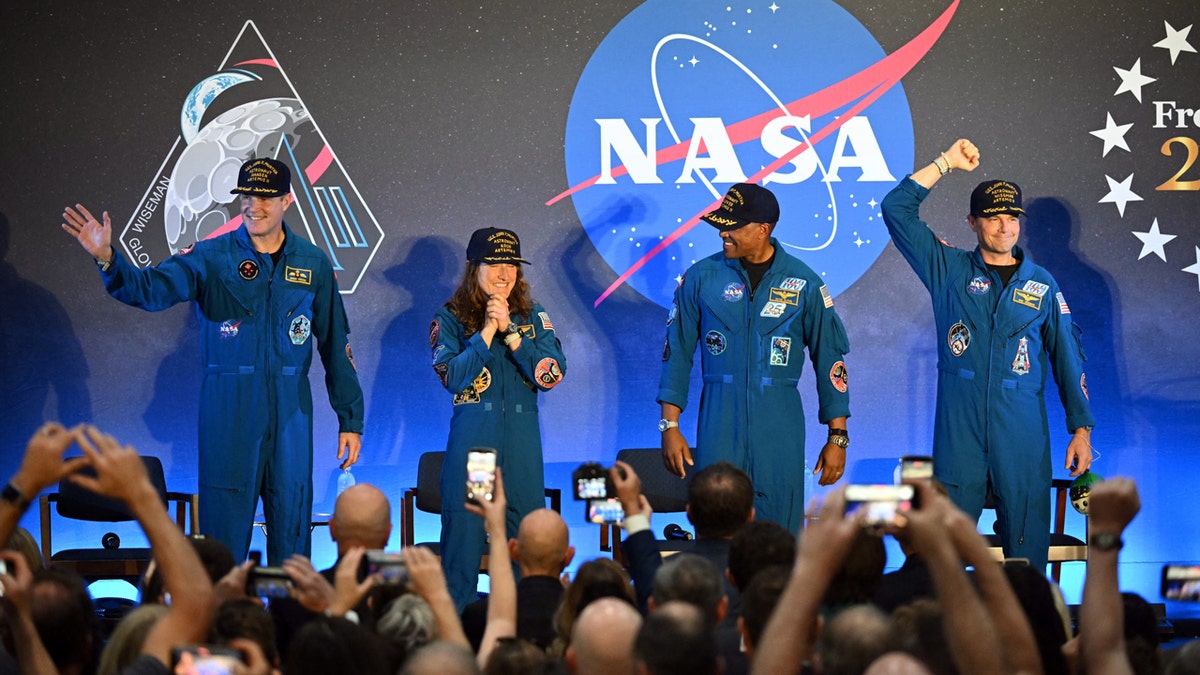
NASA’s Artemis II mission astronauts mission specialist Jeremy Hansen, left, mission specialist Christina Koch, pilot Victor Glover and commander Reid Wiseman are welcomed home at Ellington Field Joint Reserve Base, Saturday, in Houston, Texas. (Ronaldo Schemidt / AFP via Getty Images)
Wiseman who spoke first, joked that he had “absolutely no idea what to say.”
“Twenty-four hours ago, the Earth was that big out the window, and we were doing mock 39, and here we are back at Ellington at home,” he said.
Glover said he still hadn’t processed everything, thanking God “because, even bigger than my challenge trying to describe what we went through, the gratitude of seeing what we saw doing what we did, and being with who I was with, it’s too big to just be in one body.”
Koch reflected that the “start and the end” of the mission were “human moments on Earth.”
“Ten days ago, this journey started with our mission manager, Sean Duvall, knocking on my door in crew quarters and whispering, ‘Christina, We’re go for launch. Get up!’ And it ended last night when my nurse on the ship put me to bed and said, ‘Ma’am, can I get a hug?’”
FIRST-EVER PHOTO OF EARTH FROM MOON’S FAR SIDE UNVEILED AS ARTEMIS II BEGINS JOURNEY HOME, TRUMP WEIGHS IN
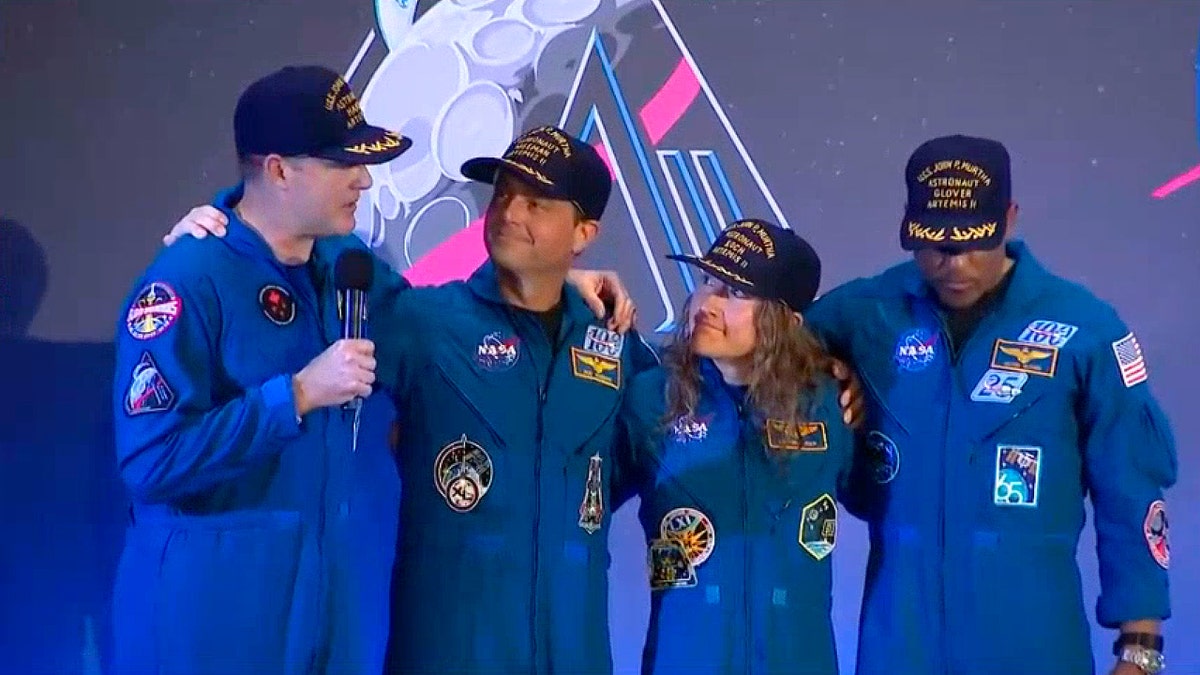
Artemis II crew hugs during the welcome home ceremony on Saturday. (KRIV)
She also said she had a new understanding of the meaning of the word “crew” since their mission.
“A crew is people or, you know, a group that is in it all the time, no matter what that is, stroking together every minute with the same purpose that is willing to sacrifice silently for each other,” she said. “That gives grace, that holds accountable. A crew has the same cares and the same needs, and a crew is inescapably, beautifully, dutifully linked. So, when we saw Tiny Earth, people asked our crew what impressions we had, and honestly, what struck me wasn’t necessarily just Earth. It was all the blackness around it.”
She also now thinks of Earth as a “lifeboat” in a universe of blackness.
“Planet Earth, you are a crew,” she added.
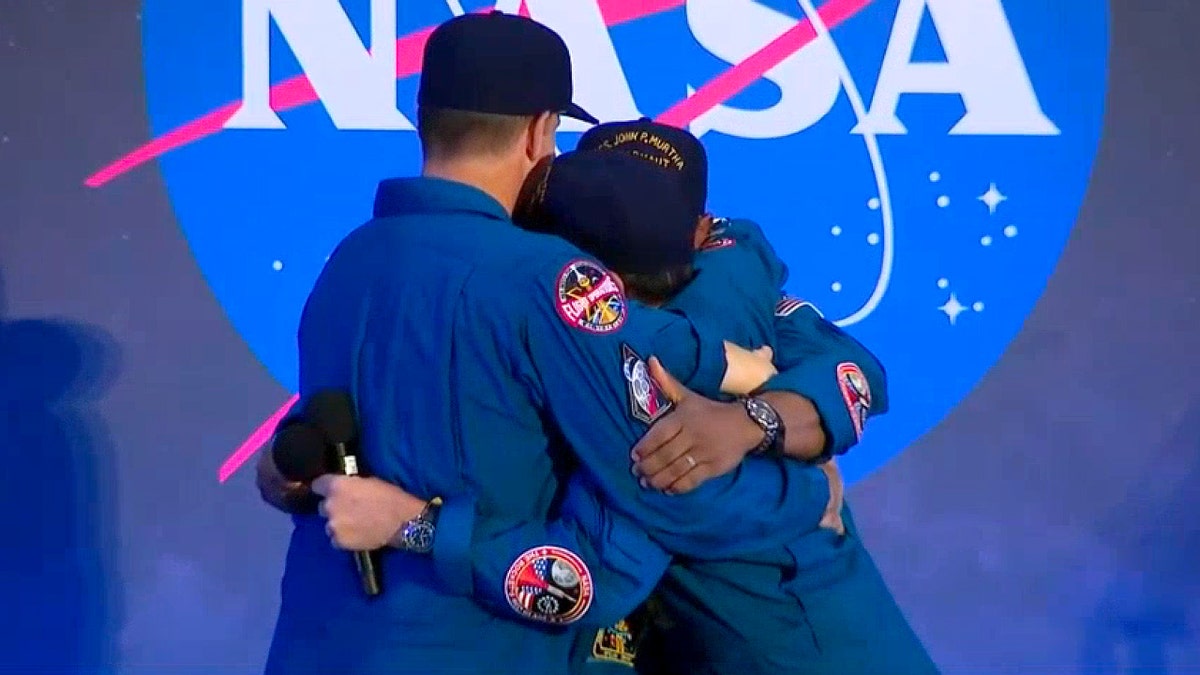
The Artemis II crew hugs at the welcome home ceremony on Saturday in Houston. (KRIV)
Hansen expressed his gratitude to all the people who supported them and their mission.
“And I don’t think people will really ever fully comprehend how well supported and trained we were. It is almost unbelievable,” he said.
CLICK HERE TO GET THE FOX NEWS APP
He added of their crew: “What you saw was a group of people who loved contributing, having meaningful contribution and extracting joy out of that,” he added with his arms around his crew members.
“I would suggest to you that when you look up here, you’re not looking at us,” he continued. “We are a mirror reflecting you. And if you like what you see, then just look a little deeper. This is you.”