Cuba’s president warns US against attacking island or trying to depose him


SAN JUAN, Puerto Rico — Cuban President Miguel Díaz-Canel said the U.S. has no valid reason to carry out a military attack against the island or to attempt to depose him.

Speaking in an interview on NBC News’ Meet the Press program, the president said an invasion of Cuba would be costly and affect regional security. But should it happen, Díaz-Canel said, Cubans would defend themselves.

“If the time comes, I don’t think there would be any justification for the United States to launch a military aggression against Cuba, or for the U.S. to undertake a surgical operation or the kidnapping of a president,” Díaz-Canel said, speaking through a translator.

He added: “If that happens, there will be fighting, and there will be a struggle, and we will defend ourselves, and if we need to die, we’ll die, because as our national anthem says, ‘Dying for the homeland is to live’.”

His comments come as tensions between Cuba and the U.S. remain high despite both sides acknowledging talks, although no details have been shared.

Díaz-Canel has accused the U.S. government of implementing a “hostile policy” against Cuba and said it has “no moral to demand anything from Cuba.” He noted that Cuba is interested in engaging in dialogue and discussing any topic without conditions, “not demanding changes from our political system as we are not demanding change from the American system, about which we have a number of doubts.”

Cuba blames a U.S. energy blockade for its deepening woes, with a lack of petroleum affecting the island’s health system, public transportation and the production of goods and services.

Cuba produces only 40% of the fuel it consumes, and it stopped receiving key oil shipments from Venezuela after the U.S. military attacked the South American country in early January, seized President Nicolás Maduro and took him to New York to face drug trafficking charges. Then, with cooperation from ruling party leaders, the Trump administration began implementing a phased plan to end Venezuela’s entrenched crisis.

The arrival of a Russian tanker carrying 730,000 barrels of crude oil in Cuba in March marked the island’s first oil shipment in three months. Russia has promised to send a second tanker.

Despite threatening tariffs in January on countries that sell or provide oil to Cuba, the Trump administration allowed the tanker to proceed.

“Cuba’s finished,” President Donald Trump said at the time. “They have a bad regime. They have very bad and corrupt leadership and whether or not they get a boat of oil, it’s not going to matter.”

Díaz-Canel said his government takes Trump’s words as a warning.

“You hear that Cuba is next, that Cuba is going to be next, that there are, there’s a way out, that they’re going to take over Cuba,” he said. “So, from the position of responsibility within the leadership of the country, that is a warning. And we need to responsibly protect our people, protect our project and protect our country.”


Iran talks done in by Tehran’s delusions over leverage they don’t have, US official says


NEWYou can now listen to Fox News articles!

Peace negotiations with Iran fell apart after Tehran severely misjudged what kind of leverage the regime believed it held, a U.S. official told Fox News Digital on Sunday.

While Vice President JD Vance left Islamabad, Pakistan, without a deal between the U.S. and Iran, the official said Vance used the talks to measure the Iranians own assessment of their position in the negotiations.

Vance found that Tehran thought they held a strong hand going into negotiations, according to the official, who added that no deal can be achieved when one party deludes itself into believing they have leverage that, in reality, they do not have.

GEN JACK KEANE ‘SKEPTICAL’ THAT IRAN CEASEFIRE WILL HOLD, WARNS TEHRAN WILL ‘DELAY AND OBFUSCATE’

Iran talks done in by Tehran’s delusions over leverage they don’t have, US official says

Iran’s Parliament Speaker Mohammad Bagher Qalibaf and Foreign Minister Abbas Araghchi were greeted by Pakistan Foreign Minister Ishaq Dar and Army Chief Field Marshal Gen. Asim Munir upon their arrival at Nur Khan airbase in Rawalpindi, Pakistan, on April 11, 2026. (Pakistan Ministry of Foreign Affairs/AP)

The U.S. official described the talks to Fox News Digital as starting out tough, though developing into a more friendly and productive dialogue over the duration of the 21-hour-long negotiations.

The high-stakes talks between the U.S. and Iran ended without a deal after Iranian officials refused to accept American terms, Vance said earlier Sunday during a press conference from the Serena Hotel in Islamabad, Pakistan.

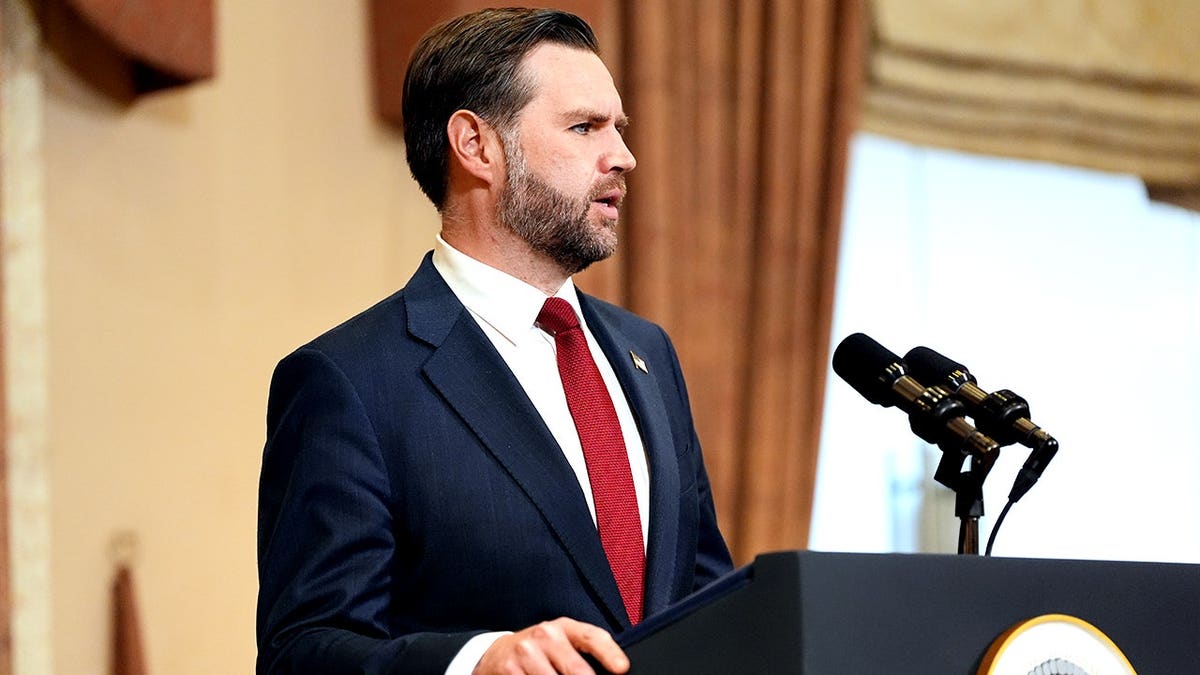
Vice President JD Vance speaking at a news conference in Islamabad Pakistan

Vice President JD Vance speaks during a news conference after meeting with representatives from Pakistan and Iran in Islamabad, Pakistan, on April 12, 2026. (Jacquelyn Martin/AP)

“So we go back to the United States, having not come to an agreement. We’ve made very clear what our red lines are, what things we’re willing to accommodate them on and what things we’re not willing to accommodate them on,” Vance said at the time. “And we’ve made that as clear as we possibly could, and they have chosen not to accept our terms.”

TRUMP REVEALS IRAN MADE ‘SIGNIFICANT PROPOSAL’ AFTER ULTIMATUM, BUT ‘NOT GOOD ENOUGH’

The U.S. official said that over the course of the discussions, the Washington delegation determined it was clear that the Iranians did not comprehend that the core of any peace deal hinges on Iran never obtaining a nuclear weapon.

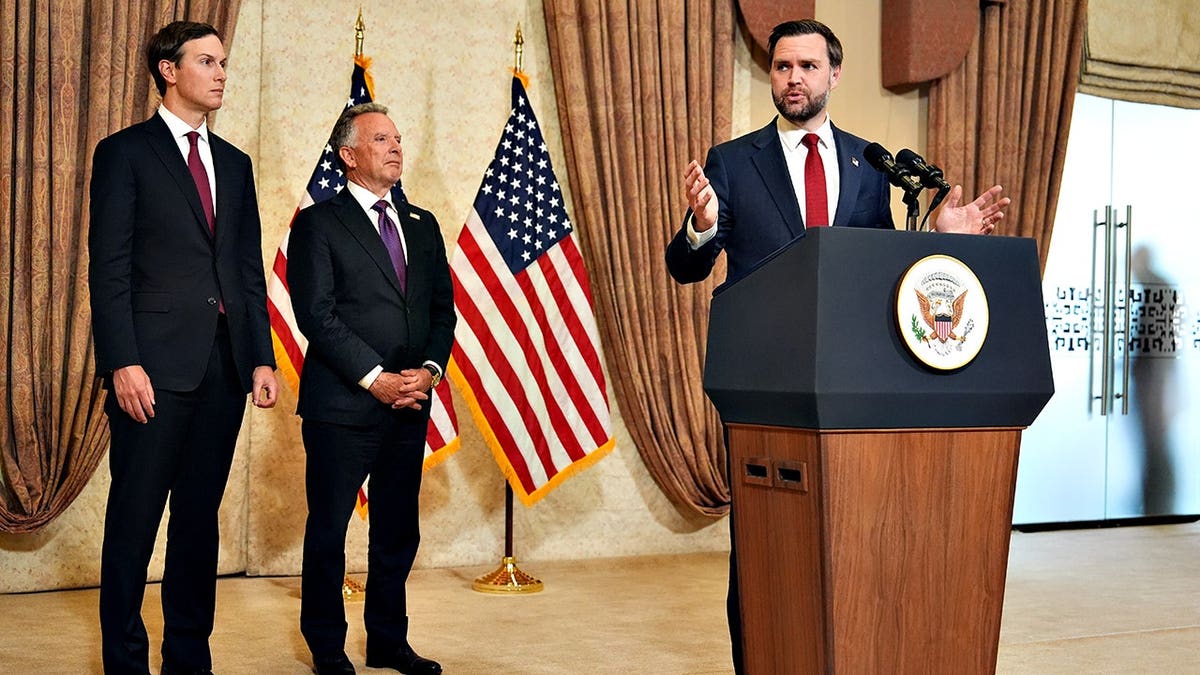
Vice President JD Vance speaking at a news conference in Islamabad with Jared Kushner and Steve Witkoff listening

Vice President JD Vance spoke during a news conference in Islamabad, Pakistan, on April 12, 2026, after meeting with representatives from Pakistan and Iran. Jared Kushner and Steve Witkoff, special envoy for peace missions, listened during the event. (Jacquelyn Martin/AP)

While that point remains the main objective of any potential peace deal, the U.S. has other red lines that it will not compromise on.

The official said that the U.S. and Iran failed to reach an agreement on all of Washington’s red lines, which include: Iran ending all uranium enrichment; the dismantling of all Iran’s major nuclear enrichment facilities; the retrieval of highly enriched uranium; the acceptance of a broader peace, security and de-escalation framework that includes regional allies; an end to the funding of Iran’s terrorist proxies Hamas, Hezbollah and the Houthis; and Iran fully opening the Strait of Hormuz with no tolls for passage.

CLICK HERE TO DOWNLOAD THE FOX NEWS APP

The official added that Vance has underscored that while a deal remains on the table, it is up to Tehran to accept the terms.

“And we leave here with a very simple proposal, a method of understanding that is our final and best offer,” Vance said during the earlier press conference before departing Pakistan. “We’ll see if the Iranians accept it.”


Nikki Haley says US will ‘probably’ need to use special forces to get Iran’s uranium, rules out 2028 run


WASHINGTON — Former 2024 GOP presidential hopeful Nikki Haley said that the US will “probably” need to dispatch a special forces team to retrieve Iran’s uranium stockpile.

“That’s probably what it’s going to come down to. I mean, this is a special force mission. It would take about a week to ten days to get done. They know how to do it. It’s dangerous,” Haley told CNN’s “State of the Union” on Sunday.


Nikki Haley says US will ‘probably’ need to use special forces to get Iran’s uranium, rules out 2028 run
A view of Iran’s nuclear enrichment facility in Natanz, Iran. AP

Nikki Haley on CNN's "State of the Union" as "Breaking News" reports "Trump: Navy will begin 'blockading' ships entering Strait of Hormuz".
Haley appeared on CNN’s “State of the Union” on Sunday. CNN

“It’s not something that we can, you know, just sit and think is casual. I think they have to do it. But once they do that, they’re taking away literally one arm of the Iranian regime to where they no longer can threaten any of our allies.”

President Trump has reportedly considered greenlighting a high-risk operation to retrieve Iran’s enriched uranium stockpiles, which are thought to be buried deep underground after the US hit its nuclear sites with super-heavy bunker buster bombs.

However, so far, Trump has refrained from approving that operation. Instead, he has publicly warned Iran that the US is monitoring its nuclear sites via satellite and will strike if Iran attempts to recover its stockpiles.

Experts have suggested that if Iran’s stockpiles of uranium were fully enriched to 90%, they’d have enough material for at least 10 nuclear bombs.

Haley, who ran against Trump in 2024 for the GOP nomination, has largely supported the president’s military campaign against Iran. She indicated Sunday that she is not eyeing a 2028 presidential run and argued it’s too early to think about whom she may support.

“I will not,” she said when asked about running.


Saskatchewan calls cut on movie rating rules | Globalnews.ca


REGINA – Some local theatres in Saskatchewan are hoping to see more independent films up on the big screen after the provincial government decided to end mandatory movie ratings.

Saskatchewan calls cut on movie rating rules  | Globalnews.ca

Jordan Delorme, general manager of the Roxy Theatre in Saskatoon, says the province’s old rules were so prohibitive that some filmmakers chose to privately show their work in living rooms at home.

Many couldn’t afford the $440 ratings fee or didn’t want to deal with government bureaucracy to get a movie rated so it could premiere in theatres.

“It felt like a paywall,” Delorme said in a recent interview.

Changes to the provincial law, which came into effect earlier this month, mean exhibitors and distributors are no longer required to get a government rating before showing their work publicly.

Those typical ratings are now optional: G (general), PG (parental guidance), 14A (under 14 accompanied by an adult), 18A (under 18 accompanied by an adult) and R (restricted to those 18 and older).

Story continues below advertisement

But theatres must still come up with their own advisories to ensure the public is aware of any explicit content.

The Financial and Consumer Affairs Authority of Saskatchewan, which regulates films, says theatres don’t have to enforce most age-based restrictions, though prohibitions remain in place for adult films.

It says such films, with sexual activity as their main object, can’t be sold, rented or shown to those under 18.

Related Videos

“The new (law) requires exhibitors to display relevant film content information, which parents and guardians can rely on in determining whether to permit certain age groups to view a film,” the authority said in a statement.

Get daily Canada news delivered to your inbox so you'll never miss the day's top stories.

Get daily National news

Get daily Canada news delivered to your inbox so you’ll never miss the day’s top stories.

In the age of online streaming, Delorme said, it has become nearly impossible to enforce what teens watch.

Story continues below advertisement

“We would certainly advise people what the content is and advise them whether or not we think that it might be suitable for somebody of that particular age,” he said.

“But it’s not our job to say, ‘You cannot see this movie because of what the content is.’”

The legal changes have bigger effects on filmmakers and exhibitors wanting to show independent work, he added.

The Roxy had to jump through hoops to screen nearly 100-year-old silent films and family friendly documentaries not rated by the province.

“It feels kind of silly at that point,” Delorme said.

Lenore Maier, the executive and artistic director at the Broadway Theatre in Saskatoon, said rating fees were prohibitive for many local filmmakers.

“There’s so few of them. Any time we can make it easier to get independent local movies on screens in Saskatchewan, that’s a win for us.”

Maier said her theatre plans to continue using the letter ratings system, noting exhibitors can still use ratings from other provinces when making advisories.


“There’s definitely no interest in actively hiding that information, because that’s not a benefit to anybody,” she said.

“Not a lot will change from the moviegoer side of things. I think it might look a little different, but it’ll be something people adjust to very quickly.”

Story continues below advertisement

The Movie Theatres Association of Canada said the Saskatchewan law levels the playing field with streaming platforms and live event venues, which aren’t subject to government ratings.

“The new framework gives consumers a better understanding of a film’s themes, language and imagery compared to a generic rating, allowing for individuals to make more informed choices,” it said in a statement.

Saskatchewan’s consumer affairs authority said the law was modelled after Ontario, which did away with ratings in 2019.

Exhibitors in the province are required to display contact information if anyone has questions or complaints, it added.

Robert Hardy, executive director of ScreenSask in Regina, said the Saskatchewan law reflects the modern world as more people move to watching content online.

“The biggest issue is going to be for parents — making sure that your kids are going to see movies that are OK by you. And I think if it works properly, this should work just as well or better,” he said.

“Saskatchewan and Ontario are the leaders in this area, which is great. I could see other provinces taking this example and saying, ‘Yeah, we’re going to do this too.’”

Timothy Lenko, a writer and director in Moose Jaw, Sask., said Saskatchewan’s previous rules created obstacles.

Story continues below advertisement

“It’s going to clear up so many headaches where we don’t have to worry about that step,” said Lenko, who’s also a co-ordinator with the Moose Jaw Film Festival.

“We are able to have full control over issuing ethical, transparent notices to audiences. It’s fantastic.”

Randy Goulden, executive director of the Yorkton Film Festival — Saskatchewan’s longest-running film festival, also applauded the move.

“We’re very pleased that there’s going to be the opportunity for more Canadian content,” she said.

This report by The Canadian Press was first published April 12, 2026.

&copy 2026 The Canadian Press


Quebec is about to learn who will be next premier | Globalnews.ca


Quebecers will find out Sunday who will become their next premier after the Coalition Avenir Québec counts the votes in a race to replace the only leader the party has ever had.

Saskatchewan calls cut on movie rating rules  | Globalnews.ca

Christine Fréchette, a former economy minister, and Bernard Drainville, an ex-environment minister, threw their names in the hat after outgoing Premier François Legault announced in January he was stepping down.

Related Videos

Story continues below advertisement

About 20,500 CAQ members were eligible to cast a vote and choose the new leader.


Get breaking Canada news delivered to your inbox as it happens so you won't miss a trending story.

Get breaking National news

Get breaking Canada news delivered to your inbox as it happens so you won’t miss a trending story.

Fréchette focused her campaign on economic issues, while also saying she was open to allowing more permanent residents in Quebec.

Drainville leaned on conservative ideas while positioning himself as the candidate best suited to defend Quebec’s identity and to adopt a stricter immigration policy.

The winner will have their work cut out for them as the latest public opinion polls show the governing party trailing far behind the Parti Québécois and Quebec Liberals.

This report by The Canadian Press was first published April 12, 2026.

&copy 2026 The Canadian Press


How sex tapes, fake assassination plots and JD Vance shaped Hungary’s election


How sex tapes, fake assassination plots and JD Vance shaped Hungary’s election
Peter Magyar, left, is hoping to beat Victor Orban, right, to become Hungary’s new prime minister (Picture: Getty/Metro)

The UK’s most recent general election in 2024 certainly contained its share of drama – think Rishi Sunak’s D-Day blunder, or Nigel Farage’s dramatic return to the fray.

But for truly bizarre politics, Hungary really takes the Dobosh.

Today, after a long and at-times gobsmacking campaign, the eastern European nation will go to the polls for its first parliamentary elections since 2022.

Last time around, incumbent Prime Minister Viktor Orbán – a strong ally of Donald Trump with a distinctive centre-parted haircut – achieved a romping victory for his party Fidesz.

He’s spent the last four years yanking his country further to the right and doing his best to stop support being sent to Ukraine in its fight against Russian invaders.

However, a worsening Hungarian economy has hampered his chances of scoring a fifth term as PM.

Want to understand more about how politics affects your life?

Metro’s senior politics reporter Craig Munro breaks down all the chaos into easy to follow insight, in Metro‘s politics newsletter Alright, Gov? Sent every Wednesday. Sign up here.

Polls suggest his party has been overtaken by a relatively new challenger called Tisza, which has rocketed in popularity since Orbán critic Péter Magyar took over as its leader in July 2024.

Magyar – whose surname literally translates to ‘Hungarian’ – was once a loyal member of Fidesz, but resigned in February 2024 with a blistering attack on Orbán’s record.

Unsurprisingly, there is no love lost between the two men, which may explain why the latest election has become a little… messy.

BUDAPEST, HUNGARY - MARCH 15: Peter Magyar, Hungarian opposition, leader of the 'TISZA' (Respect and Freedom) party, delivers a speech at a demonstration during commemorations of the 178th anniversary of the 1948/49 Hungarian Revolution on March 15, 2026 in Budapest, Hungary. A rally by Fidesz party supporters of Viktor Orban, Hungary's long-serving prime minister, is taking place alongside a demonstration led by Peter Magyar, leader of the Tisza party, and Orban's main challenger in the upcoming parliamentary elections scheduled for April 12. The 1848 Hungarian Revolution sought independence from Austria through a peaceful movement, standing apart from the many European Revolutions of that same year. Despite its failure, it remains pivotal in Hungarian history, with its anniversary, March 15, being one of the nation's three national holidays. (Photo by Janos Kummer/Getty Images)
Peter Magyar speaking in Hungary during the campaign (Photo by Janos Kummer/Getty Images)

Even before campaigning had fully kicked off, Magyar attracted international headlines with claims his opponents were plotting to blackmail him with a sex tape.

The opposition leader said Fidesz was ‘planning to release a recording, recorded with secret service equipment and possibly faked, in which my then-girlfriend and I are seen having intimate intercourse’.

The accusation stemmed, he said, from a picture of a bedroom that had been shared with journalists, captioned ‘coming soon’.

Fidesz denied any involvement in such a plot, and no such video appears to have been published.

BUDAPEST, HUNGARY - FEBRUARY 17: Russian President Vladimir Putin (L) and Hungarian Prime Minister Viktor Orban arrive to speak to the media following lengthy talks at Parliament on February 17, 2015 in Budapest, Hungary. Putin is in Budapest on a one-day visit, his first visit to an EU-member country since he attended ceremonies marking the 70th anniversary of the D-Day invasions in France in June, 2014. (Photo by Sean Gallup/Getty Images)
Vladimir Putin and Viktor Orban, who is considered one of the European leaders closest to the Russian president (Picture: Sean Gallup/Getty Images)

Then, on Sunday, the Washington Post published an explosive story suggesting the stakes in the election were being felt far beyond Hungary’s borders.

As mentioned above, Orbán has made a name for himself as a rare voice opposing support for Ukraine within the European Union and Nato.

That has endeared him to Moscow, who allegedly offered some help to tip the scales of the election in his favour – with extraordinarily melodramatic methods.

Citing an internal report for Russia’s foreign intelligence service the SVR, the US newspaper said officers considered a strategy they called ‘the Gamechanger’.

It involved, bluntly, ‘the staging of an assassination attempt on Viktor Orbán’.

Orban, who has led Hungary for 16 years, sits on Donald Trump’s Board of Peace (Picture: Fabrice COFFRINI / AFP via Getty Images)

Their alleged plan may have been inspired by the impact of the attempted killing of Donald Trump during the 2024 US presidential election, which rallied support and resulted in an iconic picture.

This report was dismissed by Hungarian foreign minister Péter Szijjártó as ‘insane conspiracy theories that are beyond imagination’.

Questions have also been asked about the decision to appoint a former interpreter for Vladimir Putin to a top role monitoring the parliamentary election.

Daria Boyarskaya will help co-ordinate the work of the Organisation for Security and Co-operation in Europe overseeing the democratic process next month.

But in a previous life, she worked for years in Russia’s foreign ministry and helped to interpret meetings including one between Putin and Donald Trump in 2019, according to the Guardian.

How fake assassination plots and sex tapes have shaped Hungary's bizarre election picture: East2West SUPPLIED TO METRO
Daria Boyarskaya beside Vladimir Putin at a meeting with Donald Trump (Picture: East2West)

The choice was criticised by rights group the Hungarian Helsinki Committee, but OSCE secretary general Roberto Montella said Ms Boyarskaya retains his ‘full trust and confidence’.

A spokesperson for the group added: ‘The Russian government does not pay Ms Boyarskaya’s salary, nor has it done it so in the past.’

Meanwhile, Polish Prime Minister Donald Tusk accused Orbán’s team of ‘inform[ing] Moscow about EU Council meetings in every detail’ in an X post on Sunday.

Political news site Politico reported the EU was limiting the amount of confidential material passed to Hungary’s leaders out of concern it would end up in the hands of the Kremlin.

János Bóka, the Hungarian Europe Minister, described the story as ‘fake news’.

To view this video please enable JavaScript, and consider upgrading to a web
browser that
supports HTML5
video

And Russia is not the only source of foreign support for Orbán and his government ahead of the crucial elections – President Trump has his back too.

In a video message shown at a conference on March 21, Trump said: ‘He’s a fantastic guy and it’s such an honour to endorse him.’

The support from across the Atlantic was reiterated in a visit last week from Vice President JD Vance, who accused the EU of ‘foreign election interference’ after travelling to explicitly tell Hungarians to vote for Orbán.

He said: ‘Of course, I want to help, as much as I possibly can, the prime minister as he faces this election season.’

Tomorrow, we’ll learn whether it had any impact – or if there’s time for any last-minute twists.

Get in touch with our news team by emailing us at webnews@metro.co.uk.

For more stories like this, check our news page.


The states revealed as best to start a family amid cratering belief in the American Dream


NEWYou can now listen to Fox News articles!

For those chasing the American dream, a new study has some insightful information about what it takes to attain it – along with data that might determine the best states to set down roots.

Declining marriages and broken families are crippling predominantly blue states, while red states thrive with better economic mobility, education and lower crime, according to a 2026 Family Structure Index released Tuesday by the Ohio-based Center for Christian Virtue.

In partnership with the Institute for Family Studies, the report examined three core factors: marriage rates, family stability and fertility rates. It also tracked cost of living, religious participation, family instability, and education levels, finding wide gaps across states that affect the “health and attainability of the American Dream.”

“This report should serve as a wake-up call for policymakers and community leaders across the country,” CCV President Aaron Baer told Fox News Digital.

TAX AND RUN: HOW NY AND CALIFORNIA ARE BLEEDING PEOPLE AND PROSPERITY

The states revealed as best to start a family amid cratering belief in the American Dream

A 2026 report by the Center for Christian Virtue and Institute for Family Studies compares red and blue states on family stability. (iStock)

Baer added that government programs alone “can’t replace strong families.”

“No amount of paid family leave, childcare subsidies, or social experimentation will rebuild the foundation that families provide,” he said. “If those policies were enough, states like California and New York would be leading the way. The data show otherwise. If we’re serious about reducing poverty and expanding opportunity, we need to strengthen the institutions that have always made America strong: faith, family, and economic freedom.”

The report finds that only 1 in 3 Americans believe in the American Dream.

The index clearly shows geographic divides. Red states like Utah rank first in family stability, while blue states like New Mexico trail behind.

Rocky Mountain and Great Plains states generally have higher marriage and fertility rates, according to the report.

Behind Utah, the rest of the top 5 states for family stability were Idaho, Nebraska, South Dakota and North Dakota. 

The bottom five states: Vermont, Nevada, Louisiana, Rhode Island, and New Mexico.

These differences are now impacting where people choose to live, according to the report.

South Carolina, for example, has seen marriage rates rise and its ranking on this list improve; while Hawaii has fallen as marriage rates decline and housing costs remain high.

HERITAGE FOUNDATION WARNS AMERICA ‘DANGEROUSLY CLOSE’ TO FAMILY BREAKDOWN POINT OF NO RETURN

As these pressures grow, more Americans are leaving high-cost blue states for more affordable red states.

“Strong families are the foundation of a healthy society,” Baer said in a press release. “This report shows that when family structure weakens, the effects ripple outward to our schools, our communities and our economy. But it also makes clear that this is not inevitable. There is a solution and a path forward.”

Notably, the report highlights a clear link between family structure and economic outcomes. 

States with more married parents saw lower child poverty rates, better educational outcomes, less crime and stronger economies, while those with higher shares of single-parent households face long-term challenges.

Other contributing factors also emerged. 

States with higher religious participation saw higher birth rates, while expensive housing markets are tied to lower fertility rates, according to the report. Education also plays a role as more college-educated adults are more likely to form stable families due to economic security.

Since 2000, the national index score has dropped from 100 to 87.3, signaling a decline in family structure, the report added. While marriage rates have stabilized in recent years, fertility rates continue to fall and pose lasting constraints for future generations.

However, these trends do vary across both red and blue states, according to a CCV spokesperson, who said the report “also underscores that these trends are not confined to any one region or political ideology.”

The findings have prompted calls for policy changes focusing on strengthening families and economic conditions.

NEW POLL FINDS AMERICANS LIKELY TO SEE EACH OTHER AS ‘MORALLY BAD’ — BUT EXPERT SAYS STRONG FAMILIES CAN HELP

Wedding

A 2026 Family Structure Index report finds red states outperform blue states in family stability, economic mobility, and education. (iStock)

“The lesson going forward is clear,” Baer said. “Red and blue states alike should advance policies that make housing more affordable, ensure good-paying jobs are within reach, keep taxes low, and expand access to quality education.”

Baer added this comes down to the impact of stable households. 

Stable two-parent homes are linked to higher college graduation rates and a better shot at reaching the middle class, the report said. Married adults are also about 80% less likely to live in poverty than single adults.

“Family structure is one of the strongest predictors we have for whether children and communities are thriving,” University of Virginia sociology professor and lead researcher Brad Wilcox said in a press release. “States that are doing well in this area have markedly lower levels of child poverty, as well as higher rates of economic mobility and homeownership.”

For many, economic realities have continued to fuel skepticism about the American Dream. Since 1980, fewer adults ages 25 to 54 have been able to buy homes, and only about 50% of those born in the 1980s earn more than their parents—down from 90% among those born in the 1940s.

CLICK HERE TO DOWNLOAD THE FOX NEWS APP

Marriage rates fell sharply from 2000 to 2010, followed by a 17% drop over the next decade, as “upward mobility has been cut nearly in half over two generations,” the report said.

“This isn’t just about statistics,” Baer said. “It’s about real children and real futures. If we want to see our nation thrive, we have to be serious about strengthening marriage and supporting families in every community.”


East Villagers revolt! Neighborhood furious over Mamdani ‘emergency order’ sticking it with planned men shelters


East Village residents are up in arms over Mayor Zohran Mamdani’s scheme to relocate one of the Big Apple’s most notorious homeless shelters to their neighborhood — potentially transforming it into a doormat for Gotham’s indigent, and a magnet for crime.

Former clientele at the soon-to-shutter Bellevue Shelter on East 30th Street in Midtown included a slew of ex-cons and sickos, such as deranged stabber Ramon Rivera, who went on a 2.5-hour stabbing spree in Manhattan on Nov. 18, 2024, that killed three people.

“None of you all can stop drinking and drugging … and all lingering around here creating crimes and all kinds of stuff,” roared Rev. Keith Gadson, one of the hundreds of locals who bashed city officials at a heated meeting Tuesday about the under-the-radar facility. “Put it in your neighborhood!”

Mamdani abruptly announced in March that Bellevue’s then-250 residents would be headed downtown, saying the nearly century-old site was in a “severe state of disrepair.”

Beginning May 1, New York City’s main homeless intake center for single men will operate at 8 East 3rd St., a building where nonprofit Project Renewal currently provides the homeless shelter and other services. Helayne Seidman for the NY Post

Beginning May 1, the city’s main homeless intake center — where they are assessed and connected to mental health and social services — will be at 8 East 3rd St., a building where nonprofit Project Renewal currently provides a homeless shelter and other services.

The facility will have 117 beds, with residents staying roughly one to two days before being relocated to other sites, the Department of Homeless Services said.

Stays are supposed to be short-term, but the Bellevue site came under fire from critics because the city housed homeless New Yorkers there for months at a time.

Intake services for families without children will be relocated to the 117-bed sister facility at 333 Bowery, which is about a block away from the East 3rd Street site.

And the city has the power to flood both buildings with hundreds of more residents — for as long as it wants — according to a review of Mamdani’s March 26 “emergency executive order” approving the shelter switcheroo.

East Village residents like Jason Murillo (left), a Republican running for state Senate, and Rev. Keith Gadson are up in arms over Mayor Zohran Mamdani’s scheme to relocate one of the Big Apple’s most notorious homeless shelters to their neighborhood — potentially transforming it into a doormat for Gotham’s indigent — and a magnet for crime. Courtesy of Jason Murillo

The order suspends a local city code that currently prohibits more than 200 shelter beds at shelter sites. The suspension also waives safety-code regulations prohibiting no more than 90 people on the first floor of both East Village sites.

“This will not be temporary shelters as they claim, it will be mega-shelters,” said Jason Murillo, a neighborhood activist and Republican running for state Senate.

Murillo accused Mamdani of pushing through the relocation plan under the guise of an “emergency” to avoid community backlash.

Former clientele at the soon-to-shutter Bellevue Shelter in Midtown included a slew of ex-cons and sickos, such as deranged stabber Ramon Rivera, who went on 2.5-hour stabbing spree in Manhattan in 2024 that killed three people. Steven Hirsch

He and other neighbors are planning to file a lawsuit to block the opening, fearing the facility will be a magnet for criminals.

During the meeting, Murillo told DHS officials residents were upset over the rushed process — and have serious concerns that the shelters would be a bad mix for a neighborhood filled with apartment buildings, restaurants, schools, hotels and bars.

“We support services for vulnerable New Yorkers, but the issue here is transparency and planning,” he said. “Where is the environmental review? Where was the public safety plan to make sure we are all safe?”

Mamdani abruptly announced in March that Bellevue’s then-250 residents would be headed downtown, saying the nearly century-old site was in a “severe state of disrepair.” Helayne Seidman

DHS officials insisted the city notified the neighborhood as fast as it could — and that it would take steps to ensure both the interior and exterior of both buildings would be kept clean and secure.

Other residents in attendance questioned why the Bellevue site simply couldn’t be renovated or why Mamdani couldn’t find another location for it in Midtown.

“We have lots and lots of empty store space!” ripped one woman.  “You can rent a store space in the 42nd street area? So why us?”

Workers move cots to a truck outside the future men’s homeless intake center at 8 East 3rd St. in the East Village. Helayne Seidman for the NY Post

It’s unclear what will become of the prime Midtown real estate once the Bellevue intake center is vacated.

DHS police and security staff will regularly monitor the new shelters’ exteriors to limit crowding and loitering and will work with NYPD cops to address any community concerns, a Mamdani administration spokesman said, adding there is “no expectation” lines will form outside.

Both East Village intake centers will operate on a “temporary” basis until the city builds a permanent site, a process that could take several years to complete, he said.

Most residents staying at the Bellevue site will be relocated to more permanent accommodations in other parts of NYC — not the new East Village intake centers, the spokesman added.

However, neighborhood activist Veronica Gonzalez said on X that “local residents are fed up.”

“Our community, families, and district deserve answers from City Hall and the mayor,” added Gonzalez, a Republican running for state Assembly.

“We hope to receive an answer soon from Mayor Mamdani and a full pause to the relocation of the Bellevue Homeless Shelter [to] the East Village.”


53% of Canadians want Carney Liberals to win majority in byelections: poll – National | Globalnews.ca


Just over half of Canadians want the federal Liberals to win enough seats in Monday’s byelections to give Prime Minister Mark Carney a majority government, new polling suggests.

Saskatchewan calls cut on movie rating rules  | Globalnews.ca

The Ipsos poll conducted exclusively for Global News found that 53 per cent of Canadians want the Liberals to form a majority, while 47 per cent are opposed to the idea.

The support is starkly split between Liberal and Conservative voters, but 56 per cent of NDP voters also said they would prefer the Liberals to win enough of the three byelections being held Monday to form a majority.

Two of the three byelections are in Toronto-area ridings that are considered safe Liberal seats, which makes it likely the government will cross the 172-seat majority threshold in the House of Commons.

Story continues below advertisement

“I think the Liberals are going to be sleeping quite nicely on Sunday night and getting ready to celebrate on the Monday,” said Darrell Bricker, CEO of Ipsos Public Affairs.

The Liberals got even closer to a majority after Marilyn Gladu became the fourth former Conservative and fifth MP to cross the floor since December 2025 on Wednesday.

MP Lori Idlout switched to the Liberals from the NDP last month.


Click to play video: 'Longtime Conservative Marilyn Gladu crosses floor, Liberals 1 seat shy of majority'


Longtime Conservative Marilyn Gladu crosses floor, Liberals 1 seat shy of majority


Although a majority of Canadians have voiced displeasure with MPs switching parties in past Ipsos polling, Bricker said Canadians appear to be accepting what it’s leading to in this case.

“Even if people don’t necessarily like the means, the ends of stability — particularly in a situation in which the country is confronted with a lot of big issues, including its position with the United States — Canadians seem to think that this is all right,” he said.

Story continues below advertisement

The prospect of a majority Liberal government puts more pressure on Conservative Leader Pierre Poilievre amid the growing exodus from his caucus, Bricker added, despite a decisive leadership vote result in January.

Get breaking Canada news delivered to your inbox as it happens so you won't miss a trending story.

Get breaking National news

Get breaking Canada news delivered to your inbox as it happens so you won’t miss a trending story.

“He can’t make the argument, which is, ‘You need me to be around because there could be an election any day,’” he said. “There isn’t going to be an election any day. So caucus relations is going to be an outsized part of what Mr. Poilievre is going to have to do over the next period of time.

“When restless members in opposition have nothing to worry about, and there’s no prospect of being in government, and they haven’t been in government since 2015, well, idle hands are the devil’s workshop.”


Click to play video: 'Poilievre’s leadership under scrutiny as Conservative floor-crossings mount'


Poilievre’s leadership under scrutiny as Conservative floor-crossings mount


Liberal support grows as Conservatives fall

The Ipsos poll suggests more bad news for the Conservatives.

Story continues below advertisement

If a general election were held tomorrow, 33 per cent of voters would choose the Conservatives, down three points from last month. The Liberals, meanwhile, rose by one point to 45 per cent support.

The Liberals now lead the Conservatives by 12 points — four times the gap between the two parties in December 2025, which was also the margin in last year’s election.


“Those double digits are coming from somewhere,” Bricker said.

“Last [year], they came from just the NDP. Now they’re also coming from the Conservatives, and the groups that voted disproportionately for the Conservatives, are more likely to vote for the Conservatives last time, are now taking a look at the Liberals and feeling comfortable with them.”

That includes younger voters, who flocked to the Conservatives in the 2025 election, believing the party was best equipped to address affordability issues.


Click to play video: 'Pierre Poilievre condemns latest Liberal floor-crossing, Carney’s ‘backroom deals’'


Pierre Poilievre condemns latest Liberal floor-crossing, Carney’s ‘backroom deals’


Now, according to the new Ipsos poll, 29 per cent of respondents aged 18 to 35 say they would vote for the Liberals, versus 22 per cent who chose the Conservatives.

Story continues below advertisement

Men and women are now equally likely to vote Liberal at around 45 per cent each, the poll found, despite Ipsos saying men have historically been more likely to vote Conservative.

“[Poilievre] is losing across the demographic perspective,” Bricker said. “You can’t go from three to a dozen points behind without losing people who were voting for you in the last election. And that’s who he’s losing.”

Conservative support remains highest in Alberta, Saskatchewan and Manitoba, though that support sits at less than half of all voters surveyed in those provinces.

The NDP would gain nine per cent of the vote if an election were held tomorrow, the poll found, up one point from last month but equal to the number in December.

The Bloc Québécois was unchanged at seven per cent nationally (29 per cent in Quebec), while the Green party sits at two per cent, down one point. The People’s Party of Canada rose one point from last month to two per cent.

These are some of the findings of an Ipsos poll conducted between April 2 and 7, 2026, on behalf of Global News. For this survey, a sample of 1,000 Canadians aged 18+ was interviewed online. Quotas and weighting were employed to ensure that the sample’s composition reflects that of the Canadian population according to census parameters. The precision of Ipsos online polls is measured using a credibility interval. In this case, the poll is accurate to within ± 3.8 percentage points, 19 times out of 20, had all Canadians aged 18+ been polled. The credibility interval will be wider among subsets of the population. All sample surveys and polls may be subject to other sources of error, including, but not limited to, coverage error and measurement error.

&copy 2026 Global News, a division of Corus Entertainment Inc.


Christmas Vacation and Congress: ‘We’re all in misery’ amid the ongoing DHS shutdown


NEWYou can now listen to Fox News articles!

If you thought the Congressional appropriations process couldn’t get any worse, I present you with 2026. And perhaps beyond.

The Department of Homeland Security remains shut down, running on pocket lint, nickels lost between the couch cushions and faded S&H Green Stamps (look ‘em up, kids). Congress hasn’t funded DHS for two months. House Speaker Mike Johnson, R-La., torqued himself into a political pretzel – opposing, then supporting, then not acting on – a Senate-approved package to fund most of DHS.

As we always say, it’s about the math, and when it comes to DHS money, it appears that lawmakers have locked a box to which they lack the combination. There is apparently no sequence of votes in the House and Senate which can crack the DHS safe as a traditional, standalone appropriations bill. 

REPORTER’S NOTEBOOK: WHY TRUMP MAY NOT BE ABLE TO FORCE CONGRESS BACK OVER THE DHS SHUTDOWN

Christmas Vacation and Congress: ‘We’re all in misery’ amid the ongoing DHS shutdown

The U.S. capitol building in Washington, D.C., (left); An Immigrations and Customs Enforcement Officer arrives at a scene (right). (Al Drago/Bloomberg via Getty Images (left); Reuters (right))

Now, Congressional Republicans and President Donald Trump are turning to one of the few methods which might work to fund DHS – something called budget reconciliation.

The Congressional budget reconciliation process is not customarily used for appropriations bills – although lawmakers can plug the measure with money to spend on federal programs. However, reconciliation is inoculated from filibusters. Thus, Republicans don’t need 60 votes. They can – ostensibly – pass a DHS bill on its own without help from Democrats if they hold their narrow coalitions together in both the House and Senate.

Congressional Republicans intend to stuff this reconciliation package with only money for ICE and Customs and Border Patrol. Nothing for disaster aid. Nothing for farmers. Nothing about the SAVE America Act. The president agrees. The goal is to finish this by June 1 – months after the latest DHS funding lapse.

But it’s more complicated than that. 

GOP INFIGHTING REPLACES CLASH WITH DEMS, DERAILS PATH TO END HISTORIC DHS SHUTDOWN

The House and Senate must take a number of steps to approve a shell of a budget resolution in order to have the filibuster-proof reconciliation tool available to them. Republicans undertook a similar endeavor last winter and spring. It was absolutely harrowing and consumed months before finally approving the One, Big, Beautiful Bill, via reconciliation. Republicans don’t have that kind of time now. Then again, DHS has either been unfunded or held together by interim spending bills since last October.

We haven’t even mentioned how Trump is using a somewhat dubious authority to pay TSA workers and others from other funds – without Congressional approval.

Three different scenes of long TSA lines are shown side by side.

Travelers experienced extensive wait times Sunday, March 22, 2026, at Louis Armstrong New Orleans International Airport (left, middle) and Hartsfield Jackson Atlanta International Airport (right) due to the partial government shutdown. (WVUE)

That leaves some to question why the administration didn’t do this to start with. But the bigger issue is an alarming pattern of Congress ceding its most precious prerogative – the power of the purse – to the executive branch. That’s to say nothing as to whether Trump’s gambit to pay workers is even Constitutional. And, it establishes a precedent which may be hard to ignore during other funding impasses.

However, here’s the bigger problem: the Congressional paralysis to pass appropriations bills on a timely basis. That’s been an issue for years now.

Historically, Congress has missed the Oct. 1 fiscal deadline, relying on “Continuing Resolutions” (CR’s) which simply renew all funding on a temporary basis. Or, lawmakers cobble together a set of the 12 annual spending bills in a “minibus” appropriations package. Lawmakers who might oppose an individual bill are willing to support a group of bills – because there’s something in there which they like or support.

But turning to reconciliation as a way out of the appropriations box canyon is also another precedent which likely agitates Congressional appropriators. Sure. They’ve done that before. And in this instance, it might finally get DHS funded. But what does this mean for the future?

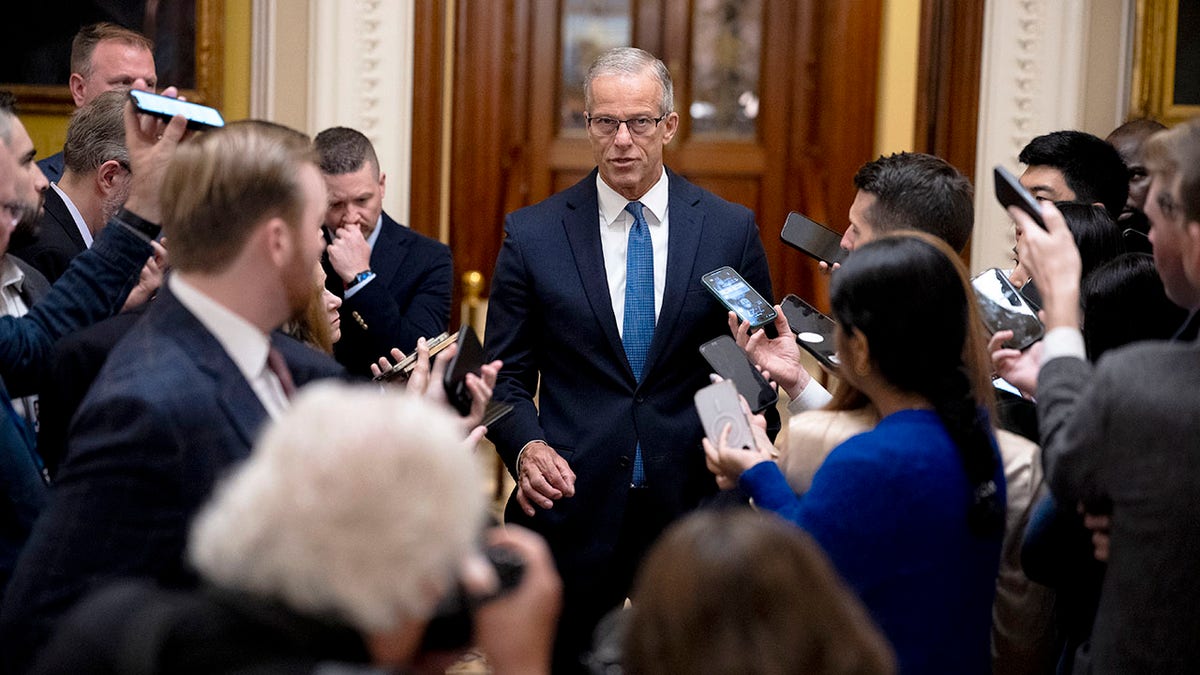
Senate Majority Leader John Thune, R-S.D.

Senate Majority Leader John Thune, R-S.D., said that congressional Democrats got “zero” reforms in the DHS funding deal.  (Andrew Harnik/Getty Images)

Which brings us to Oct. 1, 2026. That’s when the federal government pivots from Fiscal Year 2026 to start Fiscal Year 2027. 

Congress has struggled to fund the federal government since early 2025, when it began work on appropriations bills for this year. The FY ’26 funding crisis – which spawned the record-breaking, 43-day, government-wide shutdown in the fall, another partial government shutdown last winter and the current DHS stalemate – has been an issue since lawmakers were working on bills for this cycle around this time LAST spring. So how pray tell is Congress going to avoid a shutdown THIS autumn for FY ’27?

In fact, few are even speaking about that possible peril – because no one can wrap their heads around the present appropriations saga. And it’s possible that this fall’s problems could be worse than last fall’s impasse. The reason? The midterm elections hit in November. It’s doubtful that either side will be willing to make much of a deal right before voters head to the polls.

The scenarios are frightening to fathom, so people are just kind of ignoring them.

SEE IT: LAWMAKERS CAUGHT ON VACATION AMID RECORD-BREAKING SHUTDOWN WHILE DHS WORKERS GO UNPAID

We have entered a new period of semi-perpetual funding standoffs – exacerbated by mistrust between the sides, narrow Congressional margins in both the House and Senate, parliamentary mathematical equations which don’t balance and an unwillingness by Trump to broker deals or even negotiate with Democrats.

Yes. They have options to cover DHS into next year, but it’s the other 11 spending bills which could be problematic.

Imagine trying to pass a defense spending bill which has a price tag 44% higher than the one last year? Or tacks a bunch of money on for the war in Iran?

Where’s the vote combination to approve a CR, let alone an individual bill? Will Senate Minority Leader Chuck Schumer, D-N.Y., be willing to help Republicans hit the 60 vote threshold to fund things? Especially if he sees the possibility of emerging again as Majority Leader? Probably not.

Senate Minority Leader Chuck Schumer, D-N.Y.

Senate Minority Leader Chuck Schumer, D-N.Y., and Senate Democrats aren’t backing down from their list of DHS demands as the partial government shutdown rages on. (Graeme Sloan/Bloomberg via Getty Images)

And let’s say Democrats win the House, Senate or both in the fall? Do you really think these spending standoffs get better over the final two years of Trump’s term?

CLICK HERE TO DOWNLOAD THE FOX NEWS APP

Back to Chevy Chase and Clark Griswold. There’s a second part to that iconic quotation from Christmas Vacation: “We’re at the threshold of hell!” he declares.

Pretty funny, but not if you’re trying to keep the government open after the adventures of the past year. This is not hilarious to millions of federal workers who suffer from paycheck PTSD. Another round of spending mayhem could only erode further trust between federal workers and their employers. It will damage morale – which is already subterranean. That’s to say nothing of courting people to work for the government.

Yes. Things can get a lot worse. The political schisms are deep and the vote matrices to pass the bills simply don’t exist.

It may be spring, but the Christmas Vacation movie provides insight into where we stand with the Congressional appropriations bills: “It’s Christmas and we’re all in misery,” declares Ellen Griswold, played by Beverly D’Angelo.

Yeah. And wait to see what Congress has in store for THIS Christmas.