My Senior Dog Couldn’t Walk Anymore. Before She Died, She Led Me To My Husband.


“JUST BRING BACK MY MAYAAAAAAAA,” I sobbed into the phone to my then-boyfriend of two years, Tom.

He had just left our East London apartment for a two-hour journey to the specialty vet hospital, where our 13-year-old paralysed chiweenie waited to be picked up. Housebound with Covid, I waited impatiently for him to return with the love of my life.

Tom knew that Maya had always been my soulmate. She had been at my side since I was 19 and going to college in Greenwich Village. She gently snorted in my bag as I snuck past security into my film class, where a treat from my professor awaited her. Bouncy and bright, Maya romped through the city with me, often drawing adoration from passersby for her cuteness.

We were inseparable. I would wake to the surge of traffic or the rumble of street construction below, Maya nuzzled into my dark hair. Up we went to the coffee shop’s takeout window, where, surprise, surprise, more treats were ready for her taking. On the subway, to friends’ houses, on road trips across state lines, and on flights home to sunny, smoggy Los Angeles, Maya came along every step of the way.

During Hurricane Sandy, it was Maya and me against the world. No power, no running water. Maya and I traipsed along the Westside Highway at twilight, a Blessed Virgin Mary candle ablaze as a torch, walking past what felt like a post-apocalyptic downtown.

Maya even moved across the pond with me to London when I turned 30 – a reset after a five-year relationship abruptly ended.

She first moved in with my mum, who FaceTimed me at least four times a day while I spent the longest three months of my life waiting for her to arrive.

When she finally did, I felt whole, like I could exhale and lean into my new London chapter.

A few months later, Maya, almost 12, lost mobility in her back legs. I placed her in a leather duffel bag (unzipped, of course), threw in some blankets and rushed into the November night to the same specialty vet hospital, which would become our refuge for the next three years.

Still in my yoga pants and sweatshirt from that afternoon, the only thing I could think about was getting Maya better. I kept reassuring her, “It’s OK, it’s going to be OK,” even though I was ultimately reassuring myself. Stroking her soft face and trying to keep the tears back, I knew our lives would never be the same.

“Intervertebral disc disease,” the neurologist said. “She needs a spinal fusion immediately.” With only a 50% chance of regaining movement in her hind legs, I began to prepare for whatever came next.

Maya glowed in her new neon pink set of wheels. She zipped along the Hackney Canals with even more flair than before, drawing even more smiles in her new form than she had on four legs.

It was during this period that I met Tom. We both swiped right, and I planned for him to meet Maya on our third date. By then, I had accumulated a handful of dog sitters for her. While she could be home alone for up to four hours, for special nights out, I needed backup.

Maya was still figuring out her new self and was scooting all over the apartment in her white puffy diapers. As soon as I brought Tom up to meet her, Maya had an accident all over a floor pillow. Embarrassed, I began to apologise.

“It is not a bother,” he laughed as he picked her up. “Come on, you. Let’s get you cleaned up,” he cooed as he reached for the kitchen roll.

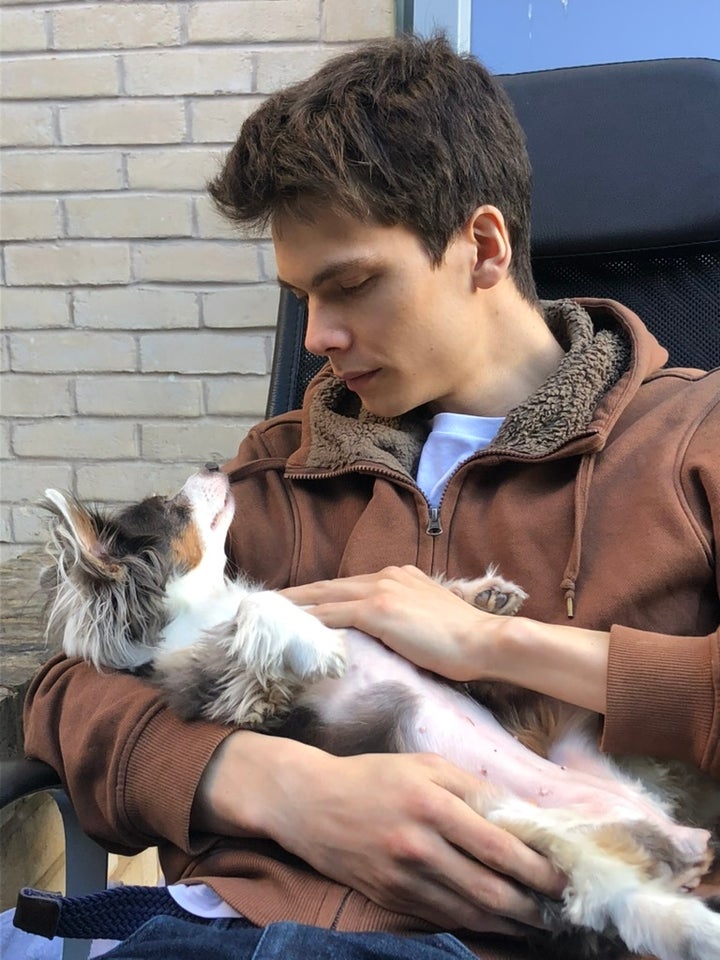
It was at that moment that I knew Tom was here to stay. During lockdown, he would drive from the other side of London and spend the entire weekend with us, giving Maya baths, making a duvet fort for her so we could watch The Twilight Zone, and going for long walks with Maya rolling beside us. He would even adorn her with origami crowns. My plus-one became a plus-two.

My Senior Dog Couldn’t Walk Anymore. Before She Died, She Led Me To My Husband.

Photo Courtesy Of Jordan Ashley

Tom and Maya in our yard in London, December 2020.

On our first family holiday in summer 2020, we rented a cottage in the Cotswolds, where Maya rolled in green fields sprinkled with cows grazing. When she grew tired and needed a rest, Tom would scoop her up in his arms, like a bride being carried over the threshold, and blow on her face to cool her down.

When the three of us finally moved in together, our priority was securing a ground-floor apartment so Maya could come and go with ease. Our entire existence centered on Maya. It was never just Tom and me, but rather the three of us, moving as an imperfect unit into this new, cohesive life together.

As our love deepened, Maya’s age began to catch up with her. Despite being the ultimate roller girl, more health issues began to pile on: hyperparathyroidism, myoclonic seizures, pancreatitis and blindness. During this time, she would be up all night, distressed, howling and crying.

We took turns, surviving on three hours of sleep, our collective mental health wearing down, yet we persevered. On these late nights, I would turn on sound bath playlists, sing to her and do everything in my power to keep her settled on the futon we had set up in the living room. We would not give up on our Maya.

In January 2024, we celebrated her 16th birthday together. Our only measure of time was her comfort. As long as she was still eating, still bright-eyed and not in pain, we kept going. She had traded in her wheels for a stroller, and we pushed her everywhere, her head poking out to take in the breeze.

Maya was on a cocktail of medication, and our lives revolved around the rituals of caring for her – giving her syringes of medicine, hiding pills in peanut butter, cooking for her. She was a metronome, and our lives played to her rhythm.

Maya flew home with me that spring. By now, she could not be left alone, so it was easier to travel with her to ensure round-the-clock care. During this time, I felt Maya’s clock was running out.

Maya's 15th birthday party in London, February 2024.

Photo Courtesy Of Jordan Ashley

Maya’s 15th birthday party in London, February 2024.

I knew an engagement was just around the corner. I had found the ring in his sock drawer, and I kept saying how important it was to me to have Maya at our wedding. She would be the bouquet, as I dreamed of carrying her down the aisle.

Tom would not be marrying just me; he would also be making a vow to her.

Within 48 hours of returning to the UK, Maya was rushed to the emergency vet because she could no longer breathe on her own. We began Googling videos on how to build an oxygen chamber at home from a plastic storage container. Tom found all the parts we would need and was ready to pick up the oxygen tank when the call came. It was time.

We sat with her on our laps for five hours, crying as we looked through all the photos of our many adventures over the years: Maya gliding in Williamsburg, a soggy Tom holding an even soggier Maya after a lake dip, Maya in her skulls and crossbones sweater, us singing happy birthday to her. And then my worst fear finally happened. Her spirit had grown too big for her now very tired body.

I was devastated. I don’t remember getting into the car or Tom driving us home. He held my hand and, through his own tears, led me into our now very empty apartment. Even though he was tucking me into bed and telling me to try to rest, I felt truly alone for the first time in 16-and-a-half years.

The engagement came six weeks later, while I was waiting for a taxi to Heathrow to fly back to New York. It would be the first time I would be in the city without her. Maya’s vet gave me an envelope of bluebells to plant in her honour. On that solo trip back to NYC, I walked down Sixth Avenue, turned left onto 13th Street, and stood in front of the apartment where Maya and I first became inseparable.

Maya's representation at the author's wedding in the Cotswolds, July 2025.

Photo Courtesy Of Jordan Ashley

Maya’s representation at the author’s wedding in the Cotswolds, July 2025.

Maya had always been my constant, my heartbeat outside my body. Losing her was like losing a piece of myself, the glue that held my world together. Kneeling, I spread some dirt beneath a tree and scattered the seeds.

Across the ocean, I knew my person was waiting for me. His love for Maya over those four years was one of the greatest acts of devotion I had ever witnessed. Our love for her and the shared grief of her absence would now be a journey Tom and I would navigate – together.

Jordan Ashley, Ph.D., is a writer and the founder and executive director of Souljourn Yoga Foundation, a nonprofit creating transformational yoga retreats that support girls’ education worldwide. Learn more at souljournyoga.com.

Do you have a compelling personal story you’d like to see published on HuffPost? Find out what we’re looking for here and send us a pitch at pitch@huffpost.com.



A Couple Asked Me To Help End Their Marriage. Then A 30-Year-Old Secret Came To Light


“You made a sex tape?!”

Susannah turned to her husband, Ron, mouth agape. He looked down, his cheeks reddening.

“It was right after college. I was experimenting,” he mumbled, twisting in his seat. “No big deal.”

As a couples therapist, I am always looking for how to mend the frayed edges of a relationship, but Susannah and Ron were different: they had come to my office to end their marriage.

I practice what I call breakup therapy — a short-term treatment I developed for couples who want to end their relationships without bitterness.

The premise is counterintuitive: instead of looking forward toward separate futures, we look backward at the relationship itself. It’s structured to look at the beginning, middle and end of their time together with exercises that focus on both their gratitude as well as their resentment.

The work culminates with the couple crafting a shared narrative about their union and literally writing it down – a story of what worked and ultimately what did not. Then, I ask them to sign it. In this way, they resolve the many unanswered, and often unasked, questions that can trap couples in recriminations and keep them from moving on.

The idea was born from my own bitter divorce. After my split, I was plagued by questions that repeated on an endless loop in my brain: “What was I thinking?”; “Why didn’t I see that red flag?”; “What is wrong with me – I’m a therapist and I should have seen what was happening.”

Then, one day, my therapist asked me a different question: who was I when I decided to marry? Suddenly, my internal feedback loop stopped.

“You’re asking me who I was, not why I married him?” I said, skeptically.

“Yes, I am,” she answered. “Marriages can be as much about identity as they are about a union. What were you trying to solve — or avoid — by marrying him?”

The question unlocked something for me. I’d been full of anger at myself, but I hadn’t really taken responsibility for my own actions. With her help, I crafted a story that I could hold onto about what function the marriage had served for me. Truly owning my choices helped me have more compassion for myself and less anger. The most startling realisation? When I had created a story that hung together, the nagging questions ended for good.

I have seen this same process unfold for many couples. But often, in the course of these sessions, new things surface.

“Susannah?” I said, surprised to hear the hurt in her voice. “This feels like a big deal for you. Why is that?”

Ron and Susannah had not been the most willing subjects for breakup therapy. During our first session, Ron blurted out: “You’re like a medical examiner doing autopsies on dead relationships! Your scalpel hurts. I don’t think you know what it feels like to be humiliated.”

“I wouldn’t be so sure,” I answered softly. “I have a teenager.”

“This feels stupid,” he said on another occasion. “She’s done, I accept that. What is there to say? This feels like horseshit.”

“See what I’m working with here?” Susannah said, throwing up her hands and shifting away from Ron on the couch. “I knew he wouldn’t take this seriously.”

“No, he’s right,” I said. “If it’s really true that you fully accept and understand her decision, Ron, then this is horseshit. But is that true?”

His silence was all the answer I needed.

Over the next few sessions, we went over how they’d fallen in love (“It just made sense, we fit”); the birth of their three children (“The unit held us together”); the unraveling of their connection (“We were ships in the night for as long as I can remember, but then one day I woke up and just wanted more from life”).

We mapped the patterns their marriage had fallen into over the course of three houses, two cross-country moves and their children’s exodus from home. It was a saga spanning decades.

Then, in our fourth session, Ron mentioned the sex tape.

“Something about this is landing hard on you,” I said to Susannah, her mouth still ajar. “Why?”

“Yeah, why?” Ron echoed.

Susannah paused and looked out the window.

“It’s that you … you tried something that – I don’t know – was out there … bold and different.”

A tear welled in a corner of her eye.

“It’s not you. You’re not brave! Or, at least you haven’t been with me, not in all these years together.”

Then she began to cry. Ron and I looked at one another.

“Susannah?” Instantly, I regretted breaking the silence.

“All this time, I decided you just couldn’t try new things,” she managed after a while. “I gave up.”

Ron put up his palms. “What is happening?” he said, exasperated.

“But if you can do that …” she continued. “What was it? Did I just not ask? Did I build my life around a lie?” She looked lost. “Was it that you never really loved me enough?”

She turned back to Ron and banged her fist on the couch.

“I did ask! I asked you to look at porn together when we stopped having sex, to take classes with me, to go on that whale-watching tour. … You just ignored me!”

This time, I held my tongue.

“Is that a thing?” she went on, turning to me. “That you can reach the end of a relationship and not even have known what was possible?”

“I made that tape 30 years ago,” Ron blurted out. “She’s upset over something I did when I was a totally different person!”

This was the impasse that I had expected, that arrives in most of my breakup therapy work – the moment when two people realise that as well as they think they know each other, there are things they don’t know or have lost track of. It’s my job to help them hold that bitter realisation. Then it’s my job to help them arrive at forgiveness or some kind of reconciliation – if not with each other, then with what happened to them.

“It was 30 years ago, Ron,” I said. “But you aren’t a different person. You’re the same person, and she’s wondering why you couldn’t have been that with her.”

I turned to Susannah and said, “You have a right to be hurt, but were you truly honest with him? Did you give him the space and the safety and the encouragement to be that person? Do you think you both can forgive each other for what you weren’t?”

It was three weeks before they appeared again in my office, having canceled two sessions in between appointments.

“I was stirred and moved by what happened here last time,” Susannah began. “When we left, I thought: Maybe there’s enough left between us?”

Ron’s eyes were downcast.

“But I realised I can’t,” she said. “I just can’t open up that part of me with him anymore. I want … I need this divorce.”

I nodded. “Ron? How do you feel?”

“I can see where we are … I’m not fighting it.” His voice broke. “I’m just really sad.”

Often it requires some kind of shock to break through the built-up layers of anger, resentment and disappointment in a couple in order to illuminate the cracks in their relationship – something true that has been avoided or left unsaid. In this case, it was the surprise of an ancient transgressive act that lay bare how little they knew each other and how misaligned they’d become.

Susannah moved closer to Ron on the couch and laced her fingers with his.

“You guys seem calmer – closer. Tell me what you are feeling,” I said.

I knew something about that calm after the storm. After my own divorce, we had maintained an uneasy truce for years, until one long car ride after dropping our daughter at camp. As we rode in silence, I suddenly remembered my therapist’s question: Who was I when I decided to get married? For the next two hours, we talked over that question and everything else, and together realised how lonely we had been — two Israelis who, instead of understanding why we had both chosen to leave, had clung to each other and to a shared language. Before long, we were laughing as we had not laughed since the early days of our marriage.

“So, where do we go from here?” Ron asked me in their last session.

“Well, in my experience, when a marriage ends, a different relationship can sometimes be created,” I said. “That’s up to you guys. All endings are sad, but not all endings have to leave you broken. There’s an opportunity here to get to know each other in a different way. And …” I leaned forward to make eye contact with each of them “… to know yourselves better.”

After they left, I sat quietly in my chair for a while. I allowed myself to remember that moment in my therapist’s office when I realised that I had been using my marriage to escape a question I had been avoiding and what a relief it had been to finally face it.

When a sex tape from decades ago unlocks two people’s grief, it’s not so much about the end of the road as it is about the roads never taken – the versions of a marriage they never tried. It is a sad moment, but also a generative one.

They’d come to me to bury their marriage. What they found instead was a way to know each other – maybe for the first time in years – even as they said goodbye.

Note: Names and some details have been changed to protect the identities of the individuals appearing in this essay.

Sarah Gundle, Psy.D., is a psychologist in private practice and an assistant professor at the Icahn School of Medicine, Mount Sinai Medical Center. She is currently writing a book about breakups. You can find her on Instagram @dear_dr_sarah.

Do you have a compelling personal story you’d like to see published on HuffPost? Find out what we’re looking for here and send us a pitch at pitch@huffpost.com.


5 Manipulative Phrases You Should Never Use With Your Partner


And speaking to HuffPost UK, relationship therapist and author at Passionerad, Sofie Roos, said there are “a few types of phrases that almost always do more harm than good in a relationship,” too.

“Many of these aren’t mainly about what you say, but about when you use them, and how they shut down a conversation or augment in a way that blames your partner and leaves them feeling that their version [of events] doesn’t matter,” she added.

Here, she shared five hurtful comments she thinks we should avoid using with our partner.

1) “You always…” or “you never…”

One of the Gottman Institute’s four horsemen of divorce is criticism, especially ad hominem critiques, which turn issues with your partner into comments about their person.

Phrases like “you always [do xyz]” can tie “one personal trait to [your partner’s] whole identity… with no nuance,” said Roos.

When comments like these are “thrown in your face, the reaction is often to go into defence mode, and the situation tends to escalate into a dirty fight.”

2) “Boo-hoo, poor you…” or “You’re so dramatic”

Dismissive, sarcastic, and diminishing statements, which suggest your partner is overreacting, are a no-go, said Roos.

They “signal that [your] partner’s feelings aren’t valid and not to be taken as equal to yours, which in the long run makes… their opinion and voice less valued.

“That’s no way to build a healthy, happy and respectful relationship.”

3) “If you really loved me…” or “I thought I meant more to you than that…”

These “manipulative” terms are unfair, Roos told us.

“Using these makes you push your partner into a certain behaviour, and you make them earn your love, which is extremely unfair, harsh and manipulative.”

It also “makes them very tense and afraid of doing wrong, where they feel their love isn’t enough.”

4) “Other couples don’t have this problem” or “My ex never did this”

Comparing your relationship to another couple’s, or even your own ex, should be avoided as much as possible.

It “makes your partner compete with others instead of making you a team against the world, which leads to feelings of not being good enough,” the therapist said.

5) “I don’t care, you do you,” or “I don’t want to tell you what you should do, you know best”

These can be tricky, Roos said, because at first glance, they can have the veneer of consideration.

But often, she said, they’re “actually loaded with anger and bitterness, which leads to a very tense atmosphere between you”. They can force your partner to do the hard work of noticing, bringing up, and “managing” problems you don’t want the effort of addressing.

Instead of this, try to “clear the air by saying what you really think”, and assume responsibility in your relationship by taking a position rather than leaving all the work to your partner.

Overall, Roos said, “Phrases that make your partner feel shamed, diminished, less worthy or manipulated have no room in a healthy relationship. Instead, say what you have on your mind and how you’re feeling, but in a respectful, nuanced, constructive and solution-oriented way that’s not aggressive or confronting.

“That will lead to a more peaceful, stable and happy relationship where both feel needed, seen and equal.”