Auqib Nabi: The fast bowler behind Jammu & Kashmir’s historic Ranji Trophy triumph


Fast bowling is viscerally raw. It is intense, unfiltered and powerful, and not only does it register in the onlookers’ minds, but it also evokes deep emotion.

Yet, for every stump that cartwheels, there is the lovely outswinger that kisses the bat and nestles safely in the wicketkeeper’s gloves. Fast bowling is bold, but also beautiful.

Top of the charts

No bowler in recent times has embodied these two aspects quite like Auqib Nabi. As Jammu & Kashmir clinched its maiden Ranji Trophy title last week, the 29-year-old from Baramulla finished with a chart-topping 60 wickets at an average of 12.56.

So penetrative was he that his strike-rate was an astounding 28.43. No bowler with 25 or more wickets had a number less than 30. Nabi also took a whopping seven five-wicket hauls, and four of those came in five innings across the quarterfinals, semifinals and final.

ALSO READ | The impact of the Ranji final will be felt beyond cricket in Jammu and Kashmir

For all the statistical grandeur, there is a pleasing reticence to everything he does. His run-up is not fiery; his pace is not express; he doesn’t stare down batters or indulge in complex vocabulary even while speaking about his expertise. Nabi is both arresting and simple.
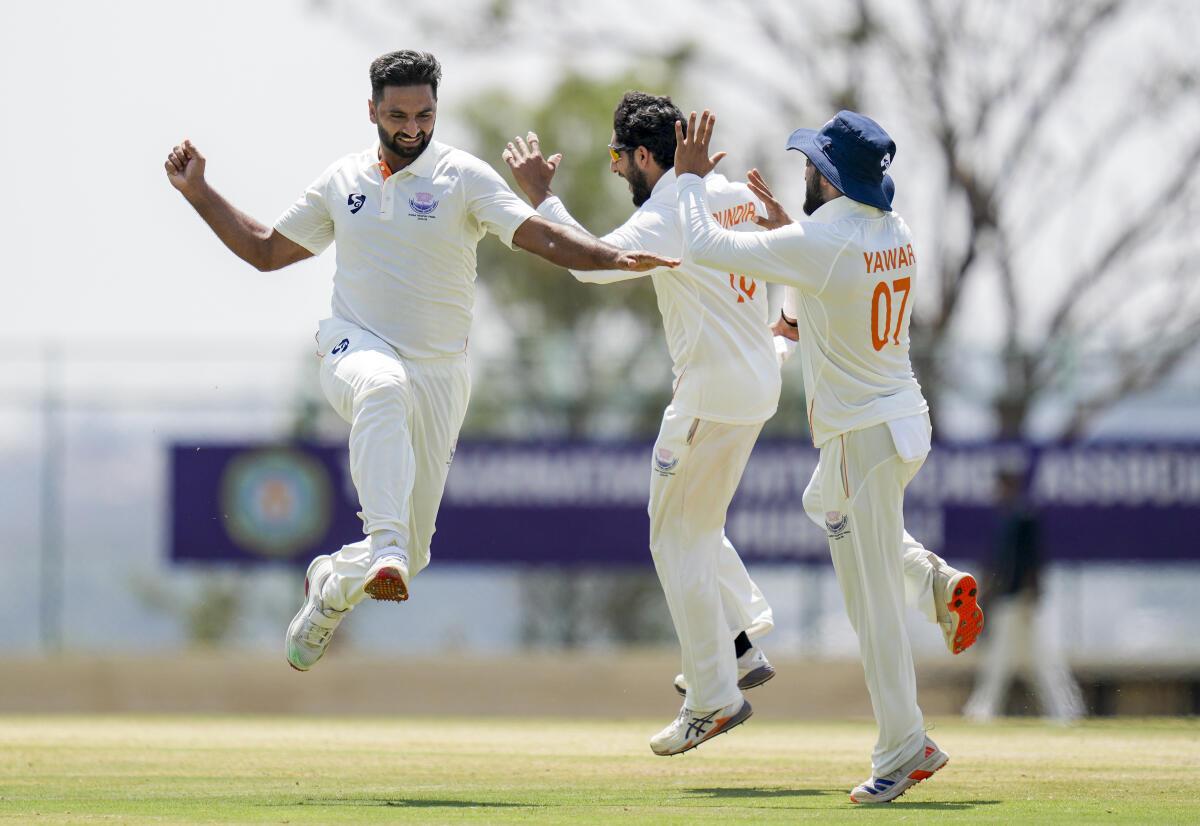
Auqib Nabi: The fast bowler behind Jammu & Kashmir’s historic Ranji Trophy triumph

Big-name hunter: Forty-three of Nabi’s 60 victims batted in the top-seven. Here he celebrates the wicket of R. Smaran (First Class avg: 73.04) in the final.
| Photo Credit:
PTI

But barely two years ago, Nabi was just another bowler in domestic cricket. He made his debut in 2019-20 under trailblazer Parvez Rasool, playing seven Ranji matches and claiming 24 wickets as J&K made the quarters for only the second time in history. However, in the three seasons after that, he accounted for just 22 scalps.

“I saw him first in the Buchi Babu Trophy nets in 2023-24,” P. Krishna Kumar, J&K bowling coach, told The Hindu. “He had a firm wrist, which is very important for a fast-bowler. Only then can you give good back-spin and release the ball better because the palm is behind the ball.

“But he was bowling more inswingers. He wouldn’t even bowl around the stick [stumps] to a left-hander. I asked him why. He said ‘Sir, I don’t have the confidence to bowl the outswinger’. So we practised, had some specific net sessions, and he learnt very quickly and improved drastically.”

In 2024-25, Nabi claimed 44 wickets as J&K reached the quarters again. But a maiden last-four appearance was thwarted by Kerala which secured a narrow one-run first-innings lead. The title-winning season, thus, seems like him wreaking vengeance.

“Nabi lands the ball on the seam, and that is why he has got so many wickets in Indian conditions,” Krishna Kumar explained. “And his movement is so late, and only two or three inches.

“I’ve been coaching for 20 years and I’ve played for 15 years. But I’ve never seen many bowlers moving the ball so late,” added the former Rajasthan cricketer, who played 70 First Class matches.

ALSO READ | Working to rectify gaps: Jaitley on Delhi’s poor Ranji show

This reflects in the manner of Nabi’s dismissals. He bowls a suffocating line, landing the red cherry consistently in that mythical ‘corridor of uncertainty’ to perplex batters. Of his 60 dismissals, 42 were caught behind, bowled or lbw.

Not a speedster’s paradise

The conditions under which Nabi has achieved this is equally noteworthy. Though India now boasts of a world-class pace attack at the international level, the domestic game is still not a speedster’s paradise. In the all-time top-10 list of wicket-takers in a Ranji season, there are just three pacers — Jaydev Unadkat, Dodda Ganesh and now Nabi.

Unadkat, in fact, knows this all too well. The Saurashtra stalwart, with four Tests caps, holds the record for most wickets in a Ranji season for a speedster — 67 in 2019-20.

“It’s not everyone’s cup of tea,” the left-arm pacer told The Hindu. “The weather is a big challenge. Ranji nowadays is not in the winters. It starts in October when it is 38 degrees in Rajkot. You have to last the whole season, play on different pitches, take wickets and win games. And in a country where to get an outright result, you always resort to turning tracks, being a fast-bowler is hard.”

Unadkat is particularly impressed by Nabi’s complete lack of stage fright. He is also delighted that Nabi has disproved, yet again, the theory that rampaging speed is a prerequisite.

“When I was in the reckoning for the Indian team, all I wanted to do was make the best batters play [the ball] all the time,” Unadkat said. “If I could do that, I knew I had the skill-set to trouble any batter. I see that belief in Nabi. He wants to get the best batters out. Some bowlers get into a shell if they’re bowling to bigger names. And if they’re bowling to set batters, the lines could be defensive. But in him, I feel it is always attacking.”

The recently concluded season was evidence enough. In an era where teams bat deep, 43 of Nabi’s 60 wickets were of those in the top-seven. The Ranji final was the perfect microcosm — K.L. Rahul and R. Smaran caught behind; Karun Nair bowled; and Mayank Agarwal leg-before.

Unsurprisingly, there is heightened clamour for Nabi to be included in the Indian team, but before that, he must manage the burden of expectations in the upcoming Indian Premier League, after being bought for an impressive ₹8.4 crore by Delhi Capitals.
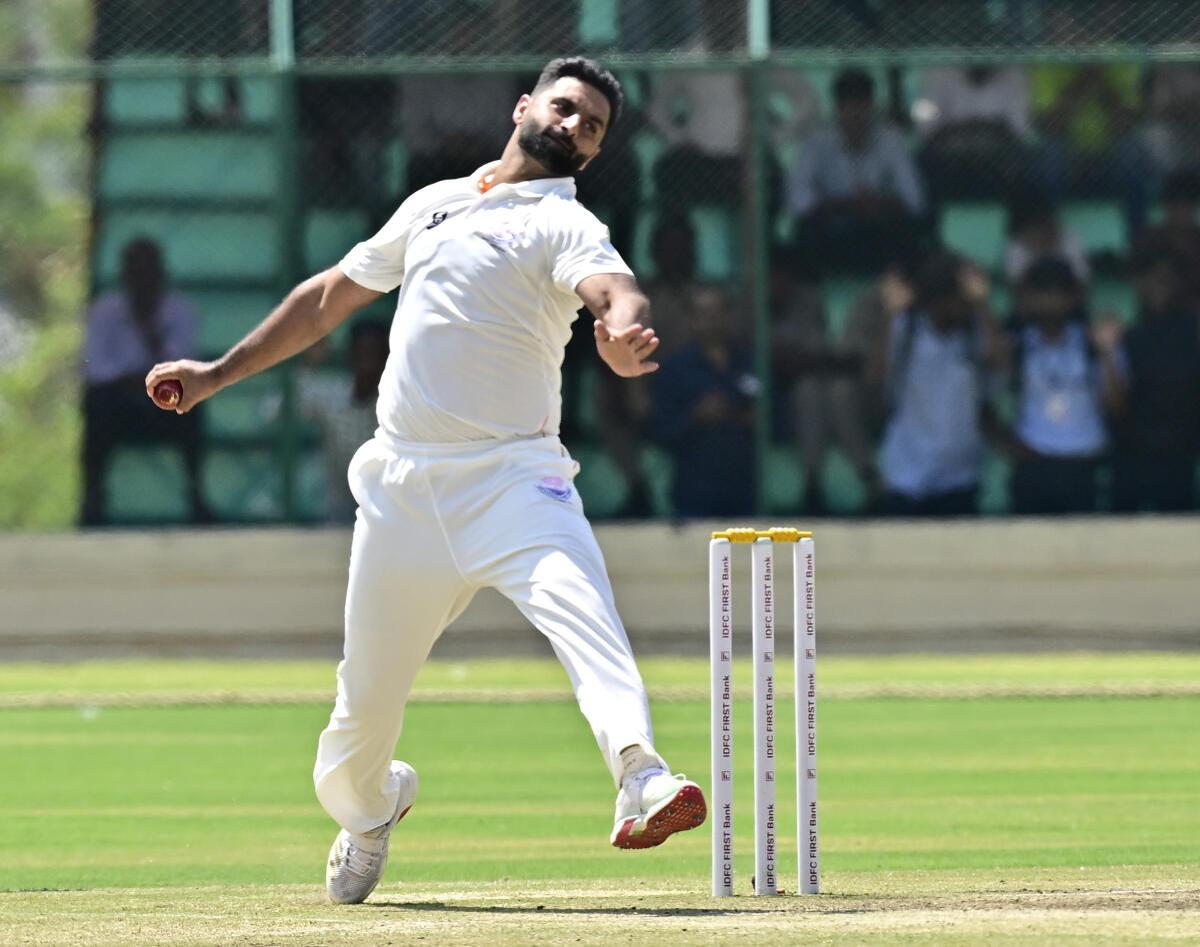
Transferable qualities? Nabi’s suffocating control, late movement and lack of stage fright are attributes that could translate well from domestic to international cricket.

Transferable qualities? Nabi’s suffocating control, late movement and lack of stage fright are attributes that could translate well from domestic to international cricket.
| Photo Credit:
K. Murali Kumar

“Once he plays IPL and is tested, there will be people saying ‘he isn’t good enough for the international level, it’s just the domestic’,” Unadkat said. “I hope he has the attitude where he doesn’t care about all those things.

“I was actually heartbroken for Anshul Kamboj when he played in England [Manchester, 2025], and people started judging him after one game. I know how difficult it is to come out of it because it took me 12 years to get another chance [after Test debut].

“The only thing that comes to my mind in order to excel in internationals is to be 100% all the time. The level of consistency has to be a little higher than domestic. Skill-wise, I believe he [Nabi] has whatever it takes. So don’t really need to push and do something different,” the 34-year-old added.

ALSO READ | Quiz: On Ranji Trophy 2025-26

Nabi, for now, is sleeping on a bed of roses. But Krishna Kumar is confident that he knows how to handle the thorns too. Nabi, after all, did not shy away from travelling all the way to Bengaluru from north Kashmir in 2019 to play league cricket and keep his competitive juices flowing.

Calm, sound, sorted

“He is very, very calm, and even if he doesn’t get a wicket in a session, he says, ‘Sir no problem, main apni jagah pe bowling karta rahunga’ [I will keep bowling in my areas]. Sometimes, the batters will also bat well and score runs. So you have to be patient.

“But Nabi knows his strengths. In the [2025] Duleep Trophy, he got five wickets against East Zone, including four in four balls. In the second match against South Zone, he got only one wicket. But there was no change in his attitude. He has a very sound mind.”
Jammu and Kashmir script history, win maiden Ranji Trophy title | Cricket News – The Times of India


Jammu and Kashmir script history, win maiden Ranji Trophy title | Cricket News – The Times of India

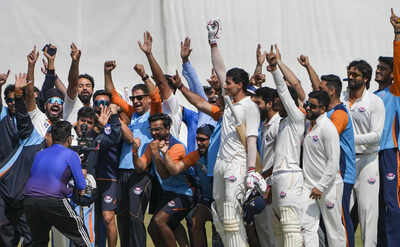
Jammu and Kashmir etched their name in Indian cricket history by claiming their first-ever Ranji Trophy title, defeating eight-time champions Karnataka on Saturday at the KSCA Stadium in Hubli. A historic season, marked by grit and determination, saw J&K outplay favourites and fellow underdogs alike, proving that persistence and strategy can triumph over legacy.The final ended in a draw, but J&K’s commanding 291-run first-innings lead was enough to secure the championship. They extended their advantage to 633 runs by finishing 342/4 in the second innings, with opener Qamran Iqbal scoring 160 not out and Sahil Lotra recording his maiden century of 101 not out.

India land in Kolkata for do-or-die WI clash | Semi-final spot on the line

STAR PERFORMANCES SHINE BRIGHTJ&K’s success was built on a collective effort. Skipper Paras Dogra crossed 10,000 Ranji Trophy runs, while Yawer Hassan, Abdul Samad, and Kanhaiya Wadhawan contributed valuable half-centuries. Pace spearhead Auqib Nabi dominated with the ball, claiming a five-wicket haul for the seventh time this season, and played a key role in turning both the semifinal and final in J&K’s favour.The team’s 10-match campaign demonstrated a rare mix of patience, tactical intelligence, and cohesion, showing that cricketing glory is not just about big names but smart execution.FROM HUMBLE BEGINNINGS TO GLORYJammu and Kashmir made their debut in India’s premier domestic competition 67 years ago, and had previously reached quarterfinals in 2013-14, 2019-20, and 2024-25, but faltered under pressure. This time, the team approached the final with calm and confidence, leaving no doubt about their readiness.Karnataka, despite their legacy and experience, struggled to gain any foothold. On the final day, they failed to take a single wicket after J&K resumed at 186/4, underscoring the visitors’ dominance.SEMIFINAL TEST PREPARES THE CHAMPIONSJ&K’s path to glory was tested in the semifinal against Bengal at Kalyani, where Bengal’s first-innings lead created a tense moment. But Nabi’s brilliant bowling dismantled Bengal for just 88 in the second innings, giving the team belief that a historic triumph was within reach. Shubham Pundir anchored the innings with a classy century, setting up a massive total of 584 and maintaining momentum for the final.OUTSMARTING THE HEAVYWEIGHTSKarnataka, a nine-time Ranji champion, entered the final expecting dominance. Yet, they were outplayed tactically by a team of relatively unknown players. Even a resilient Mayank Agarwal, who scored 160, couldn’t shift the balance. J&K’s consistent pressure, game awareness, and skill execution ensured that the favourites were never in control.INSPIRING GENERATIONS BEYOND CRICKETThis victory carries more than sporting significance. It sends a message of hope and possibility across Jammu and Kashmir, demonstrating how determination and teamwork can overcome obstacles. Pacer Auqib Nabi had long envisioned cricket infrastructure growth in the region, and moments like these could accelerate development and inspire a new generation of cricketers.The historic moment arrived at 2:10 pm, when both captains shook hands in a modest dressing room, sending the J&K squad and supporters into jubilant celebrations. For a team and a region that waited decades for this glory, the triumph was a dream realized and a legacy cemented.


From Baramulla to the brink of history: Auqib Nabi’s defining Ranji Trophy season | Cricket News – The Times of India


From Baramulla to the brink of history: Auqib Nabi’s defining Ranji Trophy season | Cricket News – The Times of India
J&K’s Auqib Nabi (PTI Photo/Manvender Vashist Lav)

Hubballi: Auqib Nabi — a name that has echoed across the Indian domestic circuit over the past couple of seasons — is one the Karnataka camp will want to forget in a hurry. The 29-year-old seamer from Baramulla ripped through Karnataka’s formidable batting line-up on Thursday, pushing Jammu & Kashmir to the brink of a historic maiden Ranji Trophy title. Nabi, however, played down his heroics, insisting that his approach was based on keeping things simple, even if his bowling proved anything but. With pronounced swing, late movement and the ability to hit the seam consistently with a strong wrist position, Nabi kept Karnataka’s leading run-getters under relentless pressure on Day 3 of the final. Coming into the title contest with 55 wickets this season — including 21 across the quarterfinal and semifinal — Nabi surpassed Uttarakhand spinner Mayank Mishra (59 wickets) to become the leading wicket-taker of the competition. Outlining his approach, Nabi said the J&K attack operated with a collective plan. “In our team, all of us follow the same plan, sticking to a particular line and length. Even if the batters try to go after us, we continue to bowl in the same channel,” he explained. Much of the build-up to the final centred on Nabi’s anticipated contest with KL Rahul, and the seamer acknowledged the attention surrounding the duel. “I was confident because I have been taking wickets. I went in with a positive frame of mind and just wanted to keep it simple. Before the match, I got a lot of messages about getting Rahul out, but I just wanted to bowl in a good channel and not focus on the batter,” he said. Nabi emphasised the importance of wrist position in generating movement, a technical aspect that has become central to his success. “Wrist position is very important. If you have a straight wrist, everything else becomes easier. The ball moves with the wrist, so a straight wrist is very important for a fast bowler,” he said. With the visitors now within touching distance of their first Ranji Trophy triumph, anticipation is building. Prominent personalities from J&K are expected to arrive in Hubballi on Friday on what could be the eve of a historic moment. For Nabi, the possibility of lifting the trophy represents the fulfilment of a long-held ambition. “When I represented J&K for the first time, it was my dream to win a trophy, especially in red-ball cricket. Growing up, I always knew we hadn’t won a trophy, so this means a lot,” he said.


Ranji Trophy: Jammu and Kashmir dare to dream under pressure – A big leap long in the making | Cricket News – The Times of India


Ranji Trophy: Jammu and Kashmir dare to dream under pressure – A big leap long in the making | Cricket News – The Times of India
Jammu and Kashmir’s players celebrate after the team’s victory in Ranji Trophy semifinal against Bengal. (PTI Photo)

KALYANI: History had barely settled in when the phone rang. A familiar face flashed up on a video call. Minutes after Jammu and Kashmir sealed a spot in the Ranji Trophy final, the team heard from BCCI president Mithun Manhas, a former head of the J&K cricket’s ad-hoc committee. It was fitting. J&K first entered the Ranji Trophy in the 1959-60 season. For decades they were treated as plucky participants, rarely as genuine threats. The transformation into a side that now talks — and plays — like title contenders has had Manhas’ imprint on it.Go Beyond The Boundary with our YouTube channel. SUBSCRIBE NOW!“We have done it, Mithun,” J&K coach Ajay Sharma shouted out on the phone, “Mithun and I go back a long way. He made his debut for Delhi under me. I know how hard he had worked for this.”There is a fairy-tale quality to J&K’s rise as a cricketing power: overcoming odds, brushing aside doubts, and learning the most important skill of all — self-belief. But this isn’t a story built on romance alone. It has also been shaped by method, patience and the hard labour of building a culture.

Why Pakistan don’t trust Babar Azam any more | T20 World Cup 2026

Former Delhi player Sharma himself admits he struggled to get a grip when he first took charge before the 2022-23 season. “When I joined for the first time, I was handling 38 boys. I was alone then,” Sharma said.The set-up looks very different now. J&K have a bowling coach in P Krishnakumar and Dishant Yagnik as their fielding coach. These are small additions on paper, significant ones in a dressing room trying to grow into a winning unit.“Initially it was challenging because it was a very different culture in J&K. It took me around two years to understand these kids. It took time to bond with them,” he said. “I was hard on them initially. But today they see me as an elder brother.”The first shift, Sharma believes, had to happen in the mind. “These boys only think about white-ball cricket and the IPL. We have players from the state in the IPL. But Mithun, as J&K cricket administrator, had a vision and that is to win the Ranji trophy. Ranji trophy still remains the country’s premier tournament. If you do well here your name goes ahead,” Sharma said.From there, the work became more deliberate: identify a core and keep backing it. A group of 24-25 boys began to take shape — some, like left-arm pacer Sunil Kumar, emerging through talent-hunt competitions. “It’s the same bunch which has developed as we kept giving them confidence,” Sharma stated.Alongside confidence came ambition — not the loud, throwaway kind, but some-thing planted carefully and watered over seasons. “I slowly made them understand that you are all talented guys and you are all around 19-20 years of age. You have the game in you so if you apply a little, you can play for India,” he said.Infrastructure, too, mattered. J&K’s push included pitch preparation, with Sharma noting the state now has both black and red soil pitches, a rare advantage for a side looking to be versatile at home and resilient away.Preparation became a season-defining theme. “Pre-season is very important and we started playing the Buchi Babu (in Chennai) for the last two-three years,” Sharma pointed out. Facing bigger sides there, and surviving those examinations, helped the group believe it could beat anyone.“J&K has become a team to reckon with. Everybody is scared of playing J&K now,” Sharma thundered. “We have all bases covered having both quality fast bowlers and spinners. We have won both the knockout matches away from home.”