Watchdog says transparency crackdown will make Ontario more secret and less secure | Globalnews.ca


Ontario’s transparency watchdog is pouring cold water on some of the Ford government’s central justifications for clamping down on freedom of information, saying the changes will actually make the province more secretive and less secure.

Watchdog says transparency crackdown will make Ontario more secret and less secure  | Globalnews.ca

The province recently announced it would rewrite its access to information laws to retroactively exclude all records belonging to the premier, cabinet ministers, parliamentary assistants and their staff.

The sweeping changes — which will effectively shield all calls to and from the premier and nullify a recent legal defeat — were explained by the government as a long-overdue update.

“I think we need to recognize this is 40-year-old legislation, almost 40 years old, so updating it was well overdue,” Stephen Crawford, the minister for public and business service delivery and procurement, said when he unveiled the changes.

“We’re going to be in line with the majority of the rest of the Canadian provinces and the federal government.”

Story continues below advertisement

Premier Ford has echoed that argument, suggesting his government isn’t “pulling a rabbit out of your hat.”

But that claim, Information and Privacy Commissioner Patricia Kosseim told Global News, isn’t entirely accurate.

Get daily Canada news delivered to your inbox so you'll never miss the day's top stories.

Get daily National news

Get daily Canada news delivered to your inbox so you’ll never miss the day’s top stories.

“This proposal would put Ontario offside,” Kosseim said in an interview. “Certainly, by our analysis, this would put Ontario in the minority of provinces and jurisdictions in Canada that would take such an extreme approach.”

The key change Ontario is making is that its law would look to exclude — rather than exempt — political records from transparency and privacy rules.

That means that neither civil servants nor the Information and Privacy Commissioner would have any jurisdiction over how premiers, cabinet ministers or their staff handle sensitive government records.

“There wouldn’t be even a conversation about whether these records are legitimately (excluded) and should be in the public domain, whether there’s a public interest in releasing them,” Kosseim said.

The government has also argued that changing the freedom of information and privacy laws in Ontario is key to combatting foreign threats.

“We’ve got to protect ourselves against the communist Chinese that are infiltrating our country, Canada, the U.S., everything into our education system, into high-tech companies,” Ford tried to explain at the start of the week.


Story continues below advertisement

“That’s who we have to protect from, too. So it’s serious.”

Despite Premier Ford’s claim, the commissioner said excluding the records would actually make them less secure.

By taking away oversight and tacitly endorsing the use of personal devices, there are concerns about whether sensitive records will be digitally protected or returned when staff or politicians leave government.

“They’re excluding it not only from the freedom of information parts of the act but also the protection of privacy parts of the act. And so there’s a, I think, a very concerning issue there of what happens to this information when it’s not subject to the same privacy and security requirements as other government-related information,” Kosseim said.

“What happens to all of these mobile devices, personal devices, computers, emails, texts, not only for the persons and individuals who are in and hold these positions currently. But what happens to those when they move on, change positions or leave government?”

Kosseim said she’s worried that excluding political records from privacy and transparency legislation would actually make them more vulnerable.

“I would say they would be less protected because they would not be subject to the privacy and security legal requirements under the act,” she said.

“And they would not be subjected to oversight by my office, which is also concerning.”

&copy 2026 Global News, a division of Corus Entertainment Inc.


Ford maintains strong polling lead, even as number of voters wanting change increases | Globalnews.ca


The majority of Ontarians believe Doug Ford — who remains the number one pick for premier — is taking the province in the wrong direction, according to a new poll which still has the Progressive Conservatives comfortably ahead of opposition parties.

Watchdog says transparency crackdown will make Ontario more secret and less secure  | Globalnews.ca

Polling conducted by Ipsos exclusively for Global News’ Focus Ontario reveals Ford and his party have broadly maintained the same popularity as they did during last year’s snap election.

The Progressive Conservatives’ support remains strong, even as the underlying numbers begin to soften.

Forty-two per cent of those polled said they would vote for the Progressive Conservatives if an election were to be held tomorrow, with 35 per cent decided or leaning Liberal. Another 18 per cent would cast their vote for the NDP and seven per cent would select another party, including the Greens.

That’s very close to the 2025 snap election, when the Progressive Conservatives pulled 43 per cent of the vote, the Liberals took 30 per cent and the NDP managed 19. The Greens scored five per cent last year.

Story continues below advertisement

The vast majority — 69 per cent — do not think Ford will step down as premier before the next election, which can be called anytime before 2029.

“The Liberals are up a little bit, but not really enough to affect who’s going to form the government, but maybe would affect who would form the official Opposition,” said Ipsos’ Global Public Affairs Global CEO Darrell Bricker.

Get breaking Canada news delivered to your inbox as it happens so you won't miss a trending story.

Get breaking National news

Get breaking Canada news delivered to your inbox as it happens so you won’t miss a trending story.

Approval ratings for party leaders tell a similar story. Forty-two per cent of people approve of Premier Ford, while 32 per cent approve of NDP Leader Marit Stiles, a significantly higher number than her overall party support.

Twenty-four per cent approve of interim Liberal leader John Fraser, and the Green Party’s Mike Schreiner has a 27 per cent approval rate.

“At the moment, people don’t really see an alternative,” Bricker said.

“If somebody’s able to start articulating this well on the opposition side of the house and … they’re seen as having a plan that would be better than the one the government has, that’s when the government starts running into trouble. But at the moment, that’s not the case.”

But it is the numbers that measure the province’s mood which could spell trouble for Ford and his Progressive Conservatives.

Ipsos found that 40 per cent of people believe the Ford government has done a good job and deserves re-election, compared to 60 per cent who believe it is time for another party to take over.


Story continues below advertisement

That reflects a seven per cent increase in the “time for change” metric since the February 2025 snap election.

“The important part is the 40 per cent that approve,” Bricker said.

“If you look at how that lines up with Doug Ford’s own personal approval and how people say they would vote if there were an election held tomorrow, it’s about the same number of 40. That’s the Doug Ford coalition, and it’s held pretty steadily since the election last year.”

Polling across a number of issues — from housing to the cost of living — also found the government is seen to be failing in its mission to “Protect Ontario.”

Bricker said dissatisfaction on individual topics, or even an increasing feeling there’s a need for change, don’t matter as much until there’s a clear opponent who could beat the premier.

“The gap closes if the opposition voters decide to unite behind one single party,” he said. “The other thing that we haven’t mentioned is the vote splitting is the thing that really benefits Doug Ford in any election scenario that you run into.”

Focus Ontario airs at 5:30 p.m. Saturday, March 21, at 5:30 p.m.

Methodology: A sample of 801 residents of Ontario aged 18+ was interviewed online. Quotas and weighting were employed to ensure that the sample’s composition reflects that of the population of Ontario according to census parameters. The poll is accurate to within ± 4.2 percentage points, 19 times out of 20, had all Ontarians aged 18+ been polled. 

&copy 2026 Global News, a division of Corus Entertainment Inc.

Ontario to miss federal deadline for publicly funding nurse practitioners | Globalnews.ca


Ontario will not have a policy in place to publicly fund all medically necessary services from nurse practitioners by April 1, as ordered by the federal government, leaving some patients paying out of pocket for primary care.

Watchdog says transparency crackdown will make Ontario more secret and less secure  | Globalnews.ca

Health Minister Sylvia Jones pushed the federal government years ago to close what she called a loophole in the Canada Health Act that allowed some nurse practitioner clinics in the province to charge patients fees for primary care.

The government has done that, clarifying that nurse practitioner services equivalent to what physicians provide are covered by the Act’s requirement that medically necessary services are publicly funded. It has given provinces and territories the April 1 deadline — but Ontario won’t be ready.

“The Ministry of Health is actively reviewing and engaged in ongoing discussions with provincial and territorial partners and the federal government regarding implementation expectations of the federal government’s direction,” spokesperson Ema Popovic wrote in a statement.

Story continues below advertisement

Provinces won’t start incurring penalties for non-compliance until April 2027. Critics and nurse practitioners say Ontario should not wait.

“The (federal government’s) letter really underscores the importance of the provincial government’s immediate implementation of a robust, sustainable funding mechanism to support nurse practitioners as key members of health-care workforce,” said Michelle Acorn, CEO of the Nurse Practitioners Association of Ontario. “The lack of easily accessible funding models has historically limited the number of public positions and practice settings for nurse practitioners in Ontario.

“Flexible funding mechanisms will support nurse practitioners in delivering the timely, high-quality, accessible care that Ontarians deserve where and when they need it.”

Nurse practitioners in Ontario can assess patients, order and interpret tests, and prescribe medication and treatment. They work in a variety of settings, including family health teams and community health teams, hospitals and long-term care homes, as well as in more than two dozen publicly funded nurse practitioner-led clinics.

Get daily Canada news delivered to your inbox so you'll never miss the day's top stories.

Get daily National news

Get daily Canada news delivered to your inbox so you’ll never miss the day’s top stories.

Two years ago, a proliferation of private subscription fee-based nurse practitioner clinics made headlines. Jones responded to opposition and media questions by putting the onus on the federal government to close a “loophole” that allowed them to operate.

“If there is a wedge that is allowing these clinics to happen, then perhaps the member opposite could pick up the phone and call their federal counterparts, because that’s what I’ve been doing,” she said in question period in March 2024.

Story continues below advertisement

“I’m making the case that if the Canada Health Act allows these for-profits, then we will be shutting them down with the changes to the Canada Health Act and federal government involvement.”

Ontario Liberal health critic Dr. Adil Shamji said it is “hypocritical” for Jones to now delay the implementation of what she so strongly urged two years ago.

“To me it suggests that it has always been more convenient for this government to allow patients to pay out of pocket than to fund it within our public medicare,” he said.

“We know that exceptional primary care can be delivered by nurse practitioners, and there is no reason that, if they are providing a service that would otherwise be covered if delivered by a physician, there’s no reason that it shouldn’t be covered under our public health-care system as well.”

Nurse practitioner Maryanne Green, along with two nurse practitioner colleagues, operates one of the subscription-based clinics Jones had threatened to shut down.

She applied to run a publicly funded clinic in 2023, when the government put out an expression of interest for new primary care teams, but was turned down. Green decided to open a clinic anyway, given the high need for primary care she saw in her community of Kingston, Ont.


“It’s frustrating,” Green said. “I am not charging because I want to. It’s because this is the only way to move forward.

Story continues below advertisement

“From the point where I put that proposal in and recognizing that OK, I’m not going to get funding, the options are to sit back and wait until either I get (Ontario Health Insurance Plan), continue trying for funding, or I move forward with the private business plan.”

Green’s clinic has urgent care services, as well as an annual membership of $1,800 for primary care. She hopes that when Ontario comes out with its plan for funding nurse practitioners, it is at an adequate level.

“I absolutely want public funding, and want to be able to provide patients with hopefully free access to health care,” she said.

“I am concerned that we’re not going to get enough funding to run a clinic like this properly. We know that there’s inherent issues within the existing models where you’ve already heard family physicians complain that they’re not making enough money with the OHIP billing process as it is, that they feel their administrative burden is too high.”

Currently in most settings, nurse practitioners are paid a salary, though rates tend to be higher in hospitals, for example, which can make recruiting and retaining nurse practitioners in existing publicly funded primary care settings challenging, Acorn said.

In addition to seeing better compensation for the nurse practitioner positions that are already publicly funded, the association wants to see flexible funding models, such as those for family doctors, who can bill OHIP on a fee-for-service basis or who are paid per patient enrolled.

Story continues below advertisement

NDP primary care critic Dr. Robin Lennox said the government should work to fully integrate nurse practitioners into the primary care system, as it works toward a goal of attaching all Ontarians to primary care by 2029.

“I would like to see enough flexibility in the funding model that our nurse practitioners are able to function as they have been trained, which is as independent primary care providers, particularly in, you know, our rural and remote regions where access to primary care is more limited,” she said.

“This is a really huge opportunity to prevent nurse practitioners from having to enter into essentially a private-payer system just to be able to provide the primary care they’re trained to deliver.”


Amherstburg mayor says Crown Royal ban should have stayed until plant was sold | Globalnews.ca


The mayor of an Ontario town, which once hosted a Crown Royal bottling plant, says international drinks maker Diageo appeared to lose any urgency trying to sell the facility after Premier Doug Ford ended his threat to ban its whisky.

Watchdog says transparency crackdown will make Ontario more secret and less secure  | Globalnews.ca

Ford threatened for months to remove Crown Royal from the shelves of the LCBO if Diageo didn’t find a way to save some 160 jobs in Amherstburg, Ont.

But at the 11th hour, as pressure from other provinces mounted, he backed down in exchange for $23 million in spending commitments from Diageo for other parts of Ontario.

Amherstburg Mayor Michael Prue said the moment the deal was agreed, he felt Diageo lost interest in trying to quickly find a buyer for their facility.

“They had a meeting scheduled with us two weeks ago, which they cancelled, and this came out shortly after the deal came out,” he told Global News in early March.

Story continues below advertisement

“We have no idea. We’re waiting for them to call back and schedule another one, but I’m not holding my breath.”

Get breaking Canada news delivered to your inbox as it happens so you won't miss a trending story.

Get breaking National news

Get breaking Canada news delivered to your inbox as it happens so you won’t miss a trending story.

The agreement Diageo signed with the Ford government was released without fanfare on a Friday afternoon, lauding $23 million the company had promised to spend across Ontario.

Some of the money was for bulk orders of spirits, advertising and packaging. Only $500,000 was to be spent directly in Amherstburg.

The bottling plant was officially closed in February and currently sits idle.

Prue said Ford’s threat to ban Crown Royal — which was first surfaced after he poured out a bottle of the whisky — was making a difference before it was stood down.

“Our best card was the premier. That was our best card. And that card has now been played,” he said. “We don’t have any independent cards. We can’t force them to sell. We can beg them, we can ask them, we can fall on our knees.”


The premier’s office did not address questions from Global News.

Diageo officially put its plant on the market in December. Prue suggested he had heard from bidders keen to quickly take it and its workforce over, but responses from the drinks maker were slowing the process down.

Story continues below advertisement

A spokesperson for the town itself said they remained “hopeful there will be a buyer (who) will reactivate the plant.” They said offers had been made through the formal process.

Diageo explained it had identified qualified bidders to take on the plant and was at the stage of officially soliciting bids. They said no qualified buyers had come forward before it was put on the market.

The ball, Prue said, is now squarely in the drink maker’s hands.

“They totally own the property. They own it lock, stock and barrel,” he said. “Nobody else can move in unless they sell it and that’s the roadblock.”

&copy 2026 Global News, a division of Corus Entertainment Inc.


Ontario taking 1st steps to create integrated digital system for medical records | Globalnews.ca


The Ford government is beginning work to create a central, electronic system to manage medical records, a move it says is part of its broader plan to connect everyone with a primary care practitioner by 2029.

Watchdog says transparency crackdown will make Ontario more secret and less secure  | Globalnews.ca

The policy is in its early stages, with officials reaching out to businesses and providers in Ontario to understand who might be interested in bidding on the proposal in the future and how much capacity they would have.

“We want to get rid of those cursed forms that you have to fill out every time you go to a different clinician,” Health Minister Sylvia Jones explained.

“[We want to] make sure we have a system that can communicate regardless of where we are. So, lab tests, hospitals, primary care providers, we need to make sure that all of those pieces together work. And that work will be ongoing with Supply Ontario.”

Story continues below advertisement

She said the key to the new system would be allowing information and documents to be seamlessly shared between different health-care systems and providers. If realized, it would allow hospitals, doctors, home care and other providers to all merge records for continuity of care.

Receive the latest medical news and health information delivered to you every Sunday.

Get weekly health news

Receive the latest medical news and health information delivered to you every Sunday.

Jones said the system would be voluntary for patients to opt into.

The government said it is currently seeking vendors who can help manage its new electronic system. Jones said a “number of businesses” would be interested in bidding on the contract, but wouldn’t comment on the cost.


The announcement comes some 20-plus years after the government launched a system called eHealth, which mutated into a scandal.

Ontario began trying to create integrated electronic medical records for patients in the early 2000s, but in 2009, the then-Liberal health minister was forced to resign after the auditor general said the eHealth agency had spent $1 billion but had little to show for it. A followup report from the auditor general in 2016 said $8 billion had been spent to that point on various electronic health record initiatives.

Jones said her new plan would not suffer the same fate, pointing to work she said will take place with the integrity commissioner and the information and privacy commissioner in drafting the plan.

Finance Minister Peter Bethlenfalvy also announced Thursday that next week’s provincial budget will include another $325 million for primary care, as Jones said the government is so far on track toward its goal of attaching everyone in the province to a primary care provider by 2029.

Story continues below advertisement

— with files from The Canadian Press

&copy 2026 Global News, a division of Corus Entertainment Inc.


Shoppers president met health minister as Ontario expanded prescription powers | Globalnews.ca


At the beginning of 2023, Ontario officially moved forward with a plan to allow pharmacists to prescribe medicine for common ailments like hay fever, cold sores and acid reflux.

Watchdog says transparency crackdown will make Ontario more secret and less secure  | Globalnews.ca

A new system ushered in by the Ford government paid pharmacists a $19 assessment fee for each consultation and gave them powers to make decisions on a total of 13 minor medical issues.

A few months later, Health Minister Sylvia Jones met with Jeff Leger, the then-president of Shoppers Drug Mart.

An internal briefing note obtained by Global News using freedom of information laws shows Jones’ staff thought the purpose of the meeting was to discuss “shared solutions to enhance the provincial primary care system.”

It’s unclear exactly what was talked about, but the two sides appear to have different memories.

Story continues below advertisement

A spokesperson for Loblaw, which owns Shoppers Drug Mart, told Global News the meeting was a “discussion focused on the pharmacy redesign and sharing some of our clinic experiences in other provinces.”

The government, however, indicated in response to questions from Global News that the meeting was requested by Shoppers to talk about its experience in the months since Ontario had allowed pharmacists to prescribe for minor ailments.

Receive the latest medical news and health information delivered to you every Sunday.

Get weekly health news

Receive the latest medical news and health information delivered to you every Sunday.

The documents written to brief Jones before the meeting show her staff expected Shoppers to ask if pharmacist powers could be expanded further.

At the time, the government was already preparing to add a further six minor ailments to the list, a move put in motion by October of 2023.

The briefing suggested Jones should tell Shoppers Drug Mart to share feedback on changes to prescription powers with the Ontario College of Pharmacists.

If Leger asked to expand pharmacists’ scope even further, Jones’s briefing notes suggested she indicate the government would entertain the idea.

“The ministry is open to working with the pharmacy sector to develop optimization strategies to make the best use of pharmacy professionals to allow patients to have more timelier, accessible experiences with the health system,” Jones’ notes say.

The document cautioned that any changes to expand scope would also have to involve consultations with the Ontario Medical Association, which has raised repeated concerns about the expansion.


Story continues below advertisement

Loblaws emphasized that the meeting with Jones came half a year after the government expanded pharmacists’ powers. It said the meeting was the most recent time the Shoppers president and Jones had met.

In July 2024, roughly a year after the sit-down, Ontario announced it would begin consultations on adding another 14 minor ailments to the list from which pharmacists could prescribe, including shingles and insomnia.

It directed the Ontario College of Pharmacists to develop regulatory changes to bring those updates in around September 2025.

A spokesperson for Jones told Global News the expansion had been a success following its introduction in 2023.

“Since we introduced these changes, over 2 million people have accessed care for a minor ailment at their local pharmacy,” they said.

Dr. Zainab Abdurrahman, president of the Ontario Medical Association, said her organization was concerned with how the powers were being rolled out — and what they could mean for patient care.

“It’s important to have pharmacists and other health care professionals involved in care. And that’s not something that any of us will argue about,” she told Global News, suggesting pharmacists should work with doctors instead of separately.

“Physicians are willing to collaborate on innovative solutions to improve access, but not at the expense of the patient’s health outcomes or trust in the health-care system due to this fragmentation and lack of oversight,” she added.

&copy 2026 Global News, a division of Corus Entertainment Inc.


New provincial offence for public drug use gives officers ‘more options,’ police say | Globalnews.ca


Law enforcement officials hope new provincial offences pushed through by the Ford government last year will give them more options to deal with public drug use as major cities struggle with enforcement.

Watchdog says transparency crackdown will make Ontario more secret and less secure  | Globalnews.ca

As part of its Safer Municipalities Act last year, Ontario began the process of creating a provincial offence for people using illegal drugs in public.

The offence means police officers will be able to hand out non-criminal tickets to people ordering them to court if they’re found using illegal substances in the open.

The government is currently considering offering the power to special constables, who work in places like transit and university campuses, as well.

Sarah Kennedy, president of the Ontario Special Constables Association, said the powers would give her and her colleagues an important middle ground between a full criminal offence and being forced to move people on without taking any further action.

Story continues below advertisement

“(Currently), they would be arrested for possession of a controlled substance and searched accordingly. They’d be fingerprinted and photographed, and they’d be put through a criminal process. That’s extensive and cumbersome considering it’s for personal use — it’s a small, small amount,” she explained to Global News.

Get daily Canada news delivered to your inbox so you'll never miss the day's top stories.

Get daily National news

Get daily Canada news delivered to your inbox so you’ll never miss the day’s top stories.

“Alternatively, if we don’t pursue a criminal avenue, the alternative is to do nothing.”

The provincial government recently posted its proposed regulation to allow special constables to hand out tickets for public drug use.

Advocates responded with concern, particularly over how it could be used on Toronto’s public transit system.

“Quite frankly, we’ve had problems in the past with special constables using force on the TTC,” Coun. Gord Perks told Global News. “There have been court cases over it … this is a big step back.”

Kennedy, however, said she believed it could offer a route for people to get help instead of being bounced from one station to another. Or, alternatively, going through a full trial for possession of an illegal drug.

“The criminal courts are full. They’re full, full of stuff, lots of busy stuff going on. Is it not in the public’s interest to have the criminal courts going after drug dealers and importers? Those are the people that prey on the people with addiction issues,” she said.


Story continues below advertisement

“The reason that pursuing a provincial avenue is beneficial to everyone involved is because … they can get before a justice of the peace and that justice of the peace can put a probation order or a peace bond on them where they are required to seek treatment and get help.”

A spokesperson for Ontario’s solicitor general said offering the powers to special constables was still under consultation. If approved, it would be added to mandatory training offered by the police college.

Tim Farquharson, chief of police in Port Hope and a member of the Ontario Association of Chiefs of Police, said public consumption offences would compel people to court.

“In this case (public consumption) it would be a  Part 111 summons with no set fine and simply a court date given to the person and they will attend court and a fine would be issued,” he wrote in an email.

Ontario’s police chiefs also welcomed the changes, which they said will give officers more ways to deal with dynamic situations.

“This approach recognizes that incidents involving substance use are often complex and require responses tailored to the specific circumstances, particularly where individuals may be vulnerable but unwilling to comply with available supports,” the chiefs said in a statement.

“We acknowledge that enforcement alone cannot solve the complex challenges facing our communities. Police services continue to pursue balanced approaches that prioritize support and treatment, while maintaining the ability to use discretionary policing tools when required.”

&copy 2026 Global News, a division of Corus Entertainment Inc.


Premier Doug Ford heaps praise on gun owner who shot intruder at Vaughan home | Globalnews.ca


Ontario Premier Doug Ford has heaped praise on a homeowner who shot an intruder in Vaughan, suggesting he should have “shot him a couple more times.”

Watchdog says transparency crackdown will make Ontario more secret and less secure  | Globalnews.ca

It was just before 1 a.m. on Tuesday when York Regional Police say they responded to reports of a shooting at a home around Carville Woods Circle and Crimson Forest Drive.

Officers said an armed suspect had forced their way into the residence, where a legal gun owner had shot at them. The suspect fled the scene and was later found in hospital.

“Congratulations, I’m glad you shot the guy, teaches the rest of these robbers,” Ford said during an unrelated news conference on Wednesday. “These guys, they need to be shot, as far as I’m concerned.”

Get daily Canada news delivered to your inbox so you'll never miss the day's top stories.

Get daily National news

Get daily Canada news delivered to your inbox so you’ll never miss the day’s top stories.

The premier has lamented his perception that crime is rising in Ontario, suggesting it wasn’t the case a decade ago.

Story continues below advertisement

“We’ve all lived here our whole lives, did we ever see this 10 years ago? Fifteen years ago? No, we’ve never seen this,” he said in Brockville, Ont., on Monday. “We’ve seen it starting five years ago, it’s running rampant across Ontario and we’re going to put an end to it.”

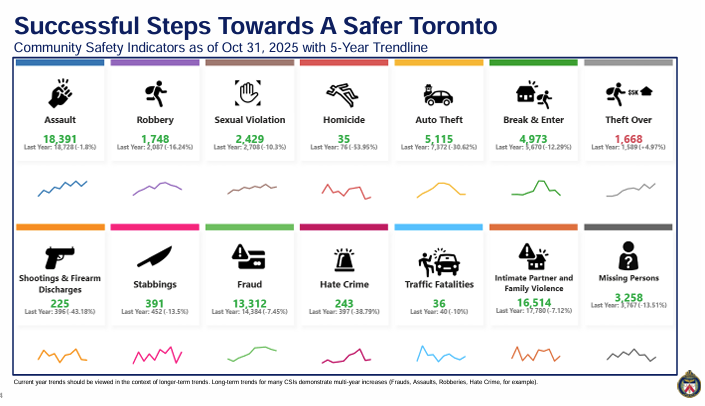
Ford was first elected premier in June 2018, almost eight years ago. Meanwhile, in Toronto, almost every major crime indicator — including homicide, assault and break and enters — was down last year.

A slide from the Toronto police’s budget presentation shows the vast majority of major crime indicators are down.


A slide from the Toronto police’s budget presentation shows the vast majority of major crime indicators are down.

Toronto police

During his news conference on Wednesday, Ford went on to repeat his praise of the homeowner.

“They need to rot in jail for the rest of their lives. Congratulations for shooting this guy. Should have shot him a couple more times as far as I’m concerned,” he said.

Story continues below advertisement

Later, he added, “What I’m saying, the vast majority of people are thinking in the province, I can assure you.”

&copy 2026 Global News, a division of Corus Entertainment Inc.


Critics say Ford is ‘flooding the zone’ to distract from transparency controversy | Globalnews.ca


Critics in Ontario say a flurry of government announcements on justice, alcohol and roads is designed to distract from sweeping changes the Progressive Conservatives are planning to apply to the province’s transparency laws.

Watchdog says transparency crackdown will make Ontario more secret and less secure  | Globalnews.ca

On Friday morning, Minister of Public and Business Service Delivery and Procurement Stephen Crawford announced the government would clamp down on freedom of information laws, retroactively exempting himself, Premier Doug Ford and his cabinet from disclosing their records.

The changes will exclude emails from cabinet ministers and their staff, meaning they won’t be subject to scrutiny. It would likely nullify a court order for Ford to release records from his personal phone, which he says he calls CEOs, politicians and advocates on.

Since that announcement, news has rained down from Queen’s Park.

Late on Friday afternoon, Ford posted a pre-recorded video on social media, saying his government would seek an injunction to ban the Al-Quds Day rally in downtown Toronto.

Story continues below advertisement

The video was posted before lawyers filed paperwork with the courts. The government didn’t have its case heard until three hours before the event — which happens every year — was due to take place. A judge threw out the request, saying the province had failed to meet the legal threshold.

Get breaking Canada news delivered to your inbox as it happens so you won't miss a trending story.

Get breaking National news

Get breaking Canada news delivered to your inbox as it happens so you won’t miss a trending story.

Later on Friday, the Ford government also made good on the premier’s promise to let malls open for shopping on both the Family Day and Victoria Day long weekends.

Then, over the weekend, Ontario’s attorney general wrote a letter to the federal government asking it to consider legalizing pepper spray in self-defence. Monday saw Ford announce a legally complicated plan to livestream bail hearings.

On Tuesday morning, the Ministry of Transportation said it would begin allowing vehicles without passengers to use high-occupancy vehicle lanes. Hours after that, the government unveiled a broadening of its tailgating rules, which won’t come into effect until September.


Click to play video: 'Ford government moves to limit transparency legislation'


Ford government moves to limit transparency legislation


“It’s a distraction — flood the zone, put out as many stories as you can so you’re not talking about the premier trying to hide from accountability,” Ontario Liberal MPP John Fraser said.

Story continues below advertisement

Between the announcements, Ford has also taken questions about the transparency changes. On Tuesday, he appeared to acknowledge the sweeping changes were motivated by a desire to keep his call logs secret.

Ontario NDP Leader Marit Stiles said the volume of announcements only underscored her interest in what calls or messages could have motivated the premier to prepare a law to cancel out a legal defeat.

“There has to be something really significant for the premier to be dropping so many of these predictable announcements,” she told reporters. “My goodness, it’s booze, it’s pepper spray, anything to distract from the fact he is losing in court and he doesn’t want anybody to be able to access his cellphone records.”

Fraser said the announcements the Ford government has made since unveiling its freedom of information law changes are easy to implement.

“You’ll notice one other thing,” he said. “The stuff he does (want to talk about), like you can bring your own booze or you can drive in this lane, it’s all easy. Stroke of a pen stuff. He can’t do the hard stuff. He can’t make class sizes smaller because he’s not interested in that, or finding people a family doctor, because he’s not really interested in doing that. It’s a game to hide from accountability.”

Ford is scheduled to hold another news conference out of Toronto on Wednesday.

&copy 2026 Global News, a division of Corus Entertainment Inc.


Ontario expanding bring-your-own-booze rules to include festivals | Globalnews.ca


The Ford government says it plans to expand tailgate permits to let people bring and drink their own alcohol at certain events, including some movie screenings and farmers’ markets.

Watchdog says transparency crackdown will make Ontario more secret and less secure  | Globalnews.ca

The province announced the move on Tuesday afternoon, suggesting it would drive local tourism and economic growth by boosting attendance at some festivals or other municipal events.

Premier Doug Ford told reporters he saw it as a policy to help attract more people to outdoor events.

Get breaking Canada news delivered to your inbox as it happens so you won't miss a trending story.

Get breaking National news

Get breaking Canada news delivered to your inbox as it happens so you won’t miss a trending story.

“We’re talking about general venues, cultural venues outside, they should be able to have a glass of wine or a beer,” he said.

“That’s not the first time this has happened. It’s happened before that certain special occasions we allow people to drink at a festival or in a park, and do it responsibly.”

Story continues below advertisement

Before the changes, only people organizing sporting tailgates could request a permit to let people bring their own alcohol. The government said the changes could extend to events like art exhibitions and neighbourhood festivals.


Finance Minister Peter Bethlenfalvy said the move would “empower local communities.”

Municipalities will have to pass bylaws allowing people to drink in public if they don’t already allow it and establish a process for events that qualify under the new rules.

Beginning in September, people will be able to apply for permits through the Alcohol and Gaming Commission of Ontario.

— With a file from The Canadian Press

&copy 2026 Global News, a division of Corus Entertainment Inc.