President Donald Trump revealed which Supreme Court justice he considers to be his “new hero” after a high court ruling rejected his sweeping tariff powers on Friday.
Trump made the declaration in a post on his Truth Social platform on Saturday morning, a day after the Supreme Court voted 6-3 to block Trump’s tariff powers under the International Emergency Economic Powers Act (IEEPA).
“My new hero is United States Supreme Court Justice Brett Kavanaugh and, of course, Justices Clarence Thomas and Samuel Alito,” the post read. “There is no doubt in anyone’s mind that they want to, MAKE AMERICA GREAT AGAIN!”
While all three justices voted with the minority, Kavanaugh wrote a fiery dissent that called the high court’s decision “illogical.”
“As they interpret the statute, the President could, for example, block all imports from China but cannot order even a $1 tariff on goods imported from China,” Kavanaugh wrote. “That approach does not make much sense.”
Kavanaugh asserted that the IEEPA “does not draw such an odd distinction between quotas and embargoes on the one hand and tariffs on the other,” but rather empowers the president to regulate imports during national emergencies using tools such as quotas, embargoes and tariffs.
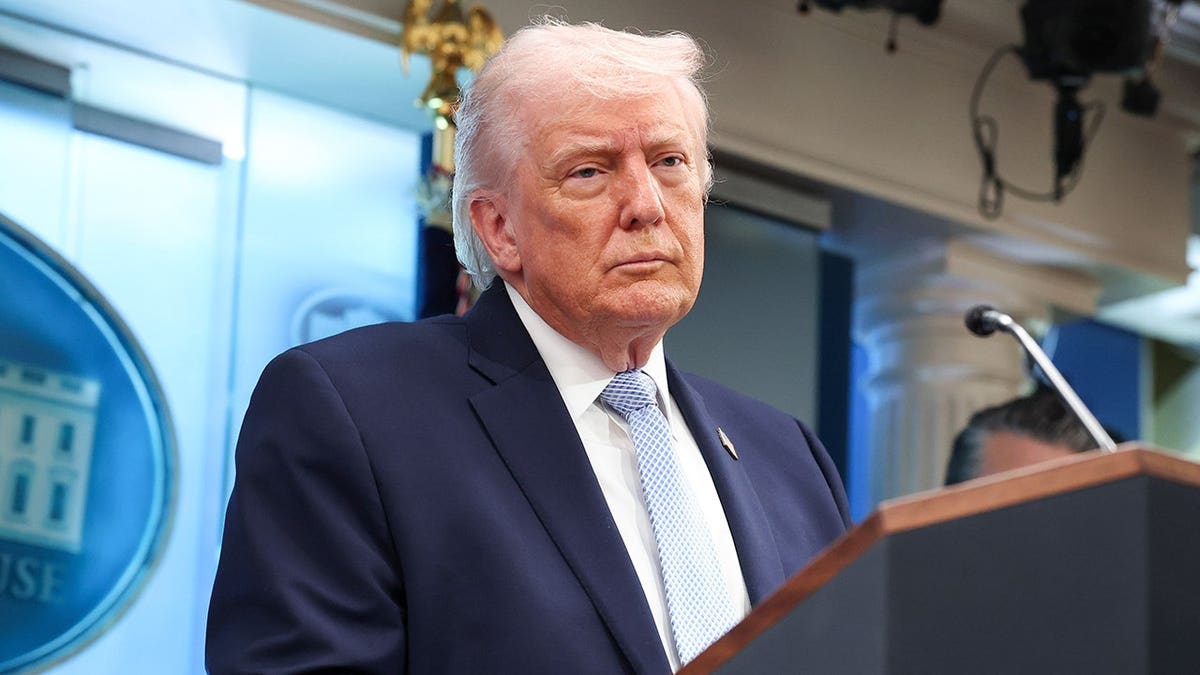
President Donald Trump speaks at a press conference at the White House after a Supreme Court ruling on tariffs on Feb. 20, 2026. Kyle Mazza/ShutterstockBrett Kavanaugh testifies before the Senate Judiciary Committee during his Supreme Court nomination hearing on Sept. 27, 2018. AP
Trump last year bypassed Congress and unilaterally levied tariffs on nearly every country in the world by invoking the IEEPA.
The president argued that an influx of illicit drugs from China, Mexico and Canada and a trade deficit that has decimated American manufacturing constituted emergencies that justified the tariffs.
Trump, in a Friday speech remarking on the decision, praised Kavanaugh for “his genius and his great ability,” adding he was “very proud of that appointment.”
Here’s the latest on President Trump’s tariffs following Supreme Court ruling:
Kavanaugh wrote in his dissent that while he disagrees with the court’s ruling, its decision may not “substantially constrain” a president’s ability to order tariffs going forward because of “numerous other federal statutes” that allow the president to impose tariffs.
The justice added that the court’s decision may, however, have substantial interim effects.
“The United States may be required to refund billions of dollars to importers who paid the IEEPA tariffs, even though some importers may have already passed on costs to consumers or others,” Kavanaugh wrote. “As was acknowledged at oral argument, the refund process is likely to be a ‘mess.’”
President Donald Trump reveals his “reciprocal tariffs” during an event in the Rose Garden of the White House on April 2, 2025. Getty ImagesThe Supreme Court voted 6-3 to block Trump’s tariff powers under the International Emergency Economic Powers Act. AP
He added that the high court’s decision could “generate uncertainty” regarding what the government has said were trade deals worth trillion of dollars with foreign nations, including with China, the United Kingdom and Japan.
Trump on Saturday raised the global tariff to 15% — up from the 10% global tariff he announced Friday in the wake of the Supreme Court ruling.
He cited Section 122 of the Trade Act of 1974 in announcing the new levy.
U.S. President Donald Trump speaks during a press briefing held at the White House February 20, 2026 in Washington, DC.
Kevin Dietsch | Getty Images News | Getty Images
President Donald Trump on Saturday said he would increase global tariffs to 15% from 10%, one day after the Supreme Court struck down his “reciprocal” tariffs.
The new tariffs will be “effective immediately,” Trump said in a Truth Social post.
“I, as President of the United States of America, will be, effective immediately, raising the 10% Worldwide Tariff on Countries, many of which have been “ripping” the U.S. off for decades, without retribution (until I came along!), to the fully allowed, and legally tested, 15% level,” he wrote.
In his social media post Saturday, Trump also warned that additional tariffs would follow.
“During the next short number of months, the Trump Administration will determine and issue the new and legally permissible Tariffs,” he wrote.
The White House did not immediately respond to a CNBC request for comment.
The increase comes after the Supreme Court on Friday, in a 6-3 tariff ruling, decided that Trump wrongfully invoked the International Emergency Economic Powers Act (IEEPA) to implement his levies.
Trump responded the same day with a 10% global tariff, exercising his authority under Section 122 of the Trade Act of 1974. The statute allows the president to implement only temporary levies, with any extension requiring congressional approval.
Read more CNBC coverage on tariffs
The president was scathing in his remarks against the Supreme Court decision, calling it in his social media post that it was “ridiculous, poorly written, and extraordinarily anti-American.”
He also attacked Justices Neil Gorsuch and Amy Coney Barrett after they voted with the majority in the ruling.
This is breaking news. Please refresh for updates.
World leaders during the G7 Leaders’ Summit in Kananaskis, in Alberta, Canada, June 17, 2025.
Amber Bracken |Reuters
U.S. trading partners offered a cautious welcome to the U.S. Supreme Court’s decision Friday to strike down large parts of President Donald Trump’s flagship trade policy on global tariffs — but global trade bodies warned of lingering uncertainty surrounding import levies.
The law that undergirds the import duties “does not authorize the President to impose tariffs,” the majority ruled six to three in the long-awaited Supreme Court decision.
Hours after the ruling, Trump said he signed an executive order imposing a new 10% “global tariff”. The “Section 122” tariffs will take effect “almost immediately,” Trump said. At a White House press briefing Friday afternoon, Trump railed against the “deeply disappointing” 6-3 ruling.
Trump’s tariff regime impacted a swathe of countries from the U.K. to India and the European Union. Some governments, like Vietnam and Brazil are still in negotiations.
Taiwan, home to the the world’s leading contract chipmaker and producer of the most advanced semiconductors, said the 10% flat tariff rate would, according to an initial assessment, have a “limited impact” on its economy.
The island will continue to “closely monitor” developments and maintain close communication with the U.S. to understand the specific measures and respond in a timely manner, the Taiwanese cabinet said in a statement on Saturday.
French President Emmanuel Macron reportedly said the Supreme Court’s ruling proved the benefit of having an effective counterweight to power.
“It is not bad to have a Supreme Court and, therefore, the rule of law,” Reuters quoted him as saying at an event in Paris on Saturday.
A U.K. government spokesperson said the country would continue to work with the White House administration to understand how the ruling will affect tariffs for the U.K. and the rest of the world
“This is a matter for the U.S. to determine but we will continue to support U.K. businesses as further details are announced,” the spokesperson said.
“The U.K. enjoys the lowest reciprocal tariffs globally, and under any scenario we expect our privileged trading position with the U.S. to continue.” The U.K. agreed a wide-ranging trade deal with the U.S. in May last year, which imposed a broad 10% levy on many goods, but also included certain carve-outs on steel, aluminum, cars and pharmaceuticals.
The Supreme Court case focused mainly on reciprocal tariffs, and the ruling leaves much of the U.K.’s trade deal with the U.S. — including preferential sectoral tariffs on steel, pharmaceuticals and autos — unaffected.
However, the British Chambers of Commerce (BCC) trade body said the U.S. Supreme Court decision adds to the ongoing uncertainty around levies.
William Bain, head of trade policy at the BCC, said the move “does little to clear the murky waters” for British businesses, warning that the President still has “other options at his disposal” to retain his current regime on steel and aluminum tariffs.
“The court’s decision also raises questions on how U.S. importers can reclaim levies already paid and whether U.K. exporters can also receive a share of any rebate depending on commercial trading terms,” Bain said in a statement. “For the U.K., the priority remains bringing tariffs down wherever possible.”
Olof Gill, European Commission spokesperson for trade and economic security, said businesses on both sides of the Atlantic depend on “stability and predictability.”
“We remain in close contact with the U.S. Administration as we seek clarity on the steps they intend to take in response to this ruling,” Gill said. “We therefore continue to advocate for low tariffs and to work towards reducing them.”
Meanwhile, Dominic LeBlanc, Canada’s minister for U.S.-Canadian trade relations, said the decision “reinforces Canada’s position that the IEEPA tariffs imposed by the United States are unjustified.”
No trade ‘win’ yet
Elsewhere, Swissmem, Switzerland’s technology industry association, welcomed the ruling — but warned that the Trump administration could invoke other laws to “legitimize tariffs,” and called on Swiss policymakers to strengthen the competitiveness of the country with new free trade agreements.
“From the perspective of the Swiss export industry, this is a good decision. The high tariffs have severely damaged the tech industry. However, today’s ruling doesn’t win anything yet,” Swissmem said.
“The high tariffs have severely damaged the tech industry,” Swissmem wrote on X. “The crucial thing now is to quickly secure relations with the U.S. through a binding trade agreement.”
The International Chamber of Commerce noted that many businesses will welcome the ruling given the “significant strain” that has been placed on balance sheets in recent months.
“But companies should not expect a simple process: the structure of U.S. import procedures means claims are likely to be administratively complex. Today’s ruling is worrying silent on this issue and clear guidance from the Court of International Trade and the relevant U.S. authorities will be essential to minimise avoidable costs and prevent litigation risks,” the ICC said.
— CNBC’s Jackson Peck and Greg Kennedy helped contribute to this story.
A lawyer picked by judges to serve as the top federal prosecutor for a Virginia office that pursued cases against foes of President Donald Trump was swiftly fired Friday by the Justice Department in the latest clash over the appointments of powerful US attorneys.
Deputy Attorney General Todd Blanche announced the firing of James Hundley on social media shortly after he was unanimously chosen by judges to replace former Trump lawyer Lindsey Halligan as interim US attorney for the Eastern District of Virginia.
While the law says that the district court may choose US attorneys when an initial appointment expires, the Trump administration has insisted that the power lies only in the hands of the executive branch.
James Hundley was fired after he was unanimously chosen by judges to replace former Trump lawyer Lindsey Halligan as interim US attorney for the Eastern District of Virginia. Briglia Hundley
“EDVA judges do not pick our US Attorney. POTUS does. James Hundley, you’re fired!” Blanche said in a post on X.
Hundley, who has handled criminal and civil cases for more than 30 years, didn’t immediately respond to an email seeking comment Friday evening.
The firing of Hundley is the latest reflection of tumult in one of the Justice Department’s most elite prosecution offices, which since September has been mired in upheaval following the resignation of a veteran prosecutor amid Trump administration pressure to prosecute two of the president’s biggest political foes, former FBI Director James Comey and New York Attorney General Letitia James.
That prosecutor, Erik Siebert, was effectively forced out and swiftly replaced by Halligan, a White House aide who secured indictments against Comey and James but was later deemed by a judge to have been unlawfully appointed.
The cases were dismissed, but the Justice Department has appealed that decision.
The Albert V Bryan US Courthouse in Alexandria, Virginia. Andrew Thomas – CNP for NY PostHundley was tapped to replace Lindsey Halligan as interim US attorney for the Eastern District of Virginia. AP
Halligan resigned from the position last month after judges in the district signaled continued skepticism over the legitimacy of her appointment.
US attorneys, the top federal prosecutors in regional Justice Department offices around the country, typically require Senate confirmation but the law does permit attorneys general to make temporary appointments for limited time periods.
In several instances, though, the Justice Department has attempted to leave its temporary appointees in place in ways that have invited court challenges and drawn resistance from judges who have found the appointments unlawful.
Last week, a lawyer appointed by judges to be the US attorney for northern New York was fired by the Justice Department after spending less than a day in the job.
Judges in the district appointed Kinsella after declining to keep the Trump administration’s pick, John Sarcone, in place after his 120-day term elapsed.
The majority of Canadian exports will remain exempted from Donald Trump’s new 10 per cent global levy, as the U.S. president pivots after the Supreme Court dealt a blow to his plans to realign global trade.
A fact sheet from the White House said the latest tariff will not hit goods compliant under the Canada-U.S.-Mexico agreement on trade, known as CUSMA.
The duty will also not be applied on top of sector-specific tariffs like steel, aluminum and automobiles.
Trump signed an executive order Friday to enact the worldwide tariff beginning on Tuesday using Section 122 of the 1974 Trade Act. That duty can only stay in place for 150 days, unless Congress votes to extend it.
“Those members of the Supreme Court who voted against our very acceptable and proper method of TARIFFS should be ashamed of themselves,” Trump posted on social media.
Story continues below advertisement
“Their decision was ridiculous but, now the adjustment process begins, and we will do everything possible to take in even more money than we were taking in before!”
Supreme Court strikes down Trump’s global tariffs
Earlier Friday, the U.S. Supreme Court concluded it was not legal for Trump to use the International Emergency Economic Powers Act, better known as IEEPA, for his “Liberation Day” tariffs and fentanyl-related duties on Canada, Mexico and China.
Trump declared an emergency at the northern border related to the flow of fentanyl in order to use IEEPA to hit Canada with 35 per cent tariffs. Those duties did not apply to goods compliant under CUSMA.
Get daily National news
Get the day’s top news, political, economic, and current affairs headlines, delivered to your inbox once a day.
In a 6-3 ruling, the court said the U.S. Constitution “very clearly” gives Congress power over taxes and tariffs. Chief Justice John Roberts wrote “the Framers did not vest any part of the taxing power in the Executive Branch.”
Story continues below advertisement
The ruling did not say whether companies hammered by those tariffs should get refunds. As of December, federal data showed US$133 billion had been collected.
The court’s decision “reinforces Canada’s position that the IEEPA tariffs imposed by the United States are unjustified,” said Canada-U.S. Trade Minister Dominic LeBlanc in a post on social media.
“While Canada has the best trade deal with the United States of any trading partner, we recognize that critical work lies ahead to support Canadian businesses and workers who remain affected by Section 232 tariffs on steel, aluminum and automotive sectors,” LeBlanc said.
During a 40-minute press conference Friday afternoon, Trump lashed out at the Supreme Court justices and said the decision was “incorrect.” Trump also denigrated Europe as too “woke” and took aim at Canada, saying the country ripped off the U.S. and stole car plants.
Trump ‘disagrees’ with Supreme Court ruling, imposes new 10% global tariff ‘effective immediately’
Trump claimed that Canada said it hoped he would win at the Supreme Court “because if you don’t win you’ll actually be able to charge us, with additional work, higher tariffs.”
Story continues below advertisement
LeBlanc spoke with U.S. Trade Representative Jamieson Greer by phone recently. When asked for comment on Trump’s claim about Canada, LeBlanc’s office referred to his social media statement.
Trending Now
Virginia Giuffre’s family responds to Andrew arrest: ‘He was never a prince’
Danielle Smith promises Alberta referendum over immigration, Constitution changes
Greer told “Fox News” Friday that while the 10 per cent tariff is in place, the Trump administration will begin investigations of countries under Section 301 of the Trade Act of 1974.
That allows a president to take trade actions if the investigation finds a trading partner’s policies are unreasonable and discriminatory, but it would take months and include a period for public comment.
Friday’s ruling will have little effect on the Canadian economy since most of its exports to the U.S. are shielded by the CUSMA carveout, said CIBC chief economist Avery Shenfeld.
Candace Laing, president and CEO of the Canadian Chamber of Commerce, said it’s “not the last chapter of this never-ending story.” She cautioned that Canada should prepare for “new, blunter mechanisms to be used to reassert trade pressure.”
Trump’s tariffs and threats of annexation have rattled Canada ahead of a mandatory review of the CUSMA trilateral trade pact later this year. Trump has called the trade agreement “irrelevant” and said it may have served its purpose.
SCOTUS rules Trump’s tariffs overstepped his authority, but what does that mean for Canada?
A successful CUSMA review must see Trump’s separate sectoral tariffs dropped, said Conservative Leader Pierre Poilievre in a social media post.
Story continues below advertisement
Poilievre criticized Prime Minister Mark Carney for not securing a deal with the Trump administration.
“The truth is no one can control what President Trump will say or do and so we must instead focus on what we can control,” Poilievre said. “We must unblock our energy and minerals, unleash our economy, and bolster our military and self-reliance for leverage to fight for tariff-free trade with the U.S.”
The Supreme Court’s decision is a win for U.S. separation of powers and the American and Canadian economies, said George Mason University law professor Ilya Somin, who represented small businesses pushing back on the tariffs.
“But also for the rule of law,” Somin told The Canadian Press. “The rule of law is at odds with a system under which the president can impose any tariffs he wants on any country for any reason at any time.”
—With files from Craig Lord, Kyle Duggan and The Associated Press
The Supreme Court on Friday struck down a huge chunk of President Donald Trump’s far-reaching tariff agenda, delivering a major rebuke of the president’s key economic policy.
The law that undergirds those import duties “does not authorize the President to impose tariffs,” the majority ruled 6-3 in the long-awaited decision.
The ruling is a massive loss for Trump, who has made tariffs — and his asserted power to impose them on any country at any time, without congressional input — a central feature of his second presidential term.
Trump’s legal stance “would represent a transformative expansion of the President’s authority over tariff policy,” the majority concluded. And they highlighted that Trump imposed the tariffs without Congress, which has the power to tax under the Constitution.
Chief Justice John Roberts delivered the opinion of the court. Justices Clarence Thomas, Samuel Alito and Brett Kavanaugh dissented.
Read more CNBC coverage on tariffs
The decision noted that before Trump, no president had ever used the statute in question “to impose any tariffs, let alone tariffs of this magnitude and scope.”
To justify the “extraordinary” tariff powers, Trump must “point to clear congressional authorization,” the court wrote. “He cannot.”
The ruling was silent on whether tariffs that have been paid under the higher rates will need to be refunded. That sum could total $175 billion, according to a new estimate from the Penn Wharton Budget Model.
Kavanaugh wrote in his dissent that the refund process “is likely to be a ‘mess,'” after predicting that the short-term impact of the court’s tariff ruling “could be substantial.”
Many of those tariffs were invoked using a novel reading of the International Emergency Economic Powers Act, or IEEPA. They include Trump’s near-global “reciprocal” tariffs, and separate duties related to the alleged trafficking of deadly drugs into the U.S.
The IEEPA does not explicitly mention tariffs, as the Supreme Court noted Friday. Instead, it allows the president to “regulate … importation” of foreign property transactions after declaring a national emergency in order to deal with certain “unusual and extraordinary” threats.
The Trump administration has argued that language empowers the president to impose tariffs on foreign goods.
Critics charged that the law does not permit the president to unilaterally impose levies of any size on any country at any time. A federal trade court and a federal appeals court both found Trump’s IEEPA tariffs illegal before the Supreme Court took up the case.
The majority of U.S. tariff revenue generated last year came from the IEEPA duties.
“This ruling is a victory for every American family paying higher prices because of Trump’s tariff taxes,” Rep. Brendan Boyle of Pennsylvania, the House Budget Committee’s top-ranking Democrat, said in a statement. “The Supreme Court rejected Trump’s attempt to impose what amounted to a national sales tax on hardworking Americans.”
House Ways and Means Committee ranking member Richard Neal, D-Mass., in a statement called the decision “a victory for the American people, the rule of law, and our standing in the global economy.”
Footwear Distributors and Retailers of America, a U.S. sneaker industry group, said Friday’s ruling “marks an important step toward creating a more predictable and competitive environment for American businesses and consumers.”
“This ruling provides relief at a time when cost pressures have been significant,” Matt Priest, president and CEO of the footwear group, said in a statement.
The Distilled Spirits Council, an advocacy group for U.S. liquor makers, responded to the ruling by urging the Trump administration to “secure a permanent return to zero-for-zero tariffs” with top trade partners.
Doing so “would provide much needed certainty for American spirits exporters while helping ease financial pressures on bars, restaurants and retailers at a time when affordability remains a major concern for consumers,” said the council’s president and CEO, Chris Swonger, in a statement.
Dominic LeBlanc, Canada’s minister for trade with the U.S., said in a post on X that the decision “reinforces Canada’s position that the IEEPA tariffs imposed by the United States are unjustified.”
Tariff tumult
Trump last April unveiled his sweeping reciprocal tariff plans at a much-ballyhooed White House event marking what he had dubbed America’s “liberation day.”
That announcement stoked a sudden market panic, and the tariffs were quickly put on pause. They have since been repeatedly tweaked, delayed and reimposed, adding confusion and further complexity to the administration’s tangled web of trade policies.
Other IEEPA-based tariffs include a set aimed at Mexico, Canada and China related to allegations that those countries have allowed the deadly drug fentanyl to flow into the U.S.
Trump, a fierce critic of America’s recent history of making free trade deals, has repeatedly praised tariffs as both a bountiful source of federal revenue and a key tool in negotiations with foreign partners and adversaries alike.
He has claimed foreign countries bear the cost of his tariffs, and he has downplayed concerns that the taxes lead to higher prices for Americans. His administration, however, has admitted that the duties are paid by U.S. importers.
Trump has claimed the tariff revenue has been so large that the duties may be able to replace the income tax. He has also floated the idea of sending Americans $2,000 tariff dividend checks.
“We have taken in, and will soon be receiving, more than 600 Billion Dollars in Tariffs,” he wrote in a recent Truth Social post.
For the IEEPA-specific tariffs, the administration said it has collected about $129 billion in revenue as of Dec. 10.
Ahead of the ruling, Trump and his administration talked up the consequences of the high court striking down the tariffs.
“If the Supreme Court rules against the United States of America on this National Security bonanza, WE’RE SCREWED!” Trump wrote on Jan. 12.
U.S. officials, including Treasury Secretary Scott Bessent, have stated they believed the Supreme Court would not undo the president’s “signature” economic policy.
While U.S. President Donald Trump’s sweeping global tariffs were struck down by the U.S. Supreme Court on Friday, experts and economists say the decision is unlikely to bring relief for consumers in Canada.
Hours after the court’s decision on his tariffs, Trump said he was imposing another global tariff of 10 per cent under Section 122 of the U.S. Trade Act, which limits tariffs that address trade deficits to 15 per cent and for no longer than 150 days.
The law Trump used to impose the global tariffs that were struck down — the International Emergency Economic Powers Act (IEPPA) — “does not authorize the President to impose tariffs,” Chief Justice John Roberts wrote in the majority opinion.
Economists have pointed out that the impact of the IEEPA tariffs on Canada has been blunted by the exemptions granted to goods traded in compliance with the Canada-U.S.-Mexico Free Trade Agreement (CUSMA).
Story continues below advertisement
According to a report by RBC, around 89 per cent of Canadian exports to the U.S. in December were not charged with tariffs because they’re compliant with rules of origin requirements in CUSMA.
“The ruling will have less impact on Canadian trade than most other countries. Most Canadian exports are already exempt from IEEPA tariffs via an exemption for CUSMA compliant trade,” the RBC report said.
Supreme Court strikes down Trump’s global tariffs
While nearly 90 per cent of the tariffs’ economic burden was borne by U.S. consumers and firms, Canadians have felt the impact of higher prices because of the integrated supply chains between the two countries.
Get daily National news
Get the day’s top news, political, economic, and current affairs headlines, delivered to your inbox once a day.
For example, beer cans use Canadian aluminum and are made into can sheets in the United States. The metal crosses the border several times before it hits the shelves.
Story continues below advertisement
Friday’s decision does not affect the sectoral tariffs on key Canadian products, like metals, autos and lumber.
“It’s not material at all for our industry in the aluminum sector because we are under a different section, Section 232,” said Jean Simard, president and CEO of the Aluminum Association of Canada.
Before Trump’s tariffs went into effect last year, some businesses acted proactively, said Concordia University economist Moshe Lander.
“Canadian businesses front-loaded a lot of exports into the U.S. to avoid the tariffs,” he said.
This meant many businesses had built up inventory to avoid price increases for their consumers.
Once prices have been raised, its unlikely that they’ll be reversed, said retail analyst Bruce Winder.
Trending Now
Trump doubles down after U.S. Supreme Court strikes down global tariffs
‘No reason to continue discussing’: Ontario mayor wants Andrew’s name dropped
“These new prices have been normalized now,” Winder said.
“Most large retailers don’t lower prices. They might use some of that money for share buybacks, dividends or strategically lower prices or promotions if they see the market going that way. But no one at the top wants to lower prices unless you have a strategic reason to do it. It’s not good for sales and earnings,” he added.
Trump could scale back aluminum and steel tariffs ahead of midterms: report
The real impact may be less so on price tags at stores and more on consumer confidence, said BMO Capital Markets senior economist Erik Johnson.
Story continues below advertisement
“It’s less likely to have implications on the job market and things that feed into decisions consumers make every day about whether to go out and buy a new car or whether to buy a new home or upgrade or downsize — all those big consumer decisions,” he said.
But Canadian businesses will continue to be on shaky ground with the cloud of uncertainty still hanging over the U.S. trading relationship, Lander said.
“The problem is not just the tariffs themselves. It’s these constant reversals on policy. Businesses that make decisions 30 to 50 years out need to have some degree of clarity,” he said.
“What you don’t need is a White House that takes a decision on a Monday, does a 180 on a Tuesday, doubles down on Wednesday, and then backs away from it entirely on Thursday,” he added.
Ukraine will mark the fourth anniversary of Vladimir Putin’s barbaric invasion on Tuesday, February 24.
The date will serve as a cruel reminder of just how long this war has been raging, especially as the third round of trilateral talks between Russia, Ukraine and the US failed to make any significant progress last week.
Moscow’s refusals to give up its maximalist goals weigh down Donald Trump’s push for a speedy peace deal – though the US president continues to falsely blame Kyiv for the stagnant talks.
Earlier this week, he told reporters that it was going to be “very easy” to reach a deal.
But he warned: “Ukraine better come to the table, fast. That’s all I’m telling you. We are in a position, we want them to come.”
Desperate to secure an agreement and consolidate his supposed reputation as a “deal-maker”, Trump has time and time again promised a truce is on the horizon – all while Russian strikes continue to target Ukraine.
But, as Ukraine enters its fifth year of war, could the president be right, and an end is in sight?
HuffPost UK asked experts just how realistic Trump’s claims are – and if there are any alternatives to a formal peace agreement.
Could 2026 Be The Year The Ukraine War Finally Turns Around?
British officials are confident that Ukraine can hold its ground on the battlefield in the east, even after a challenging winter where Russia repeatedly targeted Ukraine’s energy infrastructure.
That enables Kyiv to hold a firmer line in negotiations – like refusing to give into Putin and Trump’s demands that Ukraine gives up even more land.
But there are fears – particularly in Ukraine – that the talks themselves are just theatre to entertain Trump, with Kyiv delegates put under pressure to join.
Similarly, experts told HuffPost UK that it seems unlikely these negotiations will result in anything.
Professor Konstantin Sonin, from the University of Chicago Harris School of Public Policy said he remains sceptical that Trump could secure a peace deal because “the basic, big things remain unchanged”.
Ukrainian soldiers of the 48th separate artillery brigade fire at Russian positions on the frontline in Kharkiv region, Ukraine, Wednesday, Feb. 18, 2026.
He told HuffPost UK that Putin does not care about the cost of the war in terms of soldiers’ lives and material expenses, even though Russia is estimated to have suffered 1.2 million casualties since the conflict began.
While British officials have signalled that, beneath the surface, Russia’s economy is slowing down – with a fall in oil prices and a hike in VAT – that impact does not seem to have yet trickled through to the battlefield.
But, at the same time, the Ukrainian army and state is nowhere near the state of collapse. In fact, its defence sector has been boosted over the last four years.
“A couple of more years of grinding warfare, in which the Russian army exchanges dozens of thousands of men for villages and townships in Eastern Ukraine, are totally possible,” Sonin, a Russian citizen and Kremlin critic, said.
“And then a new US president, a Republican or a Democrat, will be able to push Putin towards peace.”
Dr Simon Bennett, from the University of Leicester’s civil safety and security unit, also suggested it seemed pretty unlikely Trump’s efforts would result in a peace deal.
He said: “The upshot of this in 2026 is likely to be that Russia’s gains will come at an even greater cost, and, occasionally, will be partially reversed, albeit on a small scale in terms of square miles retaken by Ukraine.”
Bennett predicted Putin’s ongoing bid to control the whole of Ukraine’s eastern region, the Donbas, will likely mean the territory continues to be “the same bloody quagmire in 2026 as it was in 2025.”
“A couple of more years of grinding warfare… are totally possible”
– Professor Konstantin Sonin, the University of Chicago Harris School of Public Policy
Could Anything Force Trump To Crack Down On Putin?
Kurt Volker, who stepped down as Trump’s special envoy to Ukraine in 2019, claimed this week that the president has done a lot towards ending the war.
For instance, he has encouraged Ukraine to accept the idea of a ceasefire, and forced European allies to increase defence spending.
But speaking to the Centre for European Policy Analysis (CEPA) think tank, Volker said: “He still needs to get an end to the war. We need to be demanding a ceasefire and putting pressure on Russia to do that as soon as possible.”
The president’s annual State of the Union address is set to be on February 24 this year, the fourth anniversary of Russia’s full-scale invasion.
But experts do not expect him to use the opportunity to finally recognise the extent of Russia’s aggression against Ukraine.
As Bennett said, Trump is too “inconsistent” – and his approach to policy-making is a “crisis or war waiting to happen”.
The specialist also pointed out that “Putin has no intention of negotiating a peace deal” and claimed he is playing “demonstrably gullible” Trump.
Meanwhile, when asked if the US president could crack down on Russia in a bid to boost his ratings before the midterm elections in November, Sonin said: “There will be more pressure on Trump from the Congress Republicans, because both the US population and the elite have been consistently supportive of Ukraine through the years of war.
“So, I’d expect Trump to do small things against Putin.”
President Donald Trump, right, and Ukraine’s President Volodymyr Zelenskyy shake hands at the start of a joint news conference following a meeting at Trump’s Mar-a-Lago club, Dec. 28, 2025, in Palm Beach, Fla.
Could It Be Possible To Agree To A Ceasefire, but Not A Peace Deal?
Kurt Volkner told CEPA that it could be possible to strike up a deal comparable to the one which stopped the war between North and South Korea.
That non-aggression pact has – for the most part – held for more than 70 years, even though neither side technically agreed to a sustainable peace.
Volkner said: “Someday, I do believe there will be a ceasefire. I don’t believe there will ever be a peace agreement.
“I don’t believe Vladimir Putin will ever accept that there is an independent and sovereign Ukraine.
“Again, of the West, of governments, of investors, businesses, needs to be one that assumes that we will have a strong, growing, prosperous democratic European Ukraine that is safe and worthy of investment and business growth, very much like South Korea, without a final peace agreement with Russia, that’s just going to be where we are.”
But Sonin disagreed with this idea.
He said that while the North-South Korea deal was “one of the most durable, effective peace agreements despite never being finally ‘settled’”, it’s clear from previous attempts that written agreements between Russia and Ukraine do not work.
He also pointed out that such an agreement relies on the US commitment to help South Korea if North Korea invades, and China’s commitment to help North Korea if South Korea invades.
Sonin said: “A ‘peace agreement without a peace agreement’ between Russia and Ukraine is totally possible, but it will require Polish, German, Swedish, Baltic, etc, troops on the ground in Ukraine and a firm US commitment to get involved immediately if a new conflict starts.”
Bennett also dismissed Volker’s argument, as Putin still wants to restore Ukraine into a satellite state for Moscow.
“Few western leaders mention the fact that Putin’s war aims have not changed, first, because it does not fit with the Trump-the-Peacemaker-Extraordinaire narrative and secondly, because, when it comes to dealing with Trump, most western leaders are spineless,” Bennett said.
President Donald Trump, right, shakes the hand of Russia’s President Vladimir Putin during a joint press conference at Joint Base Elmendorf-Richardson, Alaska, Friday, Aug. 15, 2025.
Can Anything Be Done In The Pursuit Of Peace?
It’s widely believed that, in the absence of a stronger response from Trump, only a firmer intervention from Europe can actually stop the war.
But Ukraine allies across the continent have so far refused to commit to sending troops unless they operate in a peace-keeping capacity, as they want to avoid direct conflict with Russia.
Sonin told HuffPost UK: “I think that European countries will have to get involved into the military defense of Ukraine – sending ground troops, drone operators, etc. Of course it is a heavy lift politically.
“However, for the elites in Poland or Germany or Czech Republic or Romania or Baltic countries a scenario of Russia-controlled Ukraine (with Ukrainian army under maybe influence of the Russian masters) should be so scary that even a political heavy lift might become reality.”
He warned that without such an intervention, “the only hope is an internal collapse of Putin’s regime”.
Similarly, Bennett said Europe must resolve the issue by sending arms to Ukraine urgently, while the Russian army is weak.
“The cost in blood and treasure will be great,” Bennett said. “But nowhere near as great as allowing Russia to regenerate its armed forces for a final push on western Europe in five to 10 years’ time.”
Bennett said he saw this year’s Munich Conference as a “watershed moment”, as US secretary of state Marco Rubio reiterated that the White House primarily sees the Ukraine conflict as a problem for Europe not for the US.
Similarly, Volker said: “Europe can do a lot and can do a lot more than it is currently doing. And as I said, I picked up in Munich a realisation among a lot of European leaders that they’re not doing enough, that they need to step in and fill a gap that the US is leaving. So there are there’s a lot they can do.”
“The US sees itself as more of an arbiter than a prime mover in respect of European security,” Bennett said, adding: “I shall put it bluntly: the only way to end this war is through war. Europe must take Russia down.”
With nothing within Russia threatening to slow Putin’s ongoing aggression, and Trump’s efforts still – for now – amounting to mainly showmanship, ending the war in 2026 seems like a pipe dream, unless Europe gets directly involved.
As Bennett said: “Our fate is in our hands, and no-one else’s.”
US President Donald Trump speaks to reporters on Air Force One before taking off from Joint Base Andrews, Maryland on Feb. 19, 2026.
Saul Loeb | AFP | Getty Images
Oil prices hovered near six-month highs on Friday after U.S. President Donald Trump warned Iran that “really bad things” will happen if there was no deal over its nuclear program.
International benchmark Brent crude futures with April delivery traded 0.2% lower at $71.53 per barrel at around 9:24 a.m. London time (4:24 a.m. ET), erasing earlier gains, while U.S. West Texas Intermediate futures with March delivery stood 0.2% lower at $66.30.
Both contracts notched their highest settle in six months in the previous session as energy market participants continue to monitor supply risks in the oil-rich Middle East.
The U.S. and Iran have held talks in Switzerland this week to try to resolve a standoff over Tehran’s nuclear program. Initial reports of progress, however, gave way to accusations from Washington that Iran had failed to address core U.S. demands.
Speaking at the first meeting of his Board of Peace in Washington on Thursday, the U.S. president said “bad things will happen” if Tehran doesn’t agree to a deal over its nuclear program.
Trump added that the world will likely find out over the next 10 days whether the U.S. will reach a deal with Iran or take military action. He later told reporters aboard Air Force One that he wanted an agreement within “10 to 15 days.”
Brent crude futures over the last six months.
His comments come after a significant buildup of U.S. military forces in the Middle East and amid reports the White House is considering fresh military action against Tehran as soon as this weekend.
Trump said Iran’s nuclear potential had been “totally decimated” by U.S. strikes on its facilities in June last year, before adding “we may have to take it a step further or we may not,” without providing further details.
Iran reportedly said in a letter to United Nations Secretary-General Antonio Guterres on Thursday that Tehran will respond “decisively” if subjected to military aggression.
The Islamic Republic has conducted military drills in the strategically vital Strait of Hormuz in recent days, as well as joint naval drills with Russia in the Gulf of Oman, also known as the Sea of Oman.
Naval units from Iran and Russia carry out to simulation of rescue a hijacked vessel during the joint naval drills held at the Port of Bandar Abbas near the Strait of Hormuz in Hormozgan, Iran on February 19, 2026.
Anadolu | Anadolu | Getty Images
“Everything is in place, or will be by Saturday night, for strikes to commence and so the window opens then,” Daniel Shapiro, former U.S. ambassador to Israel, told CNBC’s “Access Middle East” on Friday.
“Doesn’t mean that’s going to happen immediately. The president did indicate that he is waiting to hear from Iran whether they are prepared to make concessions on their nuclear program that he’s insisting on,” Shapiro said.
“I think it’s unlikely. We have never seen Iran open to those types of concessions, so I think it is unlikely they will agree to those, which means that in the days coming, the president will have to make that decision on military strikes,” he added.
A ‘very well supplied’ market
The Trump administration has said it still hopes to reach a diplomatic resolution over Tehran’s nuclear program, with White House press secretary Karoline Leavitt saying on Wednesday that it would be “very wise” for Iran to make a deal.
Martijn Rats, chief commodity strategist at Morgan Stanley, said that, while the oil market is “very well supplied” on a global basis, there are three factors propping up prices.
“Worries about Iran, clearly. Also, an unusually large amount of buying by China, simply for stockpiling purposes. It makes you wonder what they are going to do with all these inventories and then also we have very high freight rates,” Rats told CNBC’s “Europe Early Edition” on Friday.
“The factor of those three that is most prominent, of course, is the issue in Iran,” Rats said.
Strategists at Barclays said Friday that while equity markets have largely shrugged off the geopolitical noise so far, tensions have been rising since Vice President JD Vance accused Iran of failing to discuss so-called “red lines,” alongside reports of increased U.S. military capability in the region.
“We believe that any strike would likely have to be time limited and with defined targets (nuclear, ballistic missiles), as they were last summer,” the strategists said in a research note.
“With midterm elections later this year and the administration prioritizing affordability for US consumers, we suspect their willingness to tolerate a prolonged period of significantly higher oil prices, and potentially casualties too, will be limited,” they continued. “So if conflict is imminent it is likely to be short lived, in our view.”