A US Airman stationed overseas in Japan says his beloved dog named Maverick and his car were stolen by his house sitter who apparently suffered a “mental break” before taking the pooch.
“I am looking for this person. He was housesitting for me while I am deployed with the Air Force,” Andrew Beckham wrote in a Nest alert shared on Facebook on April 3. “He has stopped all contact and taken Maverick and my vehicle.”
Maverick, the 11-year-old Siberian husky, was staying at Beckham’s Aurora, Colo., home with the hired helper when he was taken outside and put into the airman’s 2014 Subaru Forester the night he went missing.
Andrew Beckham says his husky, Maverick, was taken by his house sitter while he was deployed in Japan. Andrew Beckham/Facebook
Beckham shared a snap of the suspected dognapper and revealed he had captured the worker on video driving away with his car and dog.
“(The house sitter) is having a mental break of paranoia and has run away with my car and dog 4 days ago with no contact and no phone,” Beckham wrote on Facebook.
The frustrated dog owner claims he hired the man off Trusted House Sitters — which connects pet owners with suitable sitters — and has reached out to the company asking for help locating him and his dog.
“He has not been found and he has my dog,” Beckham wrote.
Doorbell camera footage captured the nighttime dog heist as the man guided the dog out the front door and into the driveway, according to an image obtained by Fox 31 Denver.
“It was hard to see on my camera because he was taking Maverick out at night and then going in the car without telling me where he was going,” Beckham told the outlet.
Doorbell camera footage captured the house sitter leaving the Colorado home with Maverick. FOX31 Denver/YouTubeMaverick weighs approximately 60 pounds, has a missing toe on his front left paw, has mild arthritis and has one blue eye and one brown eye. Andrew Beckham/Facebook
Beckham revealed he allowed the worker to stay at his house during his deployment.
An hour before vanishing, the man allegedly called 911, claiming someone was trying to break into the home.
“He seemed scared of something. I don’t know what, but he seemed really scared,” Beckham said.
Maverick weighs approximately 60 pounds, has a missing toe on his front left paw, has mild arthritis and has one blue eye and one brown eye, according to a missing dog poster shared by Beckham.
“I feel like I’ve lost a part of home. Like there’s a hole in my chest where he should be. Maverick has been with me through deployments, through long days, through lonely nights. Losing him, it’s just heartbreaking,” he told the outlet.
Maverick runs out the front door before the house sitter puts him into Beckham’s car. FOX31 Denver/YouTubeThe house sitter was staying at Beckham’s house, taking care of Maverick, before the two disappeared. Facebook
The pooch is microchipped and is listed on several lost pet sites.
Beckham warned people to “not chase, call or whistle as this may cause them to run in fear and into danger.”
Neighbors have joined in the search for Maverick dog and his alleged abductor, driving around the Colorado city looking for Beckham’s missing car, as other volunteers printed out missing posters and plastered them around the neighborhood.
“I’m a dog person. My husband is Air Force. So those two items just told me I needed to do something,” Beckham’s neighbor Carla Wise told Fox Denver. “I drove to the airport, looked at two different, both the west and east parking garages, drove each one for about an hour this morning to see if I could help find the car… but the dog, that’s the main thing.”
“He’s out there. We’re going to get him. We’re going to find him,” she added.
A vet has shared a health warning for dog owners who notice their pet is displaying symptoms
Amber O’Connor Money and Lifestyle reporter U35s
13:52, 02 Apr 2026
The warning was shared in a video posted on Instagram (stock photo)(Image: Getty)
A UK vet has issued a warning to owners of three popular dog breeds. The animal welfare expert took to social media to share guidance about flat-faced breeds, specifically French Bulldogs, Pugs, and English Bulldogs.
In the post, Dr Alex Crow urged owners to remain vigilant for signs that their pet may be struggling to breathe, as veterinary treatment could be required. Dr Crow is a veterinary surgeon and content creator with over 38k followers on Instagram as @Alex_thevet, where he frequently shares pet advice.
In a video posted this week, Dr Crow told dog owners with concerns about their pet’s breathing to speak to their vet about a BOAS assessment. He said: “Brachycephalic obstructive airway syndrome is one of the most common conditions I see in flat-faced breeds — and one of the most misunderstood.
“BOAS affects dogs like French Bulldogs, Pugs, and English Bulldogs, where the skull has been shortened so dramatically that the airway is physically compromised from birth. Narrowed nostrils, an elongated soft palate, and an underdeveloped trachea all combine to make every breath an active effort.
“That snoring you hear at night, the snorting on walks, the heavy panting after minimal exercise — none of that is normal. It is a dog struggling to breathe through an airway that was never built to function properly. If your dog sounds like this, speak to your vet about a BOAS assessment. Early surgical intervention can dramatically improve their quality of life.”
Content cannot be displayed without consent
In the video, the vet also urged people to think twice before buying these breeds, reports the Daily Record. Dr Crow claimed: “Imagine breathing your entire life through a straw.
“Your soft palate is too long for your shortened skull. It hangs in the airway and has to be surgically trimmed just so you can breathe without constantly choking.
“Your nostrils are so narrow that air can barely pass through them. That requires surgery too—a procedure to physically cut away tissue just to open them up again. On top of that, your tongue is also too large for your mouth, so you have to permanently stick it out just to make room for airflow.
“Your constant struggle to breathe creates negative pressure in the airway, which sucks small pouches of tissue called the laryngeal saccules into the throat, adding yet another obstruction on top of everything else. And now imagine that all of that suffering is a result of the way you’ve been bred, just to look a certain way to please humans.
“This condition is Brachycephalic Obstructive Airway Syndrome (BOAS), and it affects breeds like Bulldogs, Pugs, and Frenchies—breeds that have been selectively bred to have flatter and flatter faces over generations. So, if you’re considering buying a flat-faced puppy, maybe think twice.”
PDSA said: “The symptoms of BOAS can appear in puppies but sometimes don’t start until dogs are two to four years old.” Symptoms include snoring, noisy breathing, difficulty eating, and disrupted sleep.
Dogs and people have been side by side for thousands of years, but growing populations of dogs can cause problems for certain communities.
A dog management summit held at Prairieland Park in Saskatoon allowed nine First Nations communities to gather and come up with solutions.
“Working within each of the communities sort of as a tribal council to think about what are the things that can match the community context and the community values that can start to change the situation on the grounds so that dogs who are valued members of communities can stay, live safely and in a healthy way,” said Dr. Jordan Woodsworth, veterinarian and director of Northern Engagement and community outreach at the University of Saskatchewan vet college.
Get daily National news
Get daily Canada news delivered to your inbox so you’ll never miss the day’s top stories.
Being able to gather as a community with youth, elders, and speakers to talk about how people can better protect their dogs and community as a whole is important to tackle the issue.
Story continues below advertisement
“Regarding dog awareness, it’s a really big impact and I think more First Nations should be involved in it. So, this way we can all come together to share our ideas on how we can control our own pets in our community.”
In the past, humans heavily relied on dogs, which isn’t so much the case today.
“Dogs back then were very respected because that was the animal that took us places from point A to point B, plus also to help us hunt,” said Trevor Moberly, band councillor for Birch Narrows Dene Nation.
“Our dogs came a long time ago. That was our way of life, our tradition,” said Rodrick Apesis, an English River Elder.
Some solutions brought up in the summit include spaying and neutering and community engagement, but community members say they need funding and resources to be able to do that.
“A lot of the stuff that’s going on in communities doesn’t only happen in Northern and Indigenous communities, it happens in many. It’s just that the resource availability is different in different places,” said Woodsworth.
“This isn’t a dog problem, and it isn’t solely a First Nations problem — it isn’t an isolated problem for each of these communities. It’s a system problem.”
Watch above for more on how communities gathered to help protect their animals.
Man’s best friend is more than a furry companion — many Canadians rely on service dogs everyday to live happy and healthy lives. Global News met with four of these incredible dogs to learn more about the work they do to improve the lives of people around them.
First up is Taffy, the newest member of the Saskatoon Police Service. Taffy is a three-year-old Golden Retriever who works with the Internet Child Exploitation Unit (ICE) to find electronic devices during warrant searches.
“The introduction of Taffy as a resource for investigators greatly increases our ability to locate these and hold offenders accountable,” says Staff Sargent Tim Failler. “Taffy is one of eight dog teams in Canada. And the first in Saskatchewan trained in this work.”
Taffy is also trained as a therapy dog, helping aid and comfort police officers and victims of crime.
Story continues below advertisement
Over at Medavie, Betty and Misty, a pair of black Labradors, provide comfort to paramedics on the frontline.
Get daily National news
Get daily Canada news delivered to your inbox so you’ll never miss the day’s top stories.
“They are really just here in the office for, you know, to bring comfort and joy to either frontline paramedics or our shared services staff or admin staff,” says Angela Serda, senior manager at Medavie Mobile Integrated Health.
But service dogs aren’t only for professionals. Ollie, a Cavalier King Charles Spaniel, helps his owner, war veteran Kevin Hicks, cope with Post-Traumatic Stress Disorder (PTSD).
“If I get too stressed, I stutter really badly or I get to the stage where I can’t speak properly at all,” Hicks says. “[Ollie] will pick up on that straight away, and his head’s there, and he’s pushing me. And it breaks the cycle in no time at all.”
Hicks says that without Ollie he was unable to leave his house alone. Now he works at the Saskatoon Museum of Military Artifacts, with Ollie by his side.
“In fact, everything we do, whether it’s a theatre or a concert or wherever, he comes.” Hicks says.
However cute these pups may be, it’s important for people to keep their distance and avoid petting them. This can cause distractions that make the dogs forget the tasks at hand.
“When you pet a service dog, you’re distracting them from their handler,” says Candace Bighead, director of Prairieland Service Dog Training. “There could be a handler who has quite a severe disability that requires an alert before the thing happens, so like a seizure dog.”
Story continues below advertisement
Watch the video above to see Taffy, Betty, Misty and Ollie in action.
The owner of an animal rescue in Texas was arrested after a home inspection revealed she and her boyfriend were sheltering more than 80 dogs in grotesque conditions, as investigators fear upwards of 100 others may be dead, officials said.
The gruesome discovery at the home of Ashley McFadden, 26, came after she had asked the Tyler County Sheriff’s Office to do the probe in order “to approve her home as a safe place” for her business, Southeast Texas Paw Patrol, according to a release from the office.
During the February inspection, deputies were given free rein of McFadden’s home, which she shared with her 28-year-old boyfriend Timothy Brockman.
Ashley McFadden and her boyfriend are accused of starving 80 dogs. Tyler County Sheriff’s Office, Sheriff Bryan Weatherford
Officers knew something was amiss the moment they stepped onto the property and saw three dogs tethered to a chain while four others ran loose, the release said.
There was also a pen outside the home that McFadden explained was exclusively for the more aggressive mutts, including some that had previously escaped and killed other dogs.
The inside of the home was packed with overflowing kennels that didn’t appear to have been cleaned in days, if not weeks. A mother dog and her puppies were festering in their own fecal buildup in one crate, the sheriff’s office said.
The deputies tallied around 50 dogs at the residence.
Timothy Brockman told police he was responsible for burying the dogs. Tyler County Sheriff’s Office, Sheriff Bryan Weatherford
McFadden was charged with two counts of cruelty to non-livestock animals as a felony and misdemeanor in February, the office said.
She was released on bond, with one condition, that she must rehome all of the dogs within 21 days.
Start your day with all you need to know
Morning Report delivers the latest news, videos, photos and more.
Thanks for signing up!
Deputies returned to McFadden’s home in early March, however, and found that in the few weeks she was out on bond, she had somehow amassed even more dogs.
“The smell of methane gas, produced by dog feces, was overwhelming. Dog waste was in every room . . . It was an obvious danger to any person or animal behind closed doors and windows at the residence,” the sheriff’s office detailed.
McFadden’s was charged with two counts of cruelty to non-livestock animals as a felony and misdemeanor in February, the office said. Tyler County Sheriff’s Office, Sheriff Bryan Weatherford
Authorities estimated there were 15 to 20 dog carcasses stashed in several plastic totes, ice coolers, and dog crates all in varying degrees of decomposition, the release said.
Brockman, who was present during the inspection, explained that it was his job to bury the dead dogs.
The 54 dogs seized by the sheriff’s office were placed with the Who Saved Who animal rescue in Montgomery County, Texas.
Other Houston-area animal rescue groups separately claimed 30 dogs, pushing the grand total to 84, Fox 26 Houston reported. Investigators told the outlet they fear more than 100 dogs died at the property.
In a post on Southeast Texas Paw Patrol’s Facebook, McFadden wrote that she had “been rescuing precious doggies for a while now” before officially establishing the nonprofit in December 2025.
McFadden and Brockman were both charged with felony cruelty to non-livestock animals and misdemeanor cruelty to non-livestock animals. They are held on identical $70,000 bonds, according to the jail booking report.
At the special centre,dogs like Percy (above) can run around, negotiate obstacles and navigate their wheelchairs at speed on tarmac before being promoted to the park (Picture: Supplied)
In the heart of the Lincolnshire countryside, there is a learner driver centre unlike any you have ever seen. Here, you won’t find any examiners, provisional licences or emergency stops (hopefully) – just excitable dogs racing around practising with their new wheels.
That’s because it is home to Broken Biscuits, a disabled animal rescue charity and sanctuary where poorly and recovering pups are given a new lease of life at what the founders say is the ‘world’s first disabled dog park’.
Here, disabled dogs are initiated at the learner driver centre, where they can run around, negotiate obstacles and navigate their wheelchairs at speed on tarmac before being promoted to the park, where they yip, chase balls and run without a care in the world.
Tim Giles, co-founder of Broken Biscuits, tells Metro: ‘A lot of times, when you get a dog fitted into a wheelchair, if it’s in strange surroundings, like a park, the dog will just stand there. But we found the best place to take a dog to do a fitting was a tennis court, because there is tarmac, a fence around it and they have space to run around.’
Tim with some of the dogs that use the exercise space at Broken Biscuits (Picture: Supplied)
After their discovery, Tim, 58, and co-founder and wife Cassie Carney, 49, built the racetrack to get the dogs running again.
The seven-acre park enables dogs to pass their learner driver’s test on hard surfaces, before graduating to a grassy area alongside stables and small houses where timid dogs can hide or take a break and grassy mounds which more advanced wheelchair users can climb up and race down.
The couple set up the charity 18 years ago after going on holiday in Europe and seeing how many stray puppies were paralysed then euthanised after being hit by cars.
Cassie, a veterinary nurse, and Tim started working with clinics, providing spaying and neutering in Moldova, Bosnia and Romania, when they came across Otto, a shih tzu-yorkie cross whose back legs were amputated after he was hit by a car and was due to be put down.
Tim and wife Cassie, a veterinary nurse, launched the charity 18 years ago after going to Europe and seeing how many stray puppies were paralysed and euthanised after being hit by cars (Picture: Supplied)
They brought Otto back to the UK in 2009, along with two other dogs, and set up a sanctuary that is now home to 20.
Cassie admits that working with disabled dogs, they made ‘a lot of mistakes’, because fitting wheelchairs is a complicated art. They often require a lot of adaptation, and dogs in shelters are frequently undernourished, so the fit needs to change as the pups gain weight.
‘If you get the wrong equipment, you then put the dog off. If you put them in a wheelchair that’s rubbing on their body or becomes too hot in the sun because the bars heat up, you lose that trust with the dog. So you’ve spent all this money on a wheelchair, and you feel like you failed them,’ she explains.
For the past few years, the couple have been working alongside Rachel Wettner, founder of dog charity Winston’s Wheels. She knows just how valuable a wheelchair can be after she was told her beloved Staffordshire Bull Terrier Winston would have to be put down in 2017 due to a spinal tumour.
Rachel Wettner named her charity, Winston’s Wheels, after her own dog (Picture: Supplied)
‘We [she and husband Sydney who passed away last year] took him to the vets and after scans and tests they said – just take him home and enjoy him, and when you’re ready, put him to sleep. And that was it,’ Rachel, from Suffolk, tells Metro.
‘It was heartbreaking because even though he couldn’t use his back legs, he was exactly the same dog down to his waist. He was cheeky and playful and he just wanted to carry on. And we were devastated – we’d had him from a puppy so we had such a close bond. We were just determined we weren’t going to give up on him.’
In desperation, Rachel, a learning mentor for young adults with special needs, asked for advice on social media and a kind stranger got in touch offering to loan her a wheelchair.
‘That was a real blessing because Winston took to it straight away and did everything he did before – like dog shows and paddling in the sea. It was a total game changer. He really was amazing. And the cat was fascinated by him,’ she recalls.
Rachel with her dogs Ernie, Winnie and Dino (Picture: Supplied)
Every time the wheelchair came out for a run around the garden or a walk, Winston’s tail would wag like crazy, Rachel remembers, and he enjoyed three extra years sniffing around and playing in his wheels before passing away in 2020.
Inspired, Rachel, went on to home two further disabled dogs and set up Winston’s Wheels in his memory, which has helped thousands of dogs.
The charity loans out wheelchairs to pets, which are returned when they are no longer needed after the dog has either recovered or passed away. They have even provided wheelchairs for disabled sheep. And the charity has enlisted the help of Team Tactics, who run corporate days building the wheelchairs to help spread awareness and raise funds.
Rachel’s charity loans out wheelchairs to pets (Picture: Supplied)
Blueberry the black lab
‘It’s fantastic, because people get to see these special dogs and they fall in love with them instantly. People’s reaction to them is amazing and for them to see how the wheelchairs transform dogs’ lives is brilliant, Rachel says.
Disabled dogs can live a long time – as Otto is living proof. Although now aged 13 and going through heart failure, he ‘still looks and acts like a puppy’, Cassie says.
Care for disabled dogs has come a long way in recent years aided in part by the popular TV show Colin from Accounts.
The Australian comedy tells the story of Gordon and Ashley who were catapulted together by a stray terrier (Picture:CBS Studios Inc)
Disabled dogs can live a long time – as Otto, now 13, is living proof (Picture: Supplied)
‘It’s not unusual to see a dog in a wheelchair now. When we first started, we would have Otto in his chair and cars would stop, people would point, say it’s cruel,’remembers Tim.
Cassie adds: ‘Disabled dogs are put into a “freak show” – “too difficult” category. But we want to normalise it. It doesn’t have to be that difficult or scary. Nearly all pet parents will have their dog become disabled at some point in their life – by being hit by a car or having a stroke.
‘But also, they will become disabled as they age. They will lose bladder control, their sight, their hearing, or there are diseases like cancer, arthritis and Cushing’s that will affect their mobility. It’s just a normal part of life.
‘Life rolls on and we’re glad to be able to help dogs and their owners as they navigate that.’
MORE: From pub to piste, the ‘Mile High City’ is ideal for wheelchair-friendly travel
MORE: ‘I called 999 when I was attacked by my partner – but it was me they arrested’
MORE: ‘After I had our baby it took my partner just eight weeks to attack me in our home’
A young Arizona mom was mauled to death by three dogs at her mother’s home in Southern California while protecting her 5-year-old son.
Emily Panuco, 26, from Parker, Ariz., went to her mom’s home just over the state border in Big River on Feb. 27 to see a litter of puppies when the attack occurred, according to the Colorado River Sheriff’s Department.
Emily Panuco, 26, from Parker, Ariz., went to her mom’s home just over the state border in Big River when the attack occurred. Facebook / @Emily Ann
The week-old pups were in a cardboard box near the front door of the home on 6700 block of Wingfoot Court when Panuco’s son went over to pet them.
Three adult dogs on the property, including the puppies’ mother, suddenly attacked — leading Panuco to shield her son from the terrifying onslaught.
Investigators said the boy went to pet the puppies when the three adult dogs attacked. Facebook / @Emily Ann
Panuco suffered several bite wounds and was pronounced dead at the scene.
Her son sustained two severe bites and was treated at a hospital before later being released.
Authorities did not disclose the dogs’ breed but stated that animal control took possession of them and they were later euthanized.
Panuco was described as a “devoted mother” to a 6-year-old and 7-month-old. Facebook / @Emily Ann
A GoFundMe organized by Panuco’s loved ones described her as a “devoted mother” to a 6-year-old and 7-month-old who worked at a library and “touched the lives of many children and families.”
“Her love for her own family was evident in everything she did, and her absence leaves a tremendous void,” it said.
We hope you love the products we recommend! All of them were independently selected by our editors. Just so you know, HuffPost UK may collect a share of sales or other compensation from the links on this page if you decide to shop from them. Oh, and FYI – prices are accurate and items in stock as of time of publication.
My dog Chase is the prince of our home, and he knows it.
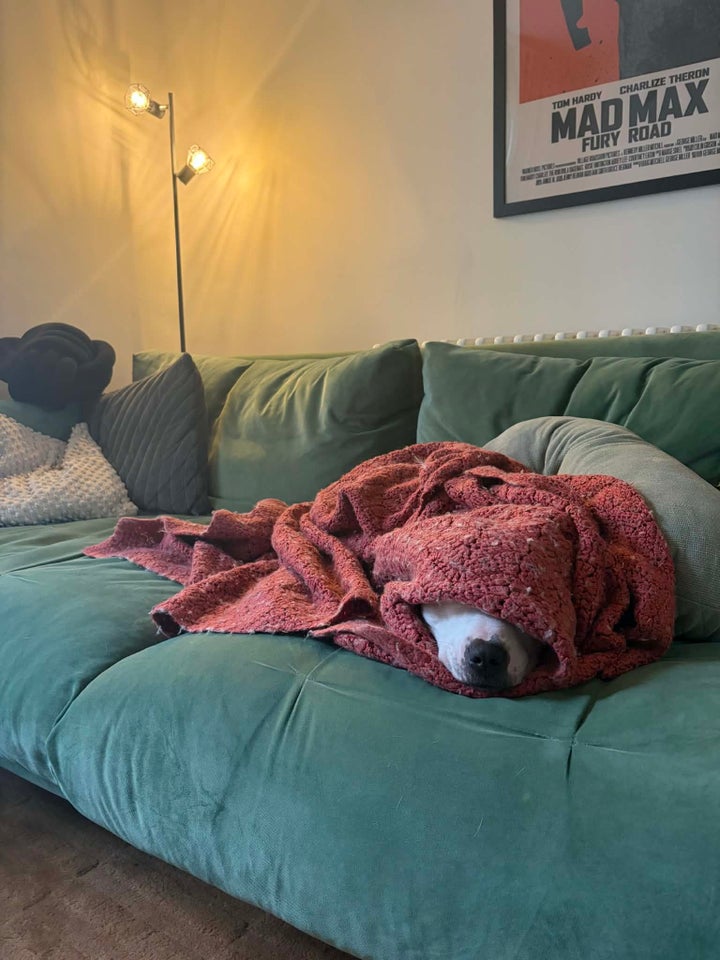
He’s a 25-kilo staffy who’s convinced he’s a lap dog (and who are we to say otherwise?). His favourite place in the entire world is our sofa.
I wouldn’t have it any other way, but there is one teeny tiny issue: Chase is scared of baths.
In fact, he detests water in nearly all its forms, from puddles to rain to getting splashed when he drinks from his water bowl (now he drinks from a ridiculous little ramekin to control said issue).
This is all to say that, while he’s far from the world’s smelliest dog, he’s definitely not the freshest either.
And his musk has turned our lovely velvet sofa into the stinkiest thing in our home by a country mile. After all, you can put lots of dog beds (ours included) in the wash. You can’t run a sofa on a spin cycle.
We’ve tried loads of things, from enzyme cleaners to old-fashioned soap and water, and nothing seemed to make a proper, lasting dent in the scent.
The spray works by destroying odour molecules on contact, and even works on airborne smells.
It gets rid of his musk instantly and its effects linger too, which means it keeps up with the fact that Chase spends about 85% of his life on the sofa.
The odour eliminator leaves behind a vaguely medical-smelling scent, but it’s more than worth it to get rid of the stink my lovely pup emits.
It’s also worked a treat on our rug, which is where Chasey brings all his food and chew toys to destroy – and therefore soaks up a hefty amount of stink in its own right.
From the car to your bins, you can pretty much use this £10 spray wherever you find a smell you don’t care for. Just be careful using it on silk, leather, wool, and natural wood surfaces, since it can be too harsh for them.
It’s so easy to use – you just need to spray it liberally onto the offending surface, wipe off any residue, and mist the air around the smell for good measure.
And with that, even the stink of a smelly staffy who’s barely glanced at soap for months is gone!
Most dog owners would love to spend every minute of every day with their pups. Alas, life gets in the way of that for many of us, which means trying to maximise whatever time we have together.
But what about when we want to get frisky with another human? Should we let our four-legged friends stay in the room? Or is it better to separate ourselves from our dogs before we start stripping down?
“When [my boyfriend] Benji and I have sex, we don’t let [our dog] Jumi on the bed, but he’s in the bedroom, and I feel a little bit weird about it,” Michelson admitted. “I feel like he doesn’t exactly know what we’re doing. What do you think about this from a behaviour standpoint?”
Levine said this is a common question she often gets from pet owners.
“For most dogs, it just doesn’t matter,” she said. “If they’re not bothered by it, it doesn’t matter at all. Dogs don’t have this hang-up like people do about things. They sort of live in the moment.”
However, there are some behaviours that signal a dog should not be present
“Where we shouldn’t have the dog in a room when people are having sex is when the dog tries to intervene,” Levine told us.
“There are lots of dogs who have a little bit of FOMO … like when people are like hugging, the dog wants to join in and so the dog is just like, in a happy way, ‘Hey! What’s going on here?’ and that just ruins the mood.”
Other pups might be uncomfortable for a more worrisome reason.
“There are also dogs who will get very distressed because of the sounds that are being made [during sex],” she said. “They may interpret some of those sounds as aggression [happening to] you, and then it’s not fair to the dog to have them in the room for that.”
Levine advised giving our furry friends a treat or a toy – either in the room or in another room – to keep them occupied until we’re done getting busy.
We also tackled a question from a listener about a similar – yet very different – scenario.
“We recently adopted a new dog and he loves to lick our older dog’s penis,” the listener said. “What’s going on there? And is there any downside to this or should I just let them go at it?”
“There are different reasons a dog may lick another dog’s penis,” Levine said. “It may be that there are just so many good odours in [that area] that they’re attracted to that.”
She also noted that they might be enjoying a taste that is present on or around the dog’s genitals.
“We want to make sure the dog doesn’t have like some sort of yeast infection or something in there that’s making it more attractive to the other dog,” she said.
What about the dog who is letting his friend lick him? “If he’s allowing this, he probably just thinks it feels good, or it does feel good,” she explained.
Levine told us she wouldn’t be worried about the behaviour if it’s happening “here and there”, but if it’s ongoing, it could cause problems.
“The concern about it going on for too long or too frequently is it’s possibly setting up for an infection in the penis that’s being licked.”
We also chatted with Levine about how to address unwanted barking, why some dogs get more aggressive as they get older, what to know before you let dogs and kids play together and much more.
Have a question or need some help with something you’ve been doing wrong? Email us at AmIDoingItWrong@HuffPost.com, and we might investigate the topic in an upcoming episode.