
‘We saw tanks on the road’: How playing chess amid regional conflict feels | Chess News – The Times of India
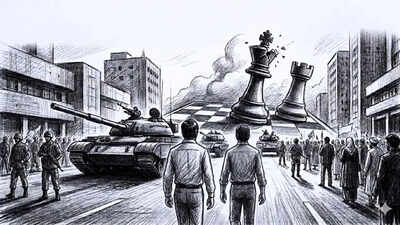
NEW DELHI: Cyprus, an island country in the eastern Mediterranean Sea, will be home to some of the best classical chess over the next fortnight as it hosts both the Open and Women’s categories of the 2026 Candidates tournament starting March 28. Serving as the only path to a World Championship match, the tournament has carried the weight of months of mounting anticipation from the global chess community. Yet, the air surrounding the event is heavy, with its iteration marred by pre-tournament uncertainties trailing the regional tension in the Middle East.The anxiety has already claimed a high-profile participant. India’s veteran Grandmaster Koneru Humpy withdrew from the Women’s tournament just days before the opening ceremony. Concerns have radiated elsewhere; World No. 2 Hikaru Nakamura raised alarms over the lack of stable power supply in the area, while the recent cancellation of a World Series of Poker (WSOP) event in the region due to safety risks cast a shadow over FIDE’s planning.In response, the International Chess Federation (FIDE) issued a ‘Safety & Logistics FAQ’ five days before the start, dismissing the risks as “extremely low and overstated”. But for the players, the board is never truly isolated from the world. How does it feel to calculate grand strategies when you know a global tension is brewing just outside the walls?In September 1978, a young Pravin Thipsay, decades away from becoming India’s third Grandmaster, landed in Tehran alongside former national champion Mohamed Rafiq Khan. They were there to play, but the Iran they entered was a country exhaling its last breaths of monarchy.The pro-Western monarchy of Shah Mohammad Reza Pahlavi was crumbling under the weight of massive civil resistance. On September 8, 1978, a day known as “Black Friday”, the military opened fire on protesters in Tehran, leaving hundreds dead and marking a point of no return for the regime.“Well, when I was young, and I was in Iran during Shah’s regime, and it was after September 8, 1978, when the students had done demonstrations,” Thipsay told TimesofIndia.com. “So when we actually entered the city, we saw tanks on the road, there were other problems, but what was important was that we saw tanks on the road, and it was disturbing for a day or so.”In the 1970s, the chess world was a smaller, more insular fraternity. Players travelled to distant lands with little more than a pocket set and a few letters of introduction. There were no smartphones, no social media feeds to provide minute-by-minute updates on troop movements.“We found it a little bit strange, but also there was no access to news, and we were going to Iran for the first time,” Thipsay recalled. “Nothing much was known to us. I was also very young. There were Russians and Americans playing, other Filipinos, other players. So I think we lived in our own world.”The tournament was hosted in Tehran’s Olympic Village. “It was very far from the city, and where there was restricted entry, and we rarely went out,” he explained. This physical separation was compounded by a total linguistic and digital blackout. “We did not get any news of the outside world because in those days, 1978, nobody spoke English in Iran, and the newspapers were all in the Iranian language. So we couldn’t really get any information. There’s no television,” he told this website.Today, players are hyper-connected; they monitor geopolitical shifts as closely as they do opening novelties. But in 1978, that was not the same.“Even when I had gone to a World Junior, I did not have any way of contacting my parents by phone. I just wrote some letters. I never got answers back because it took a lot of time,” Thipsay notes.In the weeks following the tournament, the Iranian Revolution would accelerate, eventually leading to the Shah’s exile in January 1979 and the rise of the Islamic Republic under Ayatollah Khomeini. “There was no direct violence seen before us, and the tanks were just there to control, prevent the mobs from gathering,” the 66-year-old said. “I think I looked at it, it did not really affect me at that time. I don’t know if it will not affect me today or if it will not affect other players, but that’s how the only experience I have, we just played a tournament.”While the revolution did not penetrate the Olympic Village, the elements did. “We didn’t do very well because it was very cold,” Thipsay admitted. “I think that’s the main reason. It was surprisingly quite cold at nights.”The Iranian players, however, must have felt the weight of the coming storm. Under the new regime that followed, chess would eventually be banned for several years, deemed “un-Islamic” before being reinstated in the late 1980s. But in the autumn of 1978, the silence between the locals and the foreigners painted a clear picture of a global dilemma as Thipsay concluded, “We, myself and Rafiq Khan or the Russians, the Americans, Filipinos did not get affected by that. And the Iranians, if they got, we don’t know, but they never discussed those things with us.”
 "Chess GM Zhou Jianchao’s historic unbeaten run ends after 158 games: How it compares to Magnus Carlsen")