Auqib Nabi: The fast bowler behind Jammu & Kashmir’s historic Ranji Trophy triumph
Fast bowling is viscerally raw. It is intense, unfiltered and powerful, and not only does it register in the onlookers’ minds, but it also evokes deep emotion.
Yet, for every stump that cartwheels, there is the lovely outswinger that kisses the bat and nestles safely in the wicketkeeper’s gloves. Fast bowling is bold, but also beautiful.
Top of the charts
No bowler in recent times has embodied these two aspects quite like Auqib Nabi. As Jammu & Kashmir clinched its maiden Ranji Trophy title last week, the 29-year-old from Baramulla finished with a chart-topping 60 wickets at an average of 12.56.
So penetrative was he that his strike-rate was an astounding 28.43. No bowler with 25 or more wickets had a number less than 30. Nabi also took a whopping seven five-wicket hauls, and four of those came in five innings across the quarterfinals, semifinals and final.
ALSO READ | The impact of the Ranji final will be felt beyond cricket in Jammu and Kashmir
For all the statistical grandeur, there is a pleasing reticence to everything he does. His run-up is not fiery; his pace is not express; he doesn’t stare down batters or indulge in complex vocabulary even while speaking about his expertise. Nabi is both arresting and simple.

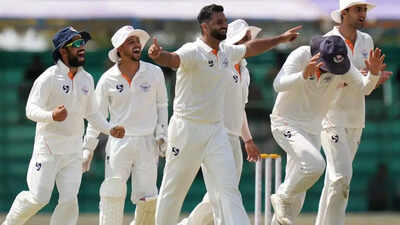
Big-name hunter: Forty-three of Nabi’s 60 victims batted in the top-seven. Here he celebrates the wicket of R. Smaran (First Class avg: 73.04) in the final.
| Photo Credit:
PTI
But barely two years ago, Nabi was just another bowler in domestic cricket. He made his debut in 2019-20 under trailblazer Parvez Rasool, playing seven Ranji matches and claiming 24 wickets as J&K made the quarters for only the second time in history. However, in the three seasons after that, he accounted for just 22 scalps.
“I saw him first in the Buchi Babu Trophy nets in 2023-24,” P. Krishna Kumar, J&K bowling coach, told The Hindu. “He had a firm wrist, which is very important for a fast-bowler. Only then can you give good back-spin and release the ball better because the palm is behind the ball.
“But he was bowling more inswingers. He wouldn’t even bowl around the stick [stumps] to a left-hander. I asked him why. He said ‘Sir, I don’t have the confidence to bowl the outswinger’. So we practised, had some specific net sessions, and he learnt very quickly and improved drastically.”
In 2024-25, Nabi claimed 44 wickets as J&K reached the quarters again. But a maiden last-four appearance was thwarted by Kerala which secured a narrow one-run first-innings lead. The title-winning season, thus, seems like him wreaking vengeance.
“Nabi lands the ball on the seam, and that is why he has got so many wickets in Indian conditions,” Krishna Kumar explained. “And his movement is so late, and only two or three inches.
“I’ve been coaching for 20 years and I’ve played for 15 years. But I’ve never seen many bowlers moving the ball so late,” added the former Rajasthan cricketer, who played 70 First Class matches.
ALSO READ | Working to rectify gaps: Jaitley on Delhi’s poor Ranji show
This reflects in the manner of Nabi’s dismissals. He bowls a suffocating line, landing the red cherry consistently in that mythical ‘corridor of uncertainty’ to perplex batters. Of his 60 dismissals, 42 were caught behind, bowled or lbw.
Not a speedster’s paradise
The conditions under which Nabi has achieved this is equally noteworthy. Though India now boasts of a world-class pace attack at the international level, the domestic game is still not a speedster’s paradise. In the all-time top-10 list of wicket-takers in a Ranji season, there are just three pacers — Jaydev Unadkat, Dodda Ganesh and now Nabi.
Unadkat, in fact, knows this all too well. The Saurashtra stalwart, with four Tests caps, holds the record for most wickets in a Ranji season for a speedster — 67 in 2019-20.
“It’s not everyone’s cup of tea,” the left-arm pacer told The Hindu. “The weather is a big challenge. Ranji nowadays is not in the winters. It starts in October when it is 38 degrees in Rajkot. You have to last the whole season, play on different pitches, take wickets and win games. And in a country where to get an outright result, you always resort to turning tracks, being a fast-bowler is hard.”
Unadkat is particularly impressed by Nabi’s complete lack of stage fright. He is also delighted that Nabi has disproved, yet again, the theory that rampaging speed is a prerequisite.
“When I was in the reckoning for the Indian team, all I wanted to do was make the best batters play [the ball] all the time,” Unadkat said. “If I could do that, I knew I had the skill-set to trouble any batter. I see that belief in Nabi. He wants to get the best batters out. Some bowlers get into a shell if they’re bowling to bigger names. And if they’re bowling to set batters, the lines could be defensive. But in him, I feel it is always attacking.”
The recently concluded season was evidence enough. In an era where teams bat deep, 43 of Nabi’s 60 wickets were of those in the top-seven. The Ranji final was the perfect microcosm — K.L. Rahul and R. Smaran caught behind; Karun Nair bowled; and Mayank Agarwal leg-before.
Unsurprisingly, there is heightened clamour for Nabi to be included in the Indian team, but before that, he must manage the burden of expectations in the upcoming Indian Premier League, after being bought for an impressive ₹8.4 crore by Delhi Capitals.
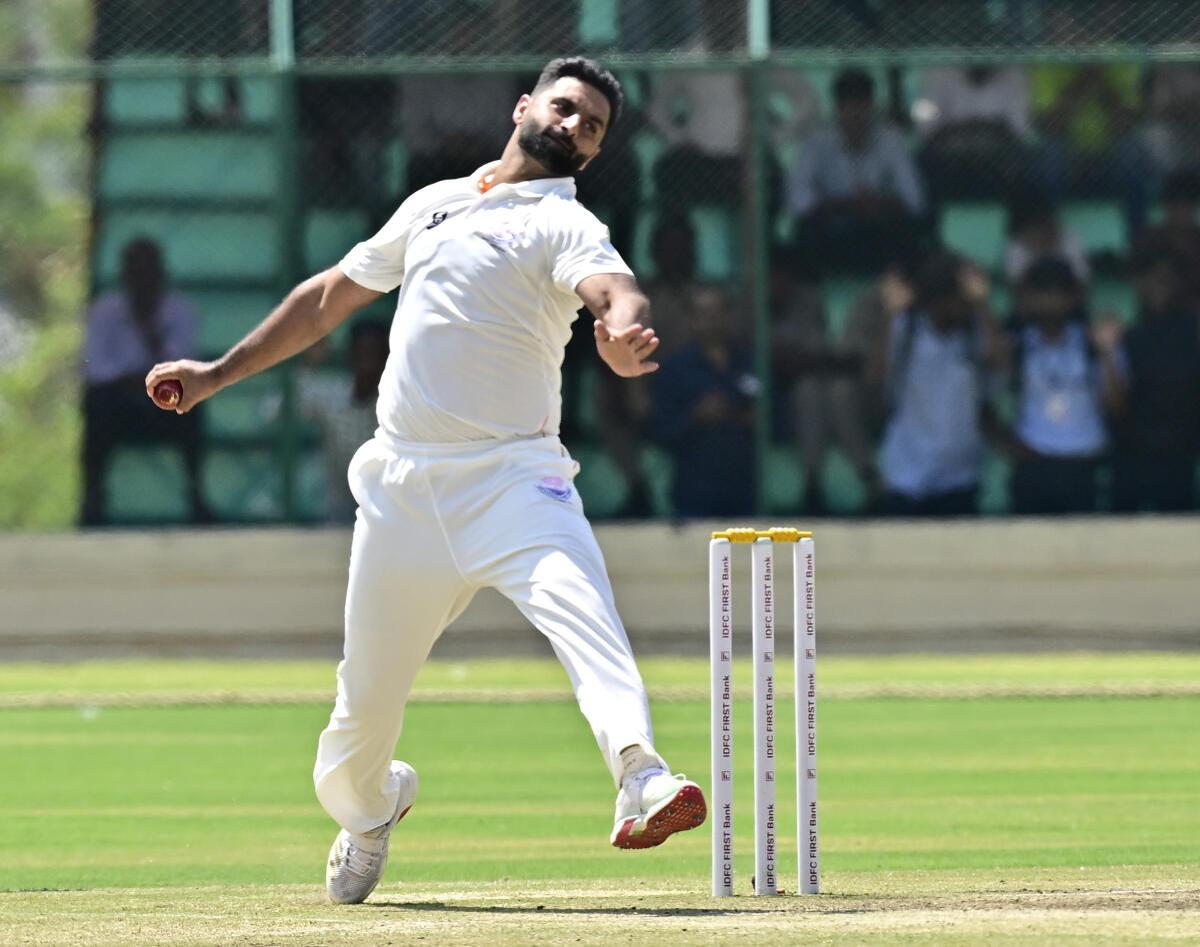
Transferable qualities? Nabi’s suffocating control, late movement and lack of stage fright are attributes that could translate well from domestic to international cricket.
| Photo Credit:
K. Murali Kumar
“Once he plays IPL and is tested, there will be people saying ‘he isn’t good enough for the international level, it’s just the domestic’,” Unadkat said. “I hope he has the attitude where he doesn’t care about all those things.
“I was actually heartbroken for Anshul Kamboj when he played in England [Manchester, 2025], and people started judging him after one game. I know how difficult it is to come out of it because it took me 12 years to get another chance [after Test debut].
“The only thing that comes to my mind in order to excel in internationals is to be 100% all the time. The level of consistency has to be a little higher than domestic. Skill-wise, I believe he [Nabi] has whatever it takes. So don’t really need to push and do something different,” the 34-year-old added.
ALSO READ | Quiz: On Ranji Trophy 2025-26
Nabi, for now, is sleeping on a bed of roses. But Krishna Kumar is confident that he knows how to handle the thorns too. Nabi, after all, did not shy away from travelling all the way to Bengaluru from north Kashmir in 2019 to play league cricket and keep his competitive juices flowing.
Calm, sound, sorted
“He is very, very calm, and even if he doesn’t get a wicket in a session, he says, ‘Sir no problem, main apni jagah pe bowling karta rahunga’ [I will keep bowling in my areas]. Sometimes, the batters will also bat well and score runs. So you have to be patient.
“But Nabi knows his strengths. In the [2025] Duleep Trophy, he got five wickets against East Zone, including four in four balls. In the second match against South Zone, he got only one wicket. But there was no change in his attitude. He has a very sound mind.”