
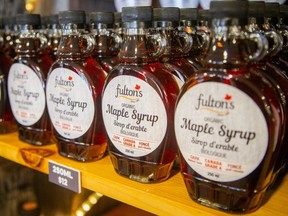
Sweet, it’s time for maple syrup season across Canada
In rural areas across eastern part of the country, maple trees are being tapped for their sap
Article content
Reviews and recommendations are unbiased and products are independently selected. Postmedia may earn an affiliate commission from purchases made through links on this page.
As another Canadian winter slowly fades away, a sweet annual activity is on tap.
Advertisement 2

Article content
Literally.
Article content
Article content
In rural areas across the eastern part of the country, maple trees are being tapped for their sap, which eventually will be turned into sweet maple syrup and enjoyed worldwide.
Here is more information about something that is as Canadian as maple syrup:
How it’s made
According to Karen Bedard, the executive director of the Ontario Maple Syrup Producers’ Association, a good harvest of sap actually starts in the previous summer. A lack of summertime moisture would prevent the trees from best preparing for the winter months.
The sugarbush — the area where the maple trees grow — needs to have room for the trees to absorb sunlight. The trees also have to be rooted in a healthy soil system to turn carbon dioxide into sugar during the summer and send it to the soil for the tree to harvest in the spring.

Your Midday Sun
Article content
Advertisement 3
Article content
For the ideal conditions to collect sap, daytime temperatures need to be slightly above 0 C and nighttime temperatures need to be slightly below freezing.
Bedard said that in the cooler evenings, the trees pull sap from the ground and up the trunk as the carbon dioxide contracts, creating a vacuum effect. In the morning when it warms, the sap is released as the carbon dioxide expands and is collected by the spiles (or spouts) that have been placed in the trees.
While many producers still use buckets for collecting sap, larger operations use a pipeline system.
After the sap (which starts as about 2% sugar mixed with water and minerals) is collected, it is boiled until it is 67% sugar.
About 40 litres of sap is needed to produce one litre of maple syrup.
Advertisement 4
Article content
RECOMMENDED VIDEO

We apologize, but this video has failed to load.
The business of maple syrup
According to a 2024 report by Agriculture Canada, 90.7% of the maple syrup production in Canada took place in Quebec, followed by 6.1% in New Brunswick and 3.1% in Ontario.
The report also noted that the Canadian maple syrup industry accounted for about 73% of global maple syrup production at the time. The United States was the second largest producer, accounting for about 23% of global production.
Because the harvesting of sap is dependent on the weather and other natural factors, the Quebec Maple Syrup Producers have a strategic reserve of three warehouses, where excess maple syrup is stored to be available for sale in a poor harvesting year.

Not just for pancakes
While maple syrup is delightful on pancakes, it also has other traditional — and non-traditional — uses.
Advertisement 5
Article content
Those traditional uses: Maple taffy (created by pouring hot syrup on a stick sitting in snow), maple butter, soft sugar candy, hard sugar candy and granulated maple sugar.
Non-traditional uses were highlighted in a recent advertising campaign by Les Producteurs et productrices acericoles du Quebec, which shows that maple syrup can be added to sauces, marinades or salad dressings.
Recipes featuring non-traditional uses of maple syrup can be found at the maplefromcanada.com website.
Syrup celebrations
Many areas in Ontario set aside time to salute and enjoy everything that is maple syrup.
In Toronto, Sugar Shack TO will be held at Harbourfront Centre on March 14 and 15. Interactive activities, live entertainment, maple-infused comfort food and tons of maple taffy are promised.
Advertisement 6
Article content
“Maple Weekend” events take place April 4 and 5 at many communities across the province.
In Elmira, Ont., just north of Waterloo, the community’s maple syrup festival has been an annual event since 1965. The one-day festival (which is on April 11 this year) offers visitors the opportunity to visit a local sugarbush to see all of the steps needed to turn the sap into syrup. Fresh pancakes and sausage are sold at the Lions Hall, a crafts and collectibles show takes at the local high school and the downtown streets are filled with vendors and entertainment.
A similar festival in Elmvale, north of Barrie, started in 1966 and this year it takes place on April 25.
Read More
-
If you’re struggling to lose weight, could chilling your carbs help?
-

Burger King revamps Whopper after customer complaints
Article content