
Pentagon seeking $200B more for Iran war, official says
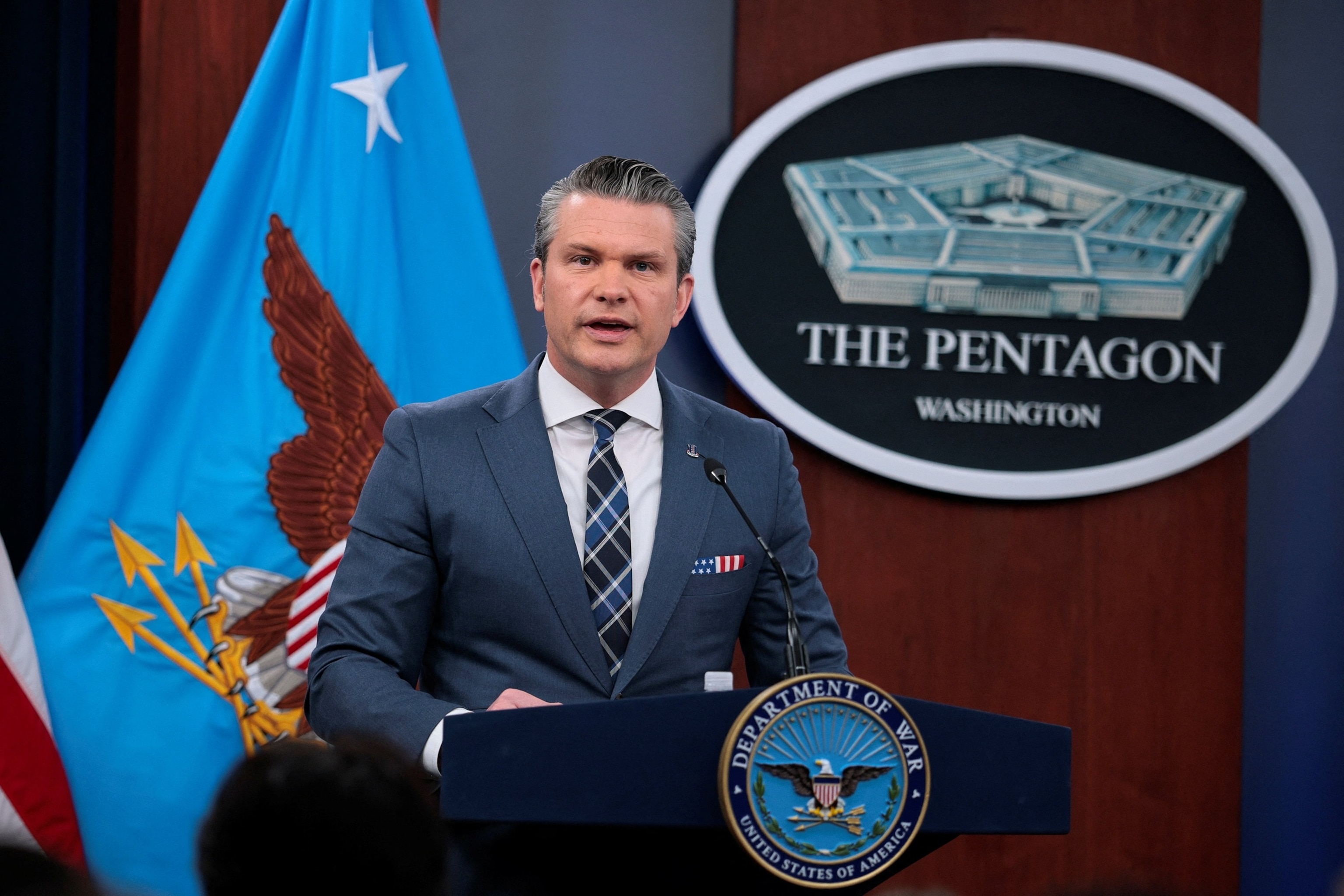
Defense Secretary Pete Hegseth said Thursday that the Pentagon will be asking Congress for more money to cover the Iran war, saying he wants to ensure current and future costs are covered “above and beyond.”
A senior administration official confirmed that a $200 billion request was sent from the Pentagon to the White House on Wednesday. The Washington Post first reported the request.

Secretary of Defense Pete Hegseth holds a briefing with Chairman of the Joint Chiefs of Staff General Dan Caine at the Pentagon in Washington, March 19, 2026.
Evan Vucci/Reuters
Multiple lawmakers said the White House has not yet submitted the request to Congress as of Thursday morning. Lawmakers remain deeply divided on President Donald Trump’s decision to attack Iran.
The conflict began Feb. 28 after negotiations on its nuclear and ballistic missile program failed, and the U.S. and Israel launched joint strikes. In its third week, the U.S. says it’s destroyed more than 7,800 military targets, 120 Iranian ships and 11 submarines.
Pentagon officials told a group of senators in a closed-door briefing earlier this month that the war in Iran cost at least $11.3 billion in its first six days.
When asked about the $200 billion request, Hegseth didn’t confirm the total, saying that the number “could move.”
“As far as $200 billion, I think that number could move. Obviously it takes, it takes money to kill bad guys,” Hegseth said in a news conference Thursday morning. “So we’re going back to Congress and our folks there to ensure that we’re properly funded for what’s been done, for what we may have to do in the future, ensure that our ammunition is — everything’s refilled, and not just refilled, but above and beyond.”
Wartime supplementals are used to ensure the military remains ready to handle other potential conflicts and to replenish stockpiles spent on the ongoing mission.
Asked about the $200 billion request on Thursday, Trump said “we’re asking for a lot of reasons beyond even what we’re talking about in Iran.”
“So we’re in very good shape, but we want to be in the best shape. The best shape we’ve ever been in,” Trump said.
He added that $200 billion request is “a small price to pay to make sure that we stay tippy top.”

President Donald Trump speaks during a meeting with Japanese Prime Minister Sanae Takaichi in the Oval Office at the White House in Washington, March 19, 2026.
Evelyn Hockstein/Reuters
House leadership has not received a formal defense supplemental request from the Trump administration, according to a source familiar with the matter.
Asked about the amount, Speaker Mike Johnson said Congress has a commitment to “adequately fund defense.”
“I’m sure it’s not a random number, so we’ll look at that,” Johnson said Thursday morning. “But obviously it’s a dangerous time in the world, and we have to adequately fund defense, and we have a commitment to do that.”

An EA-18G Growler, attached to Electronic Attack Squadron 133, prepares to launch from the flight deck of Nimitz-class aircraft carrier USS Abraham Lincoln in support of Operation Epic Fury, March 7, 2026.
US Navy
As of Wednesday night, several Senate appropriators, including Appropriations Chair Susan Collins, said they had not yet seen the request.
Sen. Patty Murray, the top Democrat on the Senate Appropriations committee, said she had not seen the funding request, and would need details to be provided.
Democrats will almost certainly require public hearings before they even consider voting in favor of the supplemental and even then, it would likely be difficult to convince enough of them to support a massive infusion of cash for the war.
“We have not seen that request, and I will tell you that this administration needs to tell Congress definitely what they’re doing and how long this is going to take. There is no goal here, and we’re not going to write them a blank check,” Murray said.
Republican Sen. Lisa Murkowski, who is on the Defense Appropriations Subcommittee, told reporters on Thursday morning that to her knowledge the Pentagon has not made a request to Congress.
“What we have is a number that we have heard the White House presented to the Pentagon. So far as I know it has not been presented to us in Congress. So it needs to not only be presented, the amount, but also the rationale behind it,” Murkowski said.
She said there ought to be open hearings before a supplemental is voted on.
“The world is feeling the impact of this war. So Congress has a role here and the administration is going to have to walk us through whether it’s $200 billion or some other iteration the supplemental will be,” Murkowski said.
While many senators were cautious about the request that has yet to reach Congress, Republican Sen. Lindsey Graham said he is already on board, saying “I’d hate to be the senator that denied the request.”
“The price of letting Iran move forward in the way they were is far more costly. You know, nobody asked, ‘What did it cost to win World War II?’ You just had to win. So my view about the price tag here, the price tag I’m most concerned about is letting Iran get back in the game to do what they’ve been doing since 1979,” Graham said. “The money we spent, the lives that have been lost by not confronting this regime has been way too costly. So whatever it costs to finish this, is worth it.”
The money that has so far been spent to fund operations in Iran comes out of Pentagon funds already allocated by Congress. Congress has not yet approved any additional funding for the war with Iran.
The funding request also indicates plans for a longer war — after Trump has previously said the war would last four to five weeks. The president has also brushed off that timeline, saying “whatever it takes.”
ABC News’ Lauren Peller, John Parkinson, Lalee Ibssa, Nathan Lee and Ford McCracken contributed to this report.