
Enigmatic Stone Age symbols found in Germany throw light on origin of writing
Strange symbols carved onto a Stone Age mammoth ivory plate found at a cave in southwest Germany could be the earliest known predecessor to writing by humans, according to a new study.
More than 40,000 years ago, humans were carving symbols onto tools and sculptures, and some of these bear mysterious sign sequences, often repeated lines, notches, dots and crosses.
But exactly how much information these signs convey has remained elusive.
Now, a new mathematical analysis has revealed that these signs could contain about the same amount of information as some of the earliest language scripts, which emerged thousands of years later.
Previous archaeological excavations have unearthed many of these ivory artefacts, bearing signs in caves in the Swabian Jura.
One such mammoth figurine found in the Vogelherd Cave in Lone Valley in south-western Germany contained rows of crosses and dots carefully engraved on it.
Another is a mammoth ivory plate found at a cave in the Ach Valley, depicting a hybrid lion-human creature adorned with rows of dots and notches.
The latest research found that the notches on this artefact are placed at regular intervals along the arm for a reason.
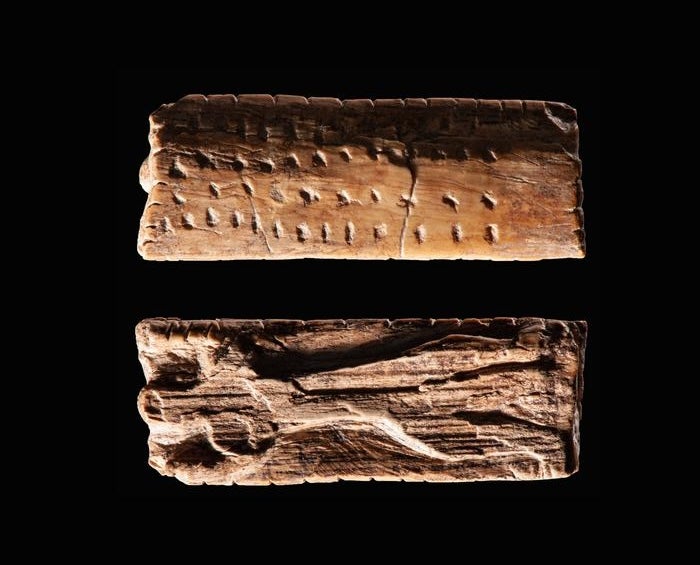
Scientists now suspect these symbols were used them to convey information and to record their thoughts.
“Our research is helping us uncover the unique statistical properties – or statistical fingerprint – of these sign systems, which are an early predecessor to writing,” said archaeologist Christian Bentz, an author of the study published in the journal PNAS.
“The artefacts date back to tens of thousands of years before the first writing systems, to the time when Homo sapiens left Africa, settled in Europe and encountered Neanderthals,” said Ewa Dutkiewicz, another author of the study from Saarland University.
The latest study analysed over 3,000 geometric symbols found on around 260 Stone Age objects to decipher frequency trends, measurable aspects of the signs, and to crack their meaning.
“Our analyses demonstrate that these sign sequences have nothing to do with the writing systems of today, which represent spoken languages and are characterised by high information density,” Dr Bentz explained.
“In contrast, the signs on the archaeological objects are frequently repeated – cross, cross, cross, line, line, line. This type of repetition is not a feature found in spoken language,” he said.
The artefact’s information density, which is the rate at which individual signs are repeated, was found to be at a similar rate to the cuneiform writing forms found in the first human civilisations, scientists say.
“The findings suggest the Stone Age hunter-gatherers developed a system of symbols with the same information density as statistically comparable to the earliest tablets from ancient Mesopotamia, which came 40,000 years later.
Archaeologists suspect the early form of writing developed by the hunter-gatherers may have allowed them to coordinate groups and survive.
“We hypothesised that the early proto-cuneiform script would be more similar to the writing systems of today, especially due to their relative proximity in time. Yet the more we studied them, the clearer it became that the early proto-cuneiform script is very similar to the much older Palaeolithic sign sequences,” Dr Bentz said.
“Then, about 5,000 years ago, a new system emerged relatively suddenly that represents spoken language. The new system, therefore, has completely different statistical characteristics,” he said.