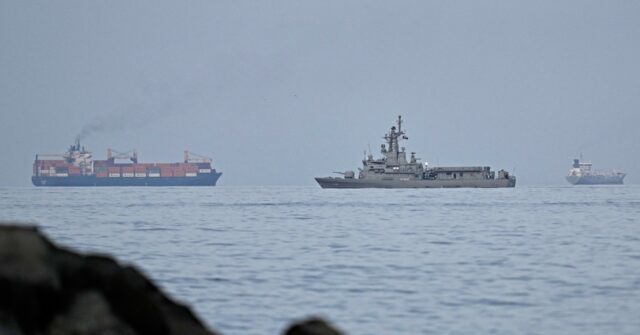

South Korea, Ukraine Step Up to Defend Strait of Hormuz as Most of Europe Balks
South Korean President Lee Jae-myung announced on Friday that he and French President Emmanuel Macron will work together to open the Strait of Hormuz for commercial shipping, though Macron had claimed as recently as Thursday that asking France for help was “unrealistic.”
Ukrainian President Volodymyr Zelensky also offered to help defend the strait on Thursday.
“President Macron and I agreed to share policy-related experiences and strategies in order to jointly address the economic and energy crises triggered by the Middle East war. We also concurred on working together to reduce uncertainty in the global economy,” President Lee said at a joint press conference with Macron in Seoul on Friday.
“We confirmed our commitment to bolstering energy security by expanding our cooperation in the nuclear and offshore wind power sectors while collaborating to secure safe maritime transport routes through the Strait of Hormuz,” he said.
The two leaders did not elaborate on what actions they would take to open the strait, and they did not take questions from the press.
Macron told reporters on Thursday that using military force to open the Strait of Hormuz was unrealistic.
“Some people defend the idea of freeing the Strait of Hormuz by force via a military operation, a position sometimes expressed by the United States, although it has varied,” he said when arriving in South Korea.
“This was never the option we have supported because it is unrealistic. It would take forever, and would expose all those who go through the Strait to risks from the Revolutionary Guards but also ballistic missiles,” he continued.
“What we say from the beginning is that this strait must be reopened because it is strategic for energy flows, fertilizers and international trade, but that it can only be done in consultation with Iran,” he concluded.
Macron was dismissive of the U.S.-Israeli conflict with Iran, and of President Donald Trump’s criticism of Europe for not helping its American ally.
“I don’t want to provide a running commentary of an operation the Americans have decided on their own with Israel. They can deplore the fact they’re not being helped, but that’s not our operation. We want peace as soon as possible,” he sniffed.
A French-owned, Maltese-flagged container ship called Kribi reportedly passed safely through the Strait of Hormuz on Thursday. The ship was traveling safely along the coast of Oman on Friday while broadcasting the message “Owner France” through its transponder.
According to ship tracking data, the ship is ultimately bound for the Democratic Republic of the Congo (DRC), and changed its transponder message to “Owner France” immediately before entering Iranian waters.
The Times of India (TOI) wondered on Friday if the safe passage of the Kribi meant a deal had quietly been struck, and Iran no longer views France as a “hostile nation.”
Ukrainian President Volodymyr Zelensky told reporters on Thursday that his country was ready to assist with reopening the Strait of Hormuz.
“No one has involved us specifically in the issue of the Strait of Hormuz. During my visits, I told representatives of the Middle East and Gulf countries: Ukraine is ready to help with everything related to defense,” he said.
Zelensky noted:
As of today, I don’t see any country lifting the blockade on its own – only joint steps can bring results. Ukraine has experience with launching the Grain Corridor in the Black Sea despite Russia’s attempts to block the flow of food and other goods. The situation now is similar, but it is about energy.
The war and the negotiations on reopening the Hormuz Strait can go in parallel. It’s worth trying to find a diplomatic solution, and this could be beneficial for both sides in the war.
Unlike Macron, Zelensky did not shy away from the notion of using military force to protect ships against Iranian terrorism, and he said Ukraine would participate in the endeavor if asked.
“An alternative step would be to control the Strait unilaterally, as Ukraine did with the Grain Corridor,” he said. “Achieving this would require interceptors, military convoys to escort the vessels, a large integrated electronic warfare network, and other tools. We stand ready to help with this.”
“So far, no one has made such a request. We are simply sharing our knowledge. If one day our partners want to make use of it, we would be ready,” he concluded.