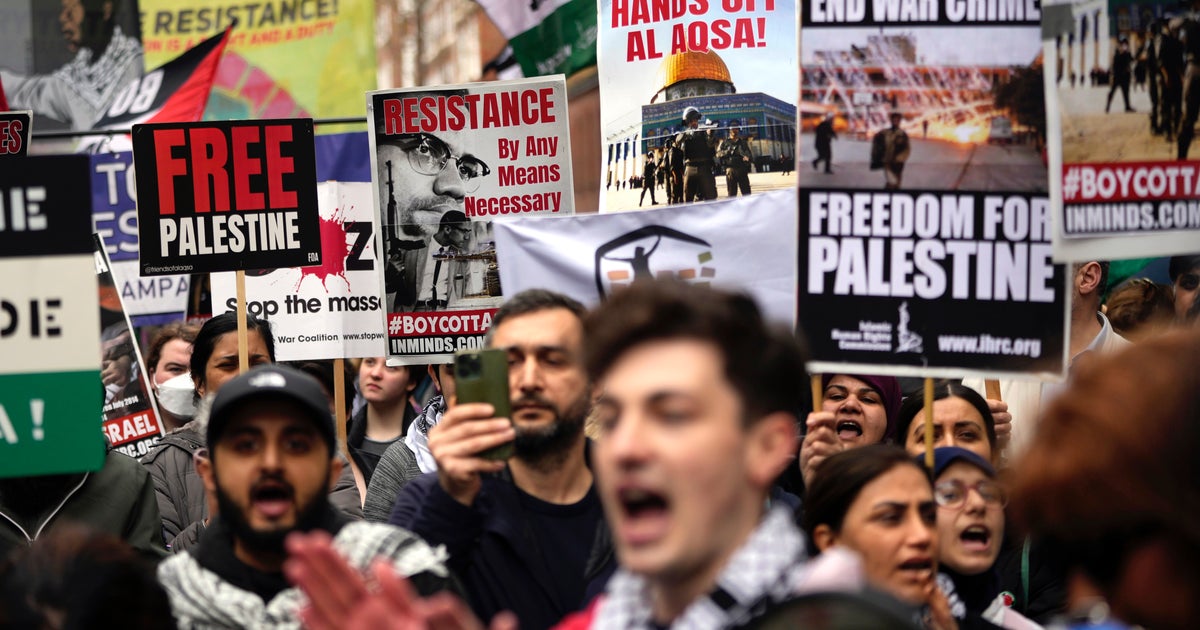

Shabana Mahmood Bans Pro-Palestine Al Quds Day March Amid ‘Public Disorder’ Fears
Shabana Maymood has approved a Metropolitan Police request to ban a pro-Palestinian march “to prevent serious public disorder”.
The annual Al Quds Day demo had been due to take place in London on Sunday.
It had drawn criticism over apparent backing for the Iranian regime after its organisers expressed support for the country’s late leader Ayatollah Ali Khamenei, who was killed in US-Israeli air strikes earlier this month.
Several counter-protests had also been planned for the day.
Announcing her decision to ban the march, Mahmood said she was “satisfied doing so is necessary to prevent serious public disorder, due to the scale of the protest and multiple counter-protests” amid the ongoing Iran war.
The home secretary added: “Should a stationary demonstration proceed, the police will be able to apply strict conditions.
“I expect to see the full force of the law applied to anyone spreading hatred and division instead of exercising their right to peaceful protest.”
The Islamic Human Rights Commission (IHRC), which organises the protest, has previously insisted the demonstration is always “good natured and peaceful”.
In a statement on the organisation’s website, the IHRC said it “strongly condemns” the decision to ban the march and was seeking legal advice.
Confirming a “static protest” will go ahead on Sunday, the statement said: “The police have brazenly abandoned their sworn principle of policing without fear or favour. They cannot present evidence because there is none.
“In essence, this is a politically charged decision, not one taken for the security of the people of London.”
It is the first time a protest march has been banned since 2012.
The Metropolitan Police said previous Al Quds Day marches resulted in arrests for supporting terrorist organisations and antisemitic hate crimes.
In a statement, the force said: “The decision to ban it this year is purely based on a risk assessment of this specific protest and counter-protests – we do not police taste or decency or prefer one political view over another, but we will do everything we can to reduce violence and disorder.”
The Met said the “uniquely complex” international situation and “severe” risks meant merely placing conditions on the protest “will not be sufficient to prevent it from resulting in serious public disorder”.
It added that it would place “strict conditions” on any static protest, which the law does not allow the police or Government to ban, but “given the tensions, we have to accept that confrontations could still take place”.
The decision follows calls from Labour and Conservative MPs to ban the march.
Earlier on Tuesday, courts minister Sarah Sackman said people expressing support for “the malign regime in Iran” should not be “on the streets of London calling for hate and hostility against this country”.
Shadow Home Office minister Alicia Kearns also called for the march to be cancelled, saying there was “no place in our country for the celebration of terrorists”.
A spokesman for the IHRC, Faisal Bodi, told the BBC’s The World Tonight that it was “a sad day for freedom of expression, freedom of assembly and the right of people to legitimately protest about issues they feel strongly about”.
He added: “This demonstration has taken place for the last 40 years peacefully.”
The IHRC has previously expressed support for Iran’s former supreme leader, the Ayatollah Ali Khamenei.
Following his death in a US-Israeli airstrike last month, the group said Khamenei “chose to stand on the right side of history” and described him as “a rare role model” who would be “mourned by freedom loving people all over the world”.
The Campaign Against Antisemitism welcomed the decision to ban the march, saying it was “a positive development” and adding: “Allowing this hate-fest to go ahead would have sent the message that Islamists rule the roost in Britain.”