
Sell off the BBL, or sell out to sports betting: Cricket’s huge call
The amount of turnover or revenue relates to the number of markets offered by wagering companies on each sport, with an explosion in the amount of in-play betting options helping to lift the product fees due to the footy codes.
Cricket, by comparison, has been very conservative in restricting the kinds of markets offered by their registered wagering partners, in contrast to the enormous number of micro outcomes within games that are commonly offered on the massive and unregulated south Asian betting market.
Loading
These “spot” outcomes, such as wagers on whether a no-ball will be bowled or a scoreless over played out, have been infamously related to numerous proven allegations of “spot-fixing” in cricket over the past 25 years, and are an area requiring constant vigilance for the integrity units of cricket bodies.
Cricket administrators are aware of this history, and have also shied away from chasing the wagering dollar to the same extent as NRL, AFL and racing for other reasons, such as concerns around how much the BBL and WBBL are marketed to children and families.
Separately, CA has a long-running sponsorship deal with Bet365, which is prominent in boundary signage at international matches, but the BBL and WBBL are not included in the deal.
Numerous proposals around raising more money from product fees have been put to CA over the years, and have often been knocked back because of concerns for the image of the game.
Loading
There have also been worries in recent years about whether state and federal governments will move to crack down on wagering as a revenue source for sports. In parallel, the amount of money raised by state governments from sports wagering has risen dramatically over the past decade, from $215 million in 2017 to $1.13 billion in 2023-24, according to a Queensland government report on national wagering statistics.
However, the push for more revenue for CA and the states has brought wagering back to the forefront. One point of disagreement is whether cricket can continue to adequately pay its players and fund the lower levels of the game simply by chasing more revenue from commercial and broadcast sources, or whether it must capitalise on a burgeoning market for private capital in cricket by selling BBL club stakes. The wagering exploration may continue regardless of whether BBL clubs are sold.
Speaking on Wednesday morning, Cricket NSW chief executive Lee Germon made it clear that Australian cricket’s largest state association wants to explore all possible alternatives to selling BBL clubs.
“Cricket NSW believe we owe our members, our fans, our cricket family that we can look them in the eye and say we’ve gone through every aspect of this decision, we’ve done our due diligence, in terms of coming to the right decision,” he said. “That is the point we’re at now.

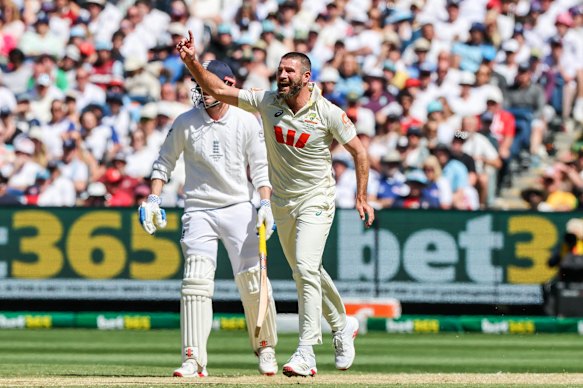
Michael Neser celebrates the prized scalp of Joe Root during the Boxing Day Test.Credit: Justin McManus
“We believe there need to be alternative proposals considered. We may well end up at the first proposal, which is selling all the clubs, but we need to do the due diligence. The more we have dug into this, the more complex it has become in terms of understanding the unknown and known flow-on effects of it.
“The more we’ve got our heads around it, the more complicated it has become. There are different opinions around the table, but there’s a big responsibility to make the right decision for cricket, and we want to ensure we go through the process to enable us to do that.”

Cricket Australia chairman Mike Baird and chief executive Todd Greenberg.Credit: Getty Images
Underpinning the debate, Germon said, was that all parties wanted Australian cricket to grow – while differing over how to achieve that growth.
“It’s a very positive thing to have the debate about what do we do? What are the consequences? Is there another way of doing it?” he said.
“So, yes there’s different positions, but we’re not diametrically opposed to the fact we want cricket to prosper.
“We want the BBL to be the best competition it can ever be, we want the best players playing, [and] we want Australian cricket to be strong.”