Premier League football matches can be crime hotspots – but community sports centres have the opposite effect

Premier League football stadiums in England can be hotspots for certain types of crime on match days, demanding a heavy police presence. But for much of the year, community sports clubs located in nearby neighbourhoods play an important role in reducing levels of crime.
Our recently published research focused on men’s match days at Tottenham Hotspur Stadium in Haringey, north London – using Haringey Council’s daily crime counts for 2023 to highlight local variations in crime on the stadium’s 23 Premier League, FA Cup and Champions League match days.
We found an average increase in all “expressive” crimes of 20 percentage points over non-match days, with drug offences also increasing significantly. Expressive crimes are those driven by emotional release and identity conflict – often fuelled by increased alcohol or drug consumption – which can lead to disorder and violence against other fans or local residents.
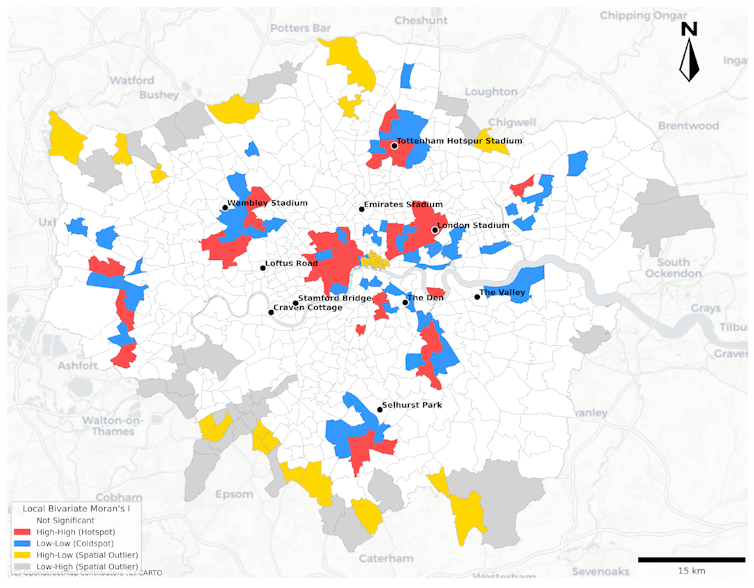
Our study, in conjunction with London Sport, also used the UK police’s open data portal to analyse the relationship between crime and distribution of sports clubs across the whole of London. This showed how community sports clubs serve an important protective role against crime in higher-risk neighbourhoods, such as the White Hart Lane and Hermitage & Gardens wards close to Tottenham’s stadium.
Three factors of “routine activity theory” converge to create crime opportunities on Premier League match days: a spike of people influenced by alcohol or team rivalry (“motivated offenders”); a sudden influx of large, dense crowds of opposing fans (“suitable targets”); and diverted or overwhelmed police resources by the sheer volume of people (“absence of capable guardians”).
Yijing Li, CC BY-SA
Around the Tottenham Hotspur Stadium over the course of 2023, there were 33 public order offences on match days, representing 20% of all such offences in the area that year. There were also 78 drug-related offences, accounting for 47% of all drug offences in the area in 2023. The average attendance for a Spurs Premier League match is over 61,000 fans, including around 3,000 away supporters.
The crime hotspots were highly localised, spiking around transport hubs such as White Hart Lane and Bruce Grove train stations, and the Bounds Green and Woodside shuttle bus locations.
But our study also highlights the risk of police displacement when officers flood a stadium zone, meaning neighbouring areas can be left under-protected. We conclude that police forces should ensure that the “ring of steel” around a stadium on match days does not create a security vacuum in adjacent residential areas.
Crime-reducing effects of sports clubs
In many parts of London, community sports clubs play an important protective role against crime in their neighbourhoods. The White Hart Lane and Hermitage & Gardens areas around Tottenham Hotspur Stadium, for example, are recognised crime hotspots with above-average rates of violence against women and drug offences.
But our analysis shows activities organised by local sports clubs there – and throughout much of London – suppress these crimes during school term times, when the clubs are operating.
The crime-suppressing effect of community sport centres fluctuates with the calendar, however, with the effect weakening significantly in December and January when cold weather limits outdoor sports activities and the school holidays leave many young people with more unstructured, unsupervised leisure time – exacerbated by a reduction in the availability of organised club activities.
This suggests policymakers seeking to address youth crime should not only fund programmes during the summer holidays but also winter “bridge” programmes – investing in indoor facilities and youth camps during the Christmas break to maintain the social supervision structure that reduces delinquency.
However, a “one-size-fits-all” policy for sports community clubs is not advisable. We found that some sports clubs located in quiet, low-density areas of London did not show the same protective effect against crime. In these residential pockets, levels of expressive crime tended to increase slightly around the club, probably because the inflow of visitors and noise created some disruption to the local social fabric.
Nonetheless, there is much evidence for sporting activities developing skills and traits in young people that offer deterrents against youth violence – including self-control, teamwork and cooperation, prosocial behaviour and conflict resolution skills. Taking part in sport can encourage a sense of belonging and ways of expressing stress that have positive effects on self-esteem and mental wellbeing.
Organised sports occupy the leisure time of adolescents who might otherwise engage in unstructured, risky behaviour. The community clubs provide “capable guardians” in the form of coaches and mentors offering social supervision that can be particularly lacking in high-deprivation areas.
In April 2025, London’s mayor Sadiq Khan announced the capital’s Violence Reduction Unit was investing a further £1 million to provide sports and physical activities to young people at the highest risk of being affected by violence in London. The unit is now partnering with London’s 17 professional football clubs in an attempt to provide positive opportunities for young people across the capital.
This article was commissioned in conjunction with the Professors’ Programme, part of Prototypes for Humanity, a global initiative that showcases and accelerates academic innovation to solve social and environmental challenges. The Conversation is the media partner of Prototypes for Humanity 2025.