
Ontario ‘not going to reverse’ decision on safe supply sites
Sylvia Jones, Premier Doug Ford defend addiction treatment policies as former Toronto mayors sound off in letter

Article content
The Doug Ford government is holding firm on its decision to defund supervised drug consumption sites as pushback continued to mount from critics.
Advertisement 2

Article content
Six former Toronto mayors added to the public outcry over the province’s policy shift on addiction treatment when they sent a letter to the premier and Health Minister Sylvia Jones on Tuesday, urging the province to reverse a decision that had caused “much physical harm and death.”
Article content
Article content
However, Ford said at an unrelated news conference on Wednesday that he wants to “help these people, but I’m not going to sit back as you put these injection sites in the middle of communities.
“There’s needles all over the place,” he said, via The Canadian Press. “It’s dangerous for kids and communities. They’re in the parks. It’s terrible and we’re closing them down.”
Province focusing on abstinence-based treatment
Public uproar has continued to grow after the province earlier this month told seven supervised consumption sites – including Fred Victor and the Moss Park Consumption and Treatment Services in Toronto – that it was pulling their funding by mid-June.

Your Midday Sun
Article content
Advertisement 3
Article content
That was in addition to the Progressive Conservative government banning such sites from within 200 metres of schools and daycares in 2024 with many of those sites announcing plans to convert into abstinence-based homelessness and addiction recovery treatment (HART) hubs funded by the province.
The province had earmarked about $550 million in part to help consumption sites transition into HART hubs with all but one of the 28 planned facilities currently operational, according to The Canadian Press.
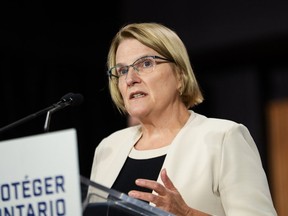
‘We’re not going to reverse:’ Health minister
The PC government has said the policy changes will make communities safer, while Ford insisted last week that their decision will help people get “proper shelter, get them the support they need, get them employment they need.”
Advertisement 4
Article content
On Wednesday, Jones insisted they will push forward with the HART hub system.
“We’re not going to reverse, we’ve been very clear: Our focus is on the HART hubs to make sure that people have access to treatment,” Jones said, via CP.
“We want to ensure that there is a pathway out of addictions and you can’t do that when you continue to fund, frankly, illicit drugs.”
RECOMMENDED VIDEO

We apologize, but this video has failed to load.
Former Toronto mayors voice concerns
While Toronto Mayor Olivia Chow voiced her support for sustained funding for treatment and supportive housing and improved federal-provincial co-ordination to deal with the opioid crisis, six former mayors – David Crombie, Art Eggleton, Barbara Hall, David Miller, John Sewell and John Tory – went a step further by insisting that the Ford government do an about-face.
Advertisement 5
Article content
“These decisions to close sites, which provide integrated health and social services as well as facilities to test drug supply, have caused much physical harm and death and have resulted in increased public expenditures without resulting in any positive impacts,” their letter said, citing a spike in non-fatal opioid overdose calls to paramedics in the city.
‘Deep concern’ for Indigenous people
Anishnawbe Health Toronto, in a letter to Jones last week that was seen by the Toronto Sun, also expressed its “deep concern” to close consumption sites due to the “life-threatening harms” that Indigenous people in the city would face.
“Though we appreciate the province’s investment in the HART Hub model to support people who use drugs, it only supports those who are on the abstinence end of the spectrum of harm reduction and excludes the vast majority of active drug users who are unable to stop even though they would like to,” the letter signed by interim executive director Michael Milward said.
Advertisement 6
Article content
“Substance-use disorders are medical disorders considered chronic diseases like depression, diabetes mellitus or coronary artery disease. We would encourage you to review the National Institute of Drug Abuse (NIDA) definition … for further understanding.”
Data from the Office of the Chief Coroner for Ontario showed there were 206 suspected drug-related deaths across the province in February compared to 209 in February 2025, though The Canadian Press said those numbers were preliminary.
— With files from The Canadian Press.
Read More
-

WARMINGTON: Fentanyl laced with veterinary drug poses deadly risks in Toronto
-

Toronto opioid overdoses spiked during holidays, health unit says
Article content