
NASCAR president Steve O’Donnell addresses 2026 TV strategy after multi-network setup caused last year’s viewership falloff

NASCAR president Steve O’Donnell addressed the series’ television strategy after last season’s multi-network rollout. The sport is now entering Year 2 of its long-term media deal and is trying to refocus fans after seven of the final ten playoff races last year drew fewer than two million viewers.
The drop came during the first season of NASCAR’s new $7.7 billion media rights agreement with Fox Sports, Amazon, Warner Bros. Discovery, NBC Sports, and Versant. O’Donnell admitted that lessons were learned and said the organization was working to stabilize audience engagement across the season.
Thanks for the submission!
Speaking on The Varsity, O’Donnell explained that the first season of the new model delivered mixed results.
“We had a few less network races. So, we thought that we’re going to get off to a tough start in terms of less network races overall ratings. We were pleasantly surprised, even despite rain at Daytona, where we kind of ended up with Fox and thought, okay this is a good start to where we’re going. And then it was a big question mark with Amazon… By the end of the Amazon five races, everyone in the industry said, ‘Can Amazon do 36 races? That was fantastic.’ It was unbelievable how they showcased the sport,” he said (36:32 onwards).
NASCAR averaged 2.45 million viewers in the 2025 Cup Series. That number represented a 14.7% drop from last year’s 2.87 million average. Viewership rose on Fox and FS1, with Fox averaging 4.52 million viewers across five races and FS1 averaging 2.46 million. Prime Video averaged 2.1 million viewers, while TNT Sports averaged 2.06 million, close to USA Network’s 1.64 million. The main NBC channel averaged 2.74 million in the final three races.
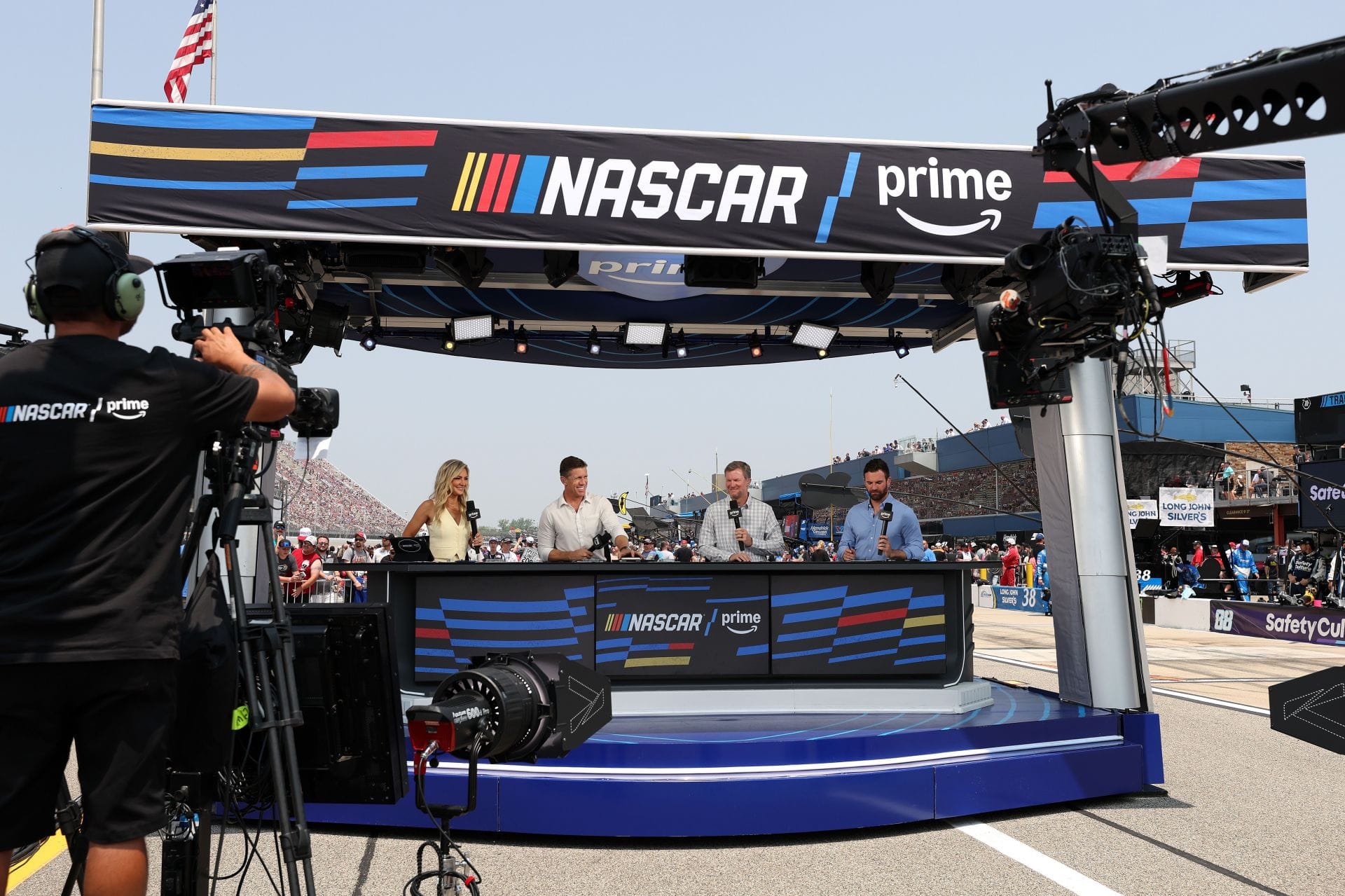
Steve O’Donnell admitted that the momentum faded in the second half of the season.
“As we look towards the latter half of the season, we felt a tail off and we put so much focus on the beginning of the season in that launch of Amazon, we felt a little bit of the pain when we went to TNT, NBC, USA. And I think one of the lessons we learned is that focus kind of middle second half of the season, we’ve got to really kind of, ‘let’s go.”
“We know we’re going to be good Fox, we know we’re going to be good Amazon. What can we do to refocus fans? Make the transition over to Warner. And then we’re on our way with Versant. So that’s going to be a big focus for us, especially with the new playoff format,” added O’Donnell (37:48 onwards)
NASCAR’s distribution over five platforms has created a seasonal viewing curve. Races begin on major broadcast TV (FOX), move to streaming (Prime), transition to cable (TNT), and later return to broadcast (NBC), a flow some drivers, including Denny Hamlin, criticized last year.
Steve O’Donnell said that the solution was aggressive promotion over the year.
“Focus as many assets as we can on that timeframe and know that.. you’ve got this portion of the season where you’ve got to turn to the fans, tell them exactly where they are and pound that home every single day and see what happens this year. It’s going to be a big focus for us… We need Warner to succeed. We need Matt Hong and Versant and his team to succeed. They’ve got a big bet on us and we’ve got a big bet on them to make sure we carry this thing through all the way to Miami with the championship.” (39:08 onwards)
NASCAR has already made adjustments heading into the 2026 season as Steve O’Donnell acknowledged early mistakes.
Steve O’Donnell outlines NASCAR’s long-term broadcast vision

Early 2026 numbers underline the challenge. The Clash, delayed multiple times due to snow, dropped from 3.077 million viewers in 2025 to 2.349 million in 2026. Early reports showed that the Daytona 500 held steady year-on-year at roughly 1.86 million viewers, while qualifying drew 710,000 on FS1.
Steve O’Donnell said the long-term future of NASCAR’s media model remains open:
“I would not say this is the way we’ll always be. We just had a discussion two hours ago about 2030, 2031. If you had a clean sheet of paper, what would the sport look like? Is there a number of races that would make more sense? Could it be 30? Could you have midweek races? How many races is that? Is it network? Is it cable? Is it digitally streamed? What do we want?”
“Ultimately, what will the sponsors be interested in as well. They help drive our sport. So I would not lock us in for the foreseeable future. Long term, it’s something to look at and really deliver what fans want. If it’s entertaining, people will tune in.” O’Donnell added (onwards)
NASCAR remains on Fox for the next two races at Atlanta Motor Speedway and Circuit of the Americas before moving to FS1 for the next five events.
Edited by Hitesh Nigam