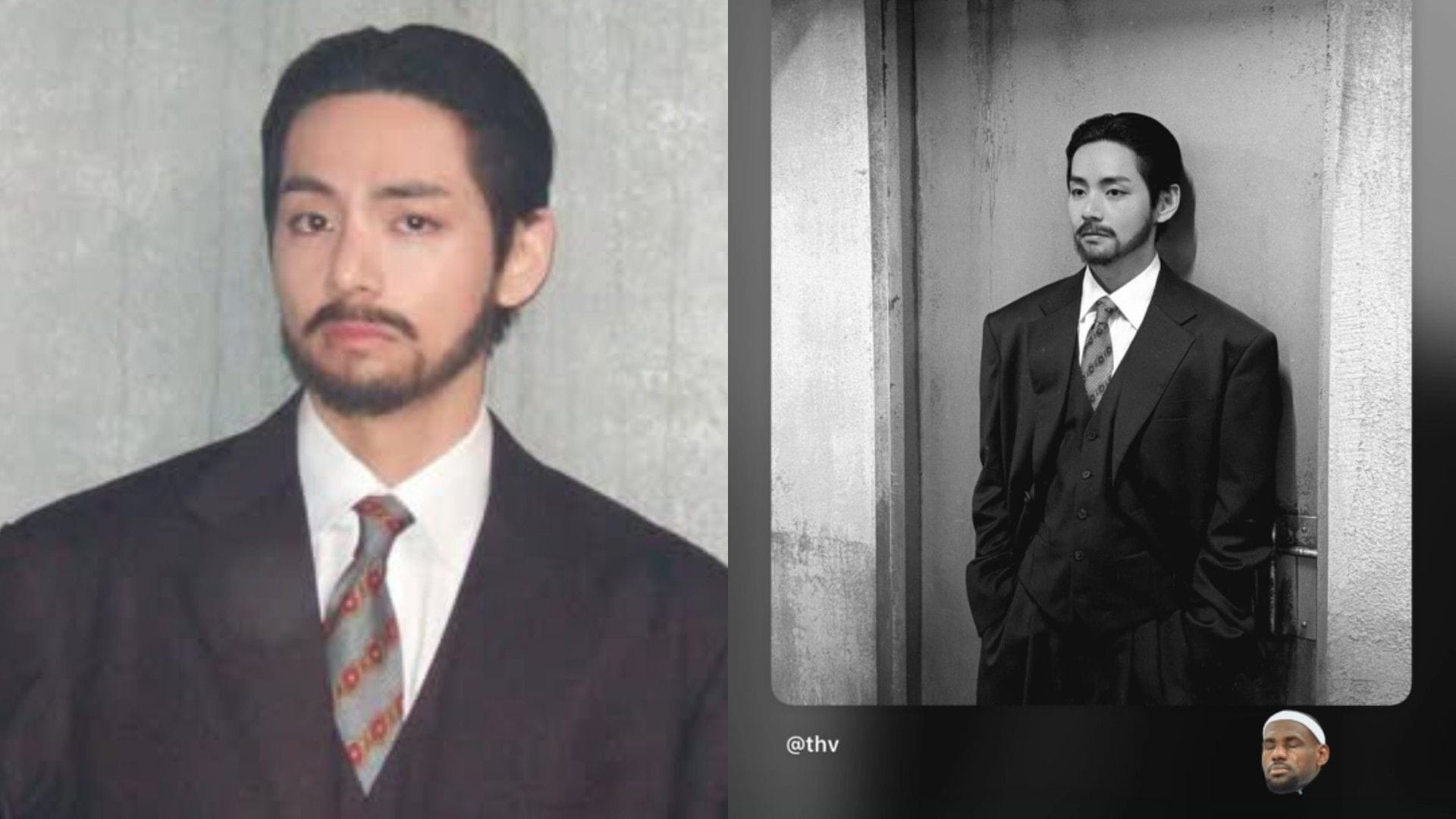

“Everything looks gorgeous on Taehyung” — Fans disagree as BTS’ V says “it doesn’t suit me” about his bearded 2.0 MV look

On April 3, 2026, BTS member V aka Kim Taehyung shared behind-the-scenes photos from the music video 2.0. The visuals drew attention for their stylistic approach, taking inspiration from a well-known scene in Park Chan-wook’s film Oldboy while incorporating a distinct 1970s aesthetic.
The music video features retro-inspired styling on all members, with subtle visual references to characters from Oldboy. Taehyung, in particular, appears at the beginning of the video with a bearded and moustached look, making a noticeable contrast from his usual clean shaved image.
From the carousel post, V later reshared one of the black-and-white images on his Instagram Stories. In the photo, he was seen standing with the same bearded look. He added a crying gif and a caption with the photo seemingly regretting on the styling choice, writing,
“I’ve tried it. And I know. It doesn’t suit me.”
Following his post, the image and caption circulated widely across social media platforms. Many fans responded by expressing disagreement with his statement, sharing the view that the look suited him. Some comments emphasized that his visuals remained strong regardless of styling choices, with one fan remarking that
“His face card doesn’t allow “doesn’t suit me”. Everything looks gorgeous on Taehyung”
Similar reactions followed, with fans consistently stating that the concept suited him and rejecting his view that the beard did not suit him.
Fans continued to express that Taehyung looked good with the bearded look.
BTS reimagine Oldboy-inspired action with dance in 2.0 MV as ARIRANG debuts atop Billboard charts
BTS released the music video for 2.0, a track from their fifth studio album ARIRANG, on March 2, 2026, at 2 a.m. KST through HYBE Labels’ official YouTube channel. The video incorporates visual references to the infamous single-take “hammer action” sequence from Park Chan-wook’s film Oldboy, reinterpreting it through performance and rhythmic choreography aligned with the song.
The video begins with RM, Jin, SUGA, j-hope, Jimin, V, and Jungkook stepping out of an old elevator dressed in suits and leather jackets. The opening scene also features a mix of stylized and comedic elements.
The members carry unconventional props such as a back scratcher, a Taeguk-patterned fan, a danso flute, and a newspaper. Exaggerated moustaches, accessories, and makeup further contribute to the lighthearted tone.
They are met by a group of men in a dimly lit hallway, setting up a confrontation similar to the original film sequence. However, instead of physical combat, the group uses synchronized dance and music to overcome the situation.
Following the hallway segment, the BTS members re-enter the elevator and transition into more contemporary outfits. The video then moves across different parts of an abandoned building, including a bathroom, office space, and corridors. These setting changes reflect the “2.0” concept, emphasizing transformation and progression.
During a Weverse livestream on April 1, the group described the filming process as enjoyable and noted that the project highlighted their evolved performance style. They also pointed out the comedic makeup in the opening scene, stating that it created a lively and chaotic atmosphere during filming.
Musically, 2.0 is a hip-hop and trap track built on an irregular rhythm. It appears as the fifth track on ARIRANG, which consists of 14 songs. The lyrics address the group’s growth, achievements, and reflections during their hiatus, indicating a new phase in their career.
The track was produced by Mike WiLL Made-It and Pluss. The writing credits include Michael Len Williams, Asheton Terrance O’Neil Hogan, Atia Boggs, Charles Hinshaw, John Mitchell, Derrick Milano, Pdogg with BTS members RM, j-hope, V, Jungkook and SUGA.
Meanwhile, ARIRANG debuted at number one on the Billboard 200, becoming BTS’ seventh chart-topping album. Its lead single Swim also reached number one on the Billboard Hot 100.
Edited by Adrija Chakraborty